
Key Takeaways
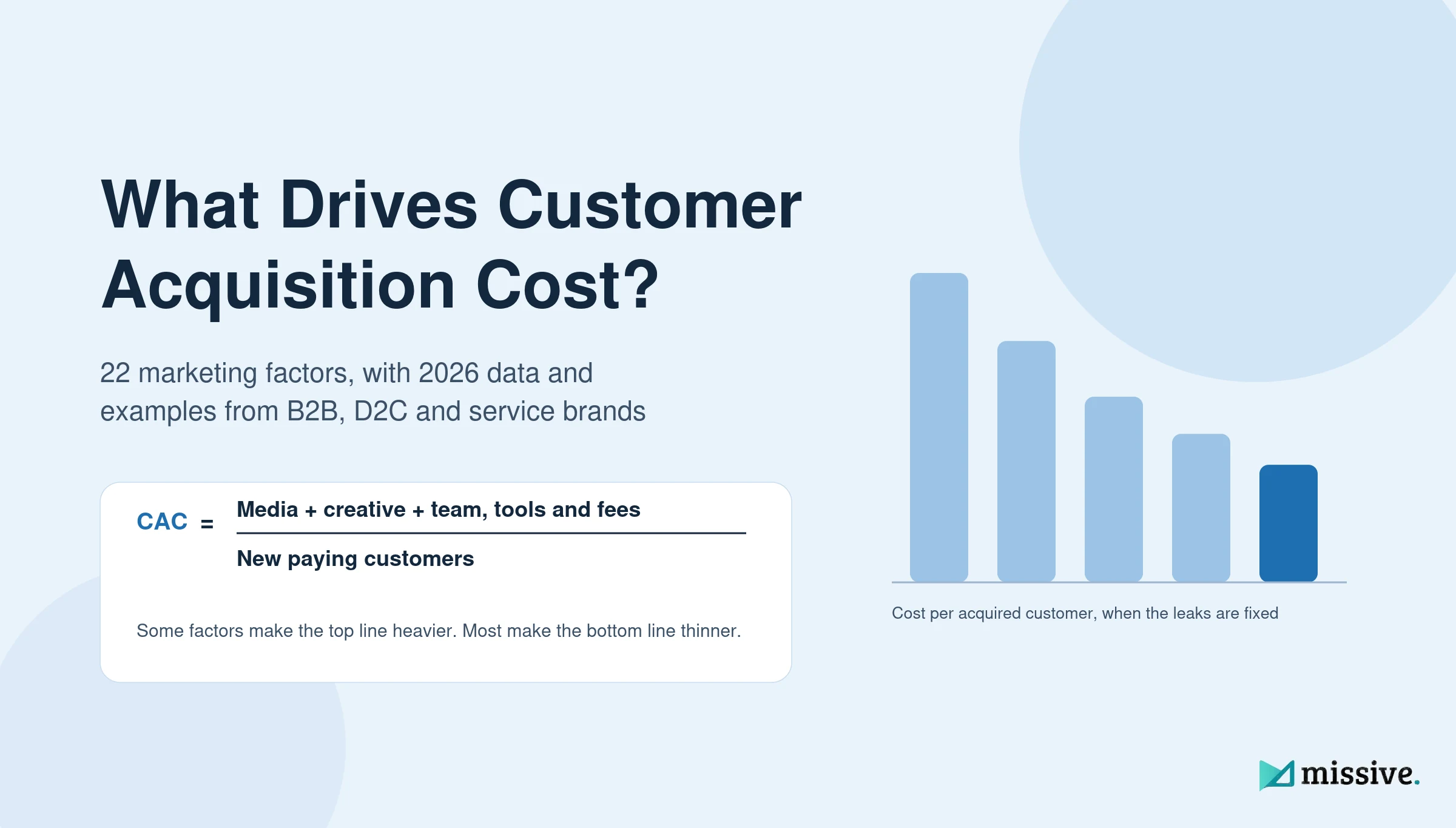
- Customer acquisition cost rises for one of two reasons. Either you are spending more to win customers, or the same spend is producing fewer of them. Each of the 22 factors in this post affects one of those two sides.
- Creative quality has a bigger effect on paid media results than targeting does. In the largest sales-effect study available, creative accounted for 49% of advertising’s sales lift, while marketers surveyed guessed 21%.
- Many of the costliest leaks appear after someone clicks. Weak landing pages, long forms and slow follow-up all increase the cost of every customer you win.
- Brand recognition, reviews and referrals reduce CAC slowly, but their effect compounds. Growth that depends only on paid media becomes more expensive each year.
- Measure fully loaded CAC and judge it against lifetime value. A customer who was cheap to acquire but leaves quickly is an expensive customer.
Earlier this year, an Italian telecom brand came to us with what looked like a budget problem. The company had an in-house marketing team, a substantial Google and Meta Ads budget, and a steady flow of leads. Barely 1% of those leads were becoming customers.
When we audited the account, we found that the ads were working as configured. The problem was that most campaigns were set up to reach people who already knew the brand.
I have seen versions of this situation for more than 15 years, across B2B, SaaS, D2C and service businesses. Customer acquisition cost (CAC) rarely rises because of one bad decision. It rises because of many small decisions that nobody reviews together, from who you target to how quickly your team replies when someone fills in a form.
The pressure on acquisition budgets is increasing. Focus Digital’s 2026 report, which analyzed more than 3,400 campaigns and $127 million in ad spend, found that CAC rose in every one of the 16 industries it tracked between 2024 and 2026, with paid CAC in retail up by 16% (Focus Digital).
When costs rise, most teams respond by cutting the budget or changing agencies. Neither step helps if the leak is somewhere else in the system.
This post is not another definition of CAC with a formula and a few general tips. It walks through 22 factors that influence acquisition cost, grouped by the part of the formula each one affects, with current data, examples from B2B, D2C and service businesses, and what other experts recommend.
Some of the factors below increase the numerator, which is everything you spend. Most of them shrink the denominator, which is the number of customers that spend produces. Once you know which side a factor affects, you know where to look when CAC moves.
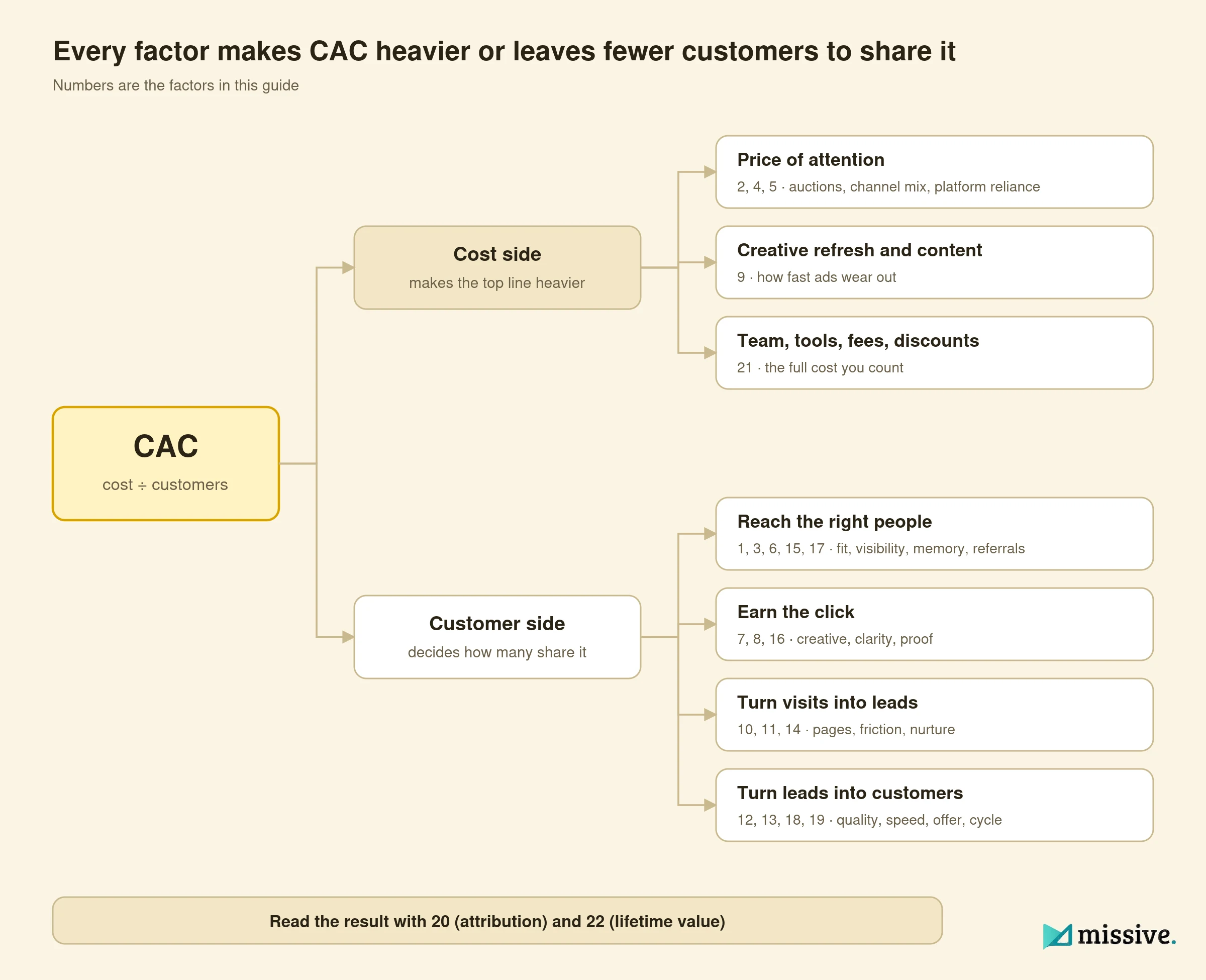
When CAC jumps, the first question to answer is whether the cost side or the customer side moved. The map above tells you which factors to check for each.
Where to Start, by Business Model
| If you run | Look first at | Because |
|---|---|---|
| B2B or SaaS | Factors 3, 13, 15, 19, 20 | Long cycles, buying committees and untracked word of mouth hide most of the cost |
| D2C or ecommerce | Factors 2, 5, 7, 9, 16 | Auction prices, platform dependence and creative wear-out drive most swings |
| Services and local businesses | Factors 10, 11, 13, 16, 17 | Conversion, reply speed, reviews and referrals decide who gets the inquiry |
Targeting and Audience: Who Are You Paying to Reach?
1. How Sharply You Define (and Exclude) Your Ideal Customer
Every impression shown to someone who will never buy, or who has already bought, adds to your cost without adding to your customer count. A loosely defined ideal customer profile (ICP) is one of the quietest ways CAC inflates, because the dashboards continue to show healthy clicks and reach.
What to change
- Build the ICP from your most profitable 20% of customers, not from everyone who ever bought.
- Keep a live exclusion list: existing customers, job seekers and students (B2B), pincodes you cannot deliver to (D2C), areas you do not serve (services).
- Sync CRM customer lists to ad platforms weekly so suppression never goes stale.
Example: In an audit of a D2C nutrition brand spending ₹3 lakh a month on Meta Ads, 35% of the paid acquisition budget was reaching people who had already purchased, because the brand had never suppressed its CRM customer list from its acquisition audiences (Voxturr). The brand was paying new-customer prices to reach its own customers.
Case study: how an Italian telecom brand cut its cost per customer by 95%
In the account I described in the introduction, the campaigns briefed to win new customers were bidding on brand terms, retargeting recent visitors, and using lookalike audiences built from existing customers and lists of current subscribers. Here is what we changed.
- Switched the scoreboard from cost per lead to win rate and cost per acquired customer, with a loss reason logged on every lost lead.
- Turned off campaigns that could not reach a new customer by design, including branded search and a retargeting campaign with weeks of spend and zero conversions.
- Rebuilt targeting around switching moments: moving house, a child’s first phone, students leaving for university, and users of competitor brands.
Within eight months, the cost per acquired customer had fallen by 95% on roughly a third less ad spend. The lead-to-customer win rate passed 5%, which the company had never achieved before, and the number of new customers won each month grew twentyfold.
These figures exclude the customer referral program. Including it, cost per customer still fell by around two-thirds. Read the full case study
Tip from another professional: Alex Hormozi’s workshop advice, as noted by attendee Austin Distel, is to rank customers by lifetime gross profit, take the top 20% and reread what they said just before buying. Those sentences become your targeting and your hooks (Austin Distel on Instagram).
2. How Crowded the Auction for Your Audience Is
Paid media is priced by auction, so your CAC rises with every competitor who bids for the same person. Your creative and landing pages can stay exactly the same while your costs climb, simply because three new brands entered your category this quarter.
WordStream by LocaliQ’s 2026 benchmarks put the average Google Ads cost per click at $5.42, higher than the year before. The average cost per lead eased to $66.69 over the same period, because conversion rates improved (WordStream). Clicks continue to get more expensive, and the difference between industries is large.
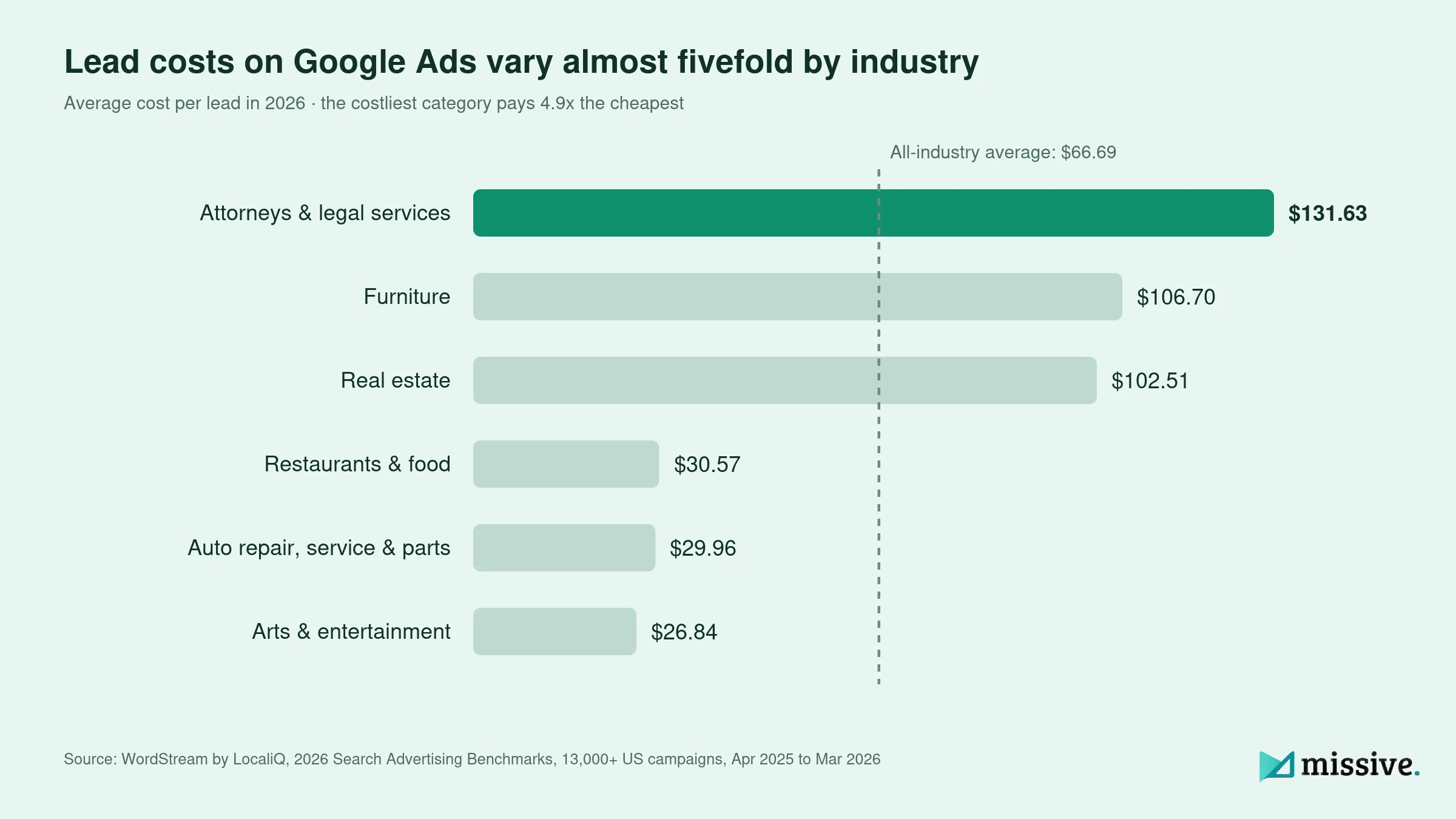
A lead in legal services costs almost five times as much as a lead in arts and entertainment. A “high” CAC therefore means very little until you compare it with the benchmark for your own category.
What to change
- Bid on problem-led and long-tail queries (“how to cut churn in a 20-seat team”) instead of only the category head term everyone fights over.
- Test placements and geographies your competitors ignore before raising bids where they all sit.
- Let organic content own the expensive head terms over time, so paid search only has to cover the gaps.
3. How Much of the Buying Journey Happens Without You
Buyers now do most of their research before they speak to anyone. In 6sense’s 2025 survey of nearly 4,000 B2B buyers, the first contact with a seller came 61% of the way through the buying journey, and in 95% of cases the eventual winner was already on the buyer’s shortlist on day one (6sense). If your answers are missing while buyers are researching, you will pay later to interrupt someone who has already chosen a favorite.
What to change
- List the 20 questions buyers ask before they talk to anyone, then check which ones your site actually answers.
- Publish the pages buyers look for but brands avoid: pricing ranges, comparisons, “who this is not for” and implementation timelines.
- Run a website content audit every six months to find pages that attract traffic but never move anyone forward.
Example: A services firm that publishes an honest “projects start at” price range on its website usually receives fewer inquiries, but a higher share of them close. Fewer, better-qualified leads cost less per customer than a full pipeline of people who were never going to buy.
Channels and Media: Where Is Your Money Going?
4. Your Channel Mix, and Where Each Channel Stops Paying Back
Every channel has a cost curve. The first rupee you spend on search reaches people who are already looking for you, and the hundredth reaches whoever is left. Average CAC hides this difference, so teams keep scaling a channel long after each additional customer has become expensive.
What to change
- Report marginal CAC (what the last tranche of budget bought), not just the average.
- Set a ceiling per channel: when marginal CAC crosses your target, move the next budget elsewhere.
- Balance demand capture (search, retargeting) with demand creation (content, social, events) so capture channels have fresh buyers to convert. If organic is your weak side, start with these ways to grow traffic and organic leads.
Worked example (illustrative numbers):
| Monthly spend | New customers | Average CAC | CAC of the last ₹1 lakh |
|---|---|---|---|
| ₹1,00,000 | 50 | ₹2,000 | ₹2,000 |
| ₹2,00,000 | 80 | ₹2,500 | ₹3,333 |
| ₹3,00,000 | 95 | ₹3,158 | ₹6,667 |
At ₹3 lakh a month, the average CAC still looks acceptable. The last ₹1 lakh, however, bought customers at more than three times the original price.
5. How Dependent You Are on Rented, Paid Reach
When most of your customers come from one ad platform, that platform’s auction sets your CAC, not your marketing. A December 2025 study by DSG Consumer Partners found that more than 70% of the Indian D2C brands surveyed relied on Meta as their primary acquisition channel (best media info). One algorithm update is enough to affect the whole business.
What to change
- Set a target share of new customers from owned and earned channels (SEO, email, WhatsApp, community, founder-led LinkedIn) and review it monthly next to paid CAC.
- Turn every paid customer into an owned contact: capture email or WhatsApp opt-in at the first touch.
- Build an organic marketing strategy that compounds, so each quarter’s content keeps bringing buyers without fresh spend.
Example: Alex Hormozi’s books, podcast and social content work as the customer acquisition engine for Acquisition.com, with close to zero marginal cost per lead compared with paid channels (US Moguls).
Watch from Missive: If most of your customers still come from one paid platform, watch my DevFest Ahmedabad talk, Start Smart: A Marketing Approach for Startups’ Go-to-Market Success. It walks through how to enter a market and build demand without a large ad budget, which is exactly the owned-channel share this factor asks you to grow.
Video: Himani Kankaria at DevFest Ahmedabad, on the GDG Ahmedabad YouTube channel
6. How Visible You Are Where Buyers Get Answers Without Clicking
Google, social feeds and AI assistants now answer many questions inside their own platforms. SparkToro’s 2026 study found that 68% of US Google searches ended without a click in the first four months of 2026, up from about 60% in 2024 (Search Engine Land). Buyers build their shortlists without visiting your website, and brands that are missing from those answers have to buy the attention back with ads.
What to change
- Publish native, no-link posts on social that teach the full idea in-feed, then measure branded search and direct traffic rather than clicks.
- Earn mentions on the sites and communities AI assistants cite for your category, not just backlinks.
- Check monthly what ChatGPT, Gemini and Google’s AI Overviews say when asked for the best options in your category, and whether you appear.
Proof from our own research: Missive’s study on how LLMs decide which brands to recommend breaks down what made some brands surface repeatedly in AI answers while others never appeared.
Creative and Messaging: What Do People See Before They Click?
7. The Quality of Your Ad Creative
Creative is the lever most teams under-invest in. Ad platforms now decide who sees an ad largely by reading the ad itself, so weak creative means you pay more to reach the wrong people.
The latest NCSolutions and Nielsen Five Keys to Advertising Effectiveness study, which draws on nearly 450 sales-effect studies, credits creative with 49% of the sales lift from advertising. That is more than reach and targeting combined.

The gap between this finding and what marketers believe is the important part. In Advertiser Perceptions’ February 2025 survey of 301 marketers and media agencies, respondents credited creative with only 21% of sales and ranked targeting as the most important driver (Westwood One). Most teams spend their optimization time on the levers that matter least.
Indian data shows the same pattern. Kantar’s Creative Effectiveness Analysis for India 2025 found that ads with strong creative delivered 36% higher profitability than ads with weak creative (exchange4media).
What to change
- Test different angles (pain, outcome, proof, objection), not five color versions of one idea.
- Judge the first three seconds separately: hook rate tells you whether the rest of the ad even gets a chance.
- Pre-test hooks as organic posts; promote only the ones strangers already respond to.
Tip from another professional: William Kast’s Short, Creative Is the New Targeting With Meta Ads, explains in under a minute why Meta now reads your creative to decide who sees the ad, the job manual targeting used to do. Watch it before your team spends another week adjusting audience settings instead of testing new angles.
Video: William Kast, Creative Is the New Targeting With Meta Ads, on YouTube Shorts
8. How Clearly Your Value Proposition Is Written
A confused visitor leaves, and you have already paid for the click. On every page that has to convert, clarity matters more than cleverness. Unbounce’s latest benchmark data (Q4 2024) shows that landing pages written at a 5th to 7th grade reading level convert at 11.1%, compared with 5.3% for pages written at a college reading level (Unbounce data via Shno).
What to change
- Rewrite every headline so a stranger knows what you do, for whom, and the result, in under eight seconds.
- Replace adjectives with specifics: numbers, timeframes, names of customers like them.
- Apply the same discipline to product pages; these tips for writing product descriptions that convert work for services and SaaS feature pages too.
Before and after: “We deliver innovative solutions tailored to your needs” tells the reader nothing. “We set up 3-step onboarding that gets your clients from sign-up to first payment in under 24 hours” can be tested, believed and remembered (Growth Experts).
Tip from another professional: Harry Dry of Marketing Examples shares a five-part landing page formula: state the value in the title, explain how in the subtitle, let people visualise it, make it believable with proof, and make the next step easy (Harry Dry on LinkedIn).
9. How Fast Your Creative Wears Out
An ad that is shown too often stops working, and platforms start charging more to show it. On Meta, ads that look too alike are grouped together and their delivery is reduced.
One analysis notes that ads with a similarity score above 60% are treated as redundant (Digital Time Savers). Creative fatigue shows up as rising CPMs and falling click-through rates while nothing else in the account has changed.
What to change
- Plan creative as a pipeline, not a project. At large budgets, one agency recommends shipping 20 to 30 new variations a week (Flighted).
- Rotate formats: short video, static, carousel, founder-to-camera, customer clips.
- Set a fatigue alert: when frequency climbs and CTR drops for two weeks running, retire the ad.
Tip from another professional: MTA Digital makes the point that five similar ads are not five tests. They are one test in five outfits (MTA Digital).
Fatigue affects organic social media as well. In our breakdown of LinkedIn’s 2026 updates, I explained that your audience notices a repeated engagement tactic before the algorithm does.
My reel below makes the same point for LinkedIn comments. Ten generic “Great post” comments do less for your reach than one thoughtful comment of ten or more words, because people and the algorithm both read repetition as noise. Watch it if your team still runs engagement on autopilot.
Video: Himani Kankaria on Instagram, how LinkedIn now treats low-effort comments
Funnel Conversion: What Happens After the Click?
10. Your Landing Page Conversion Rate
This is the cheapest CAC lever you own, because you have already paid for the traffic. In Unbounce’s latest benchmark (Q4 2024 data), the median landing page converts at 6.6% across industries, and SaaS pages convert at 3.8% (Unbounce Conversion Benchmark Report). Improving conversion lowers CAC without changing the media budget.
The math, with the same ₹1 lakh spend (₹50 per click, 2,000 visitors, 25% of leads close; illustrative):
| Page conversion rate | Leads | Customers | CAC |
|---|---|---|---|
| 3.8% | 76 | 19 | ₹5,263 |
| 6.6% | 132 | 33 | ₹3,030 |
| 10% | 200 | 50 | ₹2,000 |
What to change
- Match the page headline to the exact promise in the ad or search query that sent the visitor.
- Send each campaign to its own page instead of the homepage.
- Run one test at a time on the elements with the most weight: headline, offer, proof, form.
11. Friction in Forms, Booking and Checkout
Every extra field, step or unexpected cost loses people who had already decided to buy. Baymard Institute’s 2025 data shows that 18% of US online shoppers abandoned an order in the previous quarter because the checkout was too long or complicated. Baymard’s research also finds that most checkouts can reduce the number of form elements they show by 20% to 60% (Baymard Institute).
What to change
- Ask only for what you need to reply; enrich the rest later from your CRM or tools.
- Offer the payment and contact options your buyers prefer: UPI and cash on delivery in Indian D2C, an inline calendar for B2B demos, WhatsApp for local services.
- Watch session recordings of people who started a form and quit; the reason is usually visible in seconds.
12. The Quality of the Leads You Generate
Cheap leads that never close are the most expensive leads you can buy. When campaigns are optimized for form fills, the platforms find people who fill in forms, not people who buy.
At Missive Digital, we speak to our clients’ product and sales teams every week for this reason. Sales hears which leads were a poor fit and why, and product knows which use cases the business can actually serve. When that feedback reaches the people running the campaigns every week, targeting, messaging and qualification questions get corrected in days, not quarters.
I described one result of this habit in our post on international SEO content research: a sales team’s list of South African prospects showed us that the market said “VoIP app”, not “softphone”, and the local term had 15 times the search volume.
What to change
- Agree one written definition of a qualified lead with sales, and pay agencies on it.
- Send qualified-lead and closed-won events back to Google and Meta, so bidding learns from buyers, not browsers.
- Gate high-value free offers behind light qualification questions. These B2B SaaS lead generation strategies show where each method fits.
Example: Alex Hormozi’s companies give away assets competitors charge for, but only to people who meet set criteria. That keeps the cost of each lead low while every lead is already qualified for the next offer (ContentGrip).
13. How Fast Your Team Responds to a New Lead
A lead is worth most in its first few minutes, and its value decays quickly after that. Optifai’s 2026 benchmark of 939 B2B SaaS companies found that the average first response took 47 hours, and only 23% of companies replied within five minutes (Optifai).
What to change
- Route web leads instantly by territory or deal size, with a response-time target agreed with sales.
- Let high-intent leads book a call on the thank-you page, so nobody waits for an email.
- Use instant WhatsApp or SMS acknowledgements for services and D2C inquiries outside office hours.
Tip from another professional: Alex Hormozi tells founders that speed decides who gets the client, and sets a one-minute response target for new leads, ideally handled by someone other than the founder (Forbes).
14. Whether You Nurture and Remarket to People Who Haven't Bought Yet
Most visitors are not ready to buy on their first visit. Without nurturing, every visitor who leaves becomes a cost you pay again when you try to reach them later.
Warm audiences convert at much higher rates. Unbounce’s channel data shows that landing pages reached from email convert at an average of 19.3% (ClickMinded).
What to change
- Segment follow-ups by what someone looked at: a pricing-page visitor needs a different message from a blog reader.
- Retarget with proof and answers, not the same ad they ignored.
- Remove converted customers from every acquisition audience the same day they buy.
Brand and Trust: Why Do Buyers Pick You?
15. Whether Buyers Remember You Before They Need You
Performance ads reach only the buyers who are ready to purchase now, and that is a small group. Professor John Dawes of the Ehrenberg-Bass Institute, in work for LinkedIn’s B2B Institute, estimated in 2021 that only about 5% of B2B buyers are in the market at any given time.
The other 95% will buy months or years later (Marketing Week). Brands that those buyers already know win the click, the call-back and the place on the shortlist at a lower cost.
What to change
- Keep a steady share of budget on reaching future buyers, even when this quarter’s leads look fine.
- Use the same distinctive assets everywhere (colors, a recurring format, a founder’s face) so recognition builds.
- Track branded search volume and direct traffic as early signs that CAC will fall.
Example: B2B buyers are still people with a reputation at stake. In our post on why the smartest brands keep investing in emotional marketing, I covered Volvo Trucks’ “Epic Split” campaign, which drew more than 100 million YouTube views and was followed by a 23% rise in sales in Q4 2013.
Watch from Missive: Our Short, Brand Recall, shows what this factor looks like in practice. Buyers who remember a brand search for it by name instead of comparing options, and that memory is the cheapest acquisition route in this list. It is under a minute, and worth watching before you cut brand spend to protect this quarter’s leads.
Video: Missive Digital, Brand Recall, on YouTube Shorts
16. How Much Proof Buyers Can See
Proof lowers the risk a buyer feels, and lower risk means the same traffic produces more customers. BrightLocal’s 2026 Local Consumer Review Survey found that 97% of consumers read reviews for local businesses, and 68% now want to see a rating of at least four stars before they will consider a business, up from 55% a year earlier.
The same survey found that 45% of consumers use AI tools such as ChatGPT for local recommendations, up from 6% the previous year (BrightLocal). Your reviews now feed the AI answers that buyers trust.
What to change
- D2C: ask for reviews automatically after delivery, and show verified-buyer badges.
- B2B: publish case studies with a named customer, a starting number and an end number; keep G2 or Clutch profiles current.
- Services: grow Google reviews steadily and answer every negative one in public.
- Place proof next to the decision point (pricing, form, checkout), not only on a testimonials page.
17. How Many Customers Arrive Through Referrals and Word of Mouth
Referred customers cost little to win, and they tend to bring in more customers after them. Research published in the Journal of Marketing Research in 2024 found that referred customers go on to make 31% to 57% more referrals than customers acquired through other channels (Konabayev’s review of the research). As factor 20 explains, much of this word of mouth never appears in your analytics, which is why referral programs are usually underfunded.
What to change
- Ask for referrals at the moment of value: the first win, a renewal, a five-star review.
- Make it two-sided, so the friend gets something too.
- For B2B and services, build partner referrals with agencies, consultants and complementary vendors who serve the same buyer.
- Track referrals as a channel with its own CAC, so it gets budget like any other.
Offer and Sales Cycle: What Are You Asking Buyers to Do?
18. How Your Offer Is Built, and How Fast It Pays Back
The same traffic converts very differently depending on what you offer. A confusing menu of options, a large upfront commitment or a weak guarantee pushes more of the selling onto paid media. How quickly a customer earns back their acquisition cost also decides how aggressively you can spend.
What to change
- Cut the core offer to a few clear choices; move the rest into add-ons or upgrades.
- Lower the first step: a paid pilot, a free audit, a starter pack or a trial, depending on your model.
- Add risk reversal buyers can believe, such as a guarantee, a cancel-anytime term or a satisfaction refund.
- Design a first purchase that funds the next acquisition, then layer upsells on top.
Benchmark to aim for: In $100M Money Models, Alex Hormozi argues that a new customer should bring in at least twice what it cost to acquire and serve them within 30 days. If you achieve that, each customer funds the acquisition of the next one. If you miss it, growth depends on how much cash you can invest in advance (The Executive Insight).
19. How Long Your Sales Cycle Is and How Many People Decide
Every extra month in the sales cycle and every extra stakeholder adds touchpoints, content, meetings and follow-ups, and all of these sit in your CAC. Buyers increasingly want to complete this work without a salesperson.
Gartner’s March 2026 survey of 646 B2B buyers found that 67% prefer a rep-free buying experience, up from 61% a year earlier (Gartner). The sellers who still win are the ones whose content does the selling between meetings.
What to change
- Create content for every person in the buying group: a business case for finance, security and integration answers for IT, a rollout plan for the end user.
- Send a short pre-call video or one-pager so meetings start with decisions, not introductions.
- Use a shared action plan with dates, owners and next steps for every open deal.
- Help your salespeople become the trusted name buyers already follow. This framework shows how IT sales teams can build thought leadership on LinkedIn before the first meeting.
Measurement and Economics: Are You Counting CAC Correctly?
20. How Accurately You Attribute Customers to Channels
Wrong attribution does more than misreport CAC. It moves budget to the wrong places, and that raises CAC for real.
October 2026 showed how fragile tracking is. After GPT-6 was rolled out, links inside ChatGPT answers briefly stopped carrying their tracking tags. Adobe’s Cedric Huesler recorded about 31,000 fewer ChatGPT visits a day and about 26,000 more “Direct” visits on the same pages.
Refine Labs’ review of the episode describes Direct traffic as a junk drawer that also hides Slack links, email apps and clicks from the LinkedIn app (Refine Labs).
What to change
- Add a required free-text “How did you hear about us?” field to high-intent forms, and read the answers monthly. It is the fix Chris Walker of Refine Labs recommends for seeing dark social.
- Compare self-reported sources with software attribution side by side before moving budget.
- Report on outcomes that survive zero-click journeys, such as branded search, pipeline and revenue. These are the SEO KPIs that replace rankings and traffic.
Watch another professional: Chris Walker’s keynote on dark social at Traffic & Conversion Summit 2021 explains why software attribution undervalues the channels that create demand, and why one form field fixes most of it. Watch it before your next budget reallocation meeting.
Video: Chris Walker, Dark Social keynote at Traffic & Conversion Summit 2021, on his YouTube channel
21. What You Include in the Cost Side of CAC
Many teams report CAC based on ad spend alone and are then surprised when the business is not profitable. Creative production, agency fees, tools, salaries, discounts and payment gateway fees are all part of what it cost to win the customer.
Example from Indian D2C: One breakdown shows a brand with ₹16 lakh of ad spend and 2,000 new customers. On ad spend alone, CAC appears to be ₹800. Once creative, agency fees, first-order discounts and gateway fees are added, the real acquisition spend is ₹20.5 lakh, which means the true CAC is ₹1,025 (Base).
What to change
- Report two numbers every month: paid CAC (media only) and fully loaded CAC (everything).
- Split shared costs, such as a content team, between acquisition and retention honestly instead of leaving them out.
- Benchmark your total spend against peers. This look at how much SaaS companies spend on marketing is a useful reference point.
22. How Long Customers Stay and How Much They're Worth
Retention does not change what you paid for a customer. It decides whether that price was worth paying, and how much you can afford to pay for the next customer.
Over Black Friday and Cyber Monday 2025, returning customers generated 54.69% of revenue for brands with more than $10 million in sales on Triple Whale, compared with 33.95% for brands under $1 million (Retention Edge). High churn forces you to keep buying replacement customers simply to stay where you are.
What to change
- Judge CAC against lifetime value and payback period, never alone.
- Fix onboarding and the first 30 days, when most churn starts.
- Shift budget toward the campaigns and channels whose customers stay longest, even if their upfront CAC is higher.
Why a lower CAC is not always better: Ahrefs points out that a $10 CAC against a $100 lifetime value is a worse business than a $70 CAC against a $170 lifetime value, because the second leaves more profit per customer (Ahrefs).
Find Your CAC Leak Before You Cut the Budget
A high CAC is a symptom, not a diagnosis. Cutting spend or changing agencies rarely fixes it, because the leak usually sits in one specific stage of the customer journey. Start where your numbers break, and work through only the factors linked to that stage.

A 15-minute monthly CAC review
- Compare paid CAC and fully loaded CAC for the month (factor 21)
- Check marginal CAC on your biggest channel (factor 4)
- Look at CPM, CTR and frequency trends for signs of fatigue (factors 7 and 9)
- Review landing page and form conversion by campaign (factors 10 and 11)
- Check median lead response time against your target (factor 13)
- Read last month’s “How did you hear about us?” answers (factor 20)
- Compare the share of customers from owned, referral and organic channels with last month (factors 5 and 17)
If you take one thing from this post, I hope it is this. The cheapest customer to acquire is the one who already knows you, trusts you and has found answers from you before your ad appears.
Paid media can capture that demand, but it cannot create that trust on its own.
Before you spend another rupee on acquisition, run your content and landing pages through our E-E-A-T Content Validator Checklist. It covers the proof, clarity and trust signals that decide whether a visitor you paid for becomes a customer.
If you would like a second opinion on where your CAC is leaking, book a 30-minute consultation with us at Missive Digital. We look at what you measure first and at what you spend second.
FAQs on Customer Acquisition Cost
Customer acquisition cost (CAC) is the total amount a business spends to win one new paying customer. You calculate it by adding every sales and marketing cost for a period, including media spend, creative, tools, agency fees and team salaries, and dividing that total by the number of new customers won in the same period.
A good CAC is one your customers pay back comfortably. Most SaaS investors look for a lifetime value at least three times the acquisition cost and a payback period under 12 to 18 months. For D2C brands, Alex Hormozi's benchmark is that a customer should bring in twice what it cost to acquire and serve them within 30 days.
CAC usually rises for one of five reasons: more competitors bidding for the same audience, creative that has worn out, landing pages or forms that convert fewer visitors, slower lead follow-up, or budget spent on people who already know the brand. Check which stage of your funnel changed before you cut the budget.
Improve the steps after the click. Match landing page headlines to the ad, remove form fields you do not need, reply to leads within minutes, suppress existing customers from acquisition audiences, and add reviews or case studies next to the decision point. Each of these produces more customers from the same spend.
Cost per lead counts how much you spend to get a form fill or inquiry. CAC counts how much you spend to get a paying customer. A campaign can have a low cost per lead and a high CAC if most of those leads never close, which is why we recommend reporting win rate and cost per customer alongside cost per lead.
Yes, over time. Buyers who already recognize a brand click its ads more often, convert at higher rates and arrive through cheaper channels such as branded search and referrals. The effect is slow to build and hard to see in last-click attribution, which is why it is often underfunded.