
Key Takeaways
- Your buyers already research on AI: ChatGPT has more than 900 million weekly users, and 82% of B2B software buyers have sourced recommendations from AI chatbots. If AI assistants do not name you, you are off many shortlists before sales hears about them.
- Telecom companies are raising AI budgets fast, but marketing rarely shows up among the use cases that pay back. The gap is implementation, not tools.
- Map the work, then pick the channel where buyers decide and outcomes are measurable, then pick the tool type. Most teams already pay for the AI they need.
- AI bidding and lead scoring optimize whatever you feed them. Feed them won customers, not form fills.
- The strongest telecom wins come from AI finding buying moments and mining lost-lead reasons, then turning those into lead magnets like buyer’s checklists and migration assessments.
- Train the team on a 90-day plan, including how to humanize AI drafts, and put a compliance check wherever AI reaches a customer.
- Licenses are the smallest cost. Budget for data cleanup, training, review, hiring time, and the months you are absent from AI answers, then choose in-house, partner, or hybrid.
If you run a telecom company, or the marketing team inside one, your buyers have already changed how they shop. ChatGPT alone passed 900 million weekly users in February 2026, and G2’s 2026 Buyer Behavior Report found that 82% of B2B software buyers had sourced recommendations from an AI chatbot in the past two years. By the time a prospect fills in your form or calls your sales team, an AI assistant has often already told them which VoIP, UCaaS, or broadband providers to consider, and which to skip.
Your peers are answering with budget. Nine in ten telecom companies plan to spend more on AI this year, up from 65% a year earlier, according to NVIDIA’s 2026 State of AI in Telecommunications survey of about 1,000 industry professionals. The use cases respondents ranked highest for return were autonomous networks (50%), customer service (41%), and internal process optimization (33%). Marketing did not make the list.
That matches what I see when telecom and VoIP leaders come to us at Missive Digital. The AI is usually already in your stack: smart bidding in Google Ads, Advantage+ on Meta, a chatbot on the website, a writing assistant in every tab. What is missing is a plan that answers the questions you will be asked in the next budget meeting: what should the AI optimize, who will run it, how long until it pays back, and what it really costs in people and time, not just in licenses.
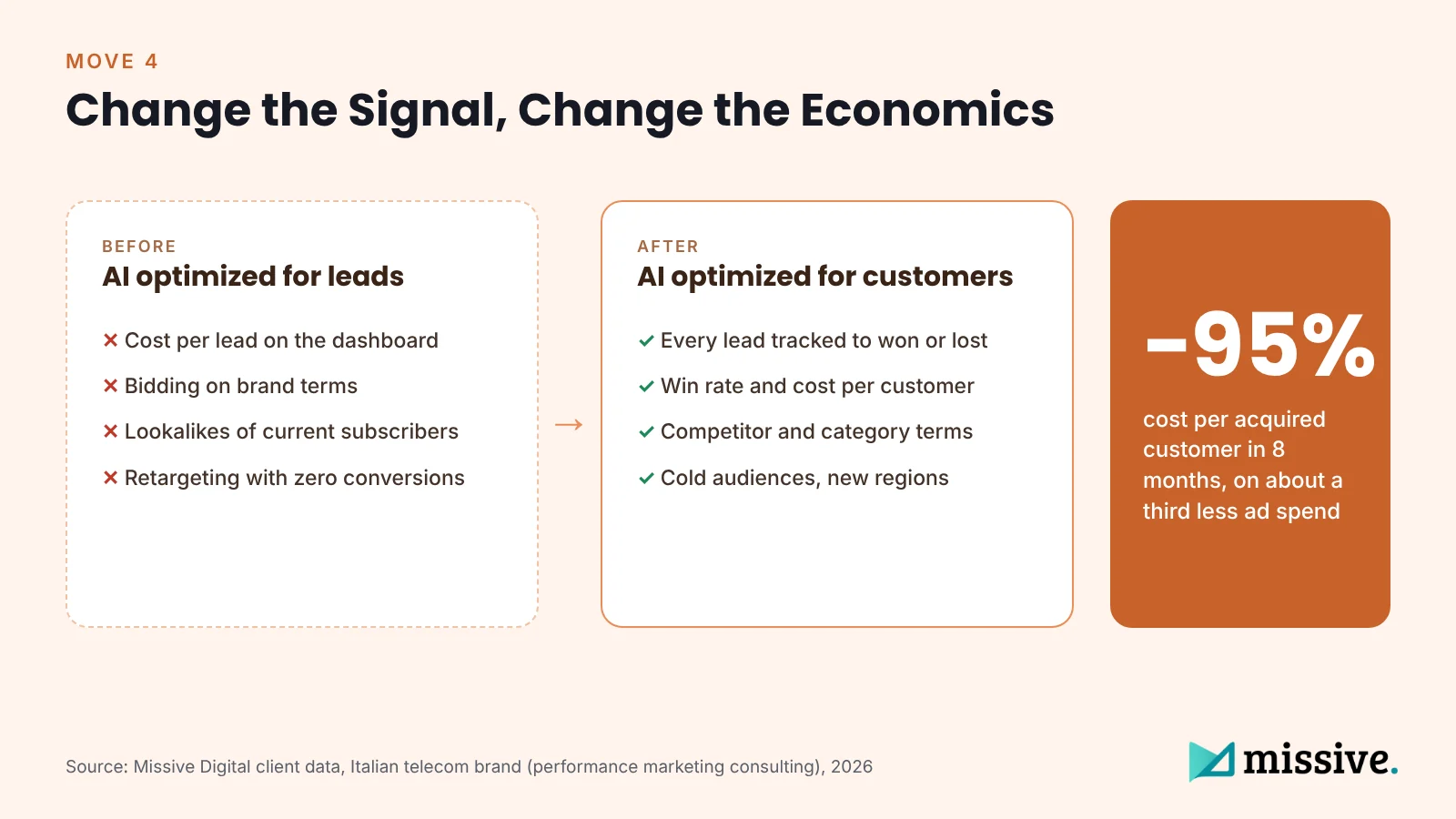
One of our clients, an Italian telecom brand, had a capable in-house team, a large ad budget, and every automated bidding feature switched on. Barely 1% of its leads became customers. Eight months after we changed what the campaigns were measured on and where they pointed, the cost of acquiring a customer had fallen by 95% on about a third less ad spend. Their Head of Sales put it simply: they used to get more leads of poor quality, and now they get fewer leads of better quality.
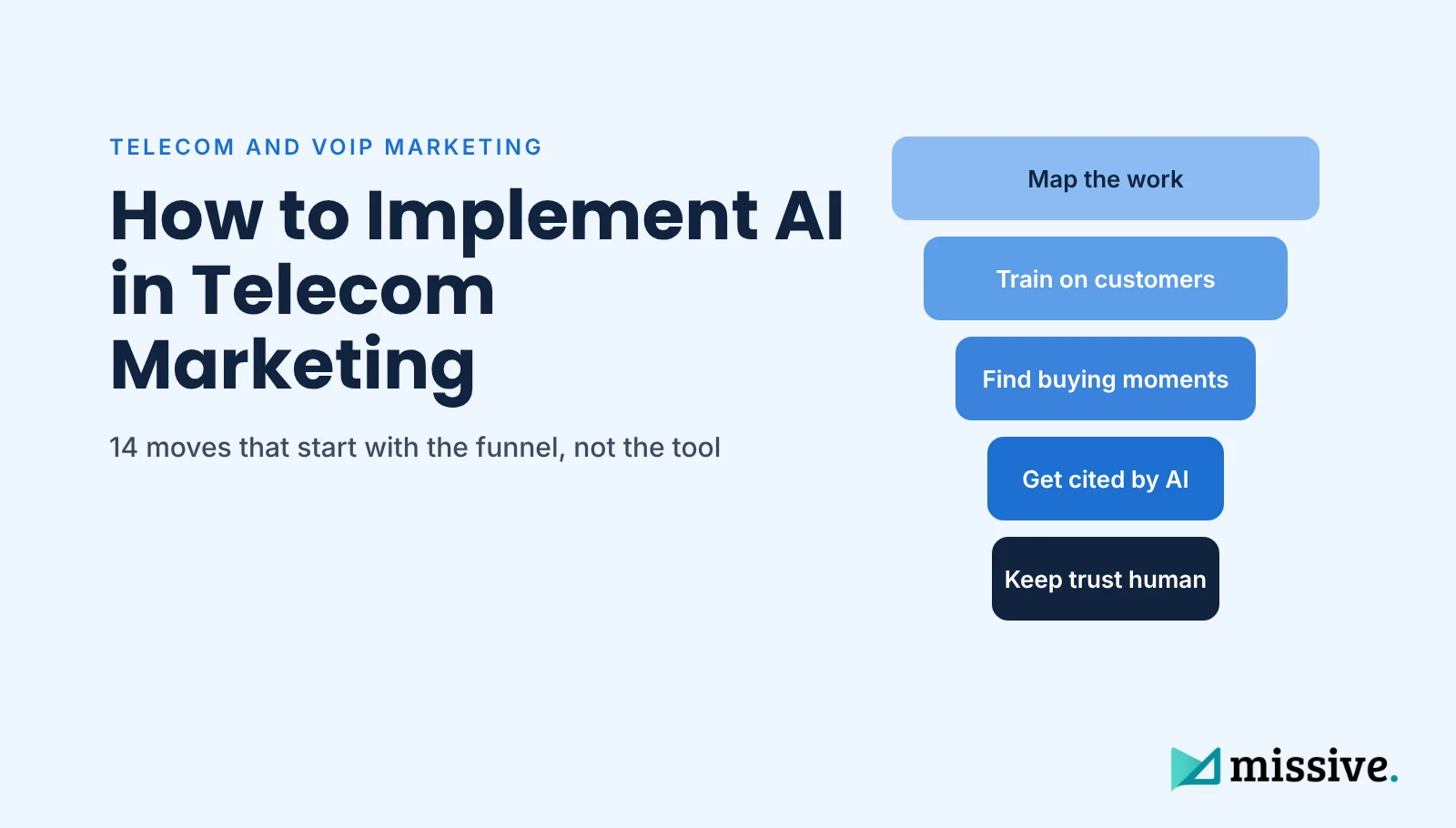
None of that came from buying a new AI tool. It came from deciding where AI helps, what it learns from, and where people stay in charge. Below are the 14 moves I would make if I were in your seat, in the order I would make them, ending with what it takes to resource them.
1. Map Your Marketing Team's Week Before You Choose Any AI Tool
Most telecom teams start with a tool and then look for a use. That is why so many AI pilots never leave the pilot stage. McKinsey’s February 2026 report, Telcos’ AI inflection point, found that virtually every operator is piloting AI, yet only 57% scale use cases across several domains and only 12% report sizable impact so far. Nearly three in four leaders use AI mainly to speed up the workflows they already have.
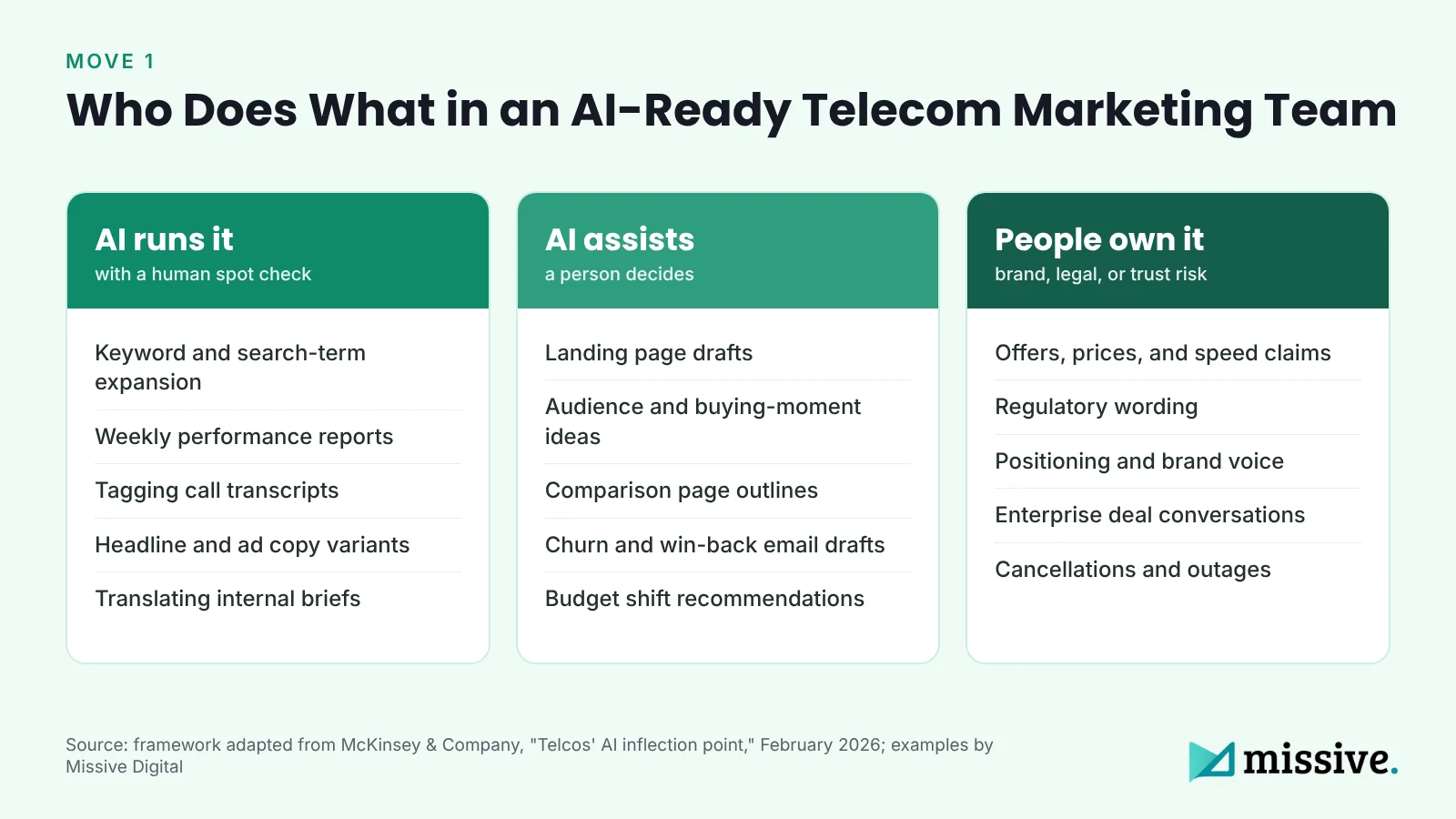
The operators that get results do the opposite. They break the work into tasks and label each one as automated, human and AI together, or human-owned. One North American operator in the report mapped its marketing team’s daily activities and redesigned workflows such as always-on marketing before it chose any technology.
Here is how I would run that exercise with a telecom marketing team:
- Log two weeks of real work. Every recurring task: keyword research, ad copy, offer pages, churn emails, coverage-check pages, reporting, sales enablement decks.
- Label each task. AI runs it (with a human spot check), AI assists a human, or a human owns it because it carries brand, legal, or relationship risk.
- Pick two or three tasks to start. Choose ones that eat the most hours and sit closest to revenue, not the ones that make the best demo.
- Tie each one to a single number and a 90-day review. Cost per acquired customer, win rate, or cost per sales-qualified lead. If the number does not move, stop and pick the next task.
2. Choose the Channel Where AI Will Work First
AI amplifies whatever channel it runs in. Put it on a channel where your buyers do not decide, or where you cannot see revenue, and it simply scales the waste faster. So before picking any tool, pick the channel.
I use three questions with telecom teams. A channel goes first only if all three answers are yes:
- Do our buyers actually make decisions here? Consumer broadband buyers compare plans on search; enterprise UCaaS buyers shortlist through peers, analysts, and AI assistants.
- Do we have clean outcome data here? Not clicks, but won and lost customers tied back to the channel.
- Can we see a revenue change within 90 days? If not, it is a second-wave channel.
| Channel | Best first AI use | Data it needs | Usually fits |
|---|---|---|---|
| Google and Bing search ads | Bidding on won customers, not leads | CRM outcomes sent back to the platform | Broadband, mobile, high-demand VoIP |
| Meta and YouTube | Creative variants per buying moment | Pixel and server-side events, offline outcomes | Consumer plans, local fiber launches |
| Email, SMS, and WhatsApp to your base | Churn-risk and upgrade triggers | Usage, contract end dates, support tickets | Retention and upsell |
| Website chat and sales calls | Intent tagging and lead routing | Transcripts linked to CRM records | Brands with heavy inbound volume |
| AI search (ChatGPT, Gemini, Perplexity) | Answer-ready pages and citation tracking | Expert content and third-party mentions | B2B VoIP, UCaaS, considered purchases |
| Account research and expert post drafts | ICP lists and subject matter expert notes | Enterprise telecom, MSPs, resellers |
The two telecom results in this post started in different places for this reason. The Italian brand had its budget and data in Google and Meta, so AI work began there. The VoIP brand sold to buyers who research slowly and quietly, so AI search came first. If you are not sure whether AI search is a channel for your brand yet, our post on how AI search is rewriting telecom SEO shows where telecom buyers already use it.
3. Pick the Right Type of AI Tool for Each Job
“AI tool” now covers at least six different kinds of software. The most common mistake I see is a team paying for a standalone AI writer when the AI it needed was already inside Google Ads or the CRM, switched on but pointed at the wrong goal.
| Tool type | What it does in telecom marketing | Examples | Check before you rely on it |
|---|---|---|---|
| AI inside ad platforms | Bidding, audience expansion, creative variations | Google Ads Smart Bidding and Performance Max, Meta Advantage+ | Is it optimizing for a CRM outcome, or for form fills? |
| General AI assistants on a business plan | Drafting, analysis, clustering notes and tickets | ChatGPT, Claude, or Gemini business plans | Is your data excluded from model training? Is there admin control and SSO? |
| Conversation intelligence and call tracking | Transcribing, tagging, and scoring calls | CallRail, Invoca, Gong | Call-recording consent and where data is stored |
| CRM and marketing automation AI | Lead scoring, next-best offer, send-time timing | HubSpot, Salesforce | Can it see won and lost outcomes, not just activity? |
| AI visibility trackers | Tracking brand mentions and citations in AI answers | Semrush AI Toolkit, Profound | Which prompts, models, and countries it tracks |
| Translation and localization | First-pass translation of briefs and drafts | DeepL, Google Translate | Glossary support and a native review step |
My rule of thumb: use the AI already built into the tools you pay for, and buy something new only when a task from your map in move 1 has no home. The Italian brand’s results came without a single new marketing tool; the change was what the existing AI was told to optimize.
4. Feed AI Your Won Customers, Not Your Form Fills
Every bidding algorithm, lead score, and lookalike audience learns from the conversion you give it. Give it form fills, and it will find you more people who fill in forms. In telecom, where a large share of leads are existing customers, price checkers, or people outside the coverage area, that is an expensive habit.
This is exactly where our Italian telecom client was stuck. Spend was judged on lead volume, so more budget bought more leads and almost no revenue. When we audited every campaign against the goal it was configured for, the campaigns briefed to win new customers were bidding on brand terms, retargeting recent visitors, and building lookalikes from current subscribers. The budget was mostly reaching people who already knew the brand.
What we changed, in order:
- Tracked every lead to the sale. Each lead was tied to its campaign, landing page, and form, then followed to won, lost, or assigned, with a documented loss reason on every lost lead.
- Made win rate and cost per acquired customer the headline numbers. Cost per lead was demoted.
- Switched off campaigns that could not reach a new customer by design, including branded search and a retargeting campaign that had spent for weeks with zero conversions.
- Pointed the budget outward, at competitor and category search terms and cold audiences in regions with few customers.
Each of those moves maps to a factor in our guide to what drives customer acquisition cost, which is where to look if your own telecom campaigns show the same symptoms.
Once the outcomes live in your CRM, send them back to the ad platforms so the algorithms learn from customers instead of clicks. Google explains the setup in its guide to offline conversion imports. Lead volume dipped for a while, then came back higher, and this time the leads turned into customers. The full story, including the referral program that ads were taking credit for, is in our Italian telecom performance marketing case study.
5. Use AI to Find Buying Moments Instead of Demographics
People rarely switch broadband, mobile, or phone system providers because an ad was clever. They switch when life or business changes. Age and interest targeting cannot see that. AI pattern-finding across your own data can.
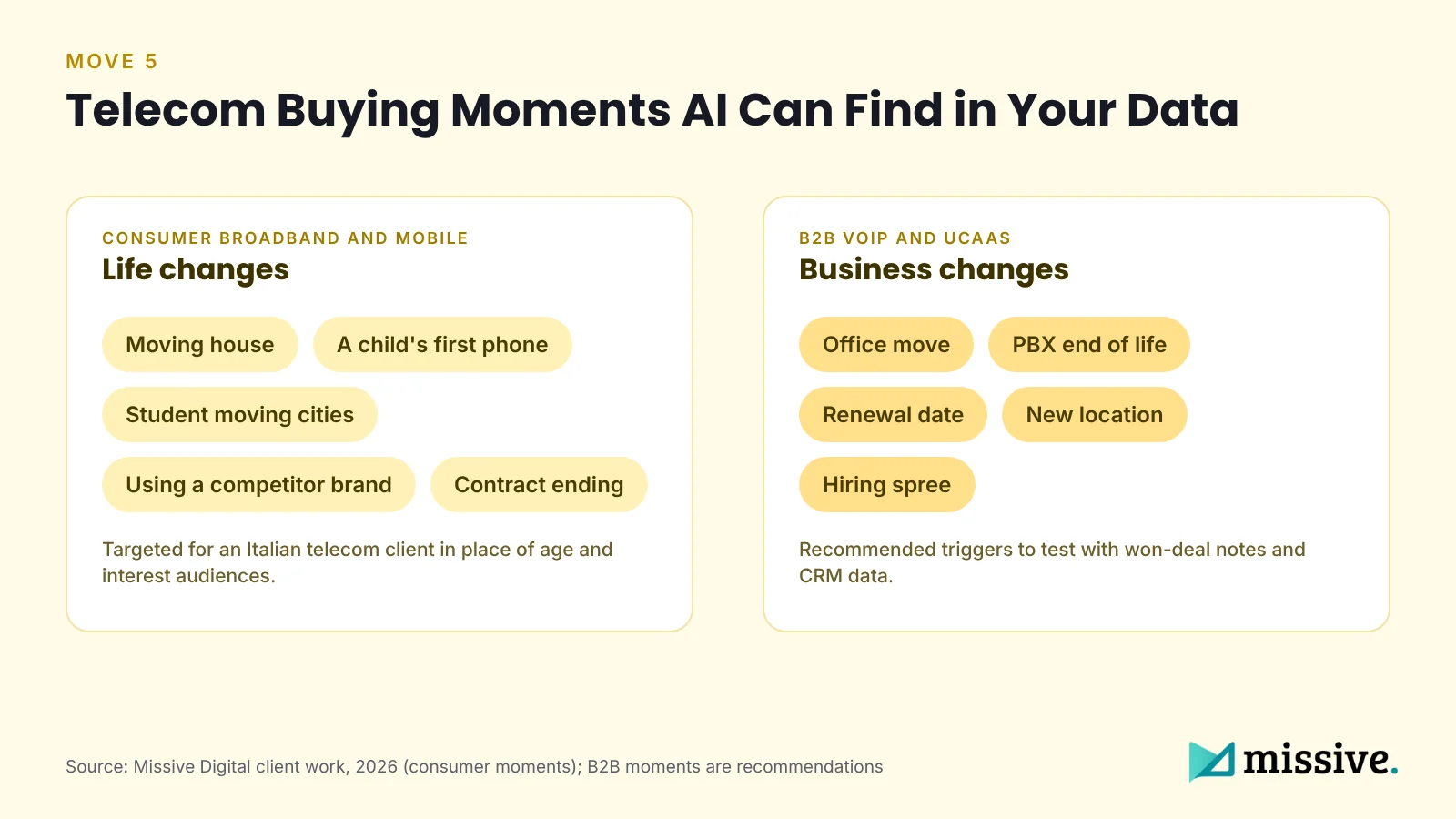
For the Italian brand, we replaced broad demographic targeting with campaigns built around switching moments: moving house, a child getting a first phone, students leaving for university in another city, and users of specific competitor brands. The in-house team got a reusable targeting logic instead of a list of interests.
To find your own moments with AI:
- Collect the raw words. Won-deal notes, sign-up form answers, support tickets, chat logs, and review text, with personal data removed.
- Ask an AI model to cluster them by trigger, not by product. A prompt like “Group these 400 notes by the event that made the customer start looking” works better than “summarize these notes.”
- Build one campaign, one landing page, and one message per moment. The student moving cities needs a different offer than the family moving house.
- For B2B VoIP and UCaaS, the moments look different: an office move, a PBX reaching end of life, a contract renewal date, a hiring spree, or a new location opening.
The economics support the effort. Strategy&’s report on AI-powered telecom personalization estimates up to $5.90 in value for every $1 invested in precision marketing, communications, and advertising.
6. Let AI Read Every Sales Call and Lost-Lead Reason
Your sales calls and CRM loss notes hold the most honest marketing research you will ever get. Almost nobody reads them at scale, which is exactly the kind of task AI is good at.
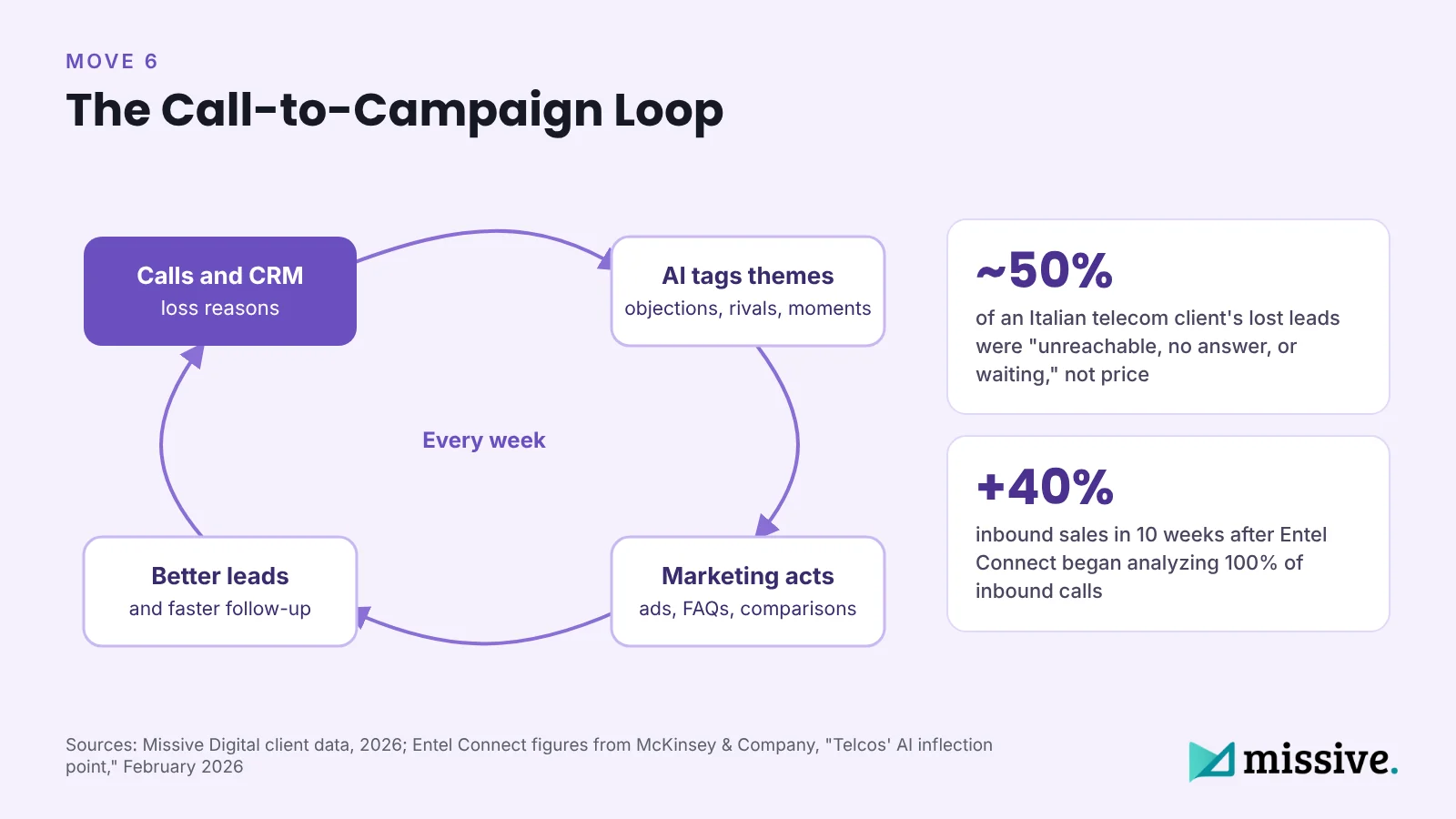
When we sorted the Italian brand’s lost leads by reason, around half were lost to “unreachable, no answer, or waiting,” not to price or competition. No new ad would have fixed that. It was a speed-to-lead and follow-up problem hiding inside a marketing report.
The same McKinsey report describes Entel Connect, whose agentic tool now analyzes 100% of inbound calls every day, compared with fewer than 1% before. Inbound sales rose 40% within ten weeks, with no drop in customer satisfaction.
A lighter version any telecom marketing team can run:
- Transcribe calls and pull loss reasons weekly from your call tracking or CRM.
- Ask AI to tag each one by objection (price, contract length, coverage, installation date), competitor named, and buying moment.
- Send the themes back into marketing. Objections become landing page FAQs and ad angles. Competitor mentions become comparison pages. A rising share of “unreachable” goes to the sales manager, not the media buyer.
Clean intent upstream makes all of this easier. For a softphone brand, we fixed intent mismatches across the website so the funnel stopped filling with junk and bot leads; the before-and-after is in our softphone telecom SEO case study.
7. Generate Variants With AI, but Scale Only What a Controlled Test Proves
AI has made ad copy, landing page headlines, and visuals cheap to produce. That moves the bottleneck from making creative to judging it. Teams that publish whatever the tool generates end up with more assets and the same results.
For the Italian brand, we ran a controlled A/B test of a new fiber landing page against the existing one, holding budget and audiences constant. The new page lifted click-through rate by roughly 10% and more than doubled lead volume at a comparable cost. The constraint had never been the ads. It was the destination.
A simple working rhythm:
- Let AI draft 10 to 20 variants of a headline, offer line, or hero visual.
- Have a person pick two hypotheses worth testing, such as “installation date up front” versus “price lock for 24 months.”
- Hold budget and audiences steady so the page or creative is the only thing that changes.
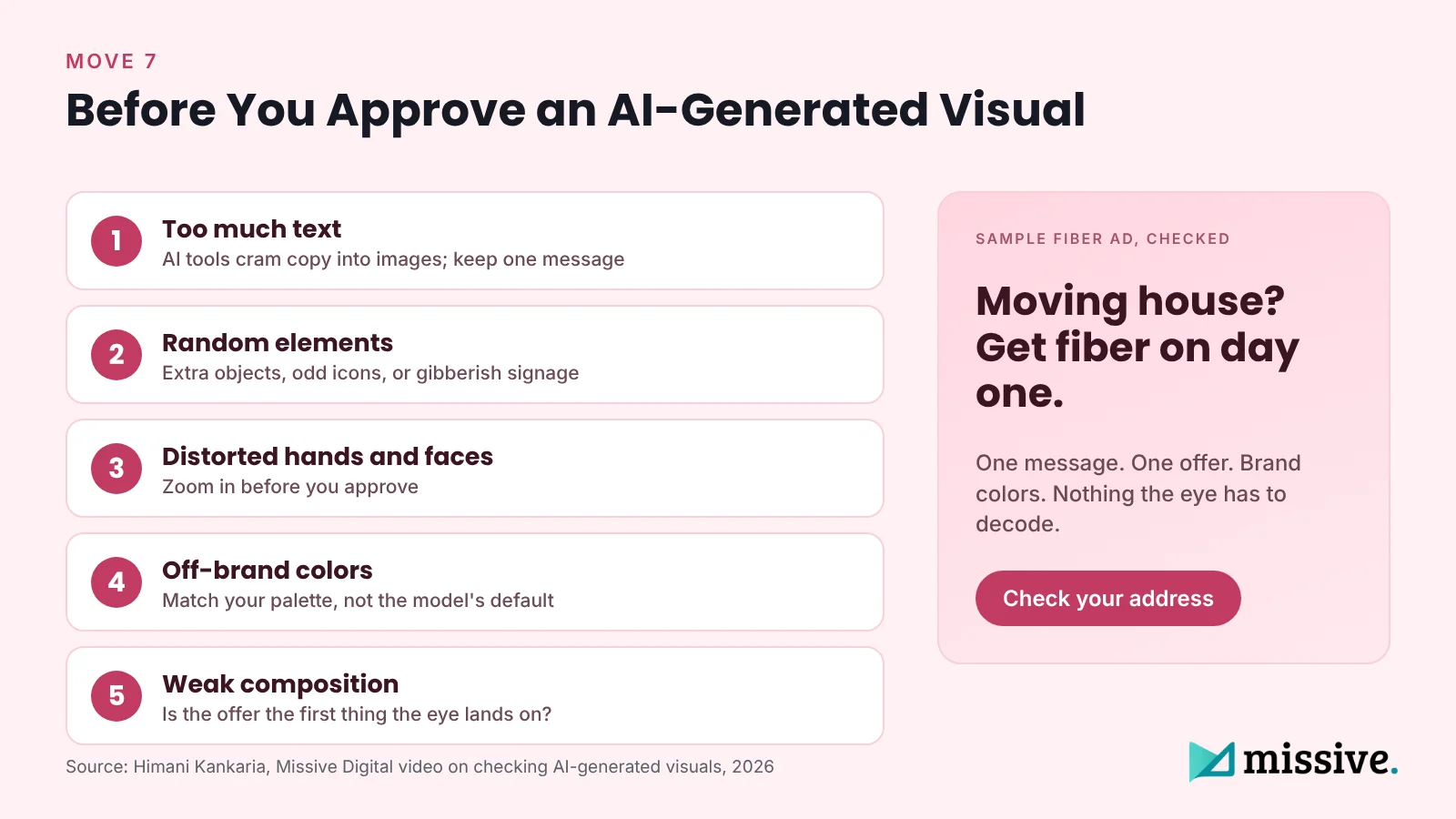
- Check every AI visual before it ships. In one of our recent videos, I walk through what to check before approving an AI-generated visual: too much text, random elements, distorted hands, wrong colors, and poor composition.
8. Use AI to Build Lead Magnets Telecom Buyers Actually Use
Telecom buyers rarely download a generic ebook. They do use things that help them make a risky decision: a checklist for comparing vendors, an assessment of what a migration involves, or a demo shaped around their setup. AI makes these faster to build and, more importantly, easier to personalize.
Two telecom brands show the formats that work.
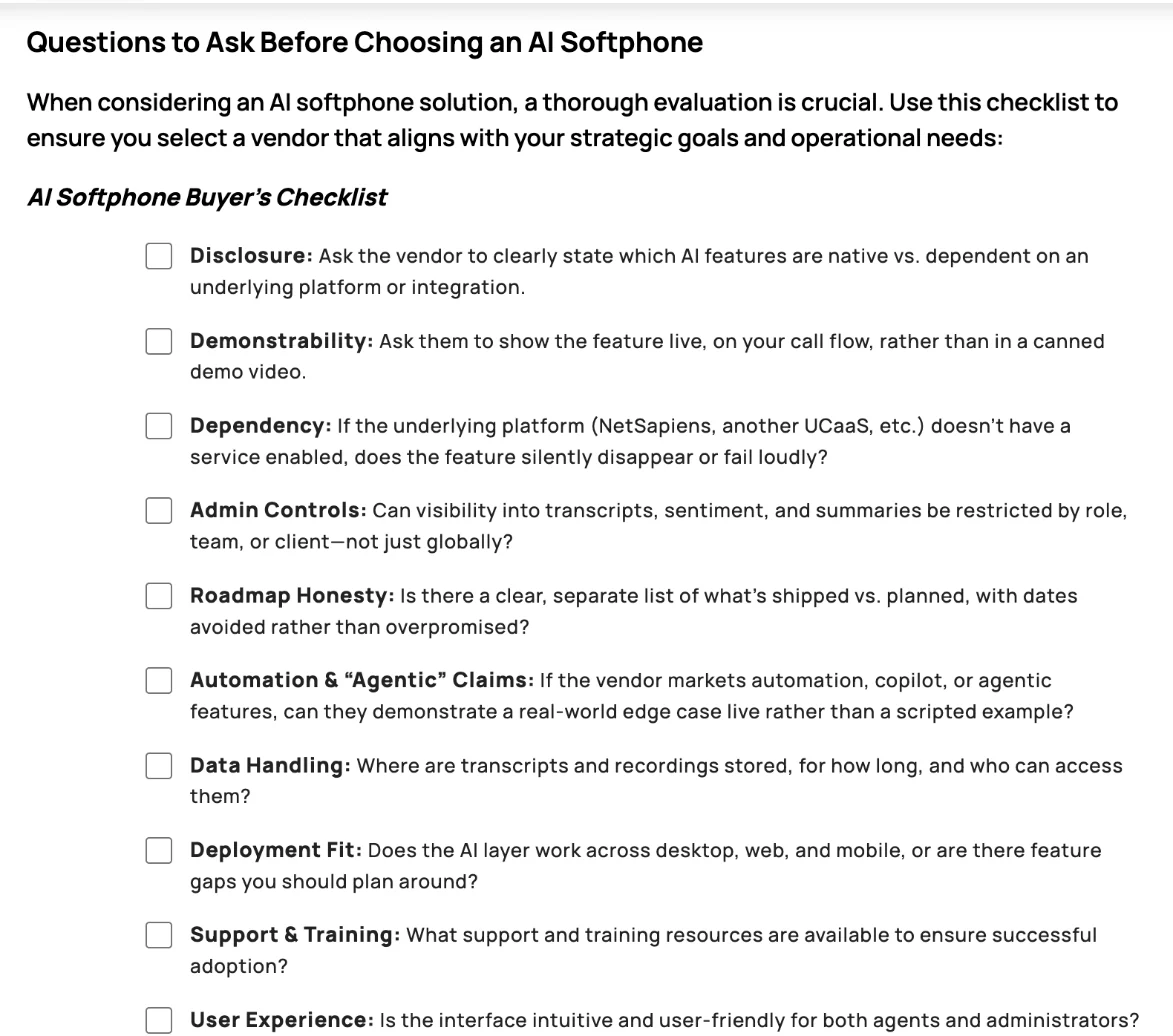
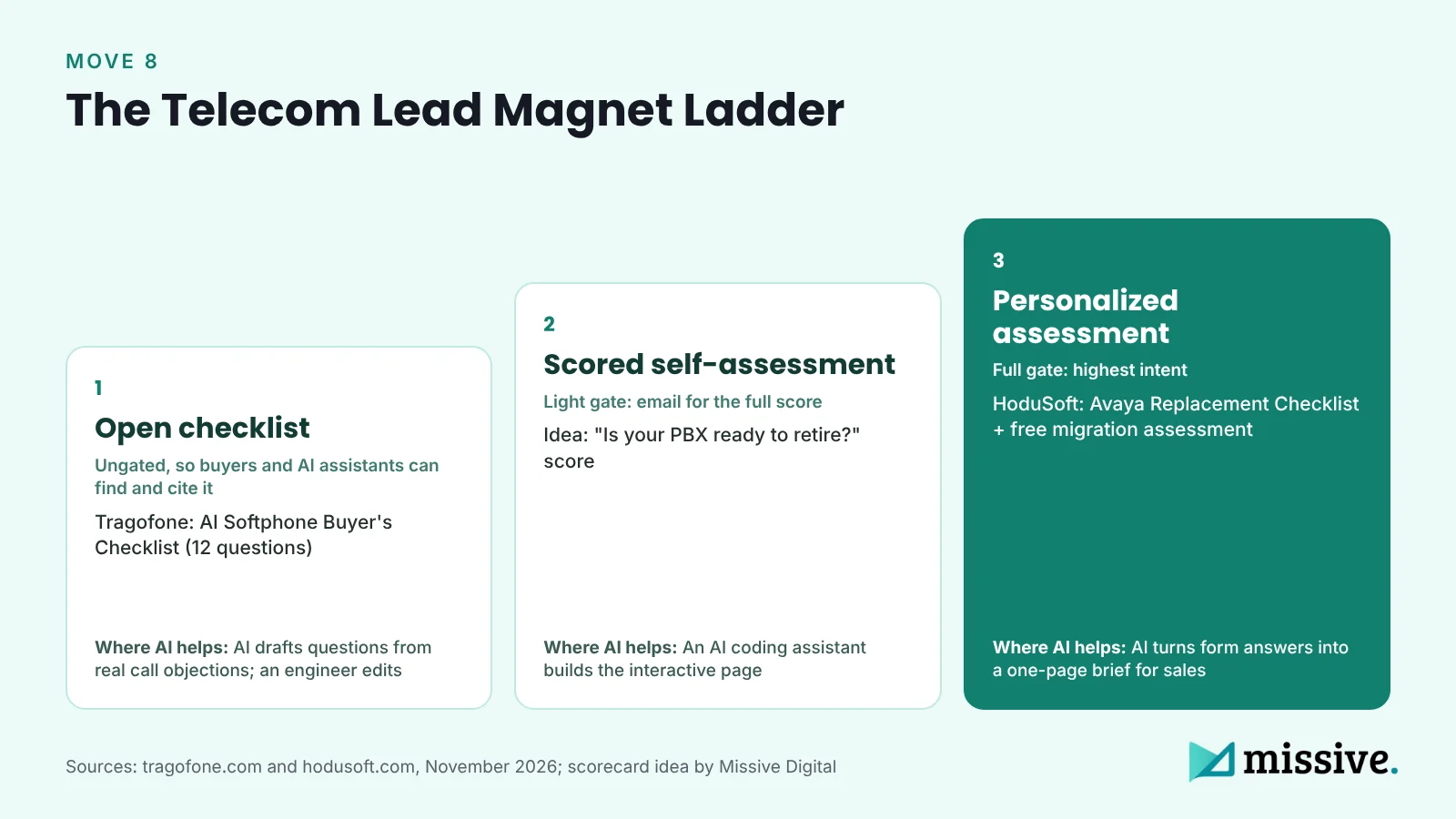
- Tragofone, a white-label softphone provider, ends its comparison of AI and traditional softphones with an AI Softphone Buyer’s Checklist of 12 questions to ask before choosing. The next step it offers is not a generic demo but a walkthrough built around the prospect’s own call flow.
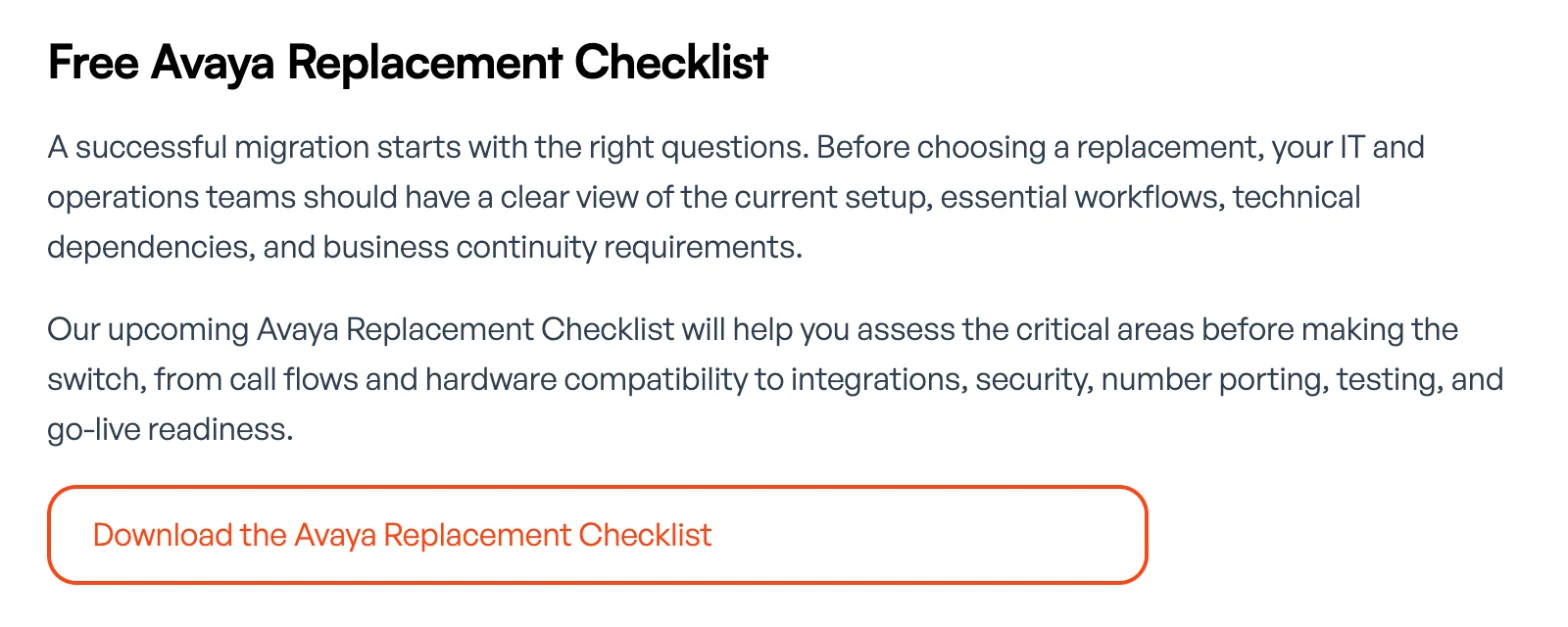
- HoduSoft, a contact center and PBX software company, pairs its Avaya alternative guide with an Avaya Replacement Checklist (call flows, hardware compatibility, integrations, security, number porting, testing, and go-live) and a free migration assessment. It also advises planning the cutover around the Avaya renewal date, which is exactly the kind of buying moment from move 5.
Here is how AI fits into building and running magnets like these:
- Write the checklist from real objections. Take the top 20 objections and questions your AI call tagging surfaced in move 6, and ask an AI model to turn them into checklist questions. A solutions engineer then edits for accuracy.
- Turn a static checklist into a scored self-assessment. With an AI coding assistant, a marketer can build a simple interactive page, such as “Is your PBX ready to retire?” or “How healthy is your softphone app?”, that scores answers and recommends a next step.
- Personalize the follow-up. Have AI summarize each form submission into a one-page brief for sales: current system, seat count, renewal date, and stated concerns. That is what makes “a demo built around your call flow” possible at scale.
- Gate only the high-intent offers. Keep checklists open so buyers and AI assistants can find and cite them; ask for details in exchange for assessments, calculations, and migration plans.
- Measure the magnet by sales-qualified leads, not downloads.
9. Make Your Brand the Answer When Buyers Ask AI Assistants
Telecom buyers increasingly ask ChatGPT, Gemini, or Perplexity which VoIP provider suits a 50-person team, or which fiber plan is reliable in their area. If your brand is not in that answer, your ad budget is fighting for whoever is left.
Neil Patel made the point in a June 2026 Short on Marketing School: Google will keep looking more like ChatGPT, and ChatGPT more like Google. The takeaway I would give any telecom marketer: stop planning AI answers and search results as separate channels.
Video: Neil Patel, "Google Will Start Looking More Like ChatGPT," Marketing School, June 2026
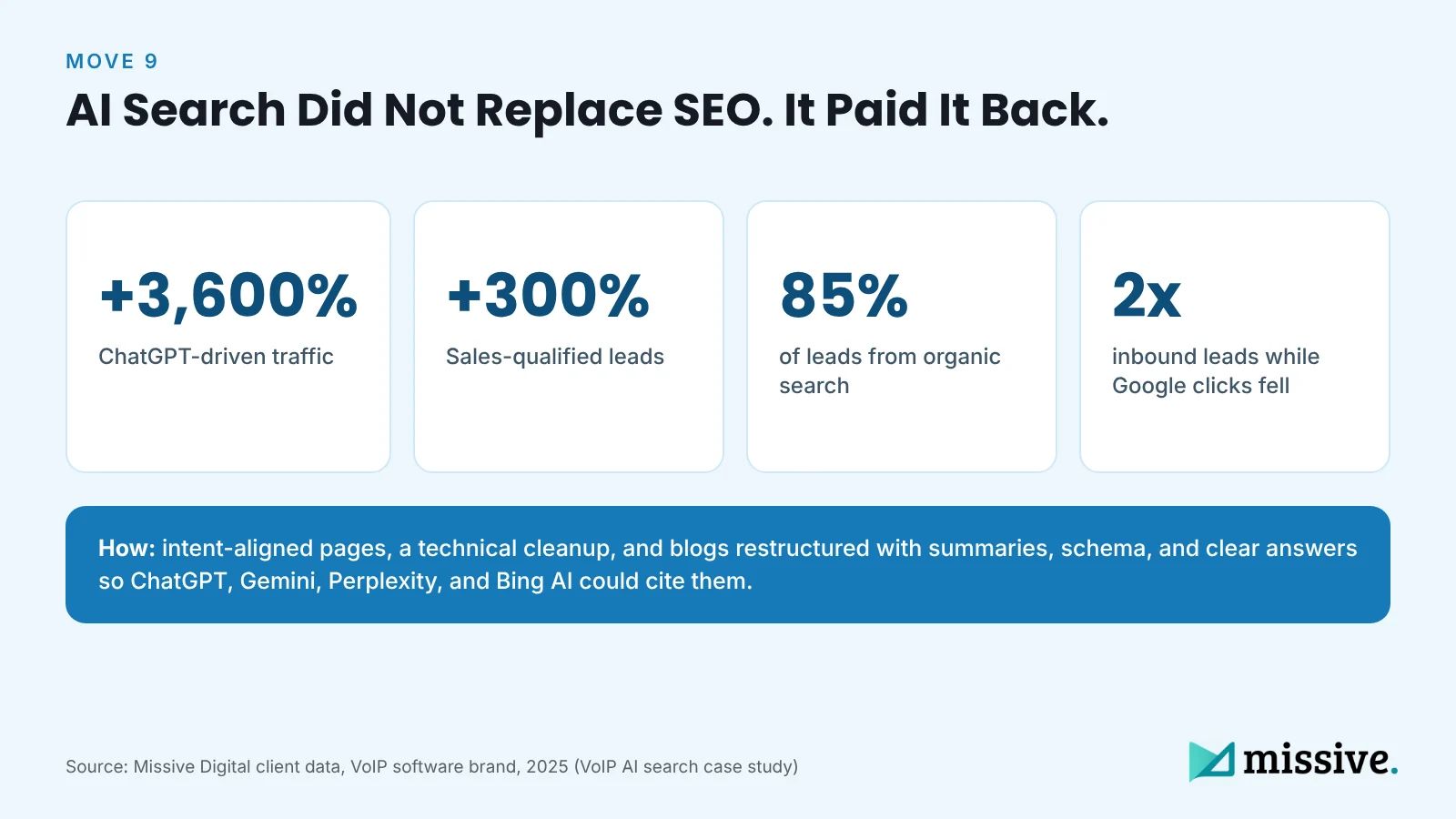
We saw this play out with a VoIP software brand. Google clicks were falling across the industry because of AI Overviews, yet the brand’s leads doubled. ChatGPT-driven traffic grew by 3,600%, sales-qualified leads grew by 300%, and organic search became the source of 85% of leads, including enterprise deals from the US, South Africa, and Europe. We did it by aligning pages to buyer intent, cleaning up the technical foundation, and restructuring blogs so AI tools could extract and cite them. The details are in our VoIP AI search case study.
Where to start:
- Ask the AI assistants your buyers’ real questions and note which brands they name and which pages they cite.
- Make your pages easy to extract: clear answers near the top, comparison tables, pricing context, and coverage details in text, not only in images.
- Earn mentions where AI looks: reviews, industry publications, partner pages, and comparison sites.
If you want to understand why some brands get named and others do not, we tested it directly. Our research on how LLMs decide which brands to recommend breaks down the signals that made AI tools mention one brand over another, and most of them apply to telecom comparisons too.
10. Train the Team Before You Roll AI Out
Your team is the one that will use AI every day, so the rollout succeeds or fails with them, not with the software. Untrained use shows up in two ways: generic output nobody wants to publish, and customer data pasted into tools that should never see it. McKinsey’s research found that the operators getting results treat change management as continuous and track how individuals actually use AI, rather than announcing a tool and hoping.
Here is a 90-day training plan I would run with a telecom marketing team:
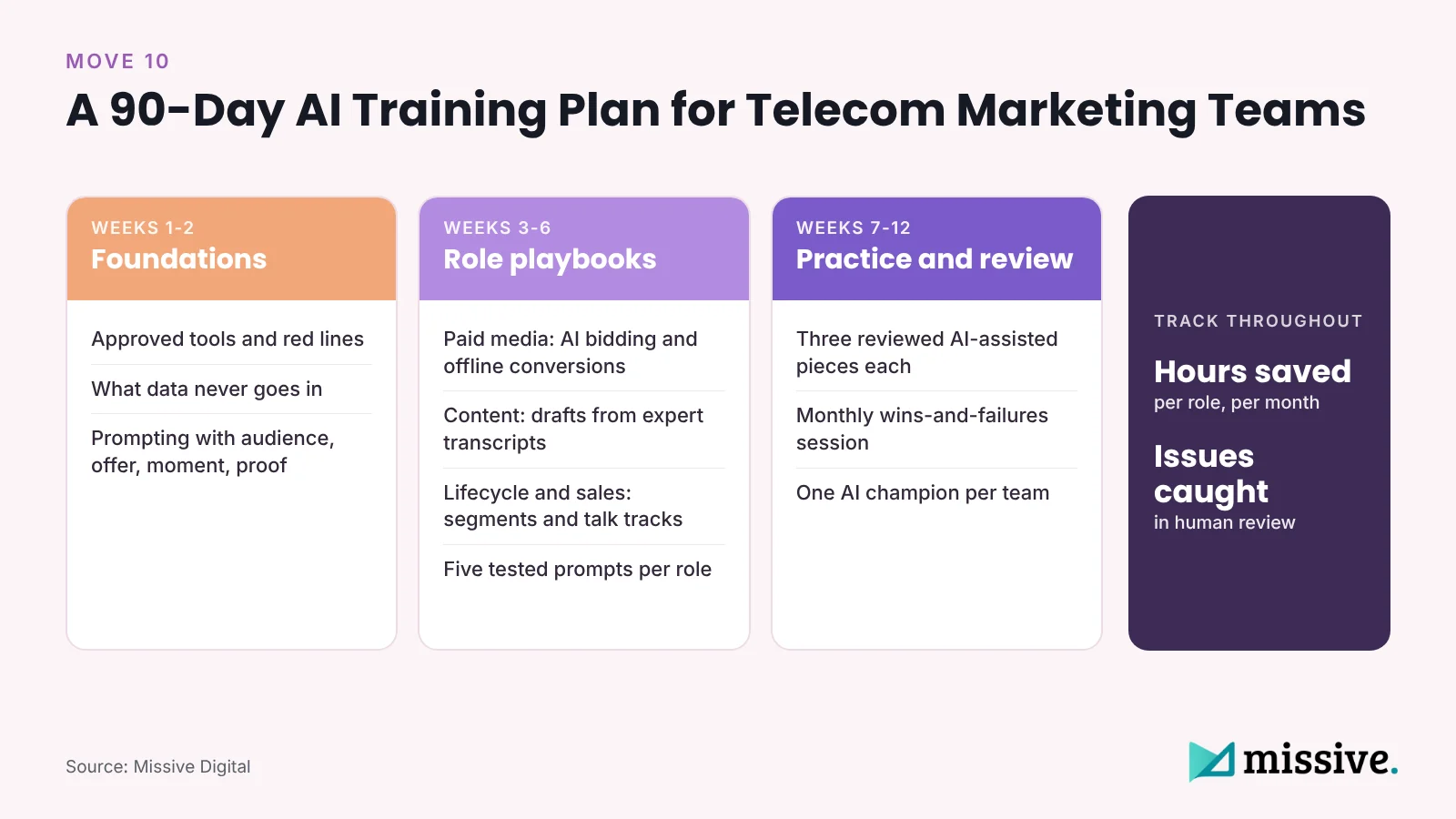
- Weeks 1 and 2: Foundations (two hours). Which tools are approved, what never goes into them (customer personal data, unreleased pricing, network or outage details), and how to prompt with context: audience, offer, buying moment, and the proof you have.
- Weeks 3 to 6: Role playbooks. Paid media learns to read AI bidding reports and send offline conversions back. Content learns to draft from expert transcripts. Lifecycle learns to build churn-risk and upgrade segments. Sales enablement learns to turn call summaries into talk tracks. Each role keeps five tested prompts in a shared prompt library.
- Weeks 7 to 12: Practice and review. Each person ships three AI-assisted pieces that go through human review, and the team meets monthly to share what worked, what failed, and what the AI got wrong.
- Throughout: name one AI champion per team, give everyone a one-page list of red lines, and track two numbers: hours saved and issues caught in review.
For the review step, a written checklist keeps quality from depending on who is checking. Our editors use our Content QA Checklist for every AI-assisted draft, and you are welcome to adapt it.
11. Teach the Team to Humanize AI Drafts, Starting From Your Experts
Ask an AI model to “write a blog on SIP trunking” and you will get the same article every other VoIP company already published. Telecom content is full of definitions and spec sheets. What AI cannot invent is your engineer’s story about porting 2,000 numbers over a weekend, or the question your sales team hears on every call.
TJ Robertson, founder of TJ Digital, shares a workflow in a short video that fixes this: record a two-minute answer on your phone, grab the transcript, and give it to AI with your brand guidelines so the draft sounds like you. For a telecom brand, the person recording should be a solutions engineer, a support lead, or an account manager.
Video: TJ Robertson (@tjrobertson52) on TikTok, embedded in his article The Best AI Use Case for Small Business Marketing
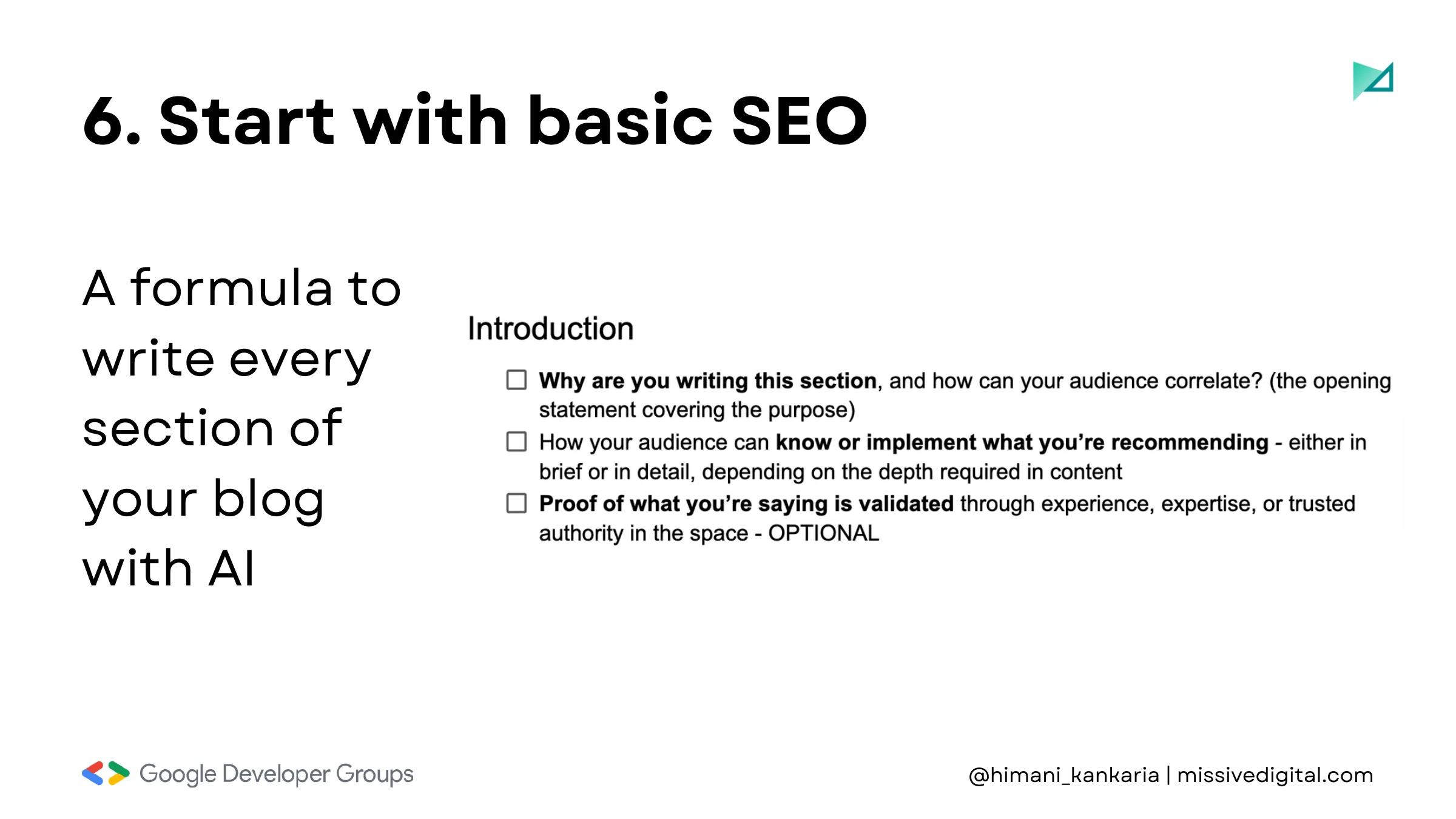
Then give the AI a structure, not just a topic. The one I teach founders and content teams asks three things of every section: why the reader should care, how they can act on it, and what proves it. I shared it at Google DevFest as a formula for writing every section of a blog with AI.
Structure is half the job. The other half is the humanizing pass, and it is a skill your team should be trained on, not left to taste. This is the pass I ask our writers to make on every AI-assisted telecom draft:
- Replace every generic claim with something specific: a number, a named customer type (“a 40-seat clinic moving off copper lines”), or a short story from the expert.
- Add one opinion the brand will stand behind, such as when you would not recommend your own product.
- Cut the AI tells: filler openers, words like “seamless” and “robust,” and lists of benefits with no proof attached.
- Read it aloud once. If it does not sound like your solutions engineer talking to a customer, rewrite it until it does.
- Run the competitor test. If a rival could publish the piece unchanged with their logo on it, it is not finished.
Our guide to humanizing AI content goes deeper on voice. For showing real experience in each part of a piece, from the introduction to the call to action, see how to add E-E-A-T to every part of a blog.
12. Put a Compliance Check Wherever AI Touches a Customer
Telecom is one of the most regulated categories to market in, and AI adds new ways to get it wrong: a voice agent calling without consent, a chatbot that never says it is a bot, or a generated ad that promises a speed nobody approved. The fix is not a policy document. It is a review step built into the workflow at every point where AI output reaches a customer, for example a “Compliance review” status that a task cannot skip in your project tool.
The checkpoints I would set up first:
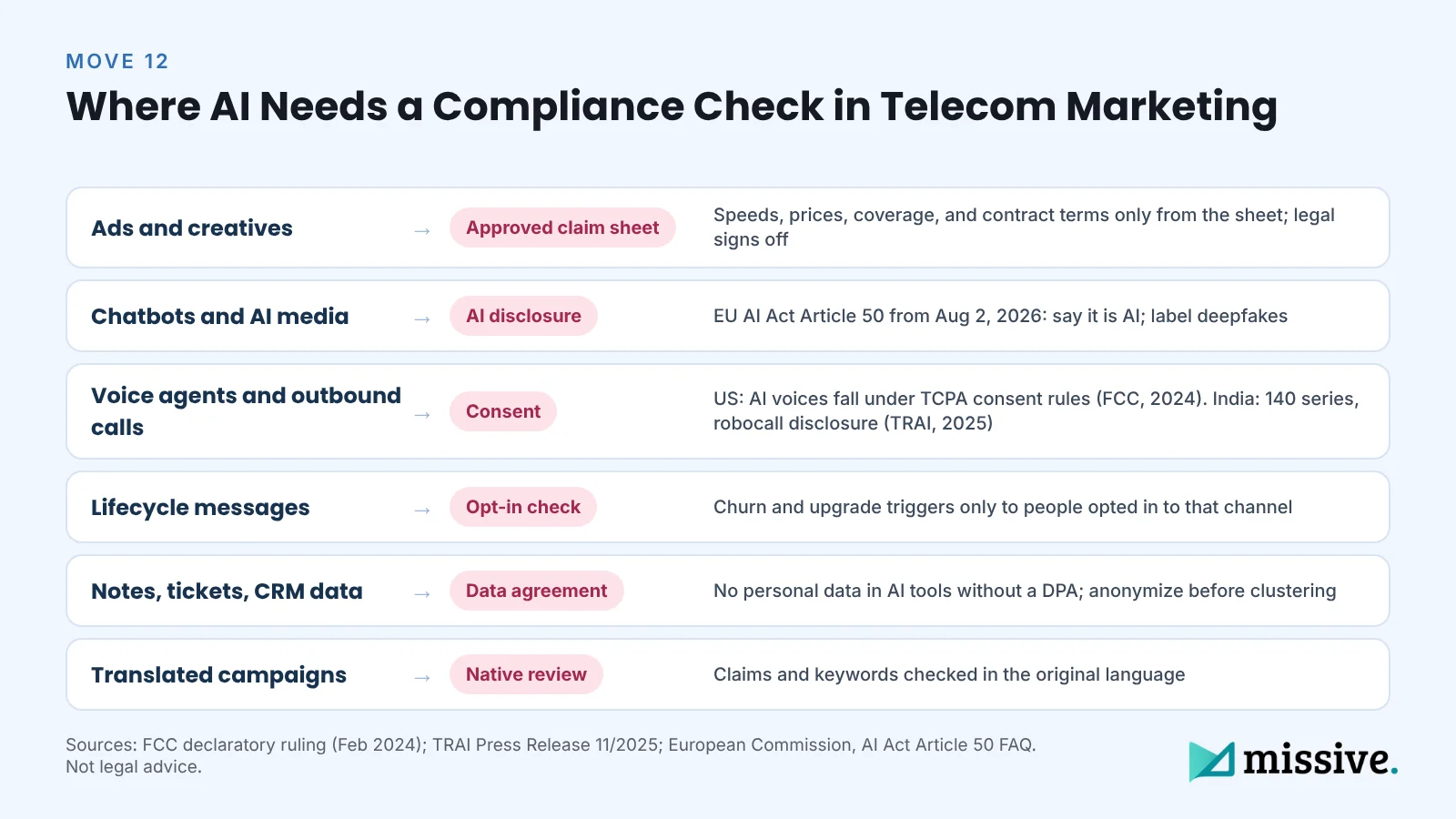
- AI voice and outbound calls. In the US, the FCC confirmed in February 2024 that AI-generated voices count as “artificial” under the Telephone Consumer Protection Act, so the same prior consent rules apply (Cooley’s summary of the FCC ruling). In India, TRAI’s February 2025 amendments keep promotional calls on the 140 series, stop telemarketing from regular 10-digit numbers, and require auto-dialers and robocalls to be disclosed (TRAI press release).
- Chatbots and AI-generated media in the EU. The AI Act’s transparency rules apply from August 2, 2026: people must be told when they are talking to an AI system, and deepfake content must be disclosed (European Commission FAQ on Article 50).
- Claims. Keep an approved claim sheet for speeds, prices, coverage, and contract terms. AI may only use numbers that appear on it, and legal signs off before anything ships.
- Data. No customer personal data goes into an AI tool without a data processing agreement. Remove personal details before clustering notes or tickets.
- Consent in lifecycle campaigns. AI-triggered churn and upgrade messages go only to people who opted in to that channel.
This is not legal advice; confirm the rules for each market with your counsel.
The same checks have to happen in every language you market in. We ran the Italian engagement from outside Italy. Both teams used AI translation to communicate day to day, but every keyword set, ad, and landing page was reviewed in the original Italian, because a claim can be accurate in English and misleading once translated. This is how I would split the work:
| Task | Let AI handle it | Keep a native speaker on it |
|---|---|---|
| Internal briefs, meeting notes, reports | Yes | Spot check only |
| First drafts of ads and landing pages | Yes | Edit before launch |
| Keyword research and search terms | Expand the list | Final selection |
| Offers, prices, and legal or regulatory claims | No | Always |
| Brand tagline and tone | Suggest options | Decide |
Our research on international SEO content strategy shows how the same topic needs different content in different markets, which applies just as much to paid and social campaigns.
13. Keep People on the Moments That Build Trust
Rory Sutherland, vice chairman of Ogilvy UK, coined the Doorman Fallacy in his book Alchemy. If you judge a hotel doorman only by the door he opens, you replace him with an automatic door and lose the security, recognition, and welcome he quietly provided. Sahil Bloom’s summary of the Doorman Fallacy is a good five-minute read before any automation project.
Telecom has plenty of doormen. A service switch feels risky to buyers, a point I made in our guide to generating leads for telecom and VoIP companies, because a failed migration means lost calls, lost customers, or a family without internet. That makes some moments too important to hand fully to a bot.
- Let AI handle the routine: plan lookups, coverage checks, installation slots, order status, and first-line FAQs.
- Hand off to a person, with the full conversation history, when a customer mentions canceling, an outage, a billing dispute, or a large business order.
- Tell people when they are talking to AI, and give them a clear way to reach a human.
- Write down your rules for customer data, consent, and which claims AI may never make on its own, such as speeds, prices, and contract terms.
14. Budget for People and Time, Not Just AI Licenses
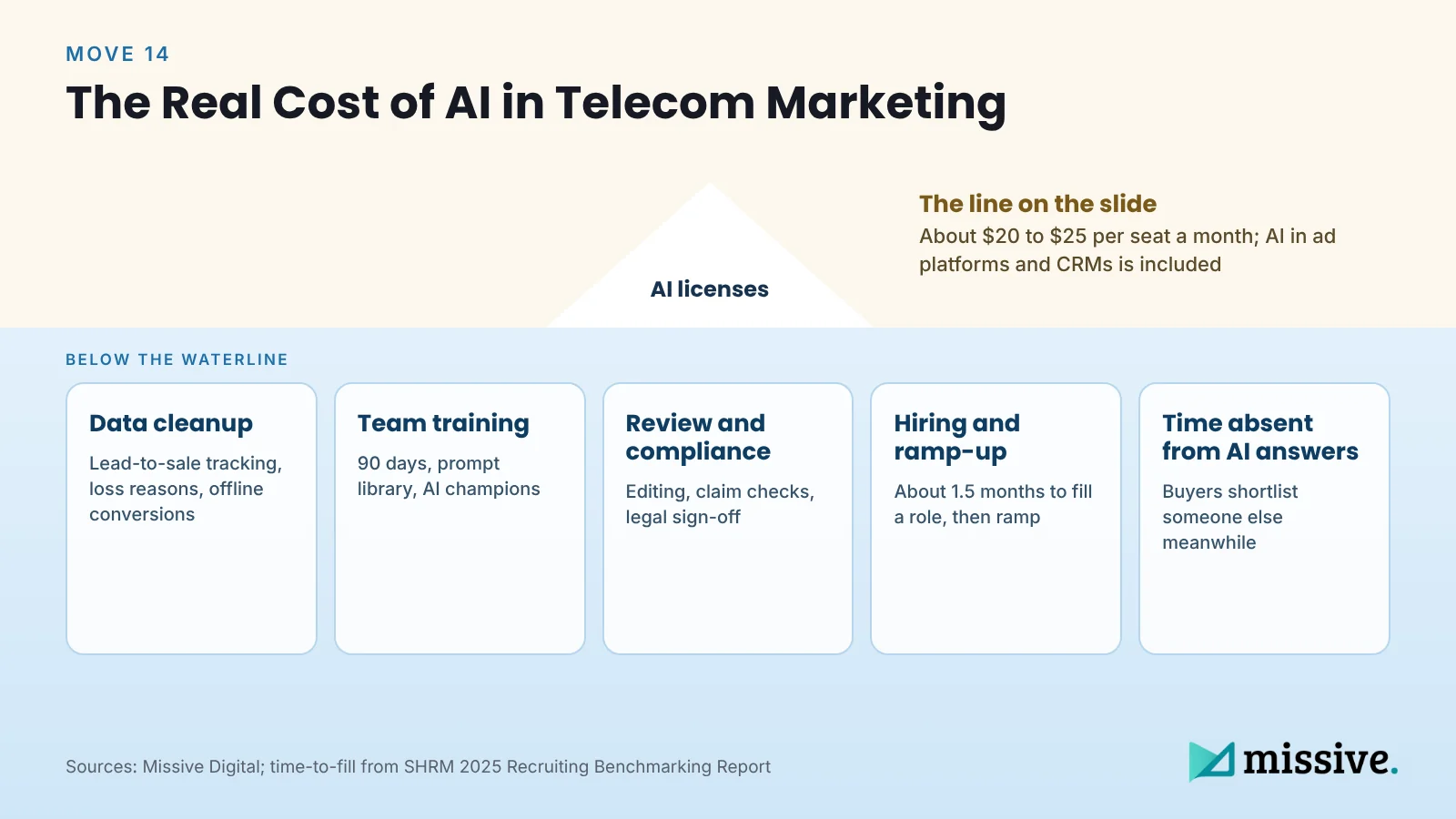
When a marketing head brings an AI plan to the CEO, the license line is usually the only cost on the slide. It is also the smallest. A ChatGPT Business seat lists at about $20 to $25 per user a month, and the AI inside Google Ads, Meta, and most CRMs costs nothing extra. The real costs sit under the waterline:
| Cost line | What it involves | Where it hides |
|---|---|---|
| Measurement and data cleanup (move 4) | Lead-to-sale tracking, loss reasons in the CRM, offline conversions back to ad platforms | Sales ops and CRM admin hours; often the longest step |
| Team training (move 10) | A 90-day plan, a prompt library, an AI champion per team | Hours away from campaigns while people learn |
| Review and compliance (moves 11 and 12) | Human editing, claim checks, legal sign-off on every AI-assisted asset | Review time does not disappear; it moves from writing to checking |
| New hires | A marketing operations or AI specialist role | About a month and a half to fill a role (SHRM 2025 recruiting benchmarks), plus ramp-up before results |
| Waiting | Months of setup before anything moves | Every month you are absent from AI answers, buyers shortlist someone else |
There are three ways to resource it, and none is right for everyone:
| Model | You pay for | Time to first result | Works best when |
|---|---|---|---|
| Build in-house | Salaries, hiring time, tools, training | Slowest: hire, ramp, then run | AI marketing is a long-term core capability and you can wait |
| Hand it to a specialist partner | A retainer or project fee | Fastest start | You need results this quarter and lack in-house skills |
| Hybrid | A partner for strategy, measurement, and training; your team runs execution | Fast start, and skills stay in-house | You have a capable team that needs direction |
The Italian engagement in this post was hybrid. We set strategy, measurement, and priorities from outside Italy, while the client’s in-house team executed everything locally. Their team now has a reusable targeting logic and a measurement framework it runs itself.
Before you sign off on any AI plan, ask your marketing head for six answers on one page: the one number it will move, the channel it starts in, the tools (and which ones you already pay for), who owns training, who owns review and compliance, and the date you will decide to scale it or stop.
Start With One Number, Not a New Tool
Your buyers are already asking AI assistants which telecom provider to choose. The question for you as a CEO or marketing head is not whether to use AI in marketing, but whether you will direct it or let it run on defaults. Implementing it well comes down to three decisions: which tasks AI takes on, what it learns from, and where your people stay in charge. Get those right and the tools you already pay for start working harder. Get them wrong and AI simply helps you buy the wrong leads faster.
If you take one step this month, make it this one: ask for the one-page answer from move 14, pick the number that matters most (cost per acquired customer, win rate, or sales-qualified leads), and point your first AI project at the task that moves it most.
Most of the moves above also lean on content: landing pages, comparison pages, checklists, and expert-led articles that both buyers and AI assistants trust. To check whether yours carry enough experience and proof, download our free E-E-A-T Content Validator Checklist.
And if you would like a second pair of eyes on your telecom funnel, see how our telecom and VoIP marketing team works, or book a 30-minute call with me.
FAQs
Start by mapping your team's recurring tasks for two weeks and labeling each one as AI-run, AI-assisted, or human-owned. Pick two or three tasks closest to revenue, tie each to one number such as cost per acquired customer, and review it after 90 days.
The ones that pay back fastest are training ad platforms on won customers instead of leads, finding buying moments like moving house or a contract renewal, analyzing sales calls and lost-lead reasons, testing landing page variants, and earning citations in AI assistants such as ChatGPT and Gemini.
Yes, when it optimizes for customers rather than leads. For one Italian telecom brand, changing what campaigns were measured on and where they pointed cut the cost per acquired customer by 95% in eight months on about a third less ad spend.
They need pages that answer buyer questions clearly, comparison and pricing context in text, a clean technical foundation, and mentions on review sites and industry publications. One VoIP brand we work with grew ChatGPT-driven traffic by 3,600% this way.
No. AI takes on repetitive work such as drafting variants, tagging call transcripts, and reporting. People still decide strategy, offers, regulatory claims, and the conversations that build trust, like cancellations, outages, and large business deals.
At minimum, every lead tied to its source and followed through to won or lost, with a loss reason. Without that, AI tools optimize for clicks and form fills instead of customers.
Usually fewer than they think. Start with the AI already inside Google Ads, Meta, and your CRM, pointed at won customers. Add a general AI assistant on a business plan for drafting and analysis, call tracking with transcription if you take inbound calls, and an AI visibility tracker if AI search is a channel for you.
It depends on the market. In the US, AI-generated voices fall under the TCPA's consent rules. In India, TRAI's 2025 amendments govern promotional calls, auto-dialers, and robocalls. In the EU, the AI Act requires telling people when they talk to an AI system and disclosing deepfakes from August 2026. Speed, price, and coverage claims need legal approval wherever you advertise.
The licenses are the small part: AI inside ad platforms and most CRMs is included, and a general AI assistant seat costs roughly $20 to $25 per user a month. The larger costs are people and time: cleaning up lead-to-sale tracking, training the team over about 90 days, reviewing AI output for accuracy and compliance, and hiring if you build in-house, which takes around a month and a half per role before ramp-up.