
Key Takeaways
- Competitor research is a validation layer, not the base. Competitors’ goals, personas, and page-level results can all differ from yours. A HubSpot Germany page with Domain Rating 83 gets about 100 organic visits a month.
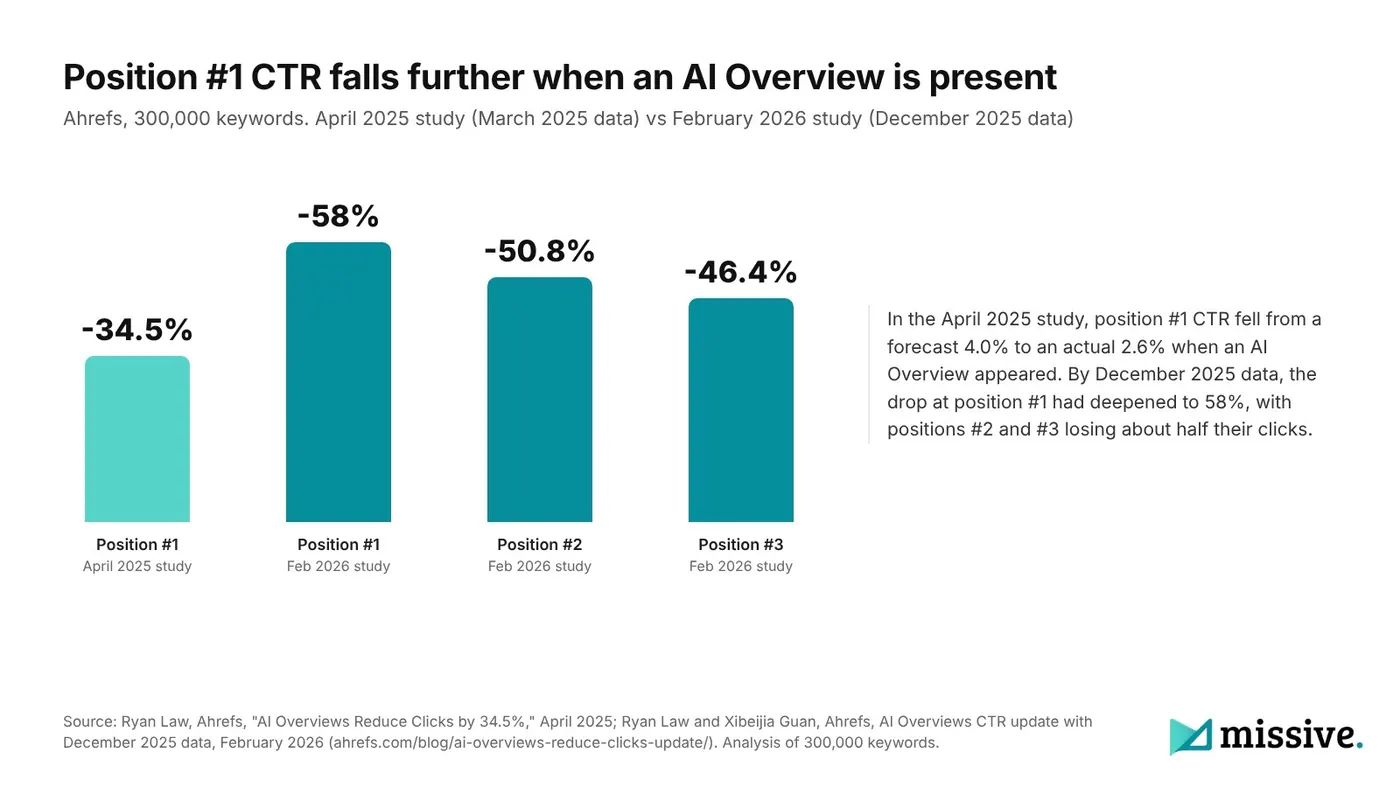
- Rankings and visibility have come loose from each other. In Ahrefs’ 2026 study, only 38% of pages cited in AI Overviews also rank in Google’s top 10 for that query, down from 76% in July 2025. Position #1 CTR falls 58% when an AI Overview is present.
- Three research routes find regional topics competitors miss: pages where competitors rank past position 50, the vocabulary on your prospective customers’ websites, and low-volume needs nobody else answers.
- The customer’s word beats the industry term. For a VoIP client, "voip app" had 15 times the search volume of "voip softphone" in South Africa, at keyword difficulty 1. Changing one headline put the page in positions 4 to 9.
- Low volume is not a veto. A blog on a 10-search-a-month topic earned 820 clicks and 38.3K impressions in 16 months.
- The same title needs a different blog for each audience and each region. A "What a reader should get after reading this" column in the content calendar locks that in before a writer starts.
- Every section should carry a reason, a method, and validation. That is what makes content read as Experience, Expertise, Authority, and Trustworthiness in a market where nobody knows your brand yet, and it is what AI answer engines cite.
- International SEO content strategists are not translating queries. They are translating context.
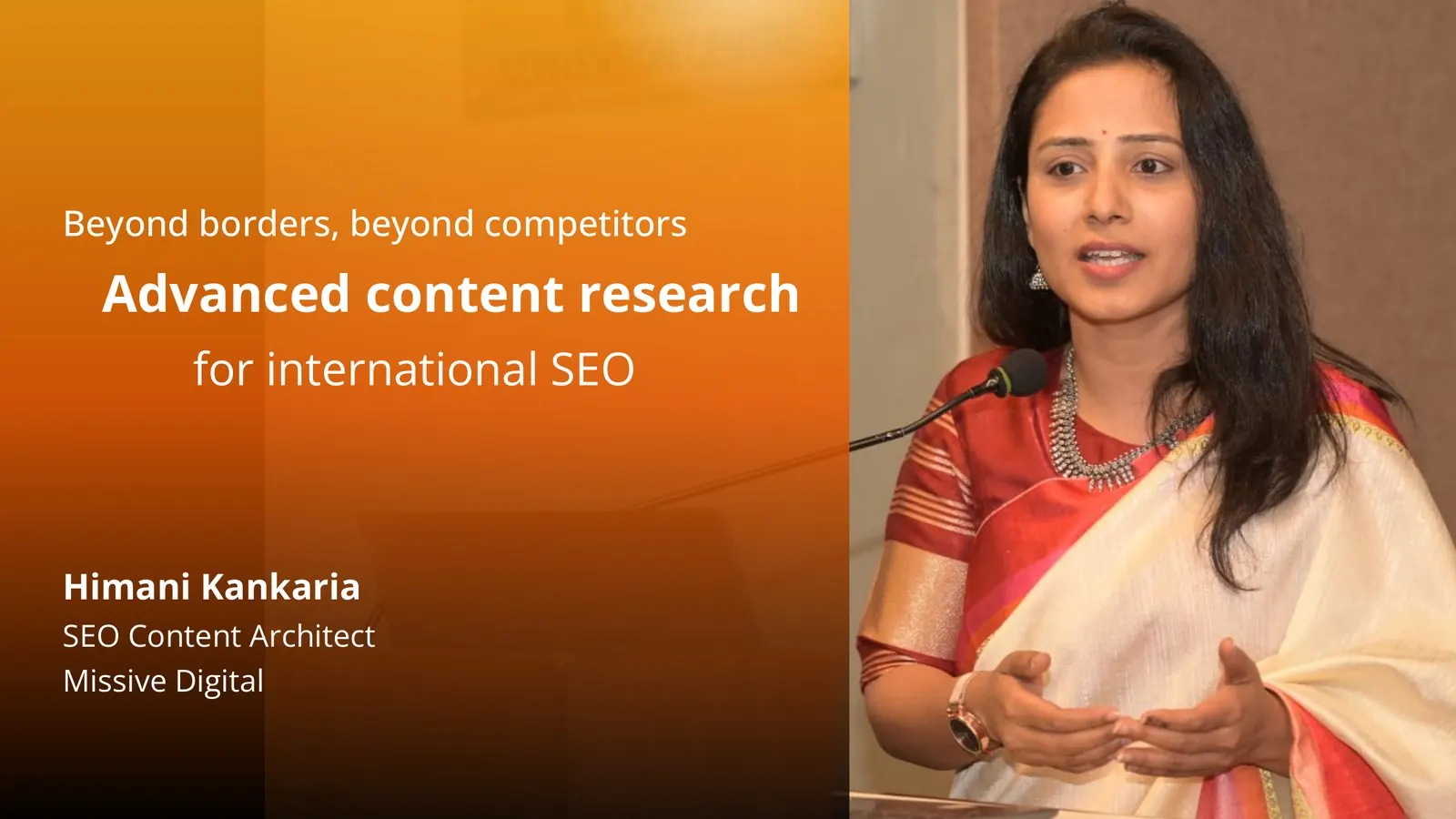
Speaking at the International Search Summit in Barcelona had been on my list for years. In November 2025, I finally stood on that stage, in a saree, in front of international SEOs from across Europe, talking about the one thing I have spent most of my career on: how to research content for people who do not speak your language, live in your market, or search the way you do.
This blog is that talk on international SEO content research, written down with the data, the screenshots, and the client examples I showed. The research in the deck ran up to November 2025, so where 2026 data has moved the picture, I have added it, including our own research on how LLMs recommend brands. If you work on international SEO projects and keep hearing "just see what competitors are doing," it is written for you.
Here is what it covers:
- Why the 2025 SERP changes make audience-first research more urgent, not less
- The four challenges that push international content teams toward copying competitors
- Three research routes that find regional topics beyond competitors, with step-by-step Ahrefs workflows
- How to keep one topic relevant across audiences and regions
- How to structure every section so a reader in a new market trusts it
Why "SEO Is Dead" Is the Wrong Lesson to Take From 2025
Quick answer: Google shipped ten ranking changes between August 2024 and June 2026 and redesigned the results page around AI Overviews and AI Mode, which now serves more than a billion people a month. Position #1 CTR drops 58% when an AI Overview appears, and only 38% of the pages those Overviews cite rank in the top 10. The data does not say SEO is dead. It says generic content is. Content built for a specific audience, need, and region still earns visibility, in Google and inside AI answers.
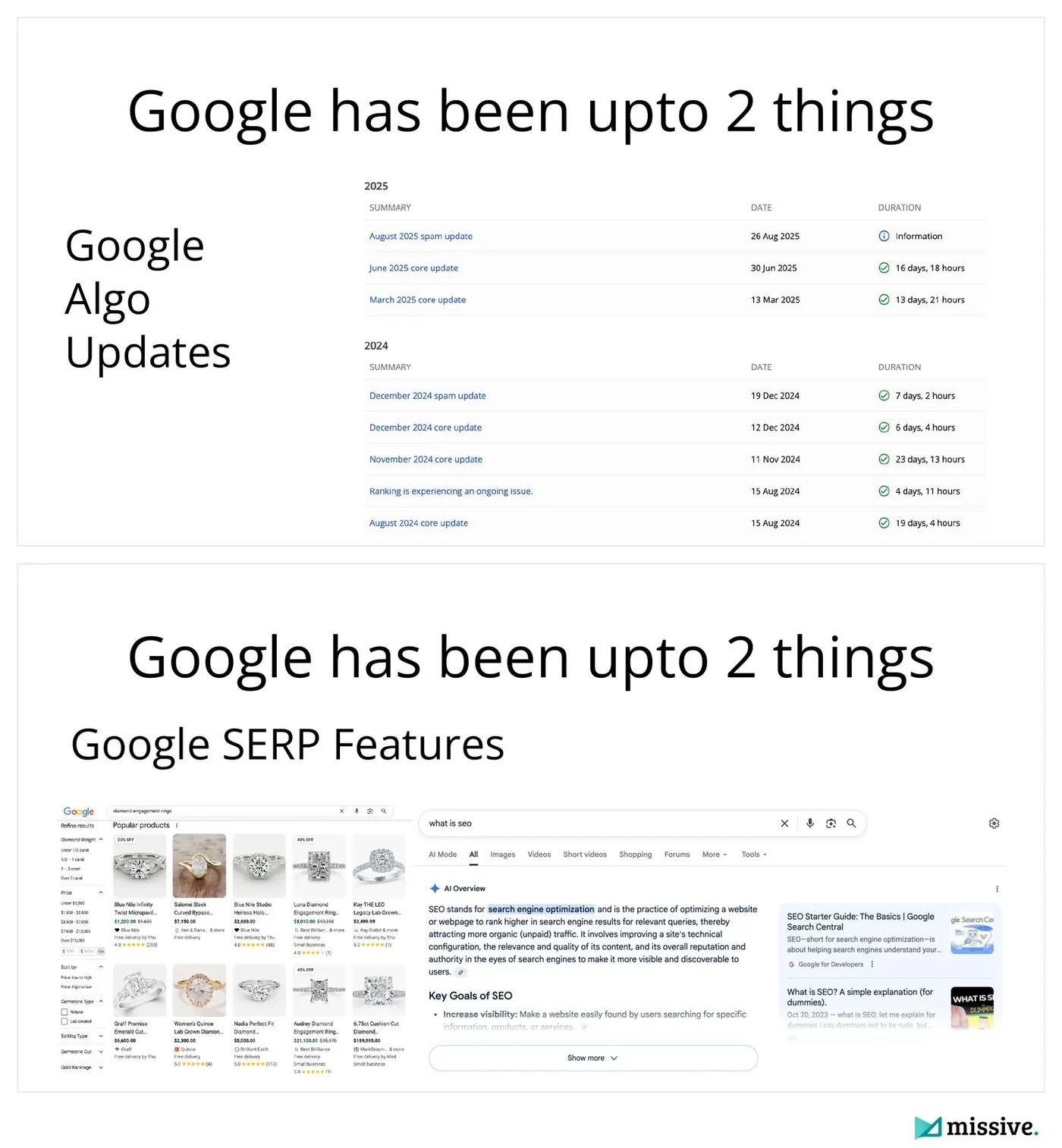
Google shipped ten ranking changes in under two years and then changed the SERP itself
For a content team planning two quarters ahead, the ranking landscape now moves roughly every two months, and 2026 has kept the pace. That alone makes "copy what ranks today" a short-lived plan.
| Date | Update | Rollout duration |
|---|---|---|
| 21 May 2026 | May 2026 core update | About 12 days (completed 2 June 2026) |
| 27 Mar 2026 | March 2026 core update | About 12 days (completed 8 April 2026) |
| 26 Aug 2025 | August 2025 spam update | Information only |
| 30 Jun 2025 | June 2025 core update | 16 days, 18 hours |
| 13 Mar 2025 | March 2025 core update | 13 days, 21 hours |
| 19 Dec 2024 | December 2024 spam update | 7 days, 2 hours |
| 12 Dec 2024 | December 2024 core update | 6 days, 4 hours |
| 11 Nov 2024 | November 2024 core update | 23 days, 13 hours |
| 15 Aug 2024 | Ranking incident | 4 days, 11 hours |
| 15 Aug 2024 | August 2024 core update | 19 days, 4 hours |
The page itself changed too. On March 5, 2025, Google announced it was expanding AI Overviews with a Gemini 2.0 upgrade and introducing AI Mode. By October 2025, AI Mode was live in more than 200 countries and territories. At Google I/O in May 2026, Google said AI Mode had passed one billion monthly users, and Head of Search Liz Reid said it reached "many, many countries, in many, many languages" within months because the models are multilingual by design. For international SEO, that is the detail that matters: the AI layer of search no longer arrives in English first and your market years later. What that looks like on two everyday queries:
- "diamond engagement rings" opens with a Popular Products grid: images, prices, retailer names, and filters for carat, price, and gemstone type, before any organic listing.
- "what is SEO" opens with an AI Overview that defines the term, lists key goals, and cites two sources, with the organic results pushed below a "Show more" fold.
The traffic curves say it faster than the update log does
Ahrefs’ own blog in Google Search Console looks like a crocodile: clicks fell from a steady 8K to 12K a day in 2024 to a 4K to 8K band by mid-2025, while impressions climbed. More people saw the results. Fewer clicked.
Ahrefs then measured the effect on 300,000 keywords, first in April 2025 and again with December 2025 data. The drop deepened:
| Measure | April 2025 study (March 2025 data) | February 2026 study (December 2025 data) |
|---|---|---|
| Position #1 CTR change when an AI Overview is present | -34.5% (4.0% forecast vs 2.6% actual) | -58% |
| Position #2 CTR change | Not reported | -50.8% |
| Position #3 CTR change | Not reported | -46.4% |
| Keywords analyzed | 300,000 | 300,000 (150,000 with AI Overviews, 150,000 informational without) |
| Authors | Ryan Law | Ryan Law and Xibeijia Guan |
Citations have come loose from rankings, and that is the opening
If the only story were fewer clicks, the right response would be defensive. The 2026 data tells a second story: the pages AI systems cite are less and less the pages that rank. For a brand entering a new market with no domain authority there, that is the opening.
| Study | What it measured | Finding |
|---|---|---|
| Ahrefs, July 2025 | Share of AI Overview citations that also rank in Google's top 10 | 76% |
| Ahrefs, 2026 (863,000 keywords, 4 million cited URLs) | Same question, eight months later, with a different detection method | 38% |
| Rankability, September 2026 | Top-10 AI citations across 31 topics | 55.2% did not rank in the traditional top 10; pages ranking 1 to 3 were still cited 98.9% of the time |
| Semrush, November 2025 (230,000 prompts, 100 million citations) | Most-cited domains across ChatGPT, Perplexity, and Google AI Mode | LinkedIn appeared in nearly 15% of AI Mode responses |
| Missive Digital, October 2026 | Which brands ChatGPT recommends for task-based prompts vs who ranks in Google | ChatGPT recommended Gumloop first for two tasks where it was absent from Google's page 1 |
Read together: ranking still helps, and a top-3 page is almost always cited. But a page can now be cited without ranking for the head term at all, as long as it answers a specific task for a specific person in their words. That is exactly the kind of content the three research routes below produce, and it is why we built the Citation Architecture Framework around claims, evidence, entity, answer, and authority rather than around keywords.
One caution when you test this for your own brand: SparkToro and Gumshoe’s January 2026 research found the same prompt returns the same list of brands less than 1 time in 100. Run each prompt three to five times and count how often a brand appears, not where it sits in one answer.
What management hears, and what to do with the same data
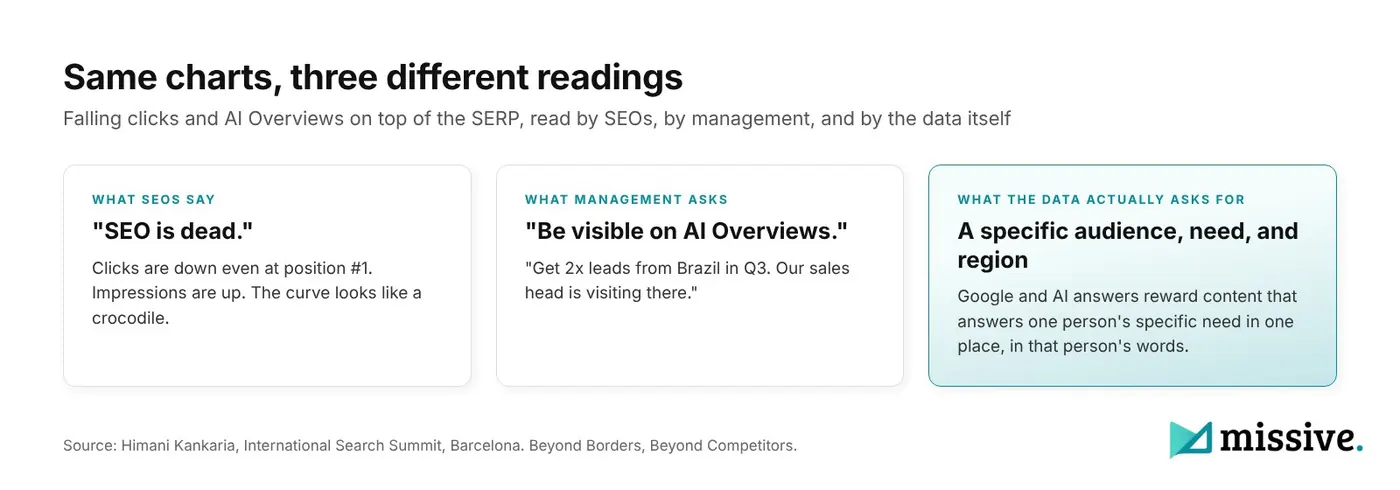
When SEOs see these charts, someone says "SEO is dead." When management sees them, the brief becomes "Be visible on AI Overviews" or, in one real brief we received, "Get 2x leads from Brazil in Q3. Our sales head is visiting there." Neither is a content strategy.
Here is how we at Missive Digital translate that pressure into a plan:
- Stop measuring content by rankings for generic head terms. Those are the queries AI Overviews answer in full.
- Research the specific person, need, and region behind the business goal. "Leads from Brazil" means Brazilian buyers with Brazilian vocabulary and Brazilian objections.
- Write content that answers that need with a reason, a method, and validation, so it is citable by an AI answer and useful to the human who clicks through.
The rest of this blog is that research process. The same thinking sits behind our AI SEO services.
The Four Challenges Content Strategists Face on International SEO Projects
Quick answer: International content research is hard for four structural reasons: no budget for local experts, a language gap between the seed keyword and real demand, the feeling that you must know everything about a region, and a default toward top-of-funnel definitions that do not convert. Each one has a workaround that does not require living in the market.
| Challenge | What it looks like on a project | What to do instead |
|---|---|---|
| No budget or buy-in for local subject matter experts | One strategist in one office owns Japan, Germany, China, and Brazil | Let local search data and local customer websites act as your subject matter expert |
| The language gap | Keyword research done on the English term, then translated | Research the local-language term first, then read its related terms and questions |
| "We need to know everything about the region" | A dozen Google Translate tabs open and no confidence in any of them | Research what the market already searches for and what prospects already publish |
| Regional content defaults to top of funnel | A library of "What is X" posts that bring learners, not buyers | Map every topic to a persona, a need, and a funnel stage before it enters the calendar |
We rarely have the budget to hire local experts, so the research has to replace them
Large international brands can afford a native content lead in every market. Most mid-size companies cannot, and the strategist in one office ends up responsible for all of them. That is a structural constraint, not a skills gap, so the process has to be designed around it.
What replaces the local expert in practice:
- Country-filtered keyword data in Ahrefs or Semrush, read in the local language
- The websites of the customers you want to win in that market (their vocabulary, their objections, their requirements pages)
- The low-volume queries your own regional pages already rank for
- A native-speaking reviewer for the final draft, which costs a fraction of a full-time regional lead
The language gap: why translating the seed keyword is the minimum, not the method
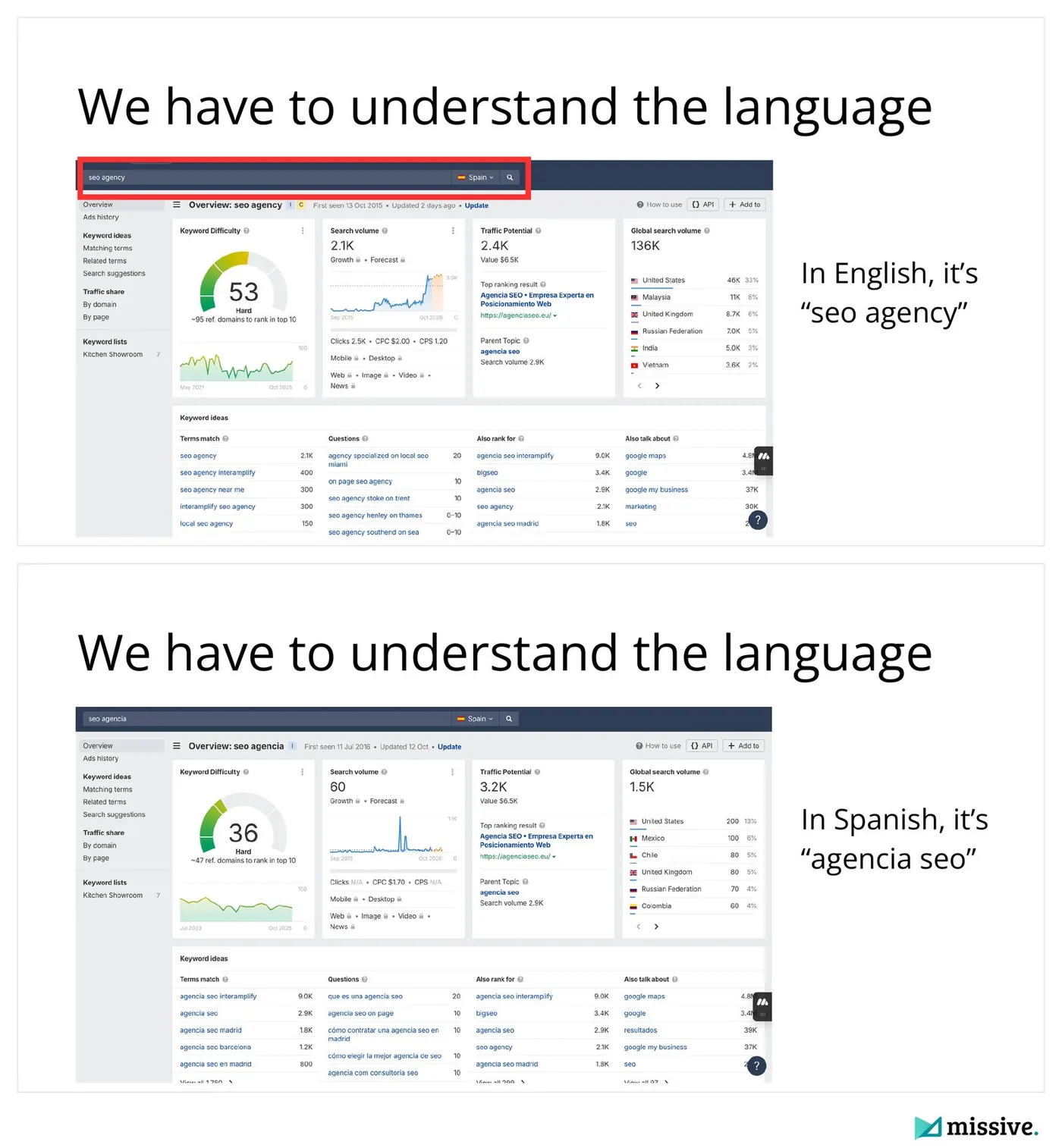
The same intent in the same country can look like two different markets depending on which language you type into the tool. Here is "SEO agency" in Spain, in English and in Spanish:
| Metric (Ahrefs, Spain) | "seo agency" (English) | "agencia seo" (Spanish) |
|---|---|---|
| Monthly search volume | 2,100 | 60 for the exact phrase |
| Traffic potential | 2,400 | 3,200 |
| Keyword difficulty | 53 (about 95 referring domains to rank) | 36 (about 47 referring domains to rank) |
| Top question ideas | "agency specialized on local seo miami," "seo agency stoke on trent" | "que es una agencia seo," "como contratar una agencia seo en madrid," "como elegir la mejor agencia de seo" |
| Top matching terms | seo agency near me, local seo agency | agencia seo madrid, agencia seo barcelona, agencia seo en madrid |
The English term returns UK and US city questions. The Spanish term returns Madrid, Barcelona, and buyer questions about how to choose and hire. Same country, same intent, different opportunity.
How to run this on any market:
- Translate the seed keyword with a native speaker or a reliable translation tool, and confirm it is the term people use, not the dictionary term.
- Search the local term with the country filter set in Ahrefs Keywords Explorer or Semrush Keyword Magic Tool.
- Read the Questions, Also rank for, and Also talk about panels in the local language. That is where the real topic list lives.
- Translate those back only to understand them, never to target them in English.
"We need to know everything about the region" is the feeling. The market's own data is the fix.
Japan, Germany, China, Brazil. Each has its own buying culture, regulatory context, seasonal calendar, and preferred formats. Nobody on a lean team knows all of it, and pretending otherwise produces generic content with a flag on it.
The three research routes later in this blog are designed so you do not need encyclopedic regional knowledge. They work from three things you can observe from anywhere:
- What competitors in that market rank for badly
- What your prospective customers in that market publish on their own sites
- What your audience in that market already searches for, at any volume
Most regional content ends up top of funnel, and it does not convert
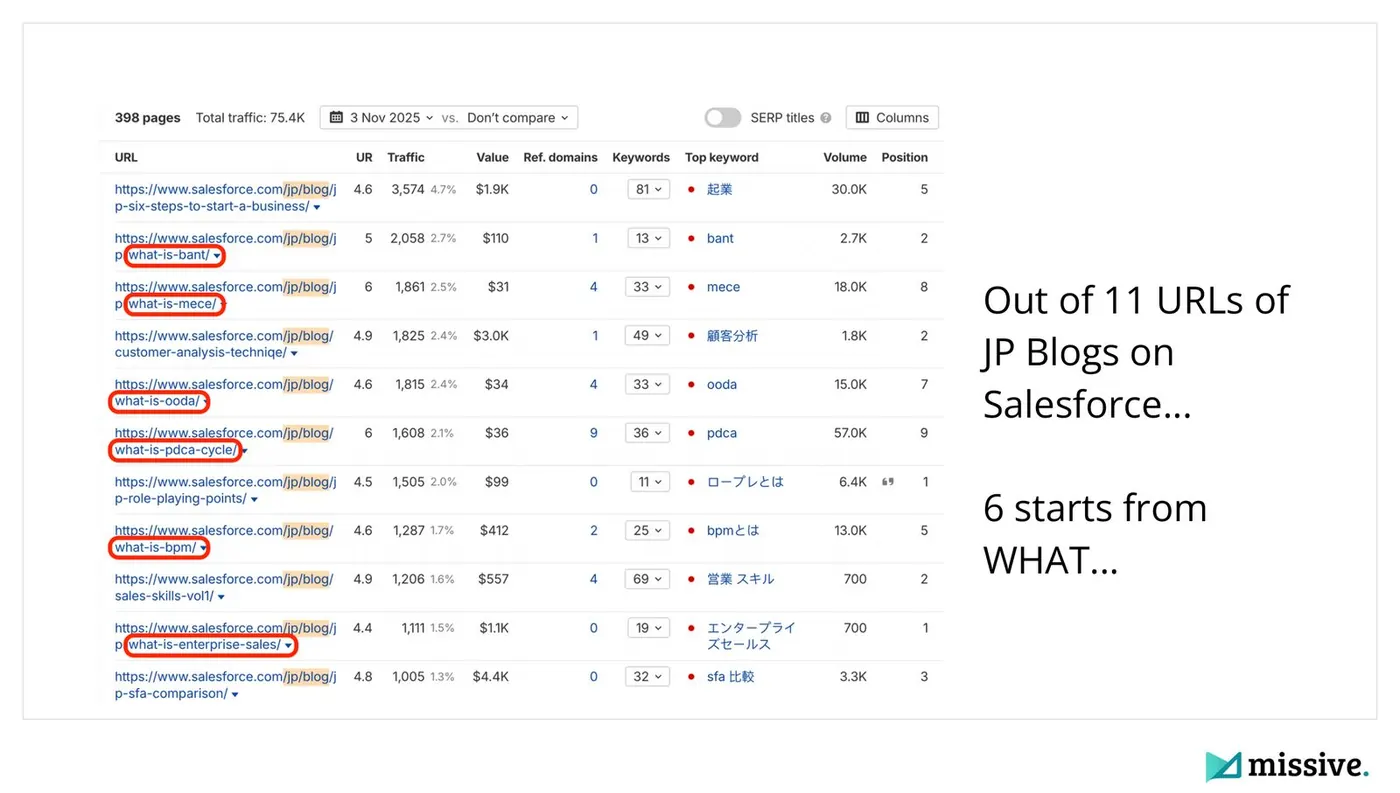
Because teams default to translating definitions, regional blogs become "What is X" libraries. Salesforce’s Japanese blog is a useful example of how even a strong brand drifts this way:
| Salesforce JP blog, top 11 URLs by traffic | Count |
|---|---|
| URLs that start with "what-is" (bant, mece, ooda, pdca-cycle, bpm, enterprise-sales) | 6 |
| Other URLs (six steps to start a business, customer analysis, role-playing, sales skills, SFA comparison) | 5 |
| Total traffic across 398 blog pages (Ahrefs estimate) | 75.4K per month |
Source: Ahrefs Site Explorer, salesforce.com/jp/blog/, data as of November 3, 2025
Those six pages bring readers who are learning vocabulary, not evaluating a CRM. For a company that needs leads from a market in a quarter, a library of definitions is the wrong first investment. The fix is a column in the content calendar that records the persona, the intent, and what the reader should walk away with. Goal 2 below covers it.
The common thread across all four challenges is pressure: faster visibility, at scale, across markets we do not live in. That pressure is exactly what makes competitor research so tempting.
Why Copying Competitors Is the Easiest Bet and the Weakest Strategy
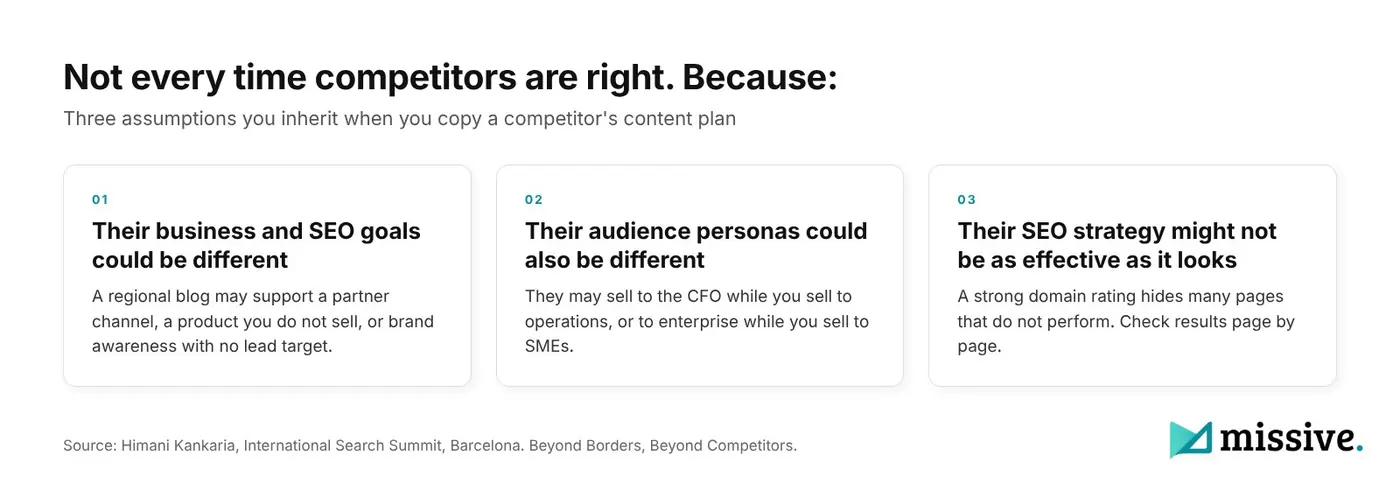
Quick answer: Competitor content plans carry three hidden assumptions: the same business goals, the same audience personas, and effective SEO. Any one of them can be wrong for you. Use competitor data to find what they cover badly, not as the base of your calendar.
The easiest bet when you need visibility fast in a new market is to open a competitor’s regional blog in Ahrefs or Semrush, export their top pages, and write better versions. I have done it. Most teams have. Here is what you inherit when you do, and how to check each assumption before it costs you a quarter.
| Hidden assumption | Why it can be wrong for you | How to check it in 10 minutes |
|---|---|---|
| Their business and SEO goals match yours | Their regional blog may support a partner channel, a product you do not sell, or brand awareness with no lead target | Read their regional CTAs and lead magnets. If the blog sells something you do not, their topic map is not yours |
| Their audience personas match yours | They may sell to the CFO while you sell to operations, or to enterprise while you sell to SMEs | Read five of their top regional posts. Note who the examples, screenshots, and objections are written for |
| Their SEO is as effective as it looks | A strong domain rating hides many pages that do not perform | In Ahrefs Site Explorer, check Top Pages at page level. Sort by traffic and look at how many pages sit under 100 visits |
A Domain Rating of 83 does not mean the page is working
Later in this blog I walk through a HubSpot Germany page with a Domain Rating of 83 that ranks for 23 keywords and earns roughly 100 organic visits a month. From the outside, HubSpot’s regional blog looks like a model to copy. Page by page, a lot of it is not performing. Copy the plan without checking page-level results and you copy the misses along with the hits.
The tools stay. Their job changes.
We still use these on every international project:
- Semrush and Ahrefs for sizing and difficulty in the local language and country
- Google News and Google Trends for timing, seasonality, and regional spikes
- People Also Ask and AlsoAsked for the question tree around a topic
- ChatGPT, Gemini, Perplexity, and Claude for first-pass regional context and to see what AI answers already cite
What changes is their role. They validate and size the opportunities we find through the three routes below. They are not where the topic list comes from. That distinction is the core of our content consulting engagements.
Goal 1: How to Find New Regional Content Topics Beyond Competitors
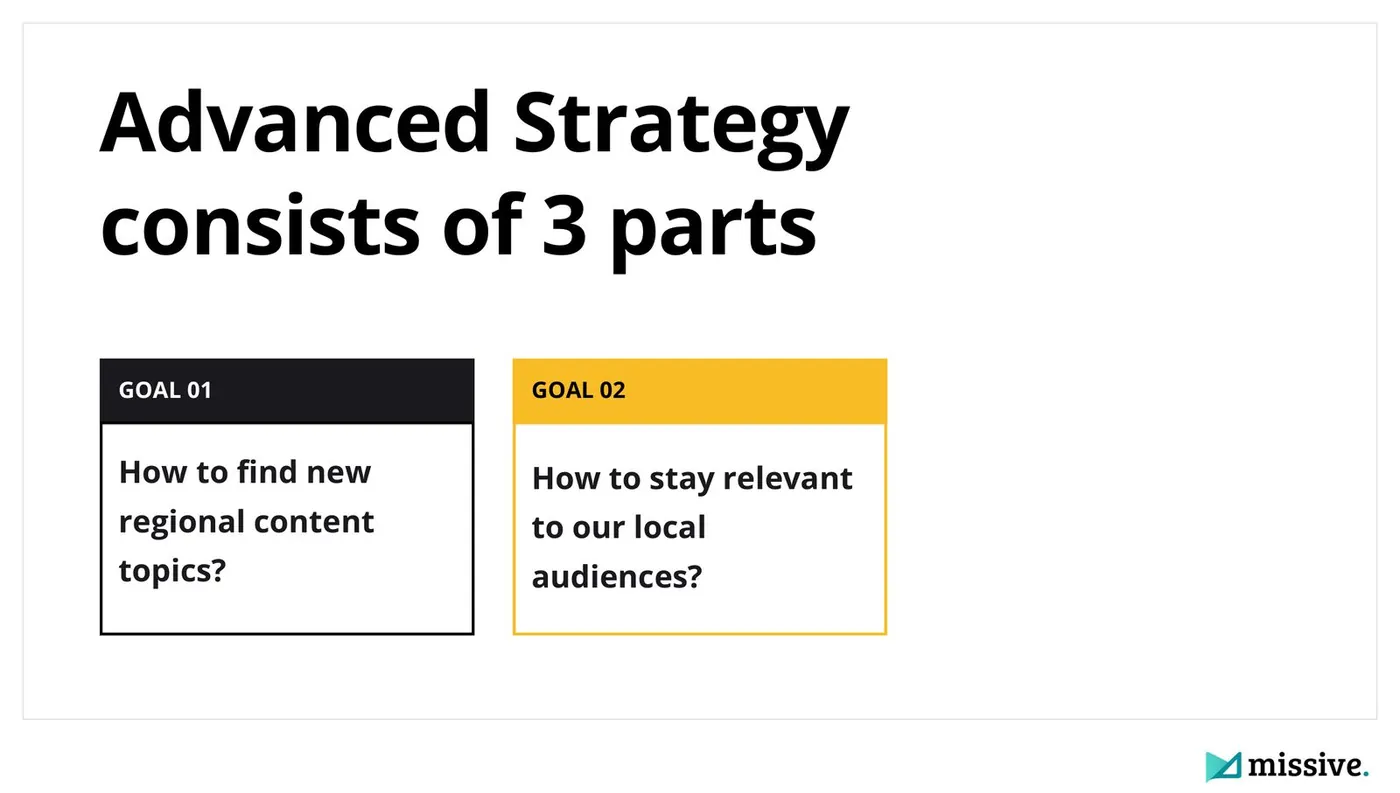
Quick answer: Three research routes surface regional topics competitors miss. Route 1 mines the queries competitors rank for past position 50. Route 2 borrows the vocabulary from your prospective customers’ own websites. Route 3 writes for needs nobody is answering, regardless of search volume. Together they form the first of the three goals of an advanced international content strategy: find new regional topics, stay relevant to local audiences, and show authority in the content.
Route 1: Research content that competitors are NOT writing
The most useful competitor data is the queries they rank for badly. A page that sits on page five or later for a query usually mentions the topic without covering it. The competitor has already validated demand for you and then failed to meet it. That is a gap you can fill with a page that actually answers the question.
The workflow, as we ran it on HubSpot’s German blog:
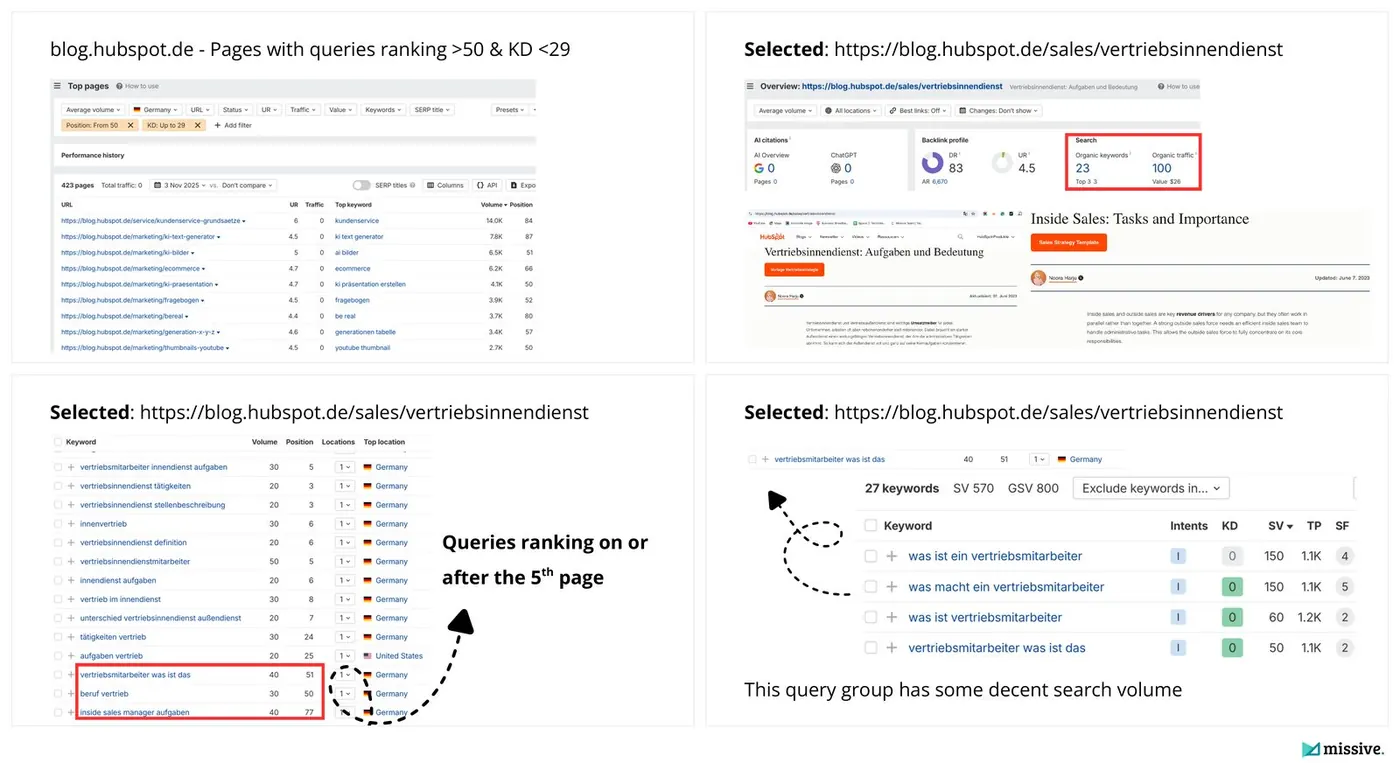
- In Ahrefs Site Explorer, open Top Pages for blog.hubspot.de with the country set to Germany.
- Add two filters: Position from 50 and Keyword Difficulty up to 29. Result: 423 pages where HubSpot ranks past page five for easy queries.
- Pick a page with a real topic. We selected blog.hubspot.de/sales/vertriebsinnendienst ("Inside Sales: Tasks and Importance").
- Open its organic keywords and sort by position. Pull the queries ranking on or after page five.
- Translate those queries to understand the intent, never to target them in English.
- Size the strongest one as a cluster in Keywords Explorer, country set to Germany.
- Confirm the gap with a site: search in quotes. No results means no page.
- Validate against your own offerings and persona before it enters the calendar.
What the data looked like at each step:
| Step | Data point | Value |
|---|---|---|
| Page authority | Domain Rating / URL Rating | 83 / 4.5 |
| Page performance | Organic keywords / monthly organic traffic | 23 / about 100 |
| Queries past page five | "vertriebsmitarbeiter was ist das" | Volume 40, position 51 |
| "beruf vertrieb" | Volume 30, position 50 | |
| "inside sales manager aufgaben" | Volume 40, position 77 | |
| Translated intent | What is a sales representative? / Sales profession / Inside sales manager tasks | Three distinct topics the page does not answer |
| Cluster size | "vertriebsmitarbeiter was ist das" cluster | 27 keywords, 570 monthly searches (800 global), keyword difficulty 0 |
| Gap check | site:blog.hubspot.de "vertriebsmitarbeiter was ist das" | No results found |
Source: Ahrefs Site Explorer and Keywords Explorer, data as of November 3, 2025; Google Search
Validation checklist before you write it:
- Does the topic align with a product or service you sell in that market?
- Does it match a persona you actually want (here: German sales leaders hiring or building inside-sales teams)?
- Is there a cluster around it, not just one query?
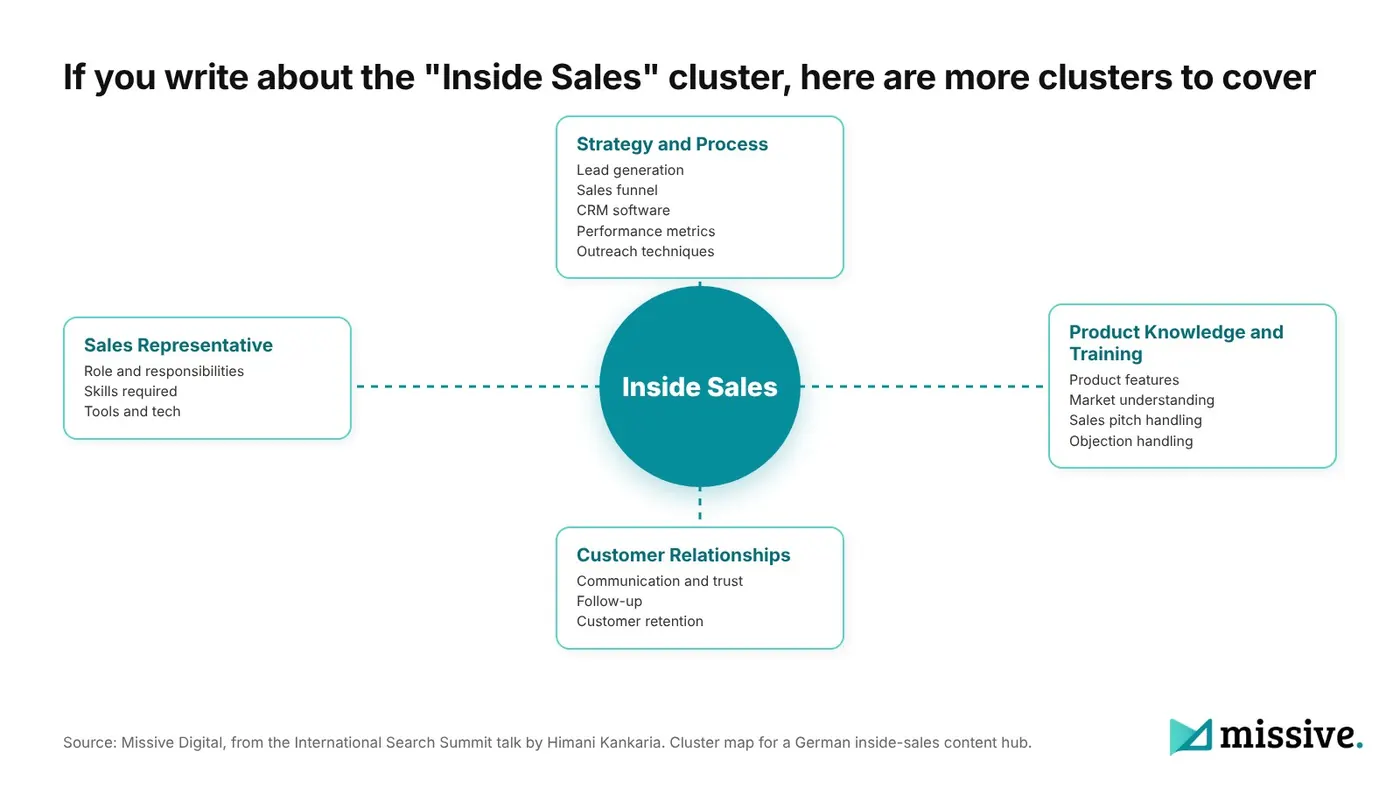
- Can you cover the neighboring clusters over time (role and responsibilities, skills required, CRM software, lead generation, objection handling, customer retention)?
If the answer to the first two is no, skip it. The method only works when the validation is honest.
One gap rarely stays one blog. Once the inside-sales cluster is validated, the neighboring clusters become the next quarter’s calendar, and each one can be checked the same way: does the competitor rank for it past page five, and do you have an offering behind it?
Route 2: Research content that your aspirational customers are writing
The choice of words differs from person to person, need to need, and region to region. Your customers in a new market may describe your product with a word you have never used, and keyword tools will show you zero demand for your word while demand for theirs sits untouched. The fastest way to find their word is to read the websites of the companies you want to sell to.
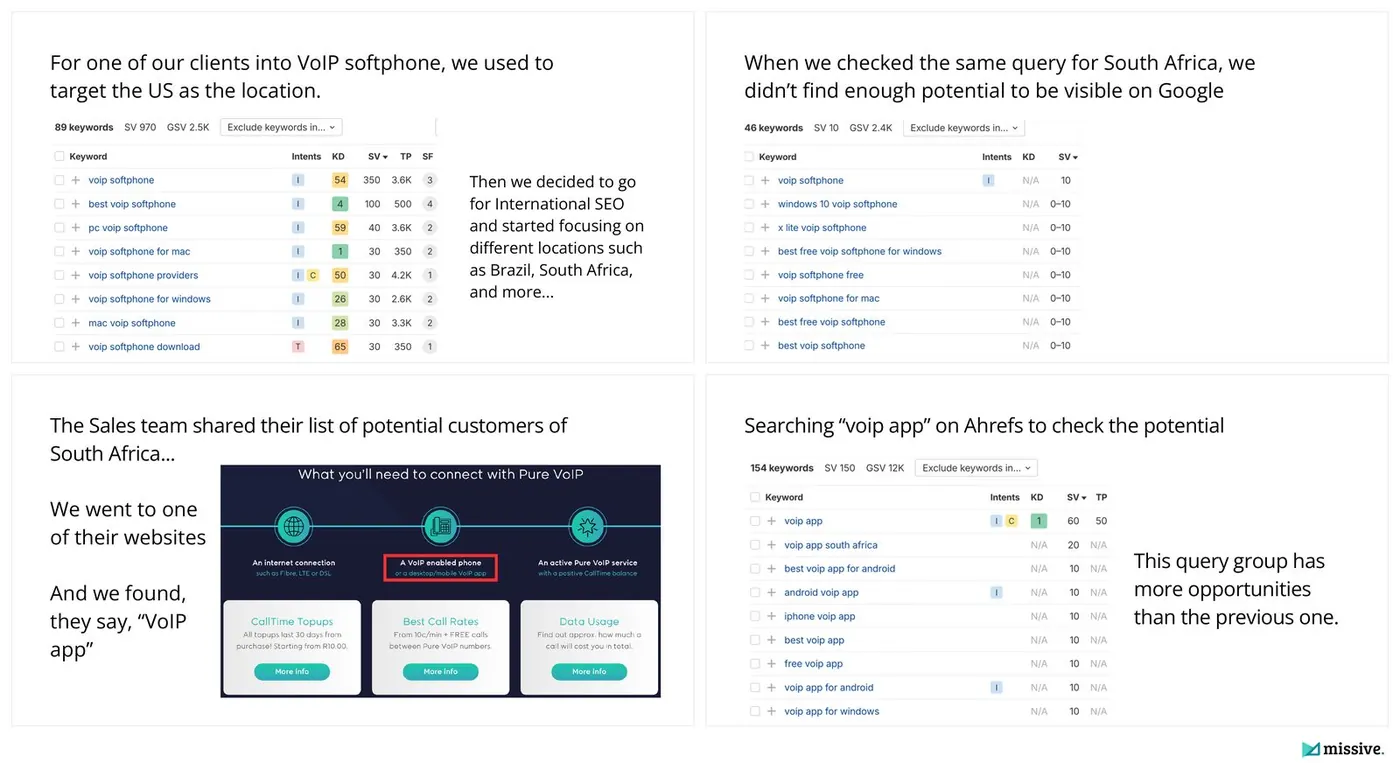
How we found it for Tragofone, a VoIP softphone client:
- We had always targeted the US with "voip softphone." When the business went international, we checked the same term for South Africa and found almost nothing.
- The sales team shared their list of prospective South African customers.
- We opened one prospect’s website, Pure VoIP, and read its requirements section: "A VoIP enabled phone or a desktop/mobile VoIP app." Nobody in that market said softphone. They said VoIP app.
- We searched "voip app" for South Africa in Ahrefs and found 15 times the volume at a fraction of the difficulty.
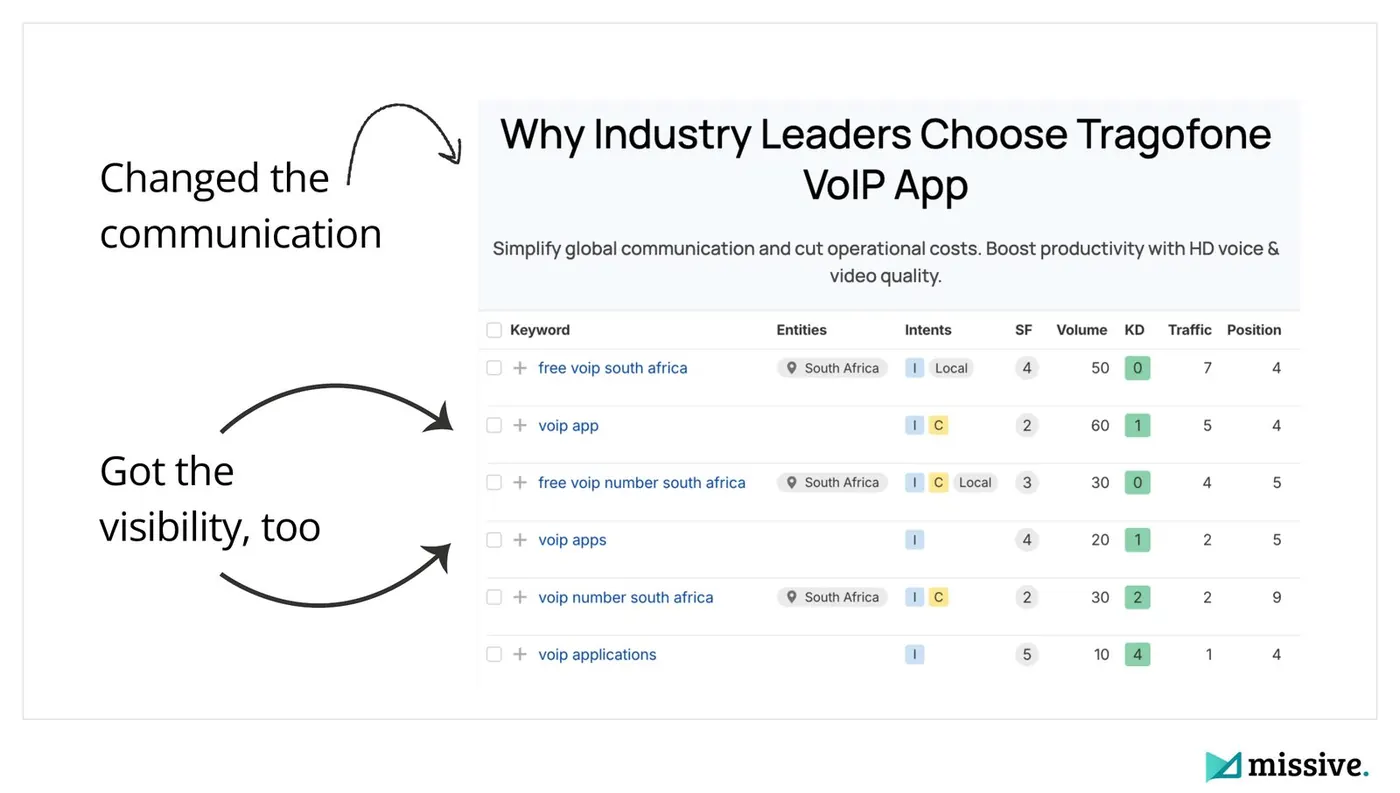
- We changed the page headline to "Why Industry Leaders Choose Tragofone VoIP App" and adjusted the copy to match.
The numbers before and after the word change:
| Query and market (Ahrefs) | Keywords in cluster | Monthly volume | Global volume | Keyword difficulty |
|---|---|---|---|---|
| "voip softphone" in the US (original target) | 89 | 970 | 2,500 | 54 |
| "voip softphone" in South Africa | 46 | 10 | 2,400 | N/A |
| "voip app" in South Africa (the customer's word) | 154 | 150 | 12,000 | 1 |
Rankings after the headline change:
| Keyword | Volume | Position |
|---|---|---|
| voip app | 60 | 4 |
| free voip south africa | 50 | 4 |
| free voip number south africa | 30 | 5 |
| voip apps | 20 | 5 |
| voip number south africa | 30 | 9 |
| voip applications | 10 | 4 |
Source: Ahrefs Keywords Explorer and Site Explorer; purevoip.co.za
We did not find a new keyword. We found the customer’s word for the thing we already sold. More on how we approach this for telecom brands on our telecom industry page.
Where to look for your customers’ vocabulary in any market:
- Requirements, FAQ, and support pages on prospect websites
- Job descriptions prospects post for the role that would use your product
- Local review sites, forums, and LinkedIn posts from people in the buyer role
- Sales call notes and CRM fields, which usually record the customer’s words verbatim
The change itself was small: one headline, one supporting paragraph, and the product name followed by the market’s word instead of ours. The rankings that followed came from matching the vocabulary, not from new links or new pages.
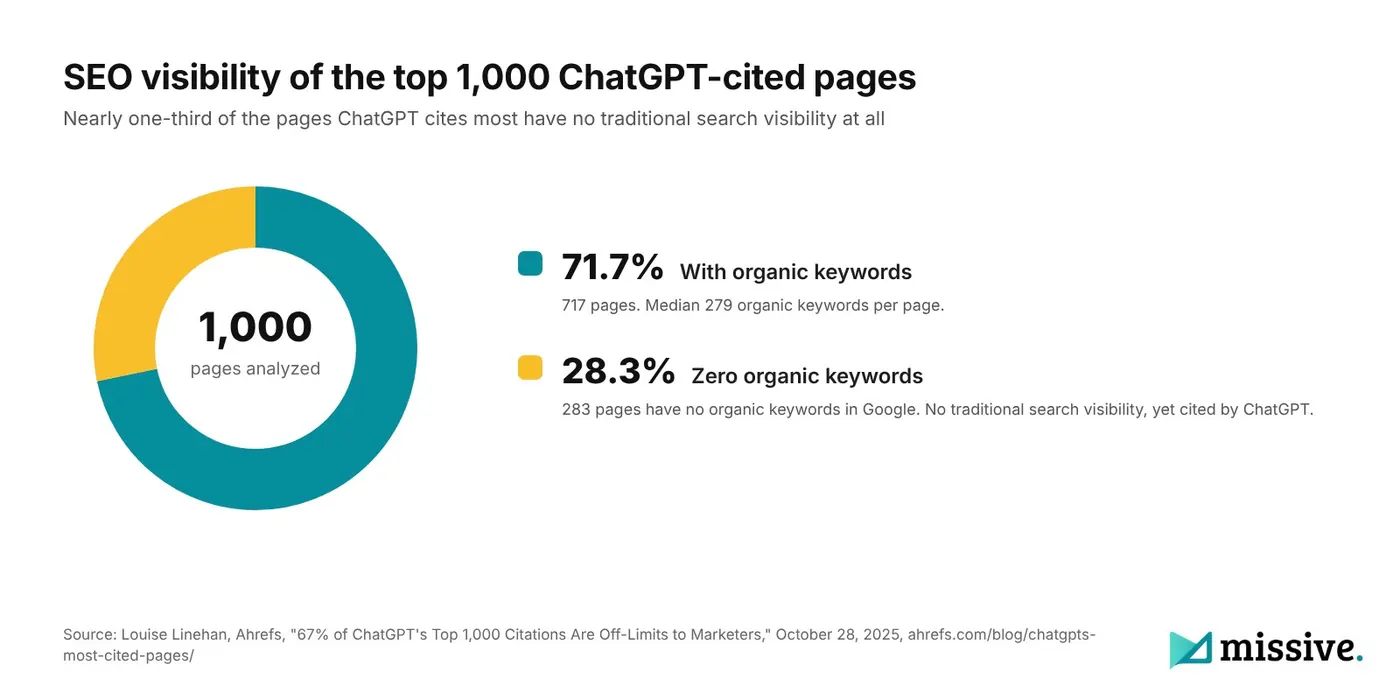
There is a bigger reason this route matters now. Ahrefs analyzed the 1,000 pages ChatGPT cites most and found that 28.3% of them, 283 pages, have zero organic keywords in Google. The 2026 data points the same way: only 38% of AI Overview citations now come from pages in Google’s top 10, and in our own October 2026 test, ChatGPT recommended Gumloop first for two task-based prompts where Gumloop was nowhere on Google’s first page. In each case the cited page was written for a specific audience’s specific task, in that audience’s own words. Writing in your customer’s vocabulary is now a route into AI answers as well as into Google.
Route 3: Research content that nobody is writing but your audience needs
This route is the hardest to sell internally because the search volume is usually tiny or missing. It is also where the most durable content lives, because nobody else is competing for it and the reader who finds it remembers who answered. Two examples, one from a pet food brand and one from our own blog, show how to find these topics and what they return.
Example 1: Edgard Cooper’s Dutch blog
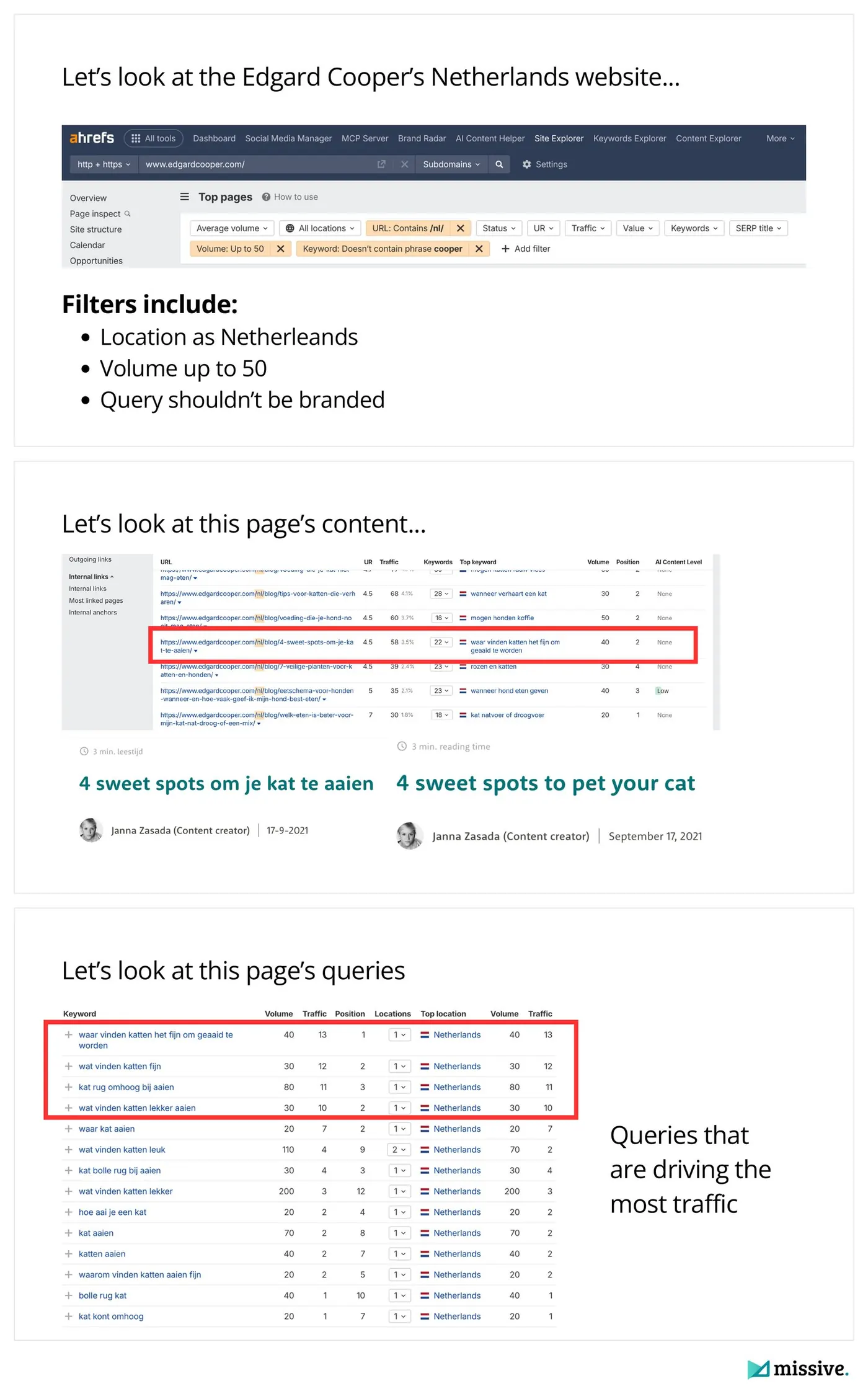
How we found the pattern in Ahrefs Site Explorer on edgardcooper.com:
- Open Top Pages with location set to the Netherlands.
- Filter URL contains /nl/ to isolate the Dutch section.
- Filter Volume up to 50 to surface only low-volume topics.
- Filter Keyword does not contain "cooper" to remove branded queries.
- Read the top keyword for each page and translate it to understand the need.
What came back for one page, "4 sweet spots om je kat te aaien" (4 sweet spots to pet your cat), published September 2021:
| Dutch query | English meaning | Volume | Position | Traffic |
|---|---|---|---|---|
| waar vinden katten het fijn om geaaid te worden | Where do cats like to be petted? | 40 | 1 | 13 |
| wat vinden katten fijn | What do cats like? | 30 | 2 | 12 |
| kat rug omhoog bij aaien | Cat's back raised when being petted | 80 | 3 | 11 |
| wat vinden katten lekker aaien | What do cats like to be petted? | 30 | 2 | 10 |
And the wider shelf of 10-search-a-month pages the same blog ranks for:
| Dutch top keyword | English meaning | Volume | Position |
|---|---|---|---|
| wat als je hond je likt | What if your dog licks you | 10 | 1 |
| de grootste hondenrassen | The largest dog breeds | 10 | 1 |
| wanneer kat in de rui | When do cats shed | 10 | 2 |
| welke hond geschikt voor gezin | Which dog suits a family | 10 | 2 |
| slimste hondenras ter wereld | Smartest dog breed in the world | 10 | 1 |
| graslelie giftig kat | Is grass lily toxic to cats | 10 | 1 |
| nat of droogvoer kat | Wet or dry food for cats | 10 | 2 |
Source: Ahrefs Site Explorer, edgardcooper.com/nl/, data as of November 2025
No pet food competitor is writing about where cats like to be petted. Cat owners are searching for it. Individually, each page is small. Together, they make Edgard Cooper the brand that answered the questions a new pet owner actually had, long before that owner compared food brands.
Example 2: a blog we wrote because our audience needed it, not because a tool said so
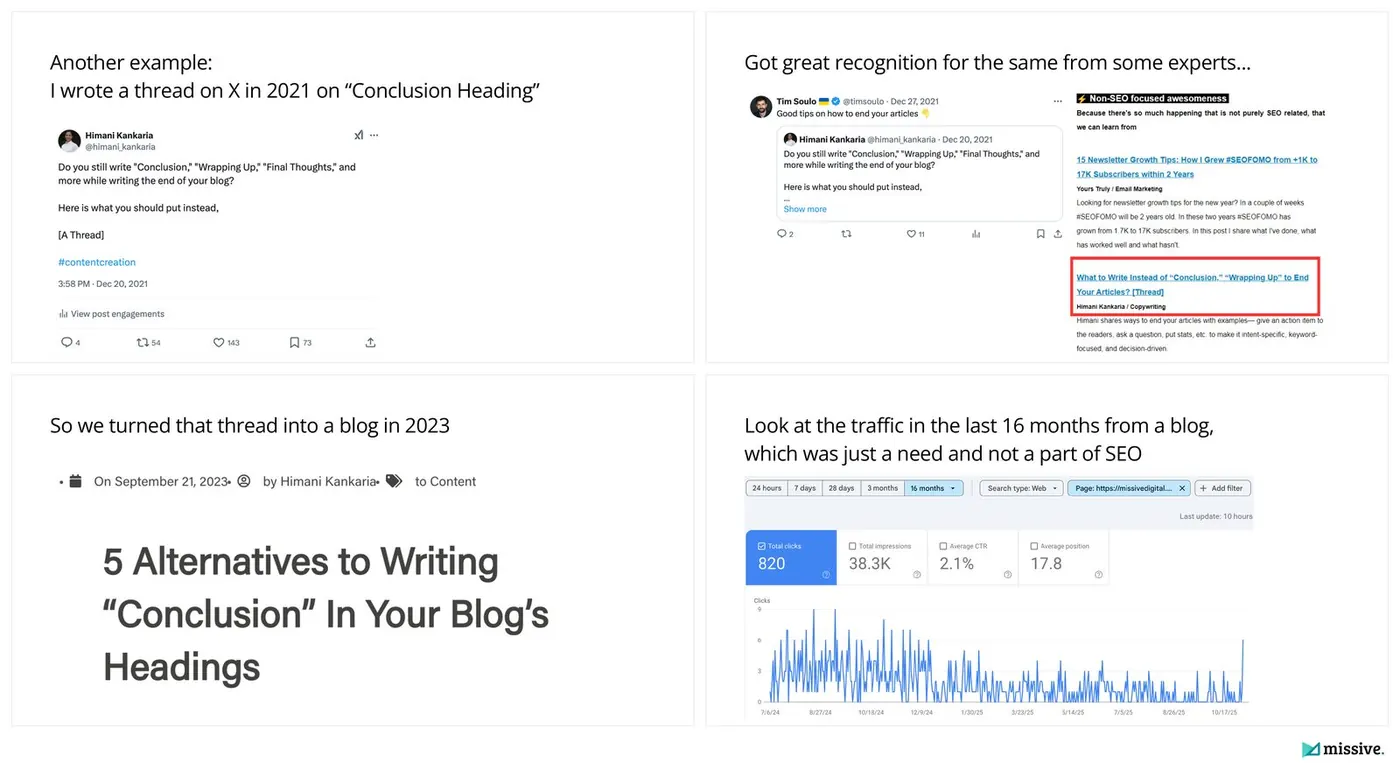
In December 2021, I wrote a thread on X asking whether people still write "Conclusion," "Wrapping Up," or "Final Thoughts" as the last heading of a blog, and what to write instead. In September 2023, we turned it into a blog, 5 Alternatives to Writing "Conclusion" In Your Blog’s Headings. We never checked search volume first. Content marketers kept asking the question, so we answered it.
| Signal | Value |
|---|---|
| X thread, December 20, 2021 | 143 likes, 54 reposts, 73 bookmarks |
| Shared by Tim Soulo, Ahrefs, December 27, 2021 | "Good tips on how to end your articles" |
| Featured in Aleyda Solis's #SEOFOMO newsletter | Listed under "Non-SEO focused awesomeness" |
| Blog published | September 21, 2023 |
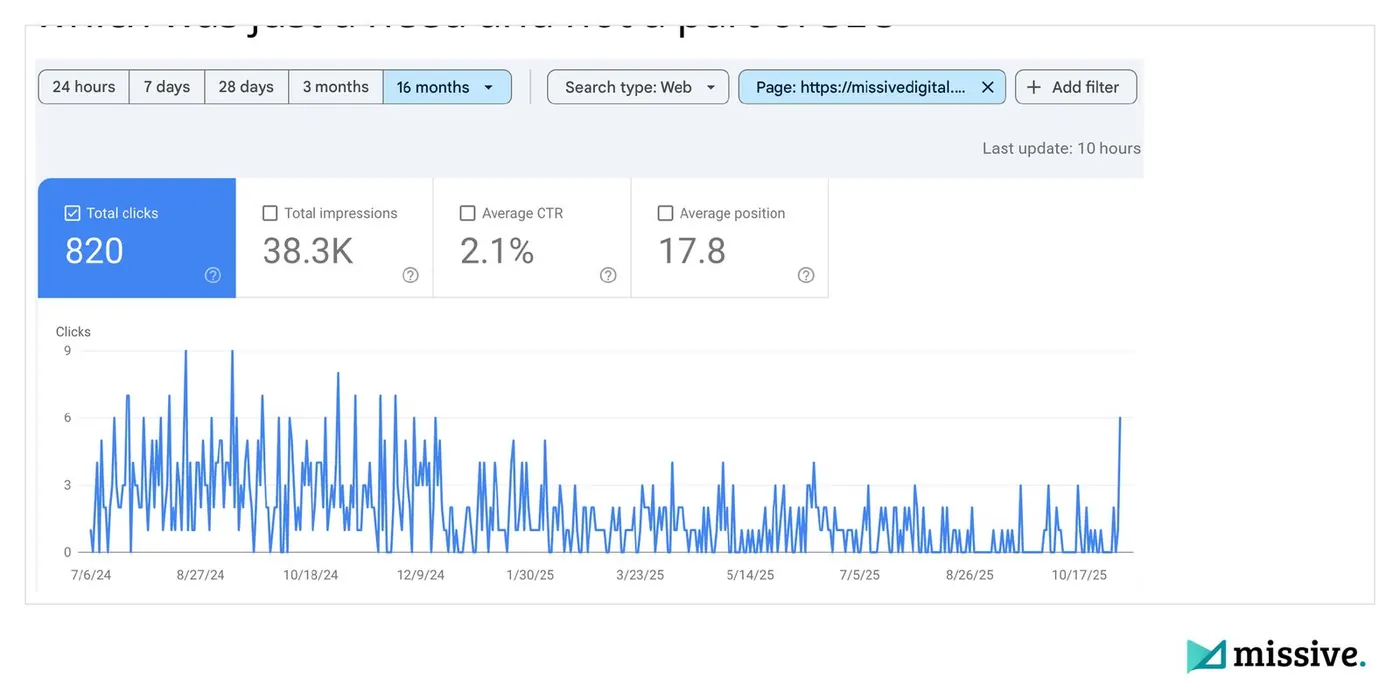
| Google Search Console, last 16 months | 820 clicks, 38.3K impressions, 2.1% CTR, average position 17.8 |
| Ahrefs volume for "conclusion heading" | 10 per month, keyword difficulty 24 |
| Related queries (8) | 0 to 10 each |
The tool said 10. The audience delivered 820 clicks. When the need is real and nobody else is answering it, volume estimates underestimate what the page will do.
How to find these topics on your own site and in your own community:
- Filter your own Top Pages or Search Console queries to volume under 50 and look for pages that already rank in the top 3. Those are needs you met by accident. Meet them on purpose.
- Collect the questions your sales, support, and community teams hear more than twice a month. Repetition is demand that tools cannot see yet.
- Check your own social posts, webinars, and talks for the moments that got saved, reposted, or asked about. Those are blog topics with a built-in audience.
- Validate the need against the persona, not against the volume.
The click pattern over 16 months is worth a look on its own. There is no launch spike and no decay to zero, just steady daily clicks from a question people keep asking, which is what a need-led topic looks like in Search Console.
The three routes compared
| Route | Where the signal comes from | What you validate it against | Time to first topic list | Why it works |
|---|---|---|---|---|
| What competitors are NOT writing | Competitor pages ranking past position 50 for low-difficulty queries in the target country | Your offerings and target persona | 1 to 2 hours in Ahrefs or Semrush | Himani Kankaria: the competitor has already proven demand but failed to answer it, so the gap is both validated and open |
| What aspirational customers are writing | Prospect websites, sales lists, job descriptions, the customer's own vocabulary | The customer's term in a keyword tool, not yours | Half a day with a sales list | Himani Kankaria: the market's word usually carries more volume and less difficulty than the industry term you default to |
| What nobody is writing but your audience needs | Low-volume queries you or a niche brand already rank for, repeated questions from sales and support, saved social posts | Whether the need is real for the persona, regardless of volume | Ongoing, from existing data | Himani Kankaria: zero competition and a real need builds trust that compounds, and volume tools underestimate it |
Goal 2: How to Stay Relevant to Local Audiences
Quick answer: The same topic needs a different blog for each audience and a different blog again for each region, because the reader’s needs move with both. The fix is a content calendar that records the persona, the intent, and what the reader should walk away with before a writer starts.
Finding the topic is half the work. The other half is writing it for the person in that region, not for a generic reader of that language. In the room at ISS, I ran a 20-second exercise that makes this concrete.
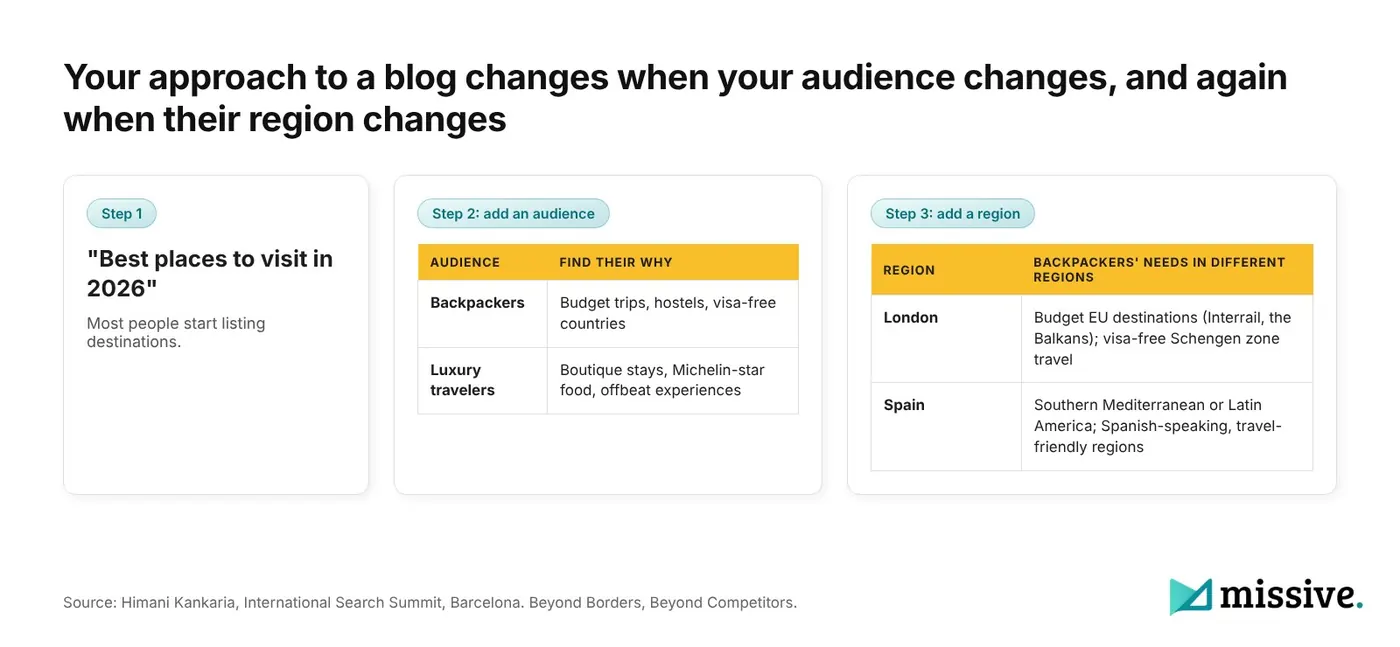
Your approach to a blog changes when your audience changes
Write a blog on "Best places to visit in 2026." You have 20 seconds. Most people start listing destinations.
Now add an audience. The destinations stop being the point. The question becomes why this audience needs to read this blog at all.
| Title | Audience | Why they need to read it | What the outline must include |
|---|---|---|---|
| Best places to visit in 2026 for backpackers | Backpackers | Budget trips, hostels, visa-free countries | Cost per day, hostel availability, visa rules, overland routes |
| Best places to visit in 2026 for luxury travelers | Luxury travelers | Boutique stays, Michelin-star food, offbeat experiences | Property names, dining reservations, private experiences, seasonality |
Same title stem. Two different outlines, two different sets of sources, two different calls to action.
It changes again when your audience's region changes
Now add a region. Even within one persona, the needs move with geography.
| Title | Reader's region | What shifts in the blog |
|---|---|---|
| Best places to visit in 2026 for backpackers in London | London | Emphasis on budget EU destinations (Interrail, the Balkans); visa-free Schengen zone travel after Brexit |
| Best places to visit in 2026 for luxury travelers in Spain | Spain | Emphasis on the southern Mediterranean or Latin America; Spanish-speaking, travel-friendly regions |
A London backpacker is thinking about Schengen day limits. A Spanish traveler is thinking about where Spanish gets them furthest. Neither shows up in a keyword tool. Both decide whether the blog is useful.
Add one column to your content calendar: what a reader should get after reading this
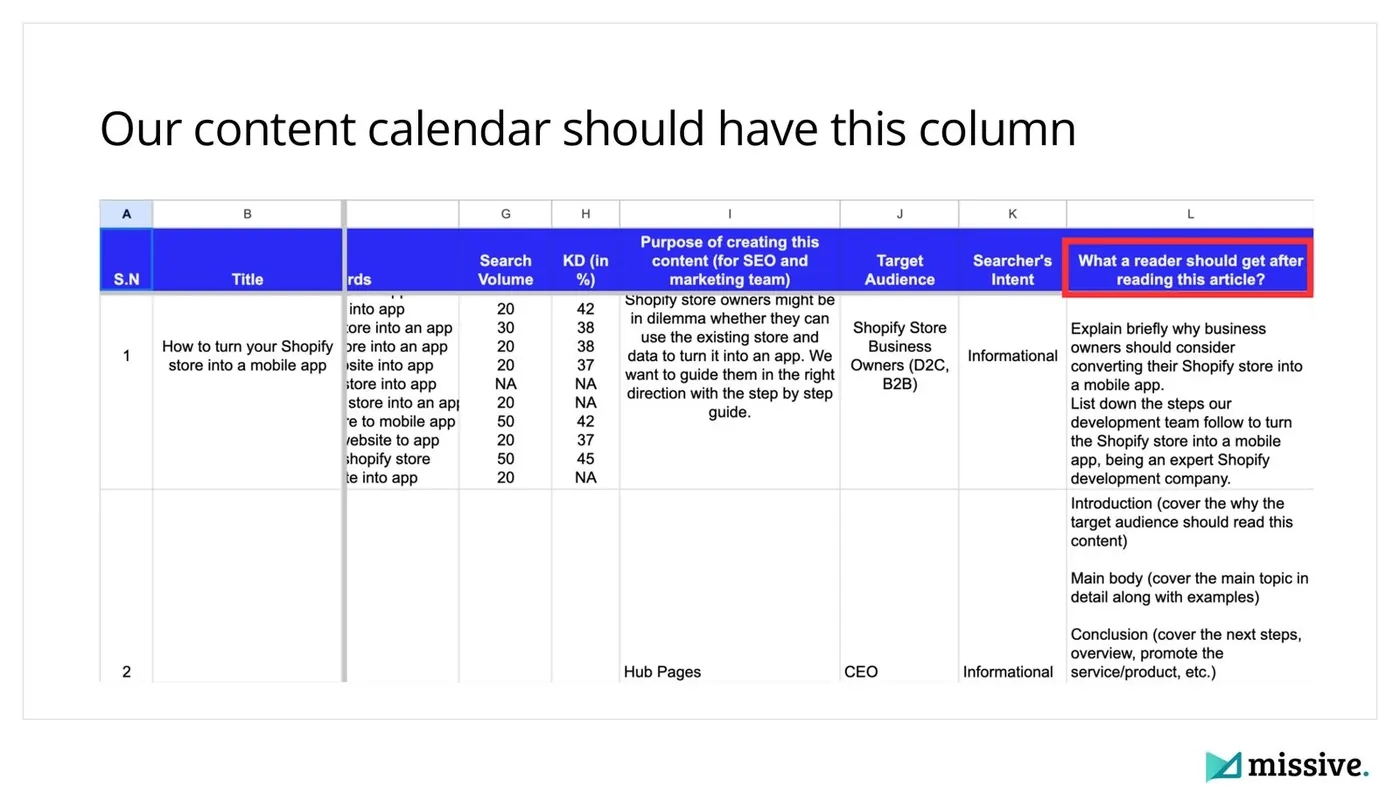
The way we at Missive Digital make this stick is a column in the content calendar titled "What a reader should get after reading this article?" It sits next to Target Audience and Searcher’s Intent, and it must be filled in before a brief goes to a writer. Once those three columns exist, a writer in one country can write for a reader in another without guessing.
The columns we keep in every international content calendar:
| Column | What goes in it | Example from a real row |
|---|---|---|
| Title | Working title | How to turn your Shopify store into a mobile app |
| Keywords, Search Volume, KD | The cluster, sized in the target country | 10 queries, 20 to 50 searches each, KD 37 to 45 |
| Purpose of creating this content | Why the SEO and marketing team wants it | Shopify store owners may be in a dilemma about whether they can use the existing store and data to turn it into an app. We want to guide them with a step-by-step guide |
| Target Audience | The persona, as specific as possible | Shopify store business owners (D2C, B2B) |
| Searcher's Intent | Informational, commercial, transactional, navigational | Informational |
| What a reader should get after reading this article? | The outcome, in one or two sentences | Explain briefly why business owners should consider converting their Shopify store into a mobile app. List the steps our development team follows, being an expert Shopify development company |
You can copy the template we use: Missive Digital content calendar template. We also run this planning layer inside our content writing services.
A localization brief checklist for every regional piece
Before a regional blog goes to a writer, we confirm:
- The persona is named, not just the country ("German inside-sales managers at SMEs," not "Germany")
- The reader’s why is written in one sentence
- The local term, not the translated term, is the target
- Region-specific context is listed (regulation, seasonality, currency, payment habits, visa or compliance rules)
- Local examples, brands, and sources are identified
- The call to action matches what that market can actually buy from you
- A native speaker is booked to review the draft
As international SEO content strategists, we are not just translating queries. We are translating context.
Goal 3: How to Show Authority in Every Section of Your Content
Quick answer: A reader in a new market has never heard of your brand and may be reading in a second language. Every section earns their trust the same way: open with the reason it matters to them, show them how to act on it, and validate it with evidence. Reason plus method reads as experience. Add validation and the content reads as expertise, authority, and trustworthiness.
This is the structure I use for every section of every blog. It is the structure behind the E-E-A-T content validator checklist I first shared at the Content Writers Symposium, the argument I made at WordCamp Nagpur 2024 on humanizing AI content for better SEO and engagement, and the reason our Citation Architecture Framework starts with a claim and its evidence rather than a keyword. It is also how we structure every piece in our content optimization work.
Open every section with the reason it matters to the reader
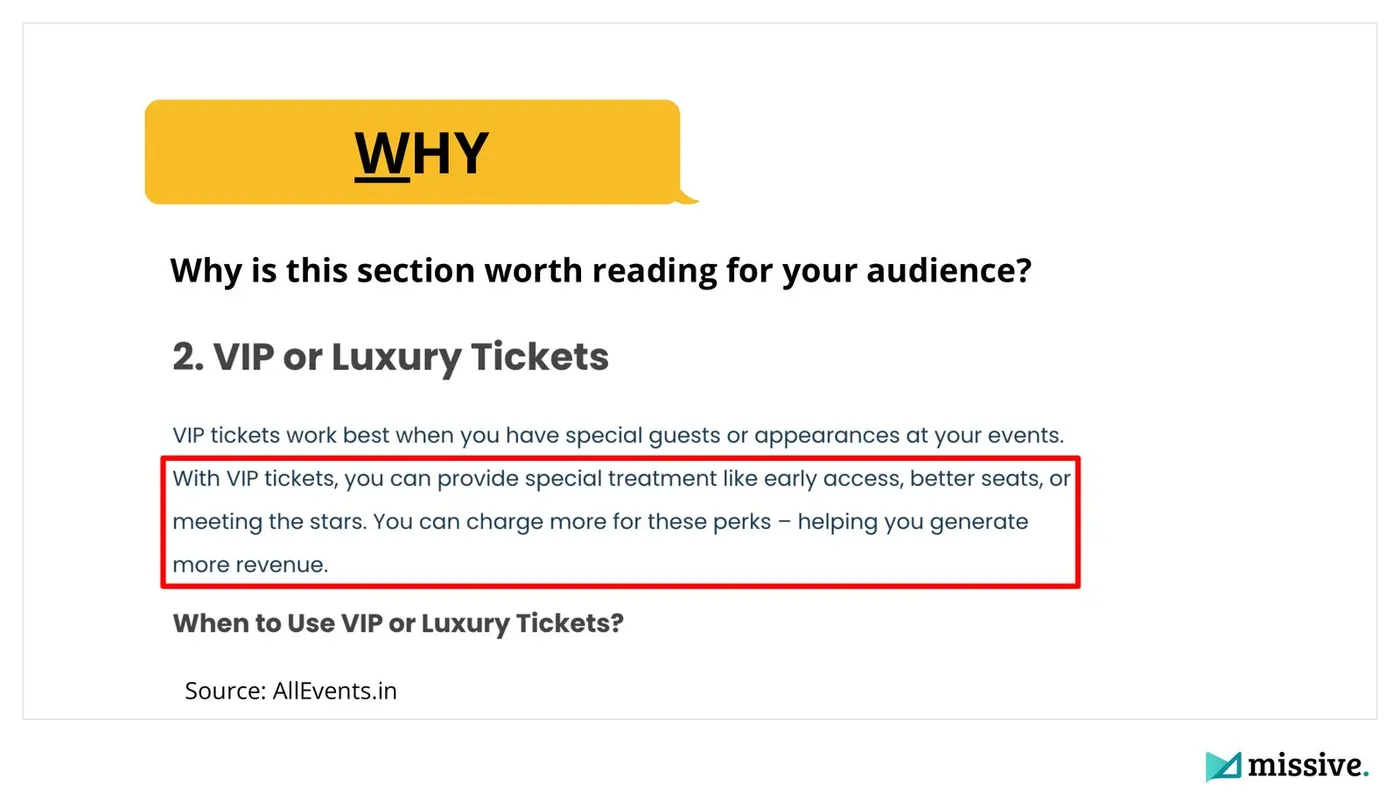
A section with no stated reason is the first one a reader skims. Before the reader gives you their attention, answer one of these two questions in the opening lines:
- Why are you suggesting what you are suggesting?
- Why is this section important or beneficial for your audience?
An event ticketing platform, AllEvents, does this in a section on VIP tickets: "With VIP tickets, you can provide special treatment like early access, better seats, or meeting the stars. You can charge more for these perks, helping you generate more revenue." In two sentences, an event organizer knows what is in it for them.
Prompts to write the opening of any section:
| If the section is about... | Open with... |
|---|---|
| A tactic or recommendation | The outcome the reader gets, in their terms (revenue, time, risk avoided) |
| A challenge or risk | What it costs the reader if ignored, with a number where possible |
| A definition or concept | The decision the reader can make once they understand it |
| A process | What breaks when the process is skipped |
Show the reader how to act on it, not just that they should
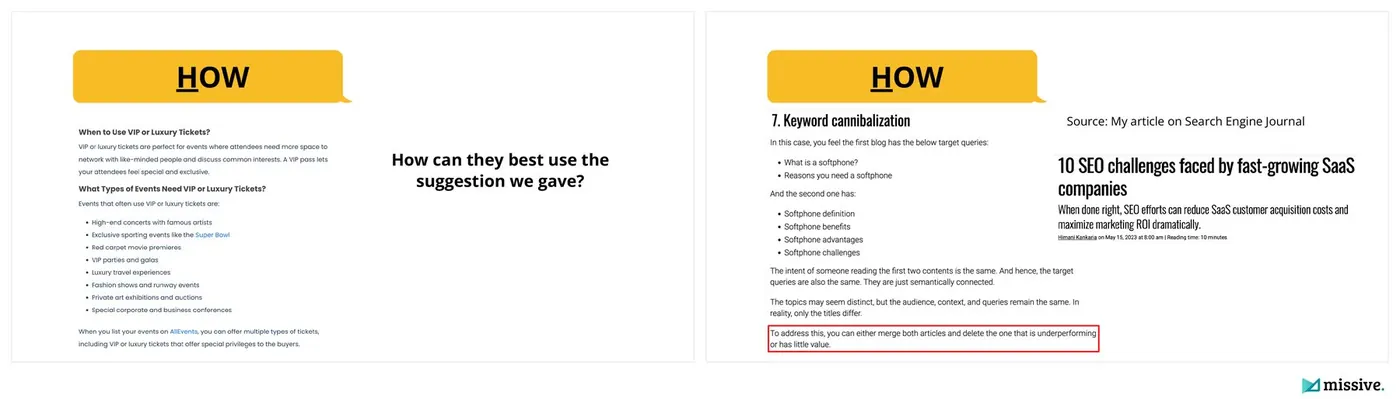
A benefit without a method is a claim. A method is something the reader can test, and testing it is what gives them the experience of having solved the problem with you. Do not just mention a benefit, a challenge, or a process. Make sure every section covers how the reader can proceed.
The same AllEvents section follows its opening with two sub-headings, "When to Use VIP or Luxury Tickets?" and "What Types of Events Need VIP or Luxury Tickets?", a list of eight event types (high-end concerts, exclusive sporting events, red carpet premieres, galas, luxury travel, fashion shows, private art auctions, corporate conferences), and a line on how to set up multiple ticket tiers on the platform.
In my Search Engine Land article on the 10 SEO challenges faced by fast-growing SaaS companies, the keyword cannibalization section does not stop at describing two softphone blogs competing for the same intent. It names the fix: merge both articles and delete the one that is underperforming or has little value.
Ways to add the method to a section without doubling its length:
- A numbered list of 3 to 7 steps
- A "when to use this" and "when not to" pair
- A short table of options with the condition that picks each one
- A single worked example with the real numbers
- A link to the template, tool, or checklist that does the work
Validate everything you write
Validation is what turns a confident opinion into something a stranger in another country can trust. It is also what AI answer engines look for when they decide which page to cite. Add it to every section, not just the introduction.
Six forms of validation and where each fits:
| Form of validation | Best used for | Example from the talk |
|---|---|---|
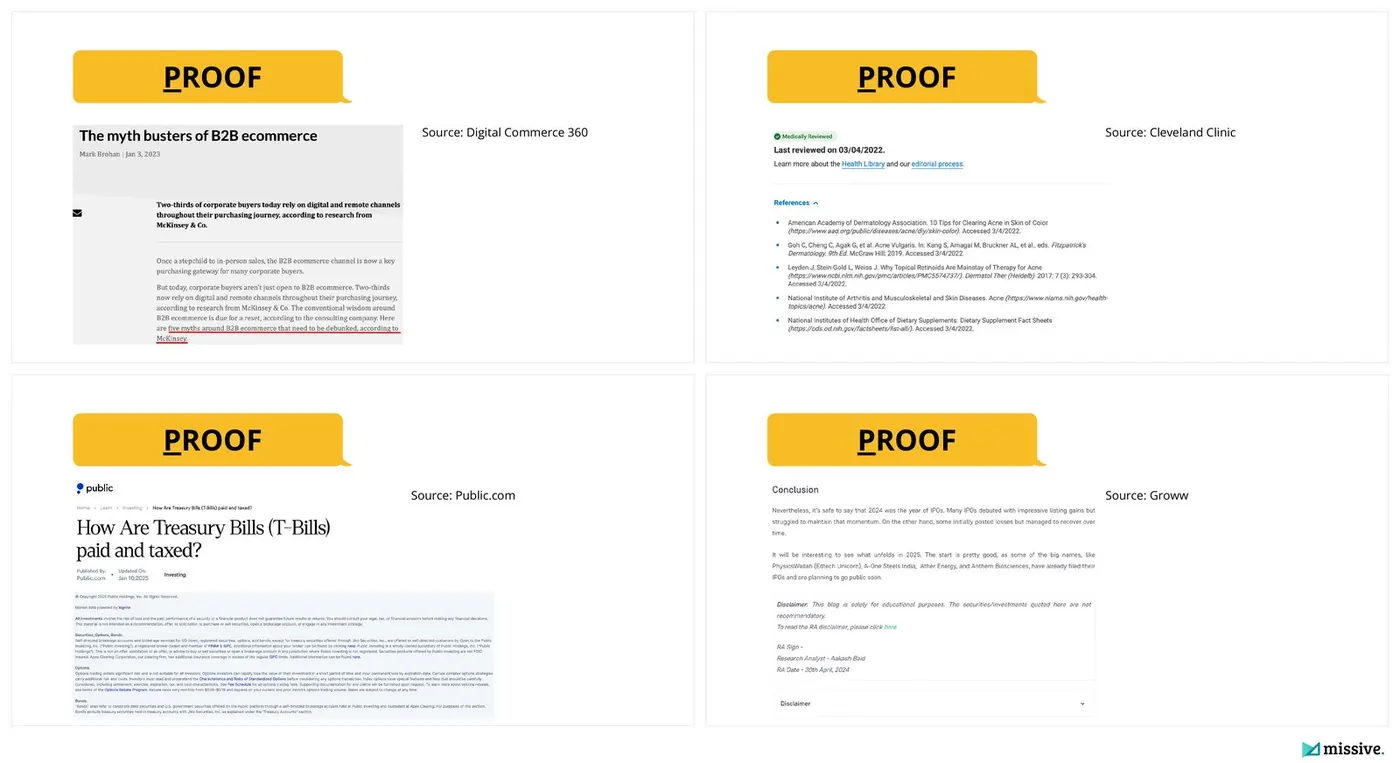
| Statistics | Sizing a problem or an opportunity | McKinsey: two-thirds of corporate buyers rely on digital and remote channels throughout their purchasing journey |
| Use cases | Showing how a recommendation plays out in a specific situation | The Tragofone "VoIP app" page change and its rankings |
| Case studies | Proving a result end to end | The conclusion-heading blog: 820 clicks from a 10-search term |
| News | Establishing that something changed and when | Google's March 5, 2025 AI Mode announcement |
| In-house expert quotes | Showing the people behind the brand know the subject | A named research analyst's sign-off on Groww's IPO review |
| Third-party expert quotes | Borrowing authority the reader already trusts | Tim Soulo and Aleyda Solis sharing the conclusion-heading thread |
Three publishers who make validation visible on the page:
- Digital Commerce 360 built The myth busters of B2B ecommerce on McKinsey’s five B2B ecommerce myths, names McKinsey in the first paragraph, and holds the featured snippet for "ecommerce myths b2b."
- Cleveland Clinic health library pages carry a "Medically Reviewed" badge, a last-reviewed date, a link to the editorial process, and a references list citing the American Academy of Dermatology, Fitzpatrick’s Dermatology, and NIH sources with access dates.
- Public.com shows the publisher, the updated-on date, and a full disclosures block on an investing explainer. Groww ends an IPO review with a research analyst’s name, a sign-off date, and an educational-purposes disclaimer.
For YMYL topics like health and finance, the reviewer’s name, the review date, and the primary sources are the proof, not decoration. We apply the same standard in our healthcare and fintech content.
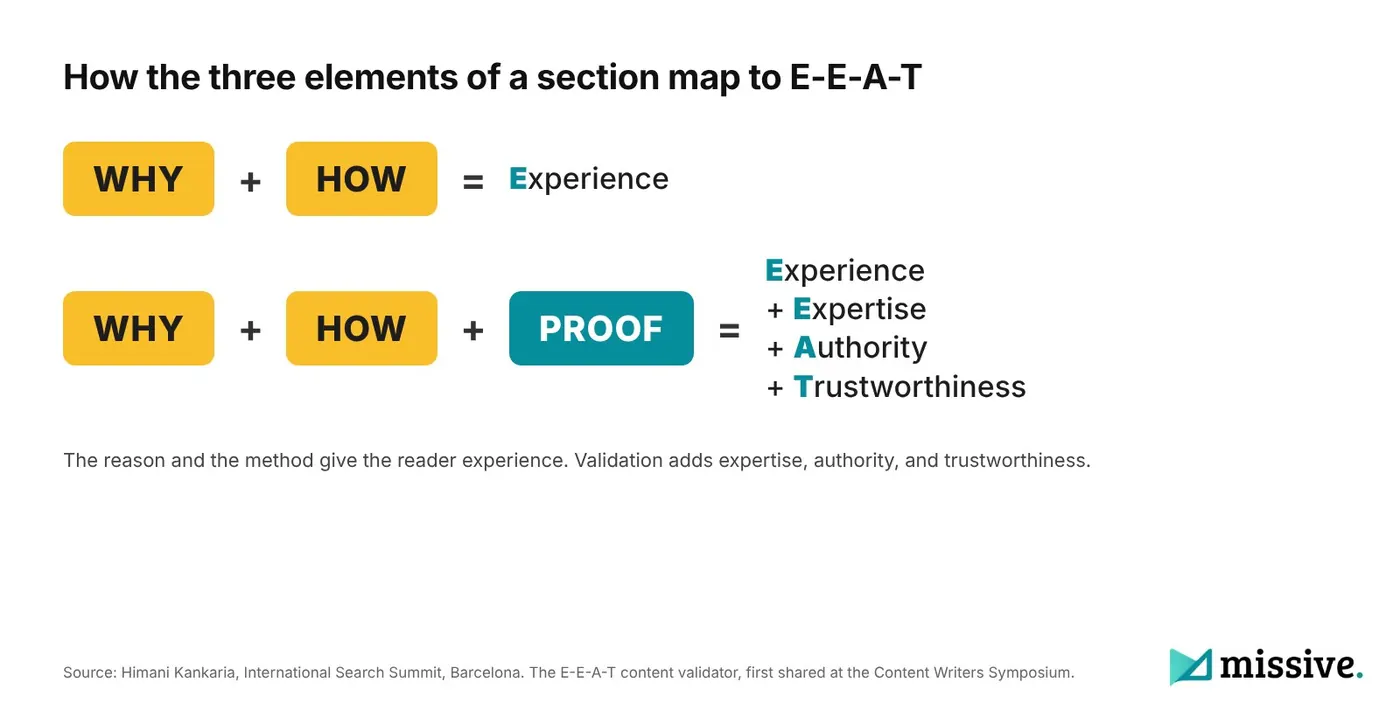
How the three elements map to E-E-A-T
| Section element | The question it answers | E-E-A-T signal it builds | Why it works |
|---|---|---|---|
| The reason | Why are we suggesting this, or why does this section matter to the reader? | Experience | Himani Kankaria: a reader who knows why they are reading stays, and a section with no reason is the first one skimmed |
| The method | How can the reader act on the suggestion, in brief or in detail? | Experience | Himani Kankaria: a benefit without a method is a claim, and a method is what the reader can test |
| The validation | What proves the claim: statistics, use cases, case studies, news, expert quotes? | Expertise, Authority, Trustworthiness | Himani Kankaria: validation is what lets a stranger in another market trust a brand they have never heard of |
Reason plus method gives the reader experience. Add validation and the same section carries expertise, authority, and trustworthiness. That is the whole of E-E-A-T, built one section at a time.
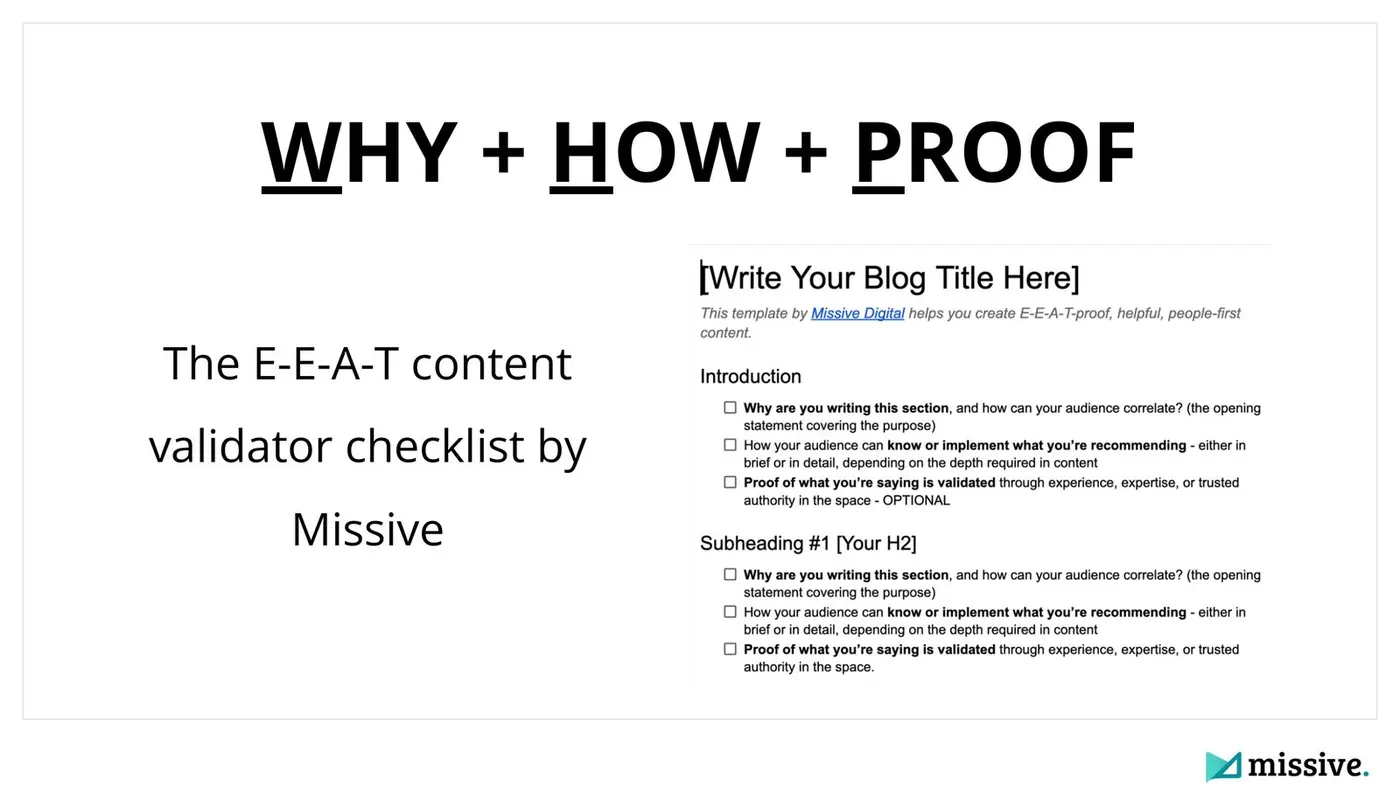
To make this repeatable across writers and markets, we turned the three elements into a checklist that sits beside every brief. Each section of the draft, introduction included, gets the same three checkboxes before it is marked ready.
Build a Content Strategy That Outlasts the Next Core Update
Ranking changes every two months and AI Overviews on top of the SERP are not reasons to stop investing in content. They are reasons to stop investing in generic content. Here is the plan to take back to your next international SEO content research review:
| What to do | How to start this week | What it protects you from |
|---|---|---|
| Choose topics beyond competitors, but relevant | Run the Position-from-50 filter on one competitor's regional blog and validate five gaps against your persona | Copying their misses along with their hits |
| Choose topics your customers speak and write about | Ask sales for ten prospect websites in the target market and read their requirements pages | Targeting a term the market does not use |
| Choose topics nobody writes about but your customers need | Filter your own Search Console to queries under 50 searches where you already rank top 3 | Dismissing durable, low-competition demand |
| Create content for a specific audience, need, and region | Add the "What a reader should get" column to your content calendar and fill it before briefing | Generic content with a flag on it |
| Give every section a reason, a method, and validation | Run the validator checklist on your next draft before it goes live | Content that reads as a claim instead of an answer |
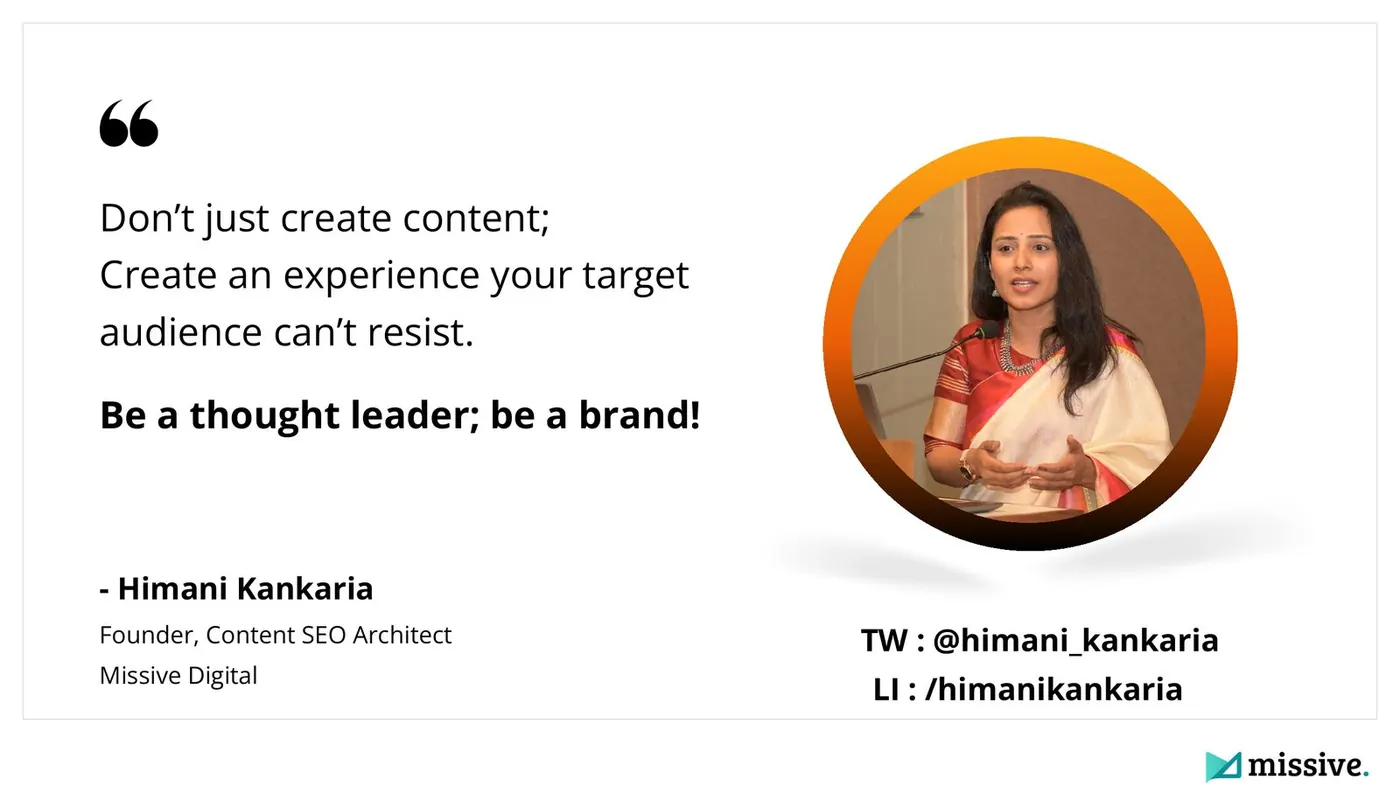
Don’t just create content. Create an experience your target audience can’t resist. Be a thought leader; be a brand.
Take the checklist with you. Copy the E-E-A-T Content Validator Checklist, the same template I showed on stage in Barcelona, with the three checkboxes for the introduction and every subheading.
If you are planning an international content program and want a second pair of eyes on the research, book a 30-minute consultation with me, or start with our free GEO Readiness Score to see how well your current content holds up in AI answers.
FAQs
Use three data sources that need no local expertise: competitor pages ranking past position 50 for low-difficulty queries in that country, the websites of customers you want to win there (read how they describe the problem you solve), and the low-volume queries your own regional pages already rank for. Translate the queries to understand them, size them in Ahrefs or Semrush in the local language, and validate each against your offerings and persona before it enters the calendar. Book a native speaker only for the final review.
No, not as a base. Their business goals, audience personas, and page-level results can all differ from yours, and a strong domain rating hides many pages that do not perform. A HubSpot Germany page with Domain Rating 83 earns about 100 organic visits a month. Use competitor data to find what they cover badly, then build your own plan around your audience's needs in each region.
Yes, when the topic is a real need for your audience and nobody else is answering it. A Missive Digital blog on "conclusion heading," a term Ahrefs showed at 10 monthly searches, brought 820 clicks and 38.3K impressions over 16 months. Edgard Cooper's Dutch blog ranks in positions 1 to 3 for dozens of 10-search pet care queries that build trust before the reader reaches a product page.
Ask your sales team for a list of prospects in that country and read their websites, requirements pages, and support documentation. For a VoIP client, South African prospects said "VoIP app," not "softphone," and the local term had 15 times the search volume at keyword difficulty 1. Then check the customer's term, not yours, in a keyword tool with the location set to that country.
Three things: the reason the section matters to the reader, the method they can follow to act on it, and validation such as statistics, use cases, case studies, news, or expert quotes. The reason and the method give the reader experience. Validation adds expertise, authority, and trustworthiness.
Because the reader's needs move with geography even inside one persona. A backpacker in London thinks about visa-free Schengen travel and budget EU routes. A traveler in Spain thinks about the southern Mediterranean and Spanish-speaking destinations. The keyword is the same. The outline, the sources, and the call to action are not.
Yes, and the 2026 data is clearer than the 2025 data. Ahrefs found that 28.3% of the 1,000 pages ChatGPT cites most have zero organic keywords in Google, and that only 38% of AI Overview citations now come from pages ranking in Google's top 10, down from 76% in July 2025. In Missive Digital's own October 2026 test, ChatGPT recommended a brand first for two tasks where it did not appear on Google's first page. The common factor is content written for a specific audience's specific need in that audience's words, which is exactly what regional, persona-led content does.
At minimum: title, keyword cluster with volume and difficulty in the target country, purpose of creating the content, target audience, searcher's intent, and what a reader should get after reading the article. The last column is the one most teams skip, and it is the one that lets a writer in one country write for a reader in another.