
Key Takeaways
- B2B buyers research and shortlist vendors before they speak to sales, so your reps need to be known before the first call.
- Decision-makers trust thought leadership more than marketing collateral, and many will pay a premium to work with companies that produce it.
- Posting consistently is not thought leadership. Focused expertise in one niche is.
- Personal profiles reach far more people than company pages, which makes your sales reps your strongest LinkedIn channel.
- Follow 7 steps as a team: one narrative, one lane per rep, a shared calendar, human-first writing, a bi-weekly sync with marketing, meaningful amplification, and shared measurement.
Posting on LinkedIn every day does not make your sales team thought leaders.
That was the first point I made to the IT Sales Community in my talk, "Better Marketing for Better Sales." It's also how I've built my own presence as the founder of Missive Digital: I've stayed in one lane, content-led SEO, and gone deep on it as an author for Search Engine Journal, Search Engine Land, and Semrush, and as a speaker at BrightonSEO and WordCamp Asia. That focus, not posting frequency, is what I'll ask your sales team to build.
It's also why I don't have to rely on outreach for inquiries. People look you up far more than you think, and when they find focused expertise, they reach out first.
Many IT sales teams are already on LinkedIn. What’s usually missing is a plan: one shared message, a clear area of expertise for each rep, and a way to tell whether posts are bringing in real conversations.
In this blog, I’ll explain why thought leadership matters for IT sales teams, what it actually means for a sales rep, and the 7-step framework your team can follow to build it together.
Why IT Sales Teams Need Thought Leadership on LinkedIn
Buyers now decide who to talk to long before they talk to sales, and they trust people’s expertise more than brand messaging. Thought leadership on LinkedIn is how your reps get on the shortlist before the first call.
Buyers Shortlist Vendors Before They Talk to Sales
In a Gartner survey of 632 B2B buyers, 61% said they prefer a buying experience without a sales rep, and 73% actively avoid suppliers who send irrelevant outreach. Forrester’s B2B predictions add that more than half of younger B2B buyers rely on external sources, including social media, to make buying decisions.
But buyers haven’t stopped needing sellers. Gartner found they still want a seller’s input for tasks that need context, like deciding whether a solution fits their company, and its analyst Alice Walmesley recommends sellers act as a sounding board rather than repeat generic information.
So the cold pitch loses, and the rep the buyer already knows from LinkedIn gets the call.
Decision-Makers Trust Thought Leadership More Than Sales Collateral
The 2024 Edelman-LinkedIn B2B Thought Leadership Impact Report surveyed about 3,500 decision-makers. Three of its findings matter most for a sales team.
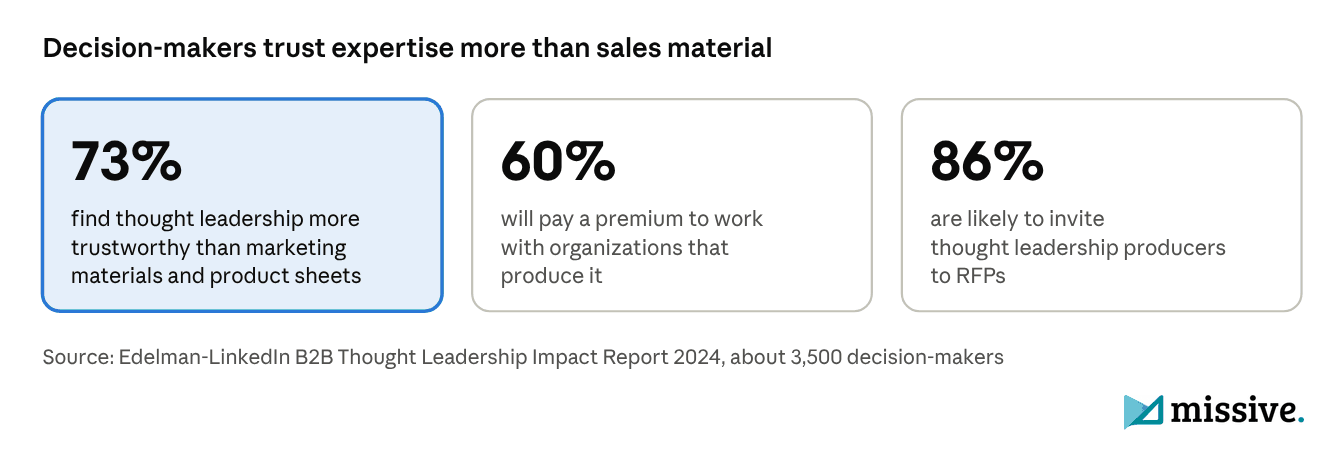
For your reps, this means an insight post does more selling than a brochure, expertise protects your price in negotiation, and visible thinking can get you invited into deals you didn’t know existed.
Thought Leadership Reaches the Buyers Your Rep Never Meets
Every IT deal has people your rep never speaks to: the CFO who approves the budget, the CISO who signs off on security, the architect who will live with your solution. Edelman and LinkedIn’s 2025 report calls them hidden buyers.
71% of hidden buyers say they have little or no interaction with sales teams, yet 95% say strong thought leadership makes them more receptive to sales outreach. When your champion forwards your rep’s post to their CFO, that post is doing the meeting your rep couldn’t get.
Personal Profiles Reach Further Than Your Company Page
LinkedIn shows people posts from their own network first. DSMN8’s 2026 analysis of the LinkedIn feed and its study of 500,000 employee posts show how large that gap is.
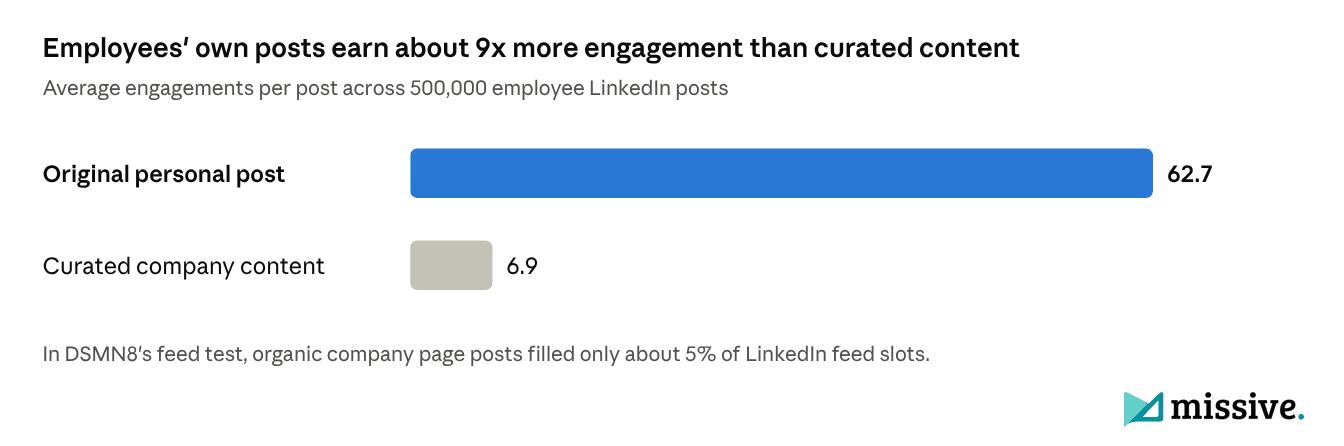
Source: DSMN8, The World’s Biggest Employee Advocacy Study (500,000 LinkedIn posts) and LinkedIn feed investigation, 2026.
So your reps should post original thinking from their own profiles, and the company page should reshare and support them, not the other way around. Sales teams already account for 33% of employee advocacy activity in DSMN8’s 2026 benchmark, more than marketing.
This is how we approach LinkedIn marketing services and personal branding at Missive Digital: the company page is the credibility layer, and people are the reach layer.
Posting Consistently Is Not the Same as Thought Leadership
Consistency helps people see you, but only focused expertise makes them trust you. The definition I use: thought leadership is content that offers expertise, guidance, or a unique point of view on a topic or in a field, with a focused approach.
The last three words matter most. Expertise is built on a niche, and for an IT sales rep, that niche is the technology and the buyer problems they know best.
| Posting consistently | Building thought leadership | |
|---|---|---|
| Topic | Whatever is trending this week | One niche your buyer cares about |
| Source | Generic tips and reshared news | Client conversations, deal lessons, and original opinions |
| Voice | Sounds like everyone else | Sounds like the rep, with a clear point of view |
| Goal | Likes and impressions | Conversations, DMs, and demo requests |
| What buyers remember | "I've seen their name" | "They're the person to ask about Power Platform" |
The bar is high. In an earlier Edelman-LinkedIn study, only 17% of decision-makers rated most of the thought leadership they read as very good or excellent. Generic posting adds to that noise. Focused expertise stands out from it, and that’s what turns LinkedIn into a pipeline-building superpower for a sales team.
The 7-Step Framework to Build Thought Leadership as an IT Sales Team
A sales team builds thought leadership in seven steps: one shared narrative, separate expertise lanes, one calendar, human-first writing, a regular sync with marketing, real amplification, and shared measurement. Each step fixes a reason team efforts usually fall apart.
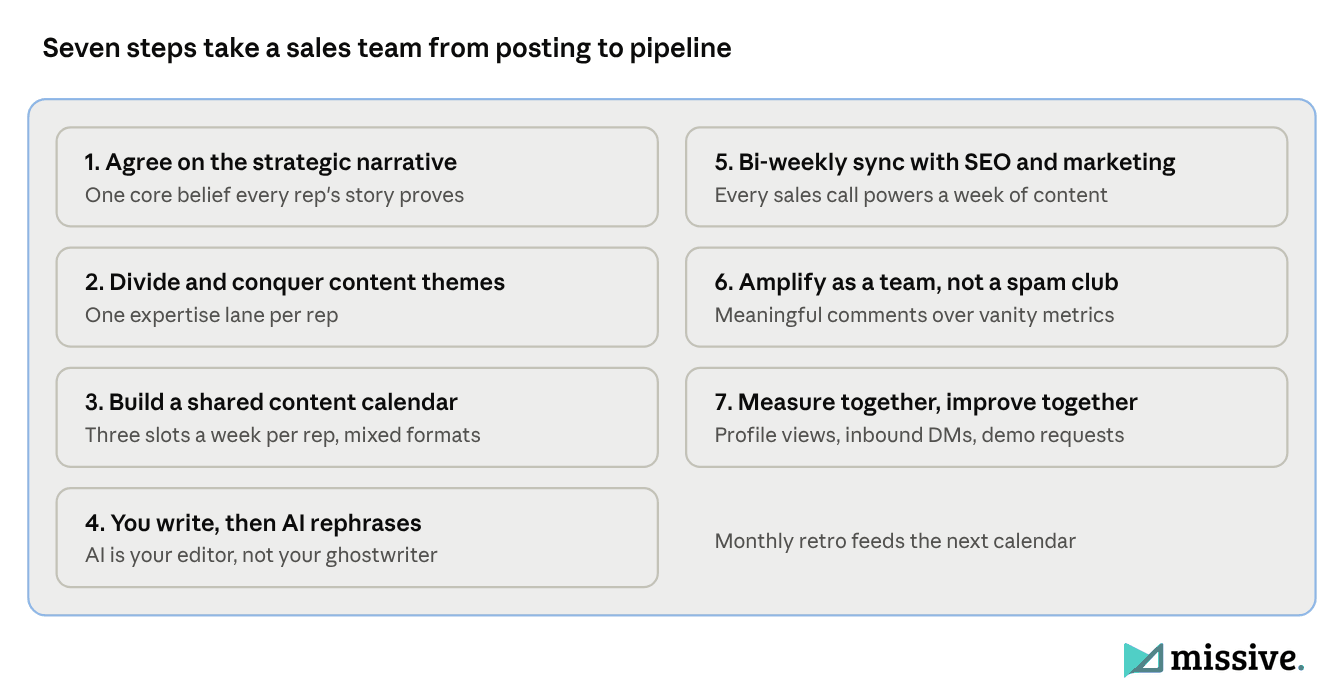
Step 1: Agree on the Strategic Narrative
Decide the ONE core belief your company stands for before anyone writes a post. Without it, five reps post about five unrelated things, and buyers can’t connect any of it to your company.
This matters more as buying groups grow. Forrester’s same predictions found that half of younger B2B buyers will involve 10 or more external influencers in a purchase. When a buyer hears about you from your website, your reps, and other people, every voice should point to the same belief.
For example: "Tech doesn’t need to be complex to be impactful." Every rep can tell a different story, but each one proves that same belief.
Here’s how to find yours in one working session:
- Bring your sales head, founder, and marketing lead into one room for an hour.
- List the three things clients thank you for most often after a project.
- Turn the common thread into one sentence a client would agree with.
- Test it: can every rep share a real client story that proves it? If not, rewrite it.
- Check that your website homepage says the same thing.
Step 2: Divide and Conquer Content Themes
Give each rep one expertise lane instead of asking everyone to post about everything. This is the focused approach in practice, and it stops your reps from competing with each other in the same feed.
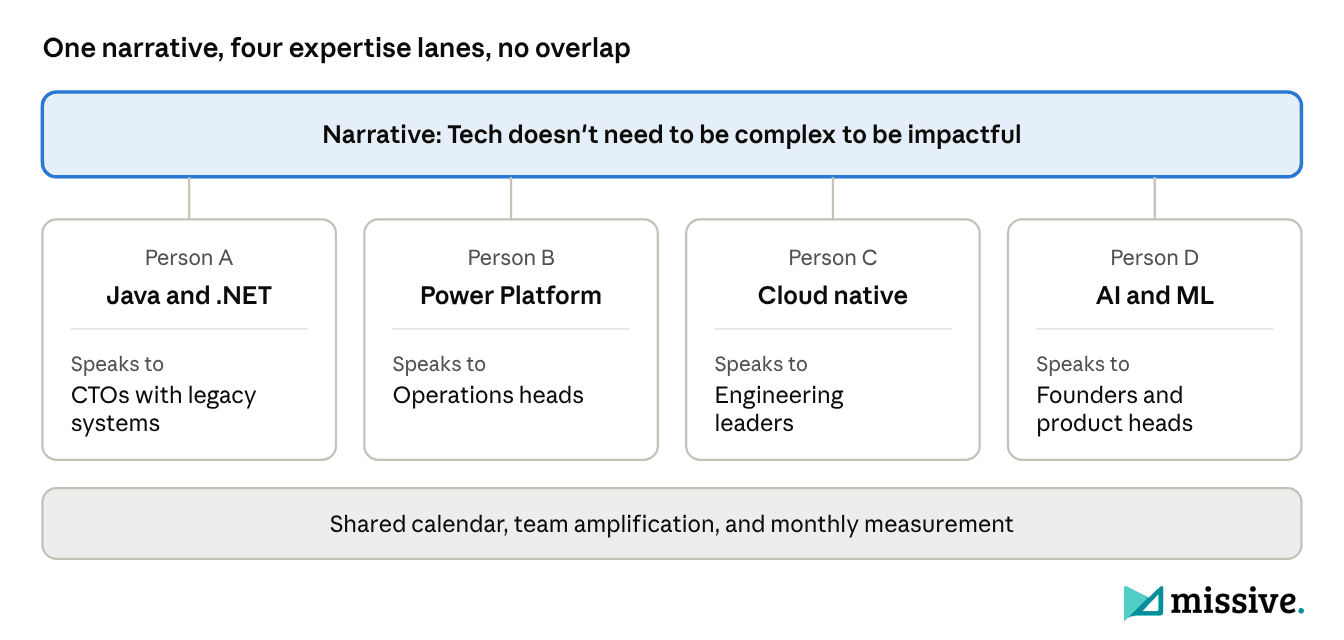
To set up lanes:
- Match each lane to what the rep actually sells and understands, not to what is trending.
- Name the buyer each lane speaks to, so every post has a clear reader.
- Keep lanes for at least a quarter before changing them. Authority needs repetition.
Example post angles for these lanes: "What we learned migrating a 10-year-old .NET app," "Three workflows clients automated with Power Platform in a week," "When Kubernetes is too much for a mid-size team," and "Questions to ask before you fund an AI pilot."
We follow the same principle in SEO at Missive Digital: we build content around one focused topic at a time, because depth signals expertise to both Google and AI tools. I’ve explained this approach in my Search Engine Journal articles.
Step 3: Build a Shared Content Calendar
Use one simple Google Sheet or Notion board for the whole team, so posts are spread out, lanes stay balanced, and nobody runs dry.
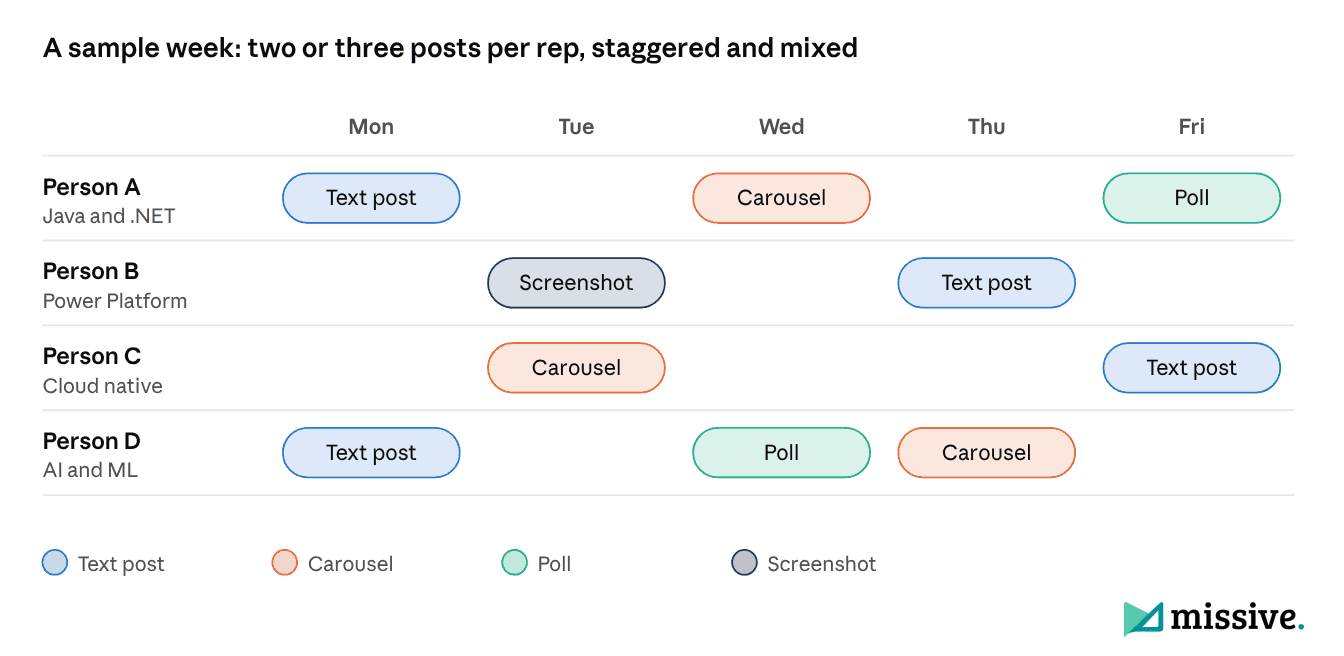
- Frequency: up to three post slots per week per person. Even one or two is fine when you’re starting.
- Formats: mix text posts, carousels, polls, and screenshots.
- Columns to include: date, rep, lane, post idea, format, source (call, project, article), status, and link once live.
The format mix matters. In DSMN8’s study of 500,000 employee posts, text-only posts earned the highest average engagement and multi-image gallery posts came second, while plain image posts came last. Their 2026 benchmark also found that 68% of employee advocates now post three or more times a week.
Step 4: You Write, and Then Let AI Rephrase It
Each rep should write the first draft in their own words, then use AI to tighten it. AI is your editor, not your ghostwriter.
The value of a sales rep’s post is the lens only they have. Something like: "I remember when the client told me they were stuck with X. We solved it with Y." No AI tool has that story.
The data backs this up. DSMN8 found that 92% of advocacy program managers use AI to scale content, and warns that this risks everyone sounding the same. Posts heavily rewritten in the employee’s own voice earned over 4 times more engagement and 6 times more comments than unedited ones. Yet only 3.6% of employees edit the content they’re given.
A prompt that keeps your voice intact: "Here is my LinkedIn post draft. Fix grammar and make it easier to read. Keep my words, my story, and my opinion. Do not add new claims, emojis, or hashtags."
Step 5: Hold a Bi-Weekly Sync With SEO, Marketing, and Content Teams
Meet every two weeks so what sales hears on calls becomes content, and what marketing publishes matches what sales says. Ask yourself: what if every sales call or customer interaction could power a week of content?
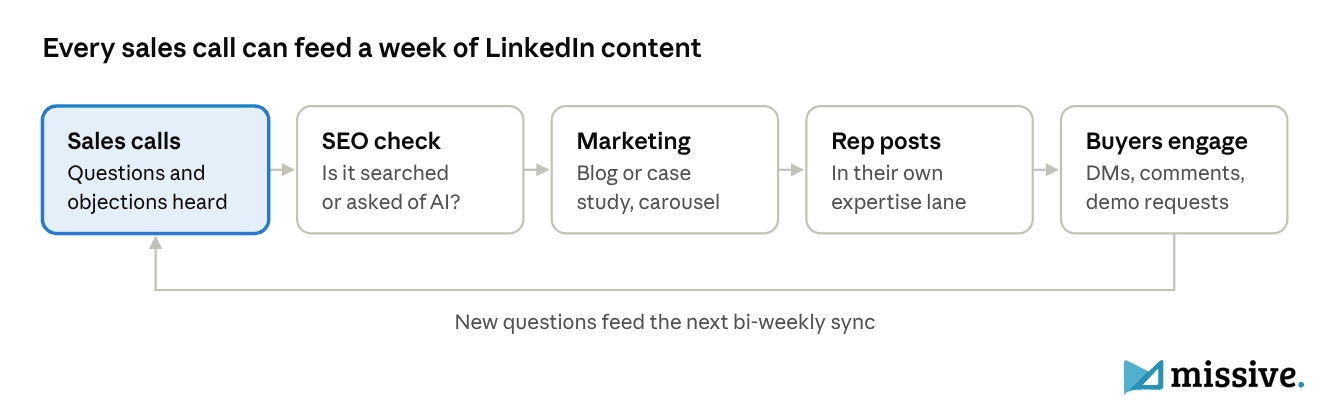
A 30-minute agenda that works:
- Sales shares: the top three questions and objections heard on calls since the last sync.
- SEO checks: which of those questions people are also searching or asking AI tools.
- Marketing plans: which questions become a blog, a case study, a sales one-pager, or a LinkedIn carousel.
- Everyone agrees: which rep posts about which question, in their lane.
This sync also fixes a quiet deal-killer. Gartner found that 69% of B2B buyers noticed differences between what a vendor’s website said and what its sellers told them.
This is the bridge we build in our content consulting and AI SEO work, so a buyer gets the same answer from your website, your rep, and an AI tool.
Step 6: Amplify as a Team, Not a Spam Club
Support each other’s posts with meaningful comments, not just a wave of likes in the first five minutes.
This works because of how LinkedIn distributes posts. DSMN8’s feed analysis found the most common reason a second-degree connection’s post shows up in your feed is that one of your first-degree connections commented on or reacted to it. When a teammate comments, the post reaches their network too.
- Comment with something that adds to the post: a related client example, a counterpoint, or a question.
- Avoid "Great post!" and copy-paste comments. They read as a pod, to buyers and to the algorithm.
- Focus on engagement and conversations, not vanity metrics like reaction counts.
Step 7: Measure Together, Improve Together
Track pipeline signals as a team, then review them once a month. Edelman and LinkedIn found that only 29% of thought leadership producers can link their efforts to leads or business wins, so simply measuring puts you ahead of most teams.
| Metric | Where to find it | What it tells you |
|---|---|---|
| Profile views | Each rep's LinkedIn analytics | Whether the right people are curious about the rep |
| Inbound DMs | LinkedIn messages, logged in your CRM | Whether posts are starting conversations |
| Demo requests from content | A "How did you hear about us?" field and a CRM source tag | Whether content is creating pipeline |
In the monthly retrospective, answer two questions: which formats performed, and what got conversations going? Then adjust next month’s calendar.
Focused posts built on a person’s own opinions can travel far beyond their network. In one of our case studies, two posts written from a fintech founder’s own thinking earned 267K+ LinkedIn impressions and reached more than 182,000 LinkedIn members, all of them outside his existing network.
Conclusion: Sales Today Is Presence, Not a Pitch
The IT sales teams that win are the ones buyers already know and trust before the first call. Thought leadership on LinkedIn is how your team gets there.
Before you plan next month’s posts, review these questions with your team:
- Can every rep say our strategic narrative in one sentence?
- Does each rep own one clear expertise lane?
- Did our posts this month come from real client conversations, or from trends?
- Are we commenting on each other’s posts in ways that add value?
- How many conversations, DMs, or demo requests came from content this month?
If most answers are "not yet," that’s your starting point. Own the conversation, earn trust early, and let your thought leadership fill the pipeline.
Be a thought leader; be a brand!
If you’d like help building a LinkedIn thought leadership program for your sales team, book a free consultation with us.
FAQs
Start with one shared narrative for the company, then give each rep one expertise lane. Plan posts in a shared calendar, write from real client conversations, amplify each other with meaningful comments, and track profile views, inbound DMs, and demo requests together.
Aim for three posts a week per rep, but one or two quality posts a week is a good start. Focus beats frequency: a rep who posts once a week in one niche builds more authority than one who posts daily about everything.
Use AI to edit, not to write. Have each rep write the first draft with their own story and opinion, then use AI to fix grammar and readability. DSMN8's data shows posts rewritten in the employee's own voice earn several times more engagement than unedited ones.
No. Consistency gets you seen, but thought leadership needs expertise, guidance, or a unique point of view in a focused niche. Without that focus, regular posting builds visibility but not credibility.
Both, with different jobs. The company page builds credibility, but personal profiles reach far more people. DSMN8 found organic company page posts fill only about 5% of LinkedIn feed slots, while original personal posts get about 9 times more engagement than curated company content.
Track profile views, inbound DMs, and demo requests that came from content. Add a "How did you hear about us?" field and a CRM source tag so you can connect posts to pipeline, and review results in a monthly team retrospective.