
Key Takeaways
- Clients and referral partners look up your LinkedIn profile before they call you. A clear, current profile is the easiest win.
- Start with your bar’s rules: no false claims, no “specialist” without certification, no client details, and no cold pitches. In India, Rule 36 bans advertising altogether.
- A good lawyer profile answers three questions in seconds: what you practice, who you help, and where you’re admitted.
- Two useful posts a week and a few thoughtful comments a day are enough to stay visible and build referral relationships.
In 2022, 89% of lawyers in the American Bar Association’s technology survey used LinkedIn for marketing. By 2024, only 76% did (ABA 2024 TechReport). Fewer lawyers posting means less competition for the ones who stay.
My position is simple: LinkedIn is the one social platform where a lawyer’s caution works in their favor. It rewards substance and credentials, not dancing reels or bold promises.
I’ve spent more than 15 years helping founders and business leaders turn what they know into visibility, and I spoke about it with Gianluca Fiorelli on The Search Session. Most of the work is unlearning old habits, keeping a professional tone, and matching every post to how you want to be known. For lawyers, there’s one more layer: your bar’s rules.
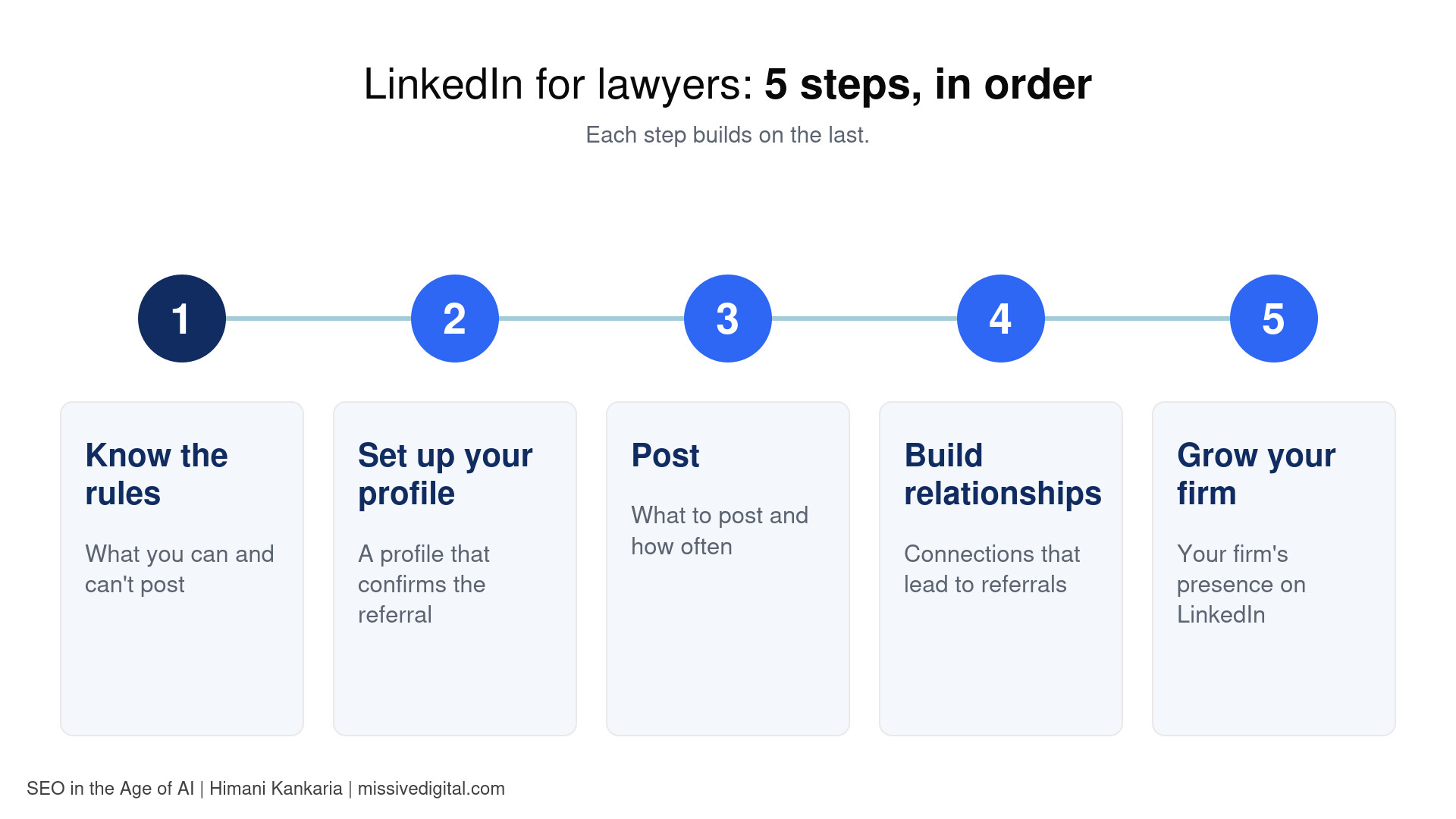
If you’re new to LinkedIn, follow the five steps below in order. Each one builds on the last.
Should Law Firms and Lawyers Use LinkedIn?
Yes, especially if you serve businesses or rely on referrals. LinkedIn won’t replace your website or your reputation, but it’s where both get checked.
Clients Look You Up Even After a Referral
Referrals still lead. Clio’s Legal Trends Report found that 62% of consumers found a lawyer through friends and family and 31% through other lawyers (Above the Law).
But the referral now gets checked. Scorpion found that 74% of legal clients research a firm online after a personal recommendation (Scorpion, 2025). Your LinkedIn profile is one of the first places they land.
Kevin O'Keefe, a trial lawyer for 17 years before founding LexBlog, says lawyers get their best work from relationships and a strong word-of-mouth reputation. LinkedIn is where those relationships stay warm between meetings.
LinkedIn Is Still the Top Platform for Lawyers
Even after the recent drop, LinkedIn remains the most used social platform for lawyers’ marketing, well ahead of Facebook.
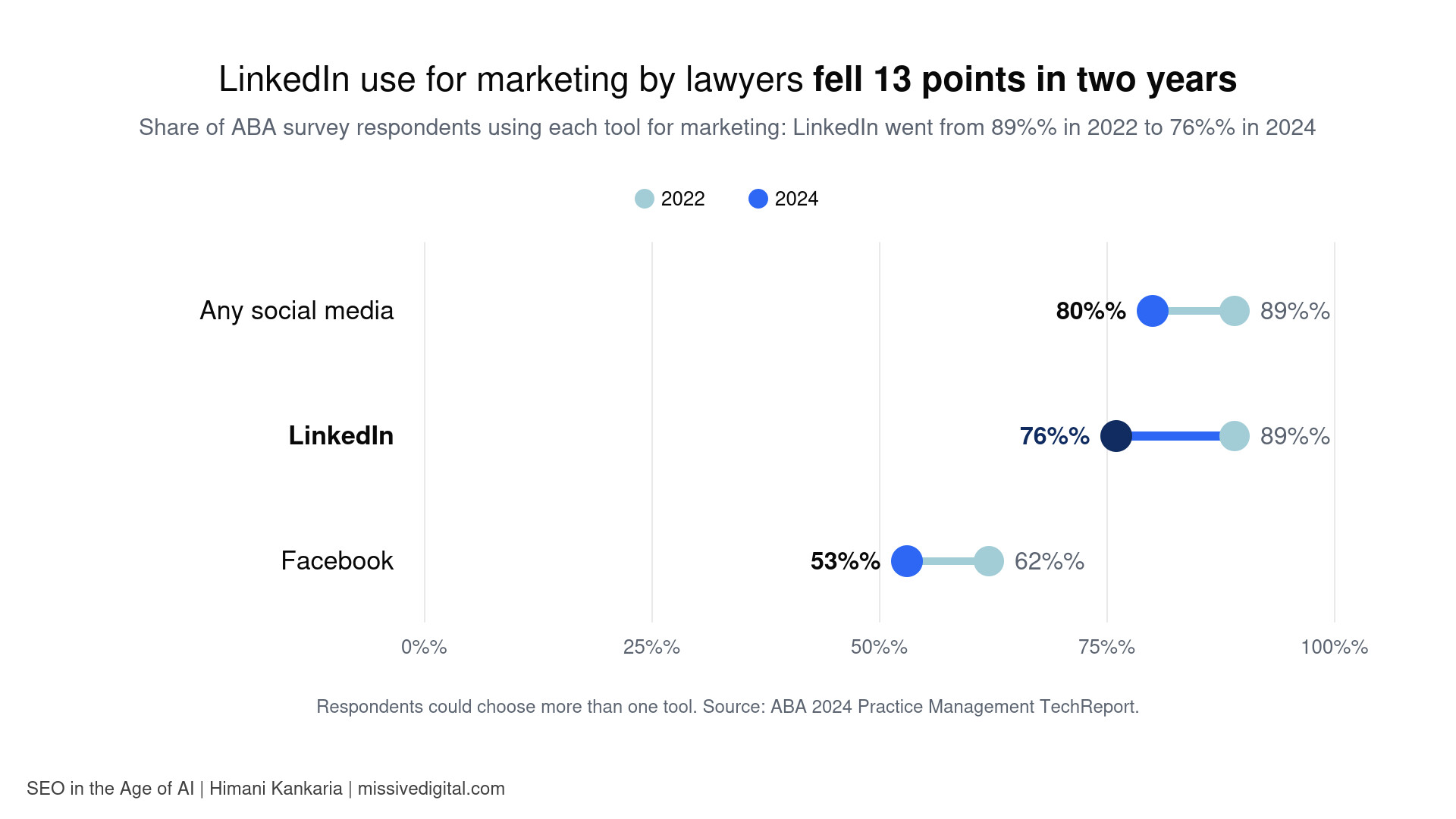
Source: American Bar Association, Legal Technology Resource Center, 2024 Practice Management TechReport (Marketing section), comparing the 2024 and 2022 Legal Technology Surveys.
Source: American Bar Association, 2024 Practice Management TechReport, Marketing section (2024 vs. 2022 Legal Technology Survey Report).
Which Practices Gain the Most From LinkedIn
| Practice type | Who you reach on LinkedIn |
|---|---|
| Corporate, M&A, venture, and banking | Founders, CFOs, investors, and in-house counsel |
| Employment, IP, tax, privacy, and compliance | HR, legal, and finance teams who share explainers internally |
| Litigation and arbitration | Other lawyers and general counsel who refer cases |
| Personal injury, family, criminal, and estate planning | Referral partners and people checking you after a referral |
For consumer-facing practices, LinkedIn plays a supporting role. People with an urgent personal problem usually start on Google, so SEO does more of the heavy lifting there.
Step 1: Know What You Can and Can't Post on LinkedIn
Before you change a single word on your profile, know the rules that apply to you. I’m a marketer, not a lawyer, so treat this as a map, not legal advice. Your own bar’s version of each rule is the one that counts.
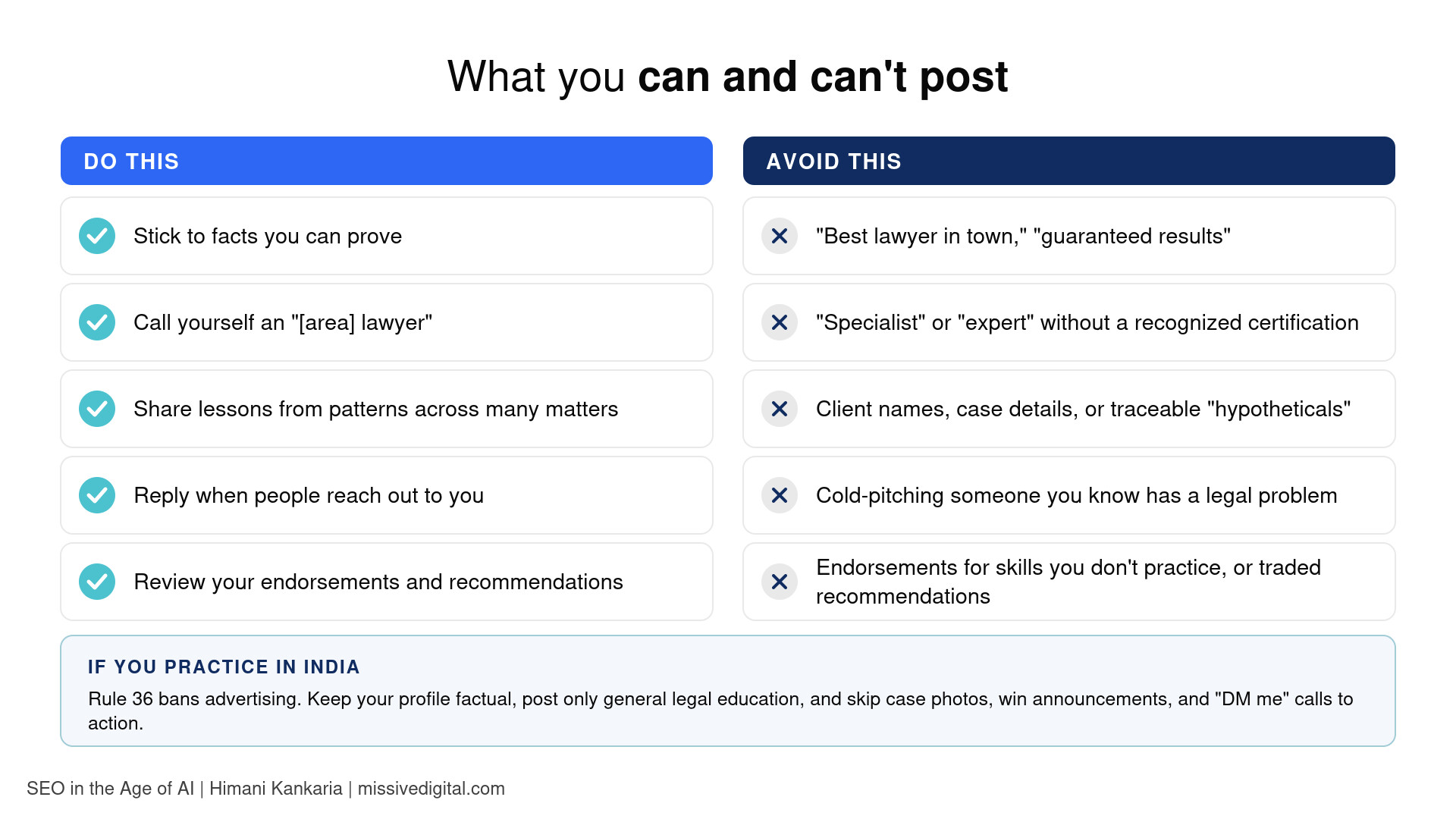
Five Simple Rules for US Lawyers
| Do this | Avoid this | Rule behind it |
|---|---|---|
| Stick to facts you can prove | "Best lawyer in town," "guaranteed results," "never lost a case" | ABA Model Rule 7.1: no false or misleading claims |
| Call yourself an "[area] lawyer" | "Specialist" or "expert" unless your bar recognizes your certification | State specialist rules; listing practice areas under Skills is generally fine (NYCLA Opinion 748) |
| Share lessons from patterns across many matters | Client names, case details, or "hypotheticals" a reader could trace back | ABA Formal Opinion 480: confidentiality applies online |
| Reply when people reach out to you | Cold-pitching someone you know has a legal problem | ABA Model Rule 7.3 and your state's solicitation rules |
| Review your endorsements and recommendations | Keeping endorsements for skills you don't practice, or trading recommendations | NYCLA Opinion 748: you're responsible for what appears on your profile |
Two small habits cover most of the rest. Add “general information, not legal advice” to posts that explain the law. And if your state requires an “Attorney Advertising” label, add it to your About section.
If You Practice in India
India is much stricter. Rule 36 of the Bar Council of India Rules bans advocates from advertising or soliciting work, directly or indirectly. The Bar Council of India repeated this for social media in March 2025 (Bar & Bench via Moneylife), and the Bar Council of Delhi named LinkedIn in its August 2025 warning (Storyboard18).
If you’re an Indian advocate, keep your profile factual, post only general legal education, and skip case photos, win announcements, and “DM me” calls to action. Check with your State Bar Council before doing more.
Step 2: Set Up a LinkedIn Profile That Confirms the Referral
When someone hears “talk to Priya, she’s great with SaaS contracts,” they look Priya up. In a few seconds, her profile should say: yes, this is the right person.
Dennis Kennedy and Allison Shields, authors of the ABA’s LinkedIn in One Hour for Lawyers, suggest starting with one question: what are you hiring LinkedIn to do? Referrals from other lawyers, in-house counsel clients, and speaking invitations each need a slightly different profile. Pick your main goal, then work through the sections below.
Write a Headline That Says What, Who, and Where
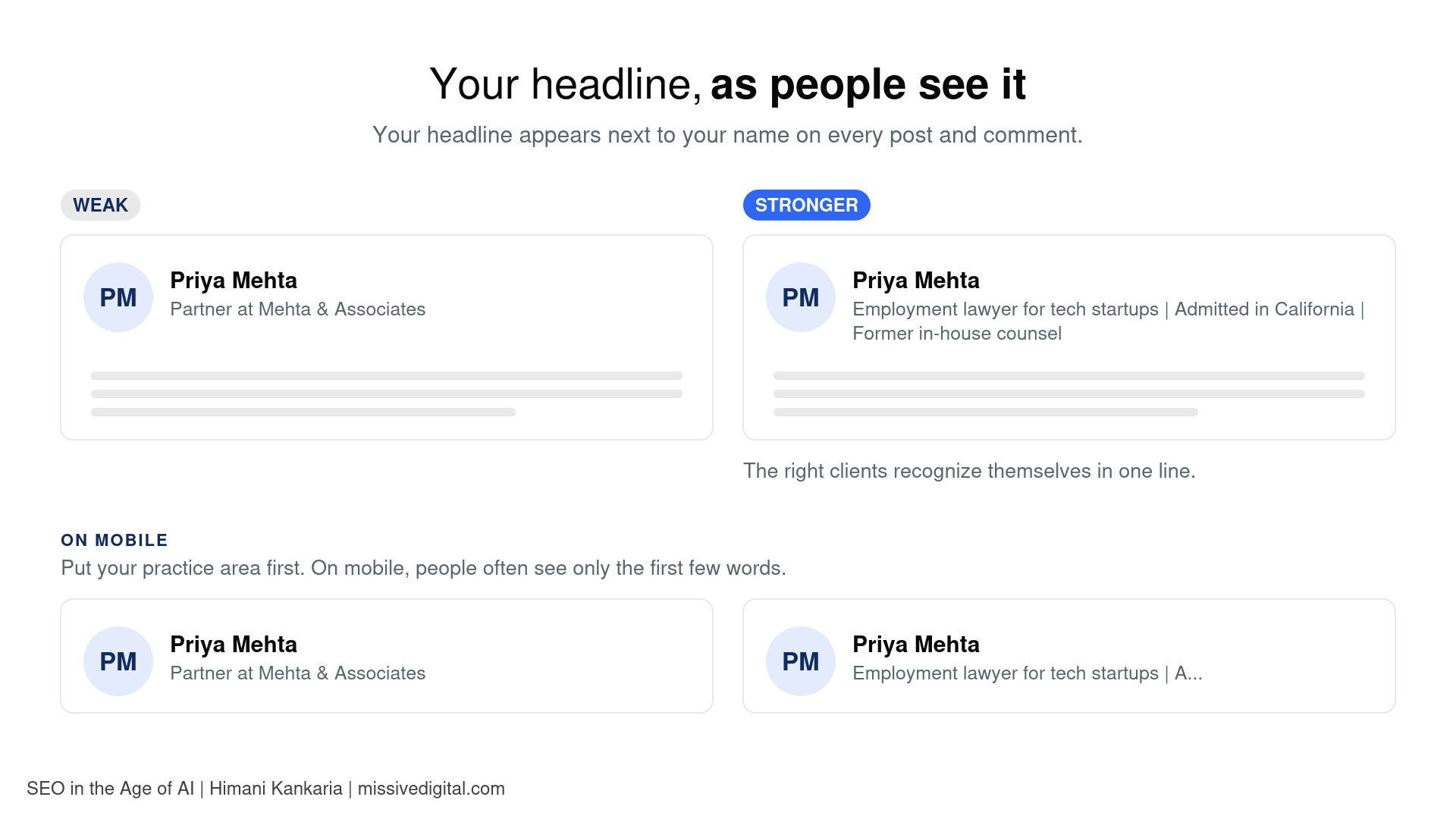
Your headline appears next to your name on every post and comment. Use this formula:
[Practice area] lawyer for [who you help] | [Where you’re admitted] | [One credible detail]
| Weak headline | Stronger headline | Why it works |
|---|---|---|
| Partner at Mehta & Associates | Employment lawyer for tech startups | Admitted in California | Former in-house counsel | Himani Kankaria: the right clients recognize themselves in one line |
| Attorney | Litigation specialist | Best results | Commercial litigation attorney | Contract and partnership disputes | New York | Himani Kankaria: drops restricted words and uses terms clients actually search |
Put your practice area first. On mobile, people often see only the first few words.
Choose a Photo and Banner That Look Like You
Use a recent, well-lit headshot with your face filling most of the frame. Skip gavel and courtroom stock images.
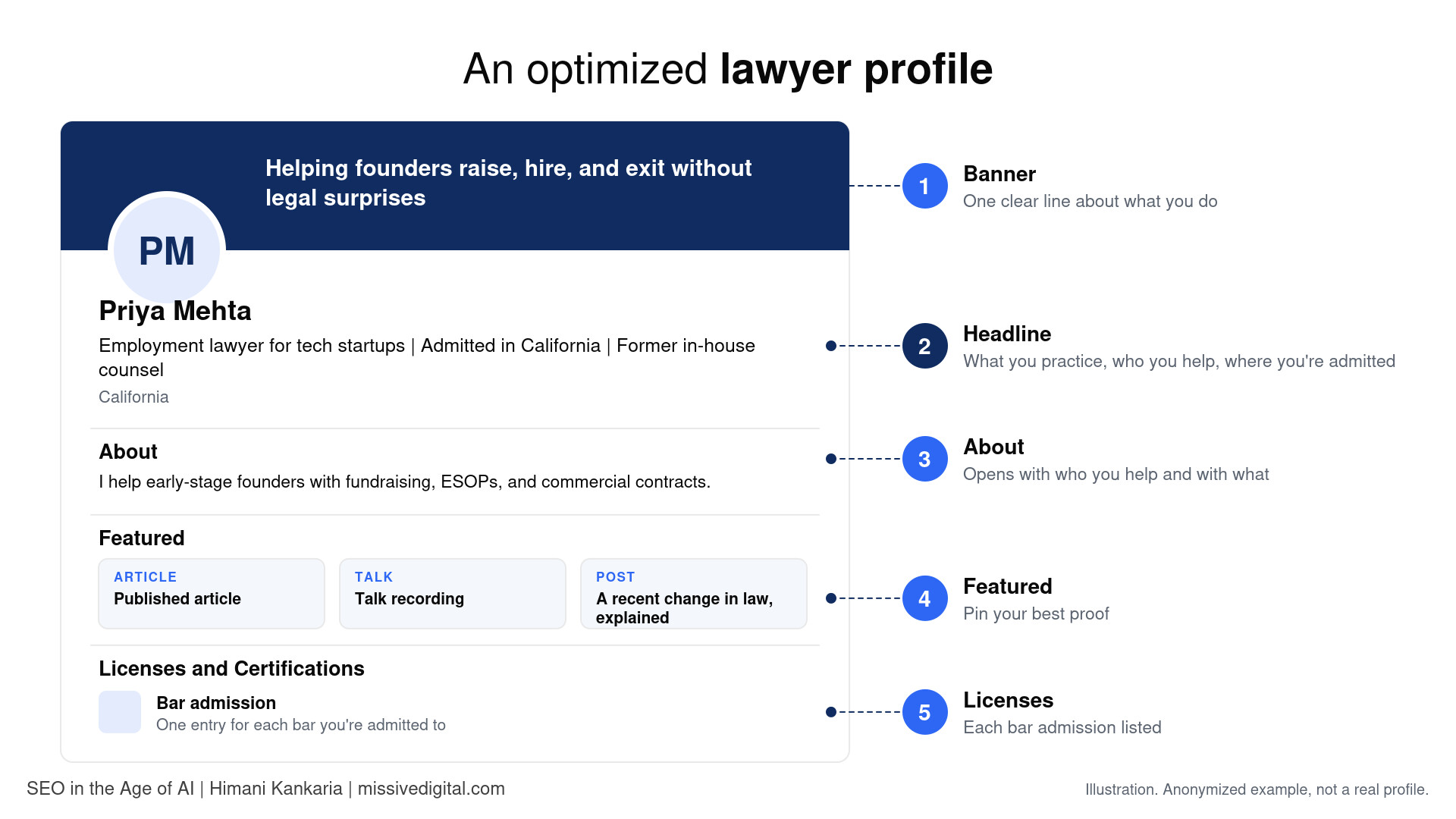
Use the banner for one clear line about what you do, like “Helping founders raise, hire, and exit without legal surprises,” plus your firm name if your bar allows it.
Write an About Section for the Person Who Just Heard Your Name
Skip the CV. Write five short parts instead:
- Who you help and with what: “I help early-stage founders with fundraising, ESOPs, and commercial contracts.”
- Why you’re credible: years of practice, bar admissions, former roles, or publications.
- How you work: your approach, how you explain things, how quickly you respond.
- What you post about: so people know why to follow you.
- A soft next step: “Happy to connect with founders and fellow lawyers.”
Use Experience and Featured to Show Proof
In Experience, add facts people can check: bar committees, CLE sessions you’ve taught, articles you’ve published. In Featured, pin your best proof, such as a published article, a talk recording, or a post explaining a recent change in law.
Finish With This Quick Settings Checklist
- 10 to 15 skills, written the way clients describe their problems (“employment contracts,” not internal jargon)
- Each bar admission listed under Licenses and Certifications
- The city where you practice as your location
- A custom URL like linkedin.com/in/yourname (LinkedIn Help)
- Your firm website in Contact Info
- Two or three recommendations from colleagues, co-counsel, or referral partners
We follow a similar approach for another regulated profession in our LinkedIn for doctors guide.
Step 3: Decide What to Post and How Often
The goal isn’t to go viral. It’s to be the name people remember when someone asks, “Do you know a good lawyer for this?”
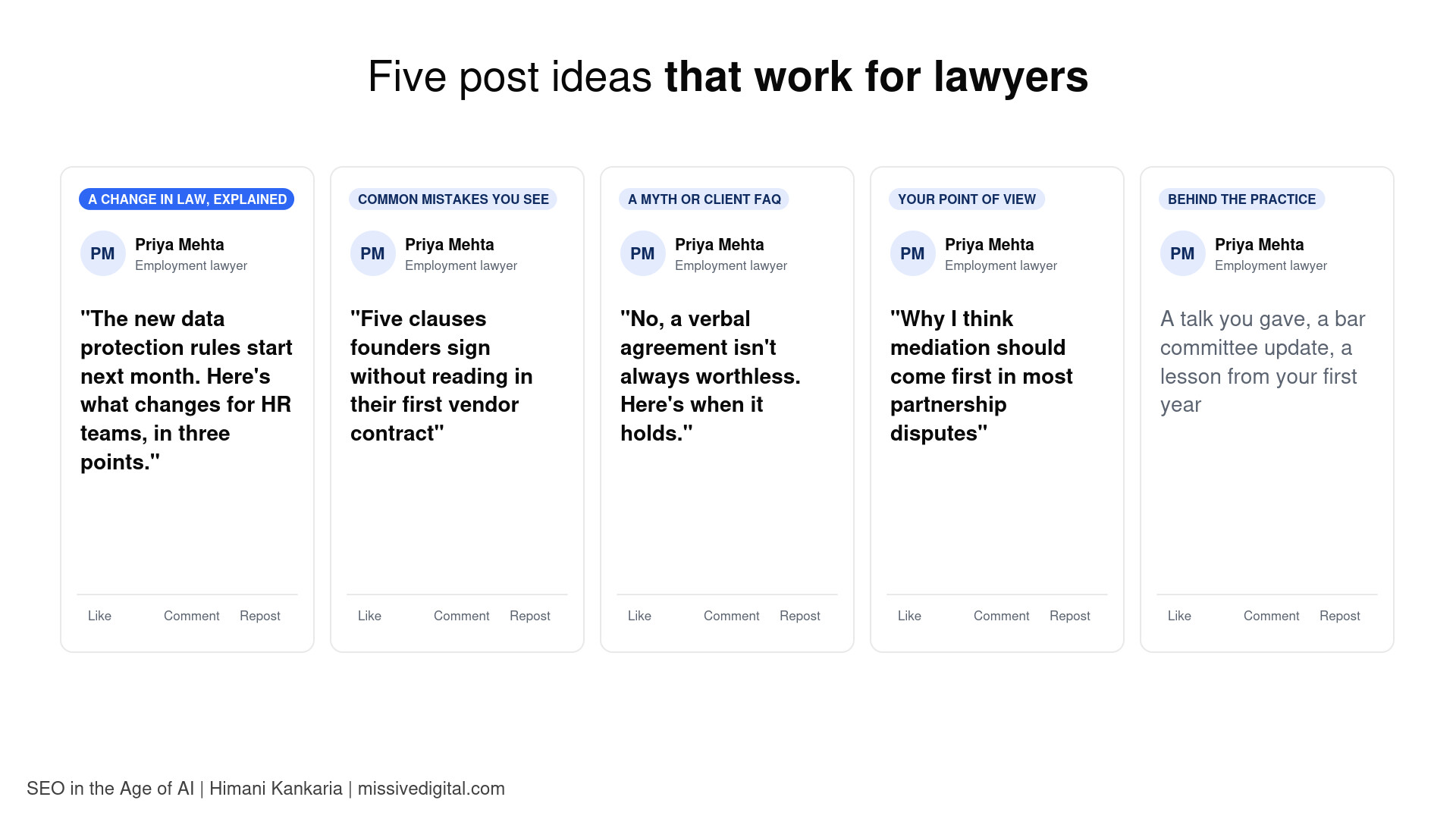
Five Post Ideas That Work for Lawyers
| Post type | Example | Why it works |
|---|---|---|
| A change in law, explained | "The new data protection rules start next month. Here's what changes for HR teams, in three points." | Himani Kankaria: timely explainers show expertise and get forwarded to colleagues |
| Common mistakes you see | "Five clauses founders sign without reading in their first vendor contract" | Himani Kankaria: patterns from many matters share experience without exposing any client |
| A myth or client FAQ | "No, a verbal agreement isn't always worthless. Here's when it holds." | Himani Kankaria: the questions clients ask you are the questions others are searching |
| Your point of view | "Why I think mediation should come first in most partnership disputes" | Himani Kankaria: a clear, consistent opinion makes you memorable |
| Behind the practice | A talk you gave, a bar committee update, a lesson from your first year | Kevin O'Keefe: people connect with the lawyer, not the firm brand (source) |
Pick a Format You Can Keep Up With
- Text post: the easiest start. Name the problem, explain it in three to five short points, and end with a question.
- Document post (carousel): good for checklists. Design the first two slides as a pair (headline on slide one, supporting line on slide two), keep it to about three slides, and use large, bold text.
- Short video: 60 to 90 seconds answering one question clients ask you every week.
- Newsletter: a good home for client alerts you already write.
Post Twice a Week and Stay in Your Practice Area
Two posts a week is enough for a busy lawyer. What matters more is staying on topic. LinkedIn’s 2026 feed update uses AI to understand what each post is about and who it suits. If your headline says “employment lawyer” but your posts jump to politics and motivational quotes, LinkedIn doesn’t know who to show you to. We explain this further in Is LinkedIn Search Irrelevant?
Make It Sound Like You
Use AI to research or outline, not to write the final post. An Originality.ai study estimated that about 81% of long-form LinkedIn posts are likely AI-generated (Originality.ai, 2026), so a real lawyer’s voice stands out.
My simple test: would you say this sentence out loud to a client across the table? If not, rewrite it.
And if you’re a partner or founder of your firm, these six LinkedIn posts founders should avoid apply to you too.
Step 4: Build Relationships That Lead to Referrals
For a lawyer, 300 of the right connections are worth more than 3,000 random ones. This step is about choosing those people and staying on their radar.
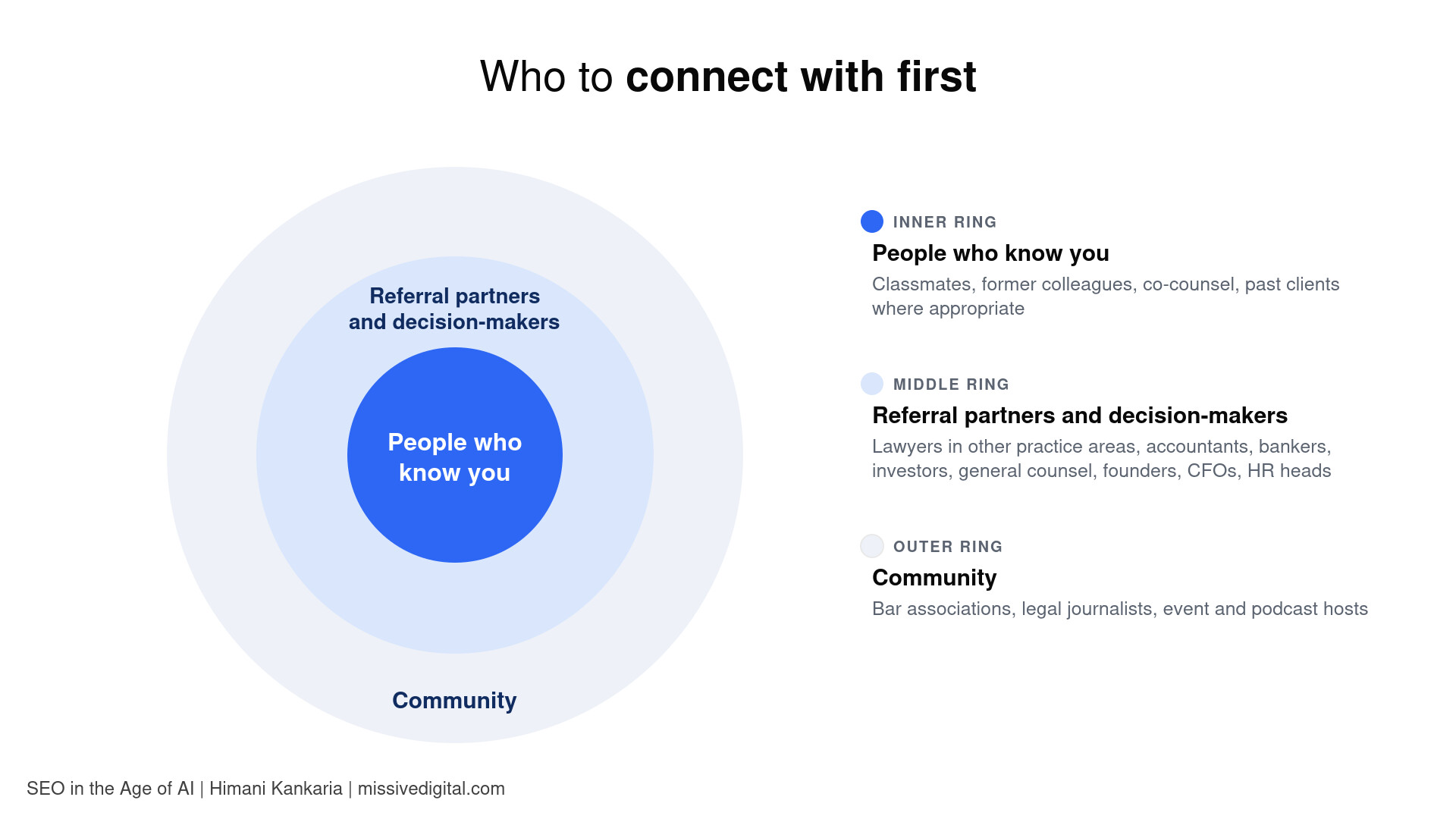
Who to Connect With First
| Group | Examples | Why it works |
|---|---|---|
| People who already know you | Classmates, former colleagues, co-counsel, past clients where appropriate | Himani Kankaria: their early likes and comments show LinkedIn who your audience is |
| Referral partners | Lawyers in other practice areas, accountants, financial advisors, bankers, investors | Himani Kankaria: they meet your future clients before you do |
| Decision-makers | General counsel, founders, CFOs, and HR heads in your target industry | Himani Kankaria: they hire outside counsel and vet them on LinkedIn |
| Community | Bar associations, legal journalists, event and podcast hosts | Himani Kankaria: they open doors to speaking and media |
Send a Connection Note That Isn't a Pitch
Always add a short note about the other person. For example:
“Hi Rahul, I enjoyed your talk on cross-border tax at the CA chapter meet. I advise founders on contracts and fundraising and often see the questions you covered. Would love to stay in touch.”
No pitch, no “let me know if you need a lawyer.” Let the other person bring up work.
Spend 15 Minutes a Day Commenting
Comments are where relationships start. A comment of ten words or more, with a real point or example, does more than ten “Congratulations!” replies, which LinkedIn treats as low effort.
A simple daily routine: comment on posts from three referral partners, two client companies, and one voice in your industry.
Connect Within 48 Hours of Every Event
After a conference, CLE, or client meeting, send connection requests while the conversation is fresh. Sharon Nelson, president of Sensei Enterprises, even invites her LinkedIn connections to the CLEs where she speaks (Ride the Lightning). After a talk, post one takeaway and tag the organizers.
Step 5: Grow Your Law Firm's Presence on LinkedIn
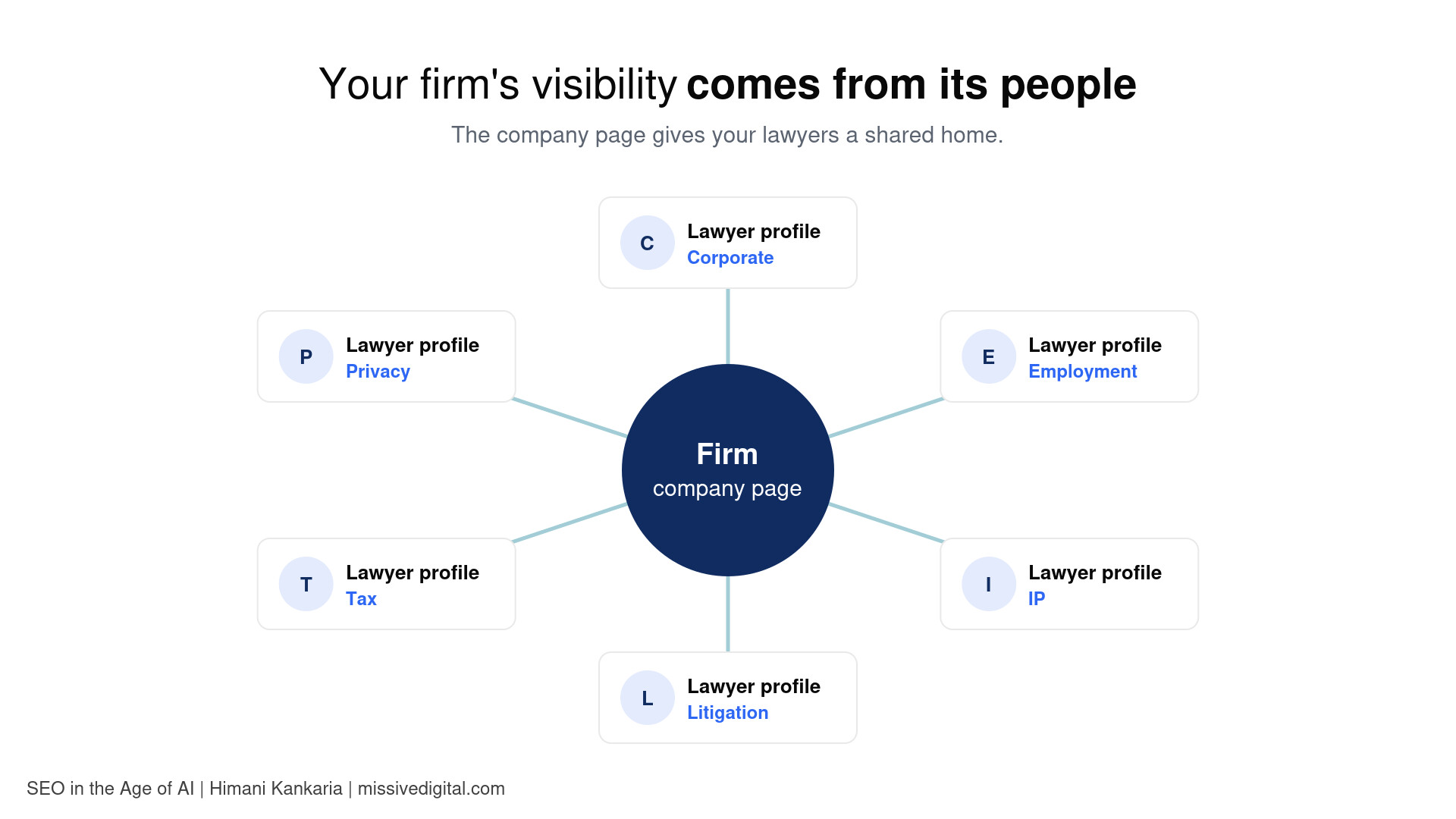
Once individual lawyers are active, the firm can multiply their reach. A firm’s visibility on LinkedIn comes mostly from its people; the company page gives them a shared home.
Use the Company Page to Support Your Lawyers
Fill in the basics: practice areas, offices, website, and a one-line description of who you serve. Then post client alerts, event announcements, team milestones, and reshares of your lawyers’ best posts.
LinkedIn Pages can also target organic posts by job function, seniority, industry, company size, and location. A labor law update can go to HR leaders, while a fundraising update goes to founders.
For more ways to make a page easy to find and follow, see our 11 social media optimization techniques.
Help Your Team Post Safely
- Write a short social media policy based on the rules in Step 1. Only 40% of lawyers in the ABA’s 2020 Profile of the Profession said their firm had one (Lawyers Mutual).
- Give each lawyer one or two topics that match their practice, so posts don’t overlap.
- Share a monthly list of post ideas so nobody starts from a blank page.
- Agree on who reviews posts before they go live.
Track a Few Numbers That Matter
| What to track | Where to find it | What it tells you |
|---|---|---|
| Who views your profile (titles and companies) | Profile analytics | Whether the right people are checking you out |
| Search appearances | Profile analytics | Whether your headline and skills match how people search |
| Conversations started from posts or comments | Messages | Whether visibility is turning into relationships |
| "How did you hear about us?" answers | Your intake form | Whether LinkedIn is influencing new matters |
Check these once a month. LinkedIn is a relationship channel, and relationships take a few months to show up as new matters.
Your First 30 Days on LinkedIn: A Simple Plan
| Week | What to do |
|---|---|
| Week 1 | Read your bar's rules (Step 1). Update your headline, photo, and banner. |
| Week 2 | Write your About section, add Featured items, skills, and bar admissions. Review your endorsements. |
| Week 3 | Connect with 30 people from your warm network and referral partners. Start commenting 15 minutes a day. |
| Week 4 | Publish your first two posts. Check who viewed your profile. |
After that, keep going with two posts a week for the next 90 days. That’s usually when people start mentioning your posts in conversations.
If billable hours leave no room for this, or several lawyers at your firm need one shared plan, our LinkedIn marketing services and personal branding team can help. Your expertise and voice stay yours; we handle the structure, writing support, and consistency.
Want a second pair of eyes on your LinkedIn profile or your firm’s plan? Book a free 30-minute consultation with our team at Missive Digital.
FAQs About LinkedIn for Lawyers
Not to start. A free account covers your profile, posts, comments, and basic analytics. Premium adds extras like a fuller list of who viewed your profile, which you can try later if you want more data.
Start with your personal profile. People trust and follow people, so personal posts usually reach further. The firm page works best for announcements and for resharing its lawyers' posts.
Yes, as long as your firm's policy allows it. The classmates and peers you connect with now become in-house counsel, founders, and referral sources later. Start by explaining what you're learning in your practice area.
In my experience, expect around three months of consistent posting and commenting before you notice more profile views, conversations, and mentions. Referral work usually follows after that.
For general topics, yes, as long as you edit the draft into your own voice. Never paste client names or matter details into an AI tool, because your confidentiality duties still apply.