
Key Takeaways
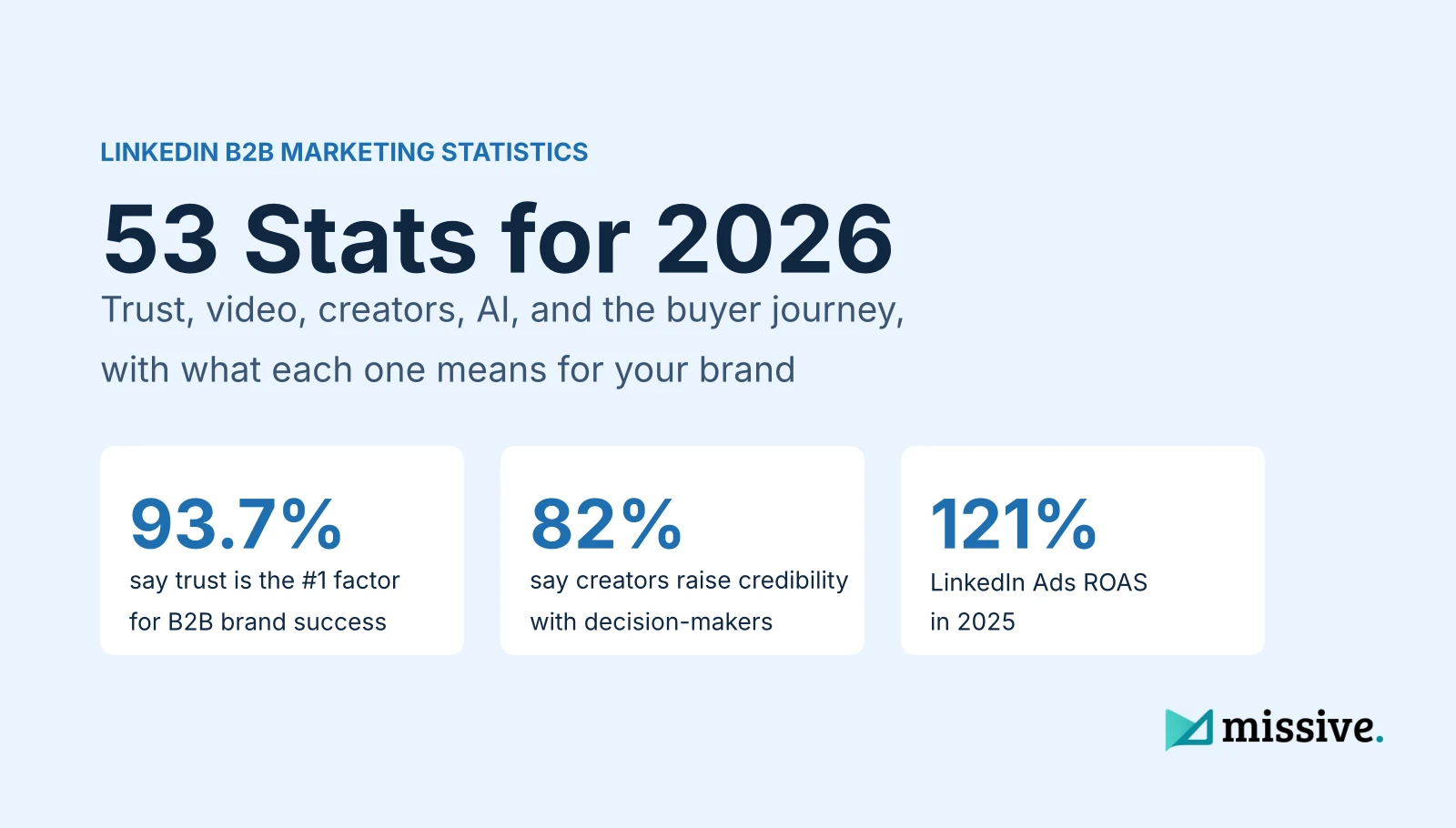
- 93.7% of senior B2B marketers say trust is the most important factor for brand success, and customer recommendations are 3x more influential than being competitive on price.
- Marketers rate being a trusted brand in your category 2x more important than being a household name.
- 82% of B2B marketers say creators increase credibility with decision-makers, and 56% of buyers who use creators check them in the final stage of buying.
- LinkedIn Ads returned 121% ROAS in 2025 as per Dreamdata, while 81% of the buyer journey now happens before sales even gets involved.
- 95% of B2B marketers use AI every week, but only 32% say their AI skills are extremely good.
While going through LinkedIn and Ipsos’s 2025 Influence Report, one number made me stop and read it again. 1,500 senior B2B marketers said being recommended by customers is 3x more influential than being competitive on price.
Honestly, I wasn’t surprised. In my 15 years of working with SaaS, IT, telecom, and eCommerce businesses, I’ve seen buyers trust what their peers say about a brand much more than what the brand says about itself.
At Missive Digital, we’ve always believed that it was never Google or SEO that generated leads on your website. It was the trust people had in Google. When Google showed your website on page one, people trusted Google’s choice, so they trusted you enough to fill out your form, and that’s how we all eventually started seeing organic leads.
For example, for an Odoo and Shopify implementation company, we focused on high-intent content and commercial keywords, and the website started generating qualified leads from businesses in 10+ countries.
That’s also why, at Missive Digital, we’ve always focused on leads, not rankings.
Now the same thing is happening everywhere else. Buyers trust what their peers, creators, and even AI assistants say about you. So doing business today is all about trust, and the numbers from 2025 and 2026 prove it.
So I’ve put together 53 LinkedIn B2B marketing statistics from 2025 and 2026, that show how much trust drives B2B buying today, grouped by the decision they help you make. With each one, you’ll see what it means for your brand, and at the end of every group, what we at Missive Digital recommend you do about it.
B2B Brand Trust Statistics: Why Being Known in Your Category Wins
Stats 1 to 12 are from LinkedIn and Ipsos’s 2025 B2B Marketing Benchmark: The Influence Report, published in June 2025. Ipsos surveyed 1,500 senior B2B marketers across the US, UK, Germany, Brazil, India, and Australia (250 from each country) between March 7 and April 7, 2025. Stat 13 is from LinkedIn’s 2026 Global B2B Marketing Outlook.
1. 93.7% of B2B marketers say trust is the most important factor for B2B brand success
Only 1% disagreed. So if your campaign briefs still start with “increase awareness” or “generate leads,” add one more line to every brief: which trust signal is this campaign building?
For example, most B2B businesses exhibit at the same industry expo year after year. Not every expo brings deals, but showing up consistently in front of the same buyers builds trust.
2. 35.8% rank customer recommendations as the top trust factor, while only 10.1% pick "category famous"
Peer recommendations came second at 15.9%. Now here’s what I found interesting. When asked directly, marketers didn’t rate “category famous” highly. But the two things they ranked on top, customer and peer recommendations, are exactly how a brand becomes famous in its category. In short, marketers don’t call it category fame, but that’s what they’re betting on.
For example, today most B2B businesses get the bulk of their leads from referrals and not from any inbound channel. That doesn’t mean inbound doesn’t work. It means a recommendation is what makes a buyer finally pick up the phone.
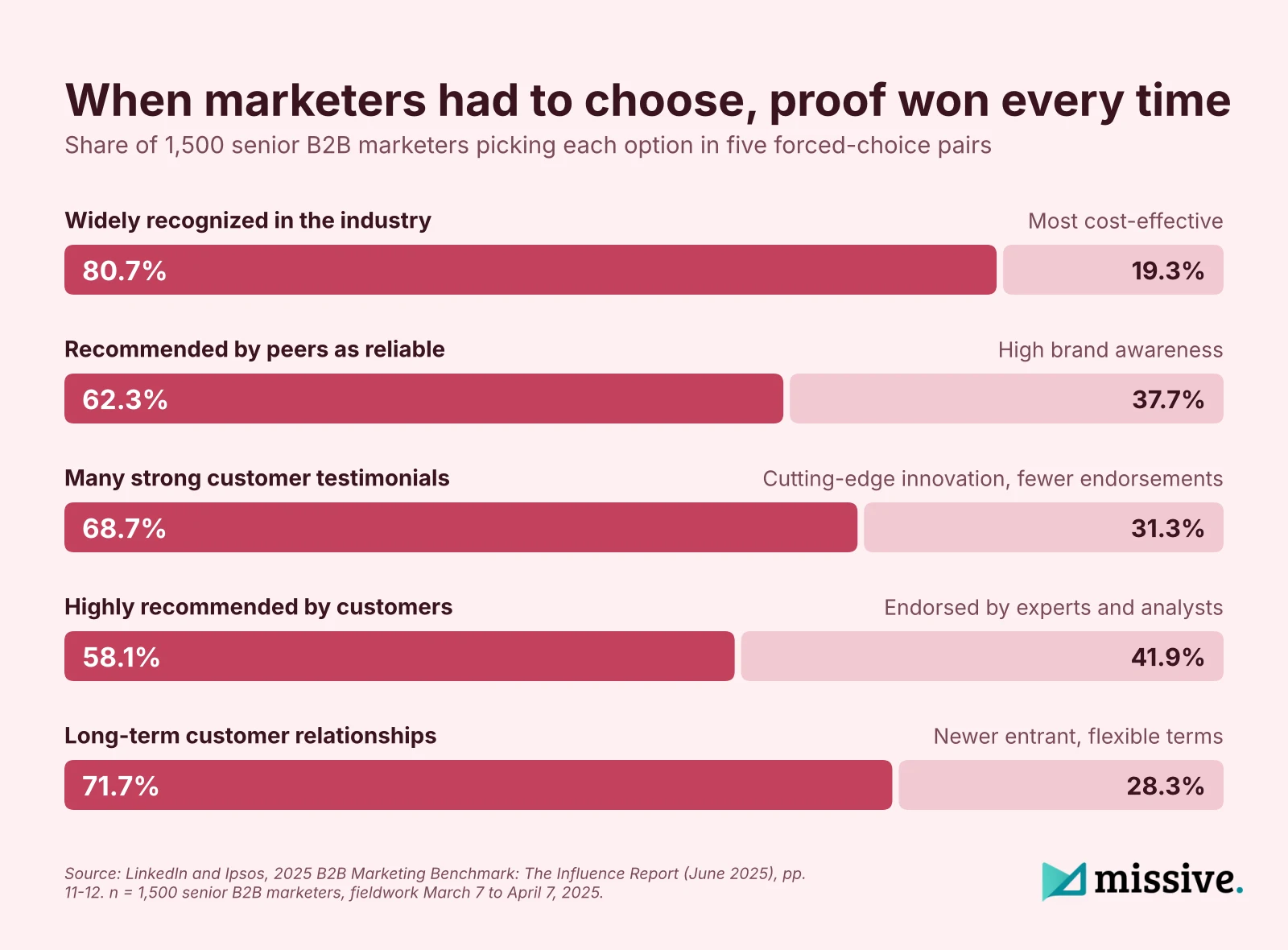
3. Customer recommendations are 3x as influential as being competitive on price
If your sales team keeps offering discounts to close deals, show them this stat. One customer explaining how you solved their problem reduces the buyer’s risk more than a lower quote does.
For example, when a CFO compares two IT vendors, the one whose existing client happily takes a reference call usually wins, even if its quote is a little higher.
4. 80.7% would rather be widely recognized in their industry than be the most cost-effective option
When marketers had to choose between the two, recognition won by more than 4 to 1. Think about it from the buyer’s side: it’s much easier to get a known brand approved internally than the cheapest one nobody has heard of.
For example, a procurement team choosing a payroll or cloud provider will usually shortlist the name everyone in the industry knows before they even look at the cheapest quote.
5. 62.3% value being recommended by peers over having high brand awareness
Awareness helps buyers know you exist. But when a peer tells them you’re reliable, that’s when you get shortlisted.
For example, a founder who asks in a WhatsApp group of other founders, “Which agency did you use for this?” is far more likely to act on those replies than on a banner ad they’ve seen ten times.
6. 68.7% prefer strong customer testimonials over cutting-edge innovation with less proof
If you’re launching a new product or feature, don’t wait six months to collect testimonials. Plan your first two or three customer stories along with the launch.
For example, when a SaaS company launches an AI feature, a two-line quote from an early customer on how much time it saved them does more than a launch video full of buzzwords.
7. 58.1% say customer endorsements are worth more than analyst endorsements
Both matter, but buyers trust people who actually use the product a little more than people who review it. This is good news for smaller brands that don’t have analyst coverage yet.
For example, many software buyers read G2 or Capterra reviews from people in a similar role long before they open an analyst report.
8. 71.7% trust brands with long-term customer relationships over newer entrants with flexible terms
So show how long your customers stay with you, not just how many logos you have. For example, “our average client has been with us for X years” tells a buyer a lot more than a logo wall.
For example, when a logistics or telecom company says it has worked with the same clients for eight to ten years, buyers read that as proof the service actually holds up.
9. 30% say generic positioning is the biggest barrier to a trusted B2B brand
Low awareness among buyers (28%) and too few credible case studies or testimonials (27%) came next. Two of these three can be fixed without any new budget: clearer positioning and better use of the proof you already have.
For example, if your homepage says “end-to-end digital solutions,” so do the homepages of a hundred other agencies. A line like “SEO for SaaS companies selling to the US” tells the right buyer instantly that you’re for them. When a new fintech app for IPO bidding and gold investing came to us with no brand identity, we built its brand guidelines from scratch before posting anything, and monthly LinkedIn impressions grew 24x within three months.
10. 24% say they have no customers willing to advocate for them
Another 22% said their executives lack a clear market perspective, and 21% said they lack third-party endorsements. Customers rarely advocate on their own. Someone has to ask them and make it easy for them to say yes.
For example, many happy clients will say great things about you on a call, but they’ll never write a review unless you send them the link and a few prompts on what to cover.
11. Being known as a trusted brand in your category is 2x more important than being a household name
This is the finding behind the report’s title, “Be Category-Famous.” Being famous outside your category costs a lot and reaches people who will never buy from you. Being trusted inside it is what gets you shortlisted.
For example, a manufacturing ERP brand doesn’t need a TV ad. It needs every plant head and CFO in its industry to have heard its name from a peer, at a trade fair, or in an industry magazine.
We’ve seen this at Missive Digital too. We’re not a household name, and we don’t need to be. But in the circles that matter to us, people know us as “the content people” and for marketing strategy, and that’s what brings the right conversations to us.
12. Being named the top solution by analysts gives the biggest mid-funnel edge (37.9%)
Video testimonials (34.3%) and written testimonials (34.1%) came close behind. Expert endorsements were also 1.7x more likely to give a brand the edge over a competitor than the company’s own written content. So your own blog alone won’t do it; you need others talking about you too.
For example, enterprise buyers often build their shortlist from an analyst ranking first, then watch customer video testimonials to decide whom to call.
13. 77% of B2B marketers say buyers need to trust and know a brand before they engage
This is from LinkedIn’s 2026 Global B2B Marketing Outlook, a YouGov survey of 1,299 B2B marketers in the US, UK, France, Germany, and India, conducted between January 14 and February 5, 2026. A year after the Influence Report, the message is the same: buyers decide whether they trust you long before they fill out your contact form.
For example, before a buyer fills out your contact form, they’ve probably checked your founder’s LinkedIn profile, read your Google reviews, and asked someone they know about you.
What We Recommend: Make Category Fame a Written Goal
The report says marketers undervalue category relevance as a goal, even though they bet on the tactics that build it. So let’s make it official. Here’s what we recommend at Missive Digital:
- Define your category the way your buyer would say it. “Performance marketing for telecom brands” is something a buyer can recommend you for. “Digital marketing” is not. For us at Missive Digital, it’s “marketing strategy” and “content.”
- List all the proof you already have. Case studies, testimonials, reviews, analyst mentions, customer quotes, and where each one is published. Most teams find they have more proof than they’re actually using.
- Ask for recommendations at the right moment. When a customer hits a milestone, ask them. Share a short draft they can edit, or offer a 15-minute recorded call instead of asking them to write a quote.
- Track it every month. The report suggests counting peer endorsements, testimonials published, and customer co-marketing pieces. I’d add one more: how often prospects mention a referral on discovery calls.
If you’re a CEO or marketing head wondering about the cost, this is mostly your team’s time. In our experience, a proof inventory can take about a week, and getting the first two or three customer stories live can take a month of follow-ups. You can read more of my thoughts on trust and content in my Search Engine Journal articles.
B2B Video Marketing Statistics: Why Short, Human Videos Win
Stat 14 is from the Influence Report. Stats 15 to 19 are from LinkedIn and Ipsos’s 2025 B2B Marketing Benchmark: Video and Influence (July 2025, same 1,500 marketers), which also includes LinkedIn’s analysis of more than 13,000 B2B video ads. Stat 20 is from the 2026 Global B2B Marketing Outlook.
14. Company explainer content is 20% more effective as video than as text
Same message, just a different format, and you get 20% more impact. So if you already have a blog post that explains your product well, start there. Turn it into a two-minute video before you script anything new.
For example, a two-minute screen recording of how your product solves one problem usually gets watched and shared internally more than the 1,500-word blog explaining the same thing.
15. 78% of B2B marketers use video, and 56% plan to make more of it
If almost everyone is doing video, having video doesn’t make you different anymore. What makes you different is what you say in it and who says it.
For example, ten SaaS brands in your space are probably posting product demos already. The one where the founder explains a real customer problem in plain words is the one people remember.
16. 41% of marketers say short-form social video delivers the highest ROI
Brand storytelling (38%) and testimonials and product demos (34%) came next. In short, keep it short, tell a story, and show proof.
For example, a 45-second clip of a customer explaining what changed after working with you often brings in more DMs than a polished three-minute brand film.
17. 73% of video completions depend on creative decisions, not production budget
Creative choices also explained 49% of engagement rates in LinkedIn’s analysis of over 550,000 video frames. So a clip shot on your phone with a strong first three seconds can do better than an expensive production that takes too long to get to the point.
For example, a phone-shot video of your engineer opening with “Here’s why your calls drop at 2 PM every day” can beat a studio ad that opens with your logo and tagline.
What other experts recommend: William Kast, a performance marketer, says the same thing about paid social. In this Short, he talks about why creative is the new targeting, which matches what LinkedIn found.
Video: William Kast, Creative Is the New Targeting With Meta Ads, on YouTube Shorts
18. Video lifts brand favorability by 26% and purchase intent by 19% compared with static content
If you’re still running mostly single images and carousels, these two numbers are enough to make the case for testing video this quarter.
For example, run the same LinkedIn campaign as a static image and as a 20-second video of your customer talking, and compare how many people remember your brand afterwards.
19. Short-form videos get 17% higher completion rates, and emotionally resonant ones double completions
Emotionally resonant videos also got 44% higher view-through rates. B2B buyers are humans too. A customer talking about how relieved they were when a problem got solved will hold attention far longer than a list of features.
For example, a hospital IT head describing how stressed the team was before a system went live, and how calm things were after, holds attention far longer than a feature list.
20. 81% of B2B CMOs say video accelerates sales cycles compared with other formats
Another 79% say video speeds up lead conversion, as per LinkedIn’s March 2026 update on creators and video. So CMOs are now looking at video as a sales tool and not just a branding tool.
For example, many sales teams now send a short personalized video after a discovery call to recap the proposal. Your champion can forward it to their boss without having to explain everything again.
What We Recommend: Turn Your Proof Into Short Videos
The numbers are clear. Short, human videos with real proof work better than polished product videos. And you don’t need a big studio budget to start. Here’s what we recommend:
- Start with the questions buyers already ask. Pick five questions from your sales calls and answer each one in a 45 to 90 second vertical video. Good scripts need the same buyer research as good content writing.
- Put a real face on camera. A founder, a subject-matter expert, or a customer talking straight to the camera feels like advice. A voiceover on stock footage feels like an ad. For an AI handwriting analysis startup, we put the founder on camera and built the content around curiosity, and Facebook impressions grew about 40x and Instagram about 6x in four months.
- Repurpose your best explainer blog first. Stat 14 says the video version is 20% more effective, and the thinking is already done.
- Check the first three seconds before anything else. If the opening doesn’t name the problem, re-edit it before you spend a single rupee or dollar on promoting it.
Budget-wise, a smartphone, a clip-on mic, and a few hours of an editor’s time every week are enough to test this for a quarter. Track completion rates and replies from your target accounts, not just views.
B2B Creator Marketing Statistics: Who Buyers Actually Listen To
Stats 21 to 25 are from the Video and Influence report (July 2025). Stats 26 to 28 are from LinkedIn’s 2026 Global B2B Marketing Outlook.
21. 55% of B2B marketers already work with creators or influencers, and 29% more plan to start within a year
If both groups follow through, more than eight in ten B2B marketers will be working with creators. So the real question for 2026 is not whether to use creators, but which ones.
For example, many B2B SaaS brands now sponsor a niche LinkedIn creator’s newsletter or podcast episode instead of buying another round of display ads.
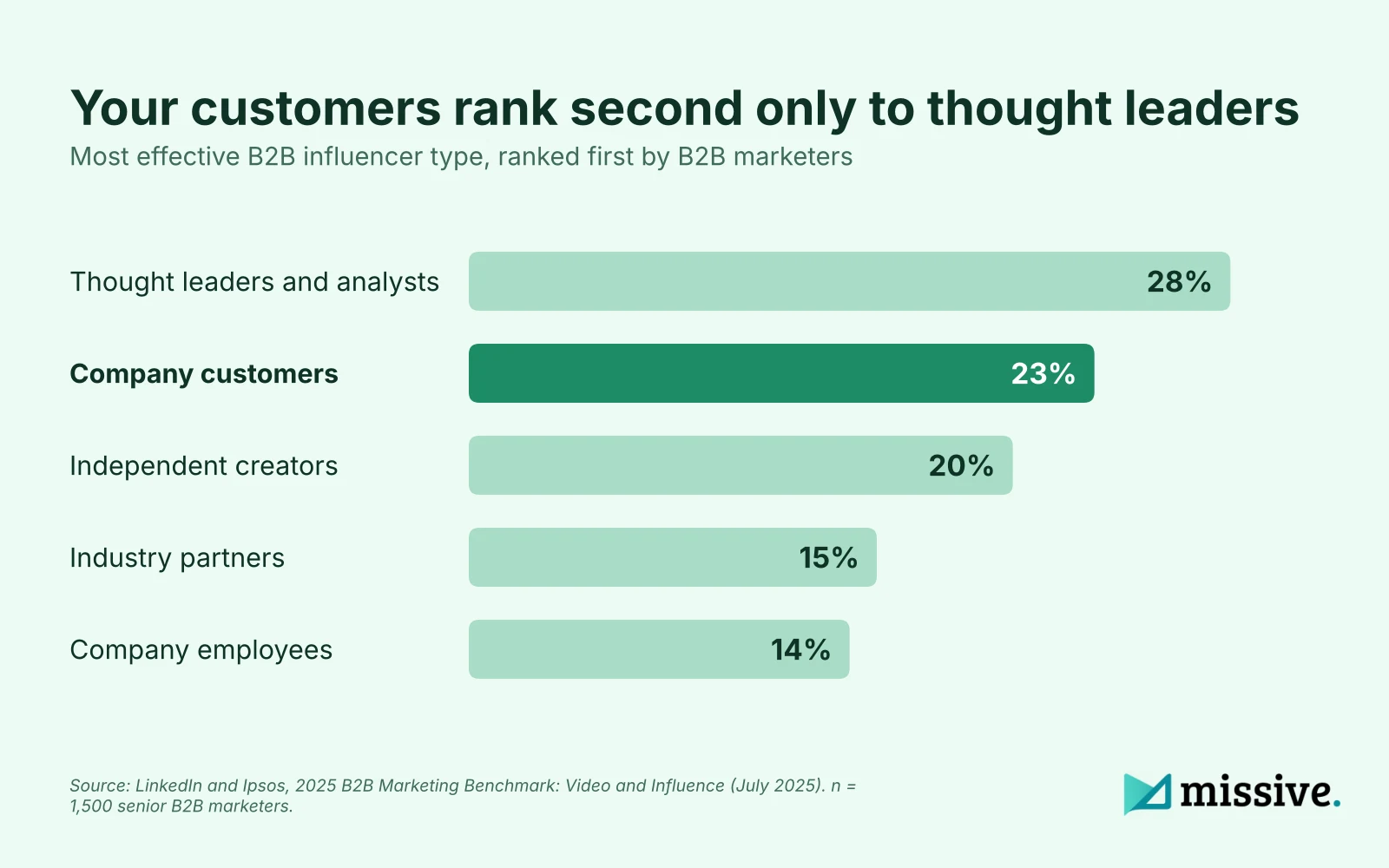
22. Thought leaders and analysts are rated the most effective B2B influencers (28%), followed by customers (23%)
Independent creators came third (20%), then industry partners (15%) and employees (14%). Look at number two again. Your own customers are rated almost as effective as experts, and most brands hardly use them.
For example, a customer who posts on LinkedIn about how your tool cut their reporting time in half reaches exactly the peers you want, often better than a paid creator would.
23. 58% choose creators for authenticity and credibility, ahead of industry relevance (49%) and brand alignment (47%)
Follower count didn’t even make it to the top of the list. For a B2B brand, a practitioner with 4,000 of the right followers is worth more than a generalist with 400,000.
For example, if you sell to CFOs, a finance leader with 5,000 CFO followers will do more for you than a lifestyle influencer with a million followers.
24. 71% say a recommendation from a subject-matter expert creator influences brand success
In the same survey, 76% of marketing leaders said working with creators builds brand authenticity. So when you pick creators, look for expertise first and reach second.
For example, a cybersecurity expert reviewing your product on LinkedIn carries more weight with IT buyers than any ad you could run.
25. Marketers using creators report lifts of 39 points in brand awareness and 30 points in leads and revenue
These are self-reported differences between marketers who use creators and those who don’t. So take them as a direction, not as a promise for your account.
For example, if you test creators for a quarter, compare the reply rate from target accounts who saw the creator content with those who didn’t before you decide to scale.
26. 82% of B2B marketers say creators increase credibility with decision-makers
LinkedIn launched its own Creator Marketplace in June 2026, and this was one of the reasons. When a platform builds a whole product around something, you know it’s not an experiment anymore.
For example, when a respected industry voice mentions your brand in a post, prospects often bring it up on your next sales call without you asking.
27. 56% of B2B buyers who use creators rely on creator input in the final stage of buying
Many marketers think creators are only for awareness. But more than half of these buyers check what a trusted creator says right before they sign. That’s where one honest review can save a deal.
For example, just before signing, a buyer might search YouTube or LinkedIn for an honest review of your tool. If a credible creator has already made one, that can close the deal for you.
28. 81% of B2B marketers who use creators say pulling back would leave revenue on the table
Once teams see creator content bringing in pipeline, they stop looking at it as a branding expense.
For example, teams that track creator content all the way to pipeline usually find a few deals they would otherwise have credited to “direct” or “referral.”
Don’t just take my word for it. LinkedIn itself put out this 35-second video on how video and creators build trust in B2B marketing, and it’s a quick watch to share with your team if they still see creators as a B2C thing.
Video: LinkedIn for Marketing, The Influence Effect: How Video and Creators Build Trust in B2B Marketing, on YouTube
What We Recommend: Start With the Creators You Already Have
Stat 22 is the one most brands skip. Your customers and employees together rank higher than independent creators, and they cost much less to work with. Here’s what we recommend:
- Make a list of your in-house voices first. Customers who have praised you publicly, employees who have a following in your niche, and partners you sell with. If your sales team isn’t posting yet, start with our 7-step framework for building thought leadership on LinkedIn.
- Pick external creators for credibility, not reach. Use the report’s own criteria: authenticity, industry relevance, brand fit, and subject-matter expertise. Ask them for their audience’s job titles, not their follower count.
- Brief them for the final stage too. Stat 27 says buyers check creators right before signing, so ask for honest comparisons and implementation stories, not only launch posts.
- Boost what works with Thought Leader Ads. LinkedIn lets you promote a person’s post instead of a company post, so you keep the human voice that got the engagement in the first place.
If you’re just starting, work with two or three niche creators for one quarter and test one clear question, like “Does creator content increase replies from our target accounts?”
Thought Leadership Statistics: How to Reach the Buyers You Never Meet
Stats 29 to 33 are from the 2025 Edelman-LinkedIn B2B Thought Leadership Impact Report, the seventh edition of this study, which surveyed 1,934 business executives between March 17 and April 3, 2025. Stats 34 and 35 are from LinkedIn’s 2026 Global B2B Marketing Outlook.
Before we get into the numbers, let me explain who hidden buyers are. They are the people in a buying group who influence the decision but rarely meet your sales team: finance, legal, procurement, IT, and the end users who will actually use your product.
29. More than 40% of B2B deals stall because the buying group cannot agree internally
Edelman cites this from Matthew Dixon’s research on buyer indecision. Many of these deals get stuck in meetings you’re never invited to.
For example, your champion in marketing loves your proposal, but the deal sits for three months because finance and IT were never convinced.
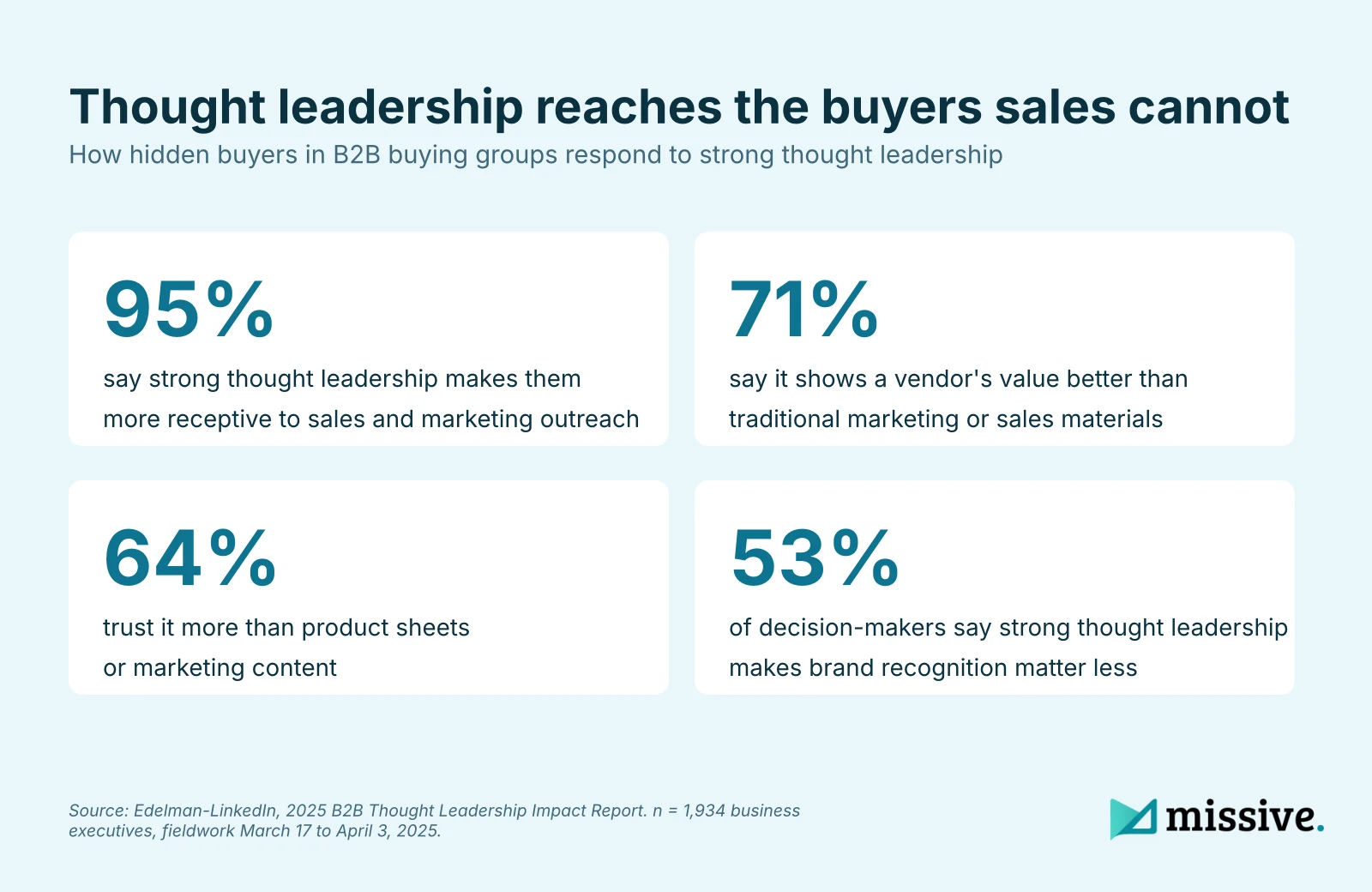
30. 95% of hidden buyers say strong thought leadership makes them more receptive to sales and marketing outreach
Edelman’s article on hidden buyers explains this well. If the people who can block your deal won’t take a sales meeting, your ideas need to reach them first.
For example, an IT head who has read two of your founder’s practical posts on data security is much more likely to accept a meeting than one who only gets a cold email.
31. 71% of hidden buyers say thought leadership shows a vendor's value better than traditional marketing or sales materials
And 64% trust it more than product sheets or marketing content. Your sales deck convinces your champion. Your thinking convinces the people your champion has to convince.
For example, a CFO is more convinced by your article on how to calculate the real cost of switching vendors than by a brochure listing your features.
32. 63% of hidden buyers spend more than an hour a week reading thought leadership
That’s almost the same as target buyers (64%), and 55% of hidden buyers use it to evaluate vendors. So hidden doesn’t mean they’re not paying attention.
For example, the procurement manager you’ve never met may already be subscribed to your CEO’s LinkedIn newsletter.
33. 53% of decision-makers say strong thought leadership makes brand recognition matter less
This one is for smaller brands. If your ideas are strong, you can compete with the big names even before the buyer makes a shortlist.
For example, a 50-person consulting firm that publishes sharp, data-backed opinions can get shortlisted right next to a Big Four firm.
34. 83% of B2B marketers say credibility matters more than traditional brand messaging
A polished brand line doesn’t build trust the way it used to. A clear, specific opinion from a real person does.
For example, a founder posting “Here’s the mistake we made with our pricing and what we changed” earns more trust than a tagline like “Innovation that empowers.” We saw this with a fintech founder whose LinkedIn was run by an internal team and didn’t sound like him. Once we started writing his own opinions in his voice, two posts alone generated 267,000+ impressions, all from people outside his network.
35. 70% of marketers say buyers rely more on peer voices and experts than on brand-produced content
This is the 2026 version of what the Influence Report found. Buyers listen to people. So your brand needs people that buyers actually want to listen to.
For example, before choosing a CRM, most buyers ask peers in communities or check what practitioners say on LinkedIn before they read the vendor’s own website.
If you want to go deeper, this session from LinkedIn’s own marketing team covers how B2B brands can use thought leadership when markets are tough and budgets are under pressure. It’s about 13 minutes, so save it for when you’re planning your content calendar.
Video: LinkedIn for Marketing, B2B Success: Leveraging Thought Leadership in Challenging Markets, on YouTube
What We Recommend: Give Your Leaders a Point of View Worth Sharing
Remember stat 10? 22% of marketers say their executives lack a clear market perspective. Thought leadership fixes that, but only when it says something the buyer hasn’t already heard ten times. Here’s what we recommend:
- Pick one belief your leader has that the industry gets wrong. That becomes the backbone of your thought leadership. Everything else supports it.
- Write for hidden buyers, not just your champion. Add the cost, risk, and implementation details that finance and IT teams look for.
- Publish under a person first, then repurpose under the brand. A LinkedIn post or newsletter from a named expert goes further than a company page post. Then turn it into a blog, a Short, and a sales asset.
- Measure quality, not volume. Track saves, comments from target accounts, and how often prospects mention a post on calls.
If you’re wondering where to start with step 3, here’s a Short from our channel with four simple ways to get noticed on LinkedIn.
Video: Missive Digital, 4 Ways to Get Noticed on LinkedIn, on YouTube Shorts
To be honest, this is exactly how Missive Digital became known as the content people. For years, I’ve been writing for Search Engine Journal and Search Engine Land and speaking at events like BrightonSEO, sharing what we learn from our client work. People started associating us with content and marketing strategy long before they ever hired us.
If your leaders need help building that voice, our personal branding services can help you find that belief and build a publishing rhythm around it.
AI in B2B Marketing Statistics: Everyone Uses It, Few Use It Well
Stats 36 to 40 are from LinkedIn and Ipsos’s 2025 B2B Marketing Benchmark: AI Is B2B’s Next Advantage (August 2025, same 1,500 marketers, surveyed between March 7 and April 7, 2025), which you’ll find on the same LinkedIn research page as the Influence Report.
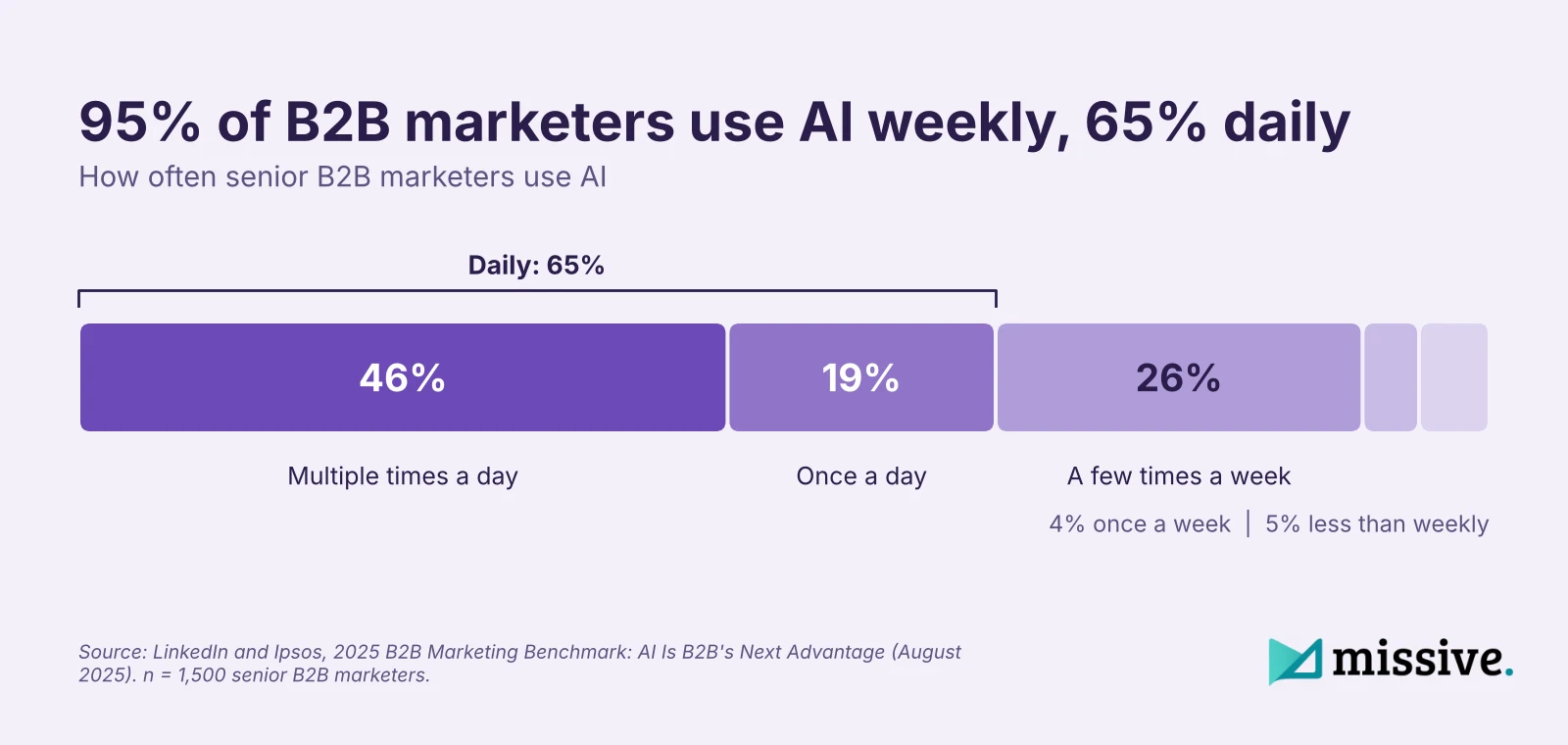
36. 95% of B2B marketers use AI at least weekly, and 65% use it daily
That includes 46% who use it several times a day. And when almost everyone is using AI, using it is not an advantage by itself anymore.
For example, if every agency pitching to you used AI to write its proposal, they’d all sound the same. The one that adds real client results and a clear opinion is the one you’d remember.
37. 86% say they understand how to use AI in marketing, but only 32% rate their understanding as extremely good
Understanding went up by 16 points in a year, but the share of real experts didn’t move at all. Most teams use AI for the obvious tasks and stop there.
For example, many teams use AI to draft LinkedIn posts, but very few use it to analyze which posts actually brought in leads.
38. Marketers save about four hours a week per task area with AI
The time saved is almost the same across research (4.04 hours), content creation (4.03), automation (3.99), data analysis (3.94), and campaign management (3.92). Heavy users save up to about 20 hours a week. The real question is: what is your team doing with those hours?
For example, if AI cuts your research time for a blog from five hours to one, use those four hours to interview a customer or your sales team for real insights.
39. Marketers who use AI in strategy, and not just execution, report 13% revenue growth and 13% cost savings
These numbers are self-reported, but the pattern makes sense. The gains come from using AI to decide what to do, not just to produce more of the same.
For example, running your last 50 sales call transcripts through AI to find the questions buyers ask most can tell you exactly what content to create next.
40. 54% say training and upskilling would help them get more from AI
Better tools (52%) and better data quality (47%) came next. So the bottleneck is skill. If you buy tools without training your team, you’re mostly paying for licenses nobody uses well.
For example, a one-hour session where your team uses AI on your actual briefs and brand guidelines helps more than a generic online course on prompts.
What We Recommend: Use AI for Speed and Humans for Proof
AI can draft, research, and summarize. But it can’t create a customer story, a first-hand test, or an opinion your leader actually holds. And those are exactly the trust signals we’ve talked about in every group above. I’ve also explained this in detail in my blog on how to actually humanize AI content. Here’s what we recommend:
- Spend the saved hours on proof. If AI saves your team 20 hours a week, put some of those hours into customer interviews and original data.
- Train your team on your own workflows. Generic AI courses help less than a session built on your actual briefs, brand voice, and review process.
- Review every AI-assisted piece before it goes live. Check facts against the original sources, add first-hand experience, and remove the generic lines. Our free Content QA Checklist is a good place to start.
- Use AI before you create, not just while you create. Use it to analyze win-loss notes, sales call transcripts, and search data to decide what content to make. Stat 39 says that’s where the returns are.
LinkedIn Ads and Buyer Journey Statistics: Where Your Deals Really Start
Stats 41 to 47 are from Dreamdata’s LinkedIn Ads Benchmarks Report 2026, published in March 2026 and based on their customers’ data across 66 million sessions and 3.5 million customer journeys. Just so you know, Dreamdata is a LinkedIn Marketing Partner.
Stats 48 to 50 are from Oktopost’s B2B LinkedIn Benchmark Q1 2026, where every number is backed by at least 10 companies.
41. LinkedIn Ads returned 121% ROAS in 2025, up from 113% in 2024
In the same data, Google Search returned 67% and Meta 51%. So for B2B budgets that are being questioned every month, LinkedIn was the only major platform that paid back more than it cost.
For example, a SaaS company might pay more per click on LinkedIn than on Google, but its LinkedIn leads come from the job titles that actually sign contracts.
42. LinkedIn now takes 41% of total B2B ad budgets
That’s up 2 points in a year, while non-branded search budgets dropped from 37% to 33%. Budgets are simply going where the returns are.
For example, many B2B teams that used to put most of their budget into generic search keywords are now moving part of it to LinkedIn, where they can target by job title and company.
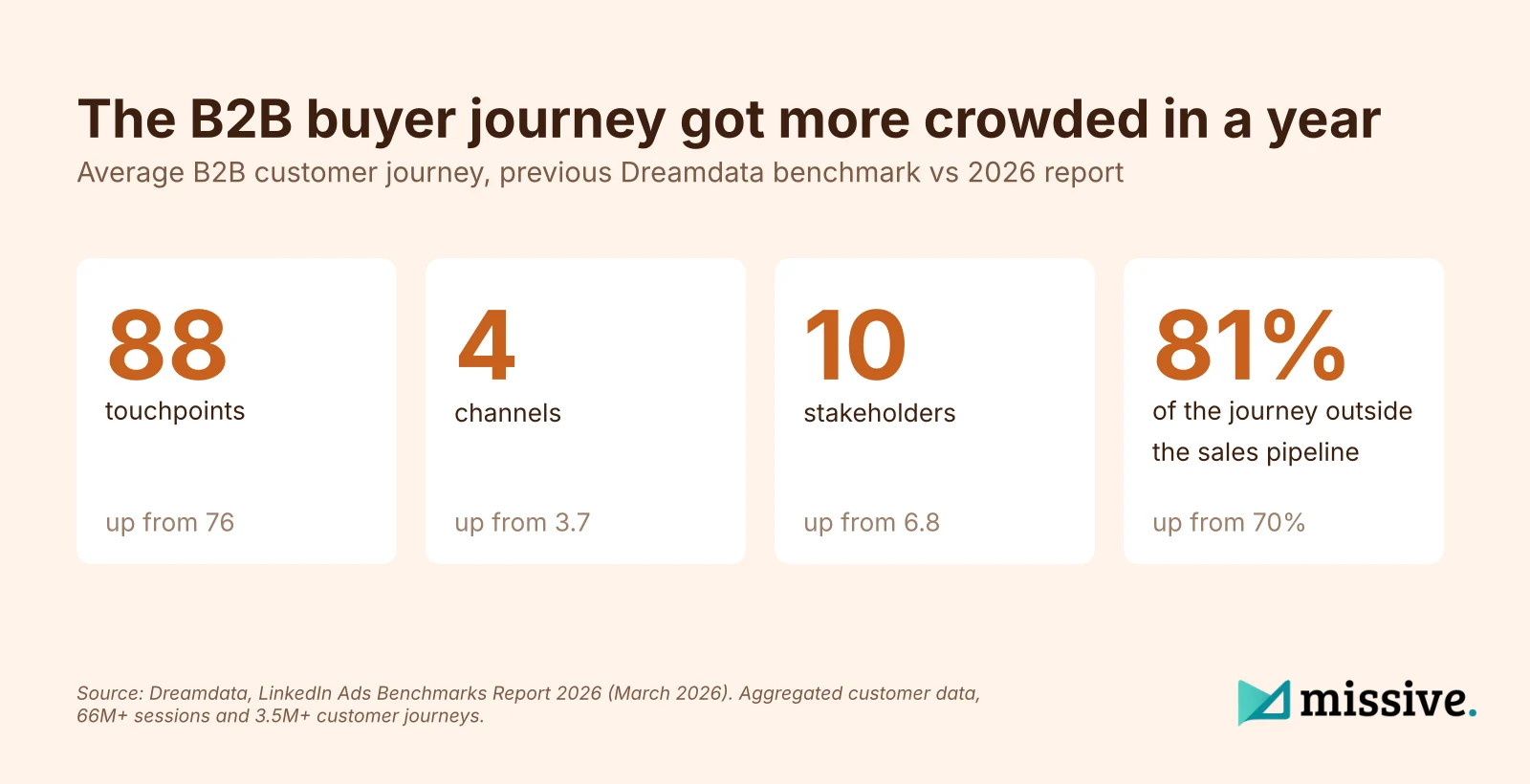
43. 81% of the B2B customer journey now happens outside the sales pipeline
A year ago, it was 70%. Most of the buying decision is being made in places your CRM never sees: peer conversations, communities, podcasts, and social feeds.
For example, a buyer might first hear about you on a podcast, discuss you in a private Slack group, and then search your brand name. Your CRM will only show “organic search.”
What other experts recommend: Chris Walker has been talking about this “dark social” activity for years and how that’s where B2B demand is actually created. In this two-minute video, he explains what dark social is, which is worth watching if your team still gives all the credit for a deal to the last click.
Video: Chris Walker, What is Dark Social?, on his YouTube channel
44. The average B2B buyer journey now involves 88 touchpoints, 4 channels, and 10 stakeholders
That’s up from 76 touchpoints, 3.7 channels, and 6.8 stakeholders. So more people are involved in every decision, and each of them needs a reason to trust you.
For example, selling HR software to a mid-size company can involve HR, finance, IT, legal, and the CEO, and each of them looks for different proof.
45. LinkedIn Ads appear in 30.2% of SQL-stage sessions and 28.3% of new-business sessions
At the MQL stage, it’s 24.2%. So LinkedIn’s influence actually grows as deals get closer to closing, which is the opposite of what most teams think about a “top of funnel” channel.
For example, once a prospect is talking to your sales team, showing case studies on LinkedIn to them and their colleagues keeps your brand in front of the whole buying group.
46. The first organic company page impression leads to closed revenue in 90 days on average
Compare that with 281 days from the first ad impression. When buyers keep seeing your company page in their feed, deals close faster.
For example, a prospect who keeps seeing your company page posts about client wins and team expertise is already warm by the time they book a call.
This connects to what LinkedIn’s B2B Institute calls the 95:5 rule: at any given time, only a small share of your buyers are in the market, and the rest will buy later. Dreamdata, the same team behind stats 41 to 47, did a full session on why B2B growth starts long before the purchase. It’s about an hour long, so bookmark it for when you have time to go deep.
Video: Dreamdata, The 95:5 Rule: Why B2B Growth Starts Long Before the Purchase, on YouTube
47. LinkedIn costs EUR 70.11 per company influenced, against EUR 128.70 on Meta and EUR 110.37 on Google Search
Yes, LinkedIn’s cost per click (EUR 5.98) looks high next to Meta’s (EUR 1.60). But in B2B, cost per click is the wrong comparison. What matters is how much it costs you to reach an account that can actually buy from you.
For example, 100 clicks from Meta might cost less, but if only two come from companies that can buy from you, LinkedIn’s fewer, better-targeted clicks often turn out cheaper.
48. The median B2B company page engagement rate on LinkedIn was 5.10% in Q1 2026
The top 25% reached 8.61% and the top 10% reached 21.63%. If your page is below 5%, fix the content first, not the posting schedule.
For example, if your page only posts product announcements, try a few posts with client stories or behind-the-scenes lessons and compare the engagement.
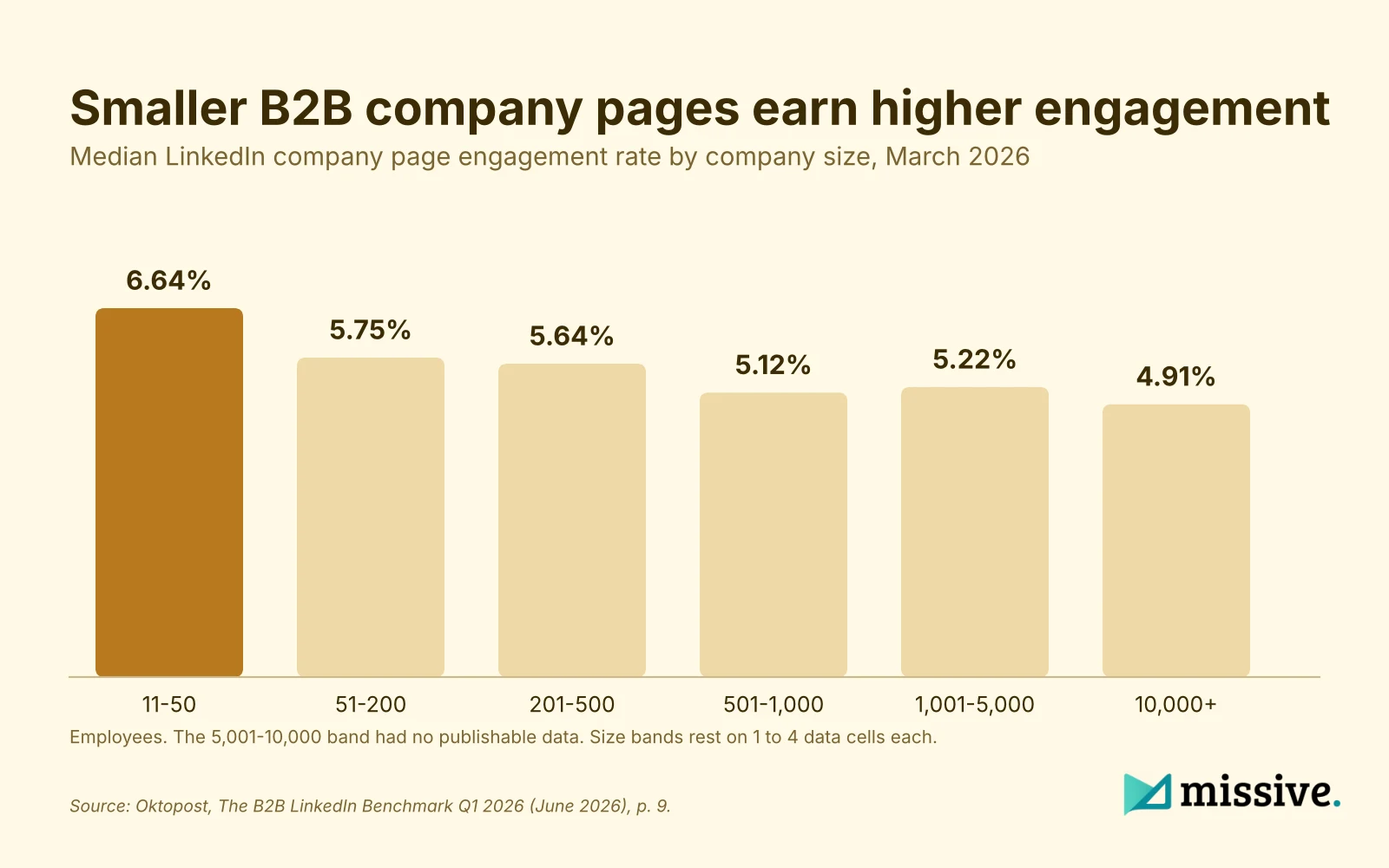
49. Smaller companies get more engagement than enterprises: 6.64% median for 11 to 50 employees against 4.91% for 10,000+
This pattern held in every month of the quarter, though the data for each size band is thinner. So if you’re a small brand with a real voice, you have an advantage here that big brands find hard to buy.
For example, a 30-person agency whose founder and team share honest lessons can get more engagement than a global brand posting press releases.
50. Manufacturing company pages had the highest engagement at 6.99% in March 2026
Financial services (5.98%), technology (5.44%), and business services (4.66%) came next. So the industries people call “boring” on LinkedIn are often the ones where buyers engage the most.
For example, a short video of a machine in action or a plant visit post from a manufacturing company often gets more comments than a SaaS feature update.
What We Recommend: Use LinkedIn Across the Whole Funnel, Not Just for Leads
Together, the Dreamdata and Oktopost numbers tell us one thing: LinkedIn works across the entire buyer journey, and your organic presence and paid ads support each other. Here’s what we recommend:
- Keep your company page and leaders’ profiles active every week. Stat 46 shows organic impressions shorten time to revenue, and stat 49 shows a real voice beats a big team size.
- Measure cost per account influenced, not cost per click. You’ll only see what stat 47 shows when you report this way. For an Italian telecom brand that judged spend on lead volume, we changed what they measured before touching what they spent, and the cost of acquiring a customer fell by 95% on a third less ad spend.
- Plan for 10 stakeholders. Create content for the finance head, the IT reviewer, and the end user, not just the person who downloads your guide.
- Connect LinkedIn engagement data to your CRM. Without it, 81% of the journey stays invisible, and LinkedIn will look weaker than it actually is.
If you want a team to manage all of this for you, take a look at our LinkedIn marketing services.
Network and Community Statistics: Why Buyers Ask People Before Brands
Stats 51 to 53 are from LinkedIn’s August 2025 research release. Censuswide surveyed 19,268 professionals in 14 countries (July 4 to 7, 2025) and 7,000 B2B marketers at middle management or above in 14 markets, including India (July 3 to 15, 2025).
51. 43% of professionals say their network is their number one source of advice at work
They ranked their network above search engines and AI tools. And your buyers are professionals first, so this is how they research vendors too.
For example, when a marketing head needs a new agency, the first thing they usually do is ask their network on LinkedIn or WhatsApp for recommendations.
52. 77% of B2B marketing leaders say buyers vet brands through their networks, not only through company channels
Your website and ads are only one part of what buyers look at. What people in their network say about you is the other part, and many times, it matters more.
For example, even after going through your website, a buyer may message an ex-colleague who has worked with you and ask, “How was your experience with them?”
53. 80% of marketers say they are increasing investment in community-driven content
In the same release, 80% said trusted creators are now essential for credibility with younger buyers. So budgets are moving from talking about yourself to getting the right people to talk about you.
For example, more brands now host closed communities, roundtables, or LinkedIn groups where customers share their experiences, instead of just publishing more blogs.
What We Recommend: Get Recommended by People and by AI
The things that make people recommend you (customer stories, expert mentions, and a consistent point of view) are also what AI assistants look at when they decide which brands to name. We saw this in our own research too, which I’ve shared in our blog on how LLMs decide which brands to recommend.
LinkedIn is saying the same thing. At Cannes Lions 2026, LinkedIn ran a session on how B2B brands can win AI search with creators. It’s about 19 minutes, and it connects the trust you build through people with how AI picks brands.
Video: LinkedIn for Business, How to Win AI Search With Creators, Cannes Lions 2026, on YouTube
But there’s a catch. Ahrefs’ June 2025 study of the domains AI assistants mention most, which covered about 76.7 million Google AI Overviews, found that AI Overviews cite social sites like LinkedIn less than their link profiles would suggest. So LinkedIn builds trust with people, but your proof also needs to live on pages that AI tools can read and cite. Here’s what we recommend:
- Publish your proof on your own website, not just on LinkedIn. Turn each strong LinkedIn post into a page with the case study, the data, and the named expert. For one of the largest IT companies we work with, rebuilding their blogs to be deep, structured, and credibility-first doubled their visibility in ChatGPT, with their content showing up in AI answers across 5 countries.
- Describe your category the same way everywhere. Use the same words on your website, your leaders’ profiles, review sites, and partner pages, so both people and AI can connect the dots.
- Get mentioned in places buyers and AI both trust. Industry publications, review platforms, podcasts, and partner content all count as third-party proof. Remember stat 10: 21% of brands lack it.
- Check what AI says about you today. Ask ChatGPT, Perplexity, and Google AI Mode who they recommend in your category, and note which sources they cite.
And when you start checking what AI says about you (step 4), avoid these common mistakes. We’ve covered six of them in this Short.
Video: Missive Digital, 6 AI Search Tracking Mistakes Brands Still Make, on YouTube Shorts
This is exactly what our AI SEO services focus on: making sure the trust you build with people also shows up when buyers ask an AI assistant for a shortlist.
What These LinkedIn B2B Statistics Mean for Your 2026 Plan
If you look at all 53 numbers together, they point to three decisions for your 2026 plan:
- Invest in getting recommended, not just getting seen. Customer recommendations, peer voices, and credible creators beat awareness, price, and features in almost every study here.
- Treat proof like a production line. Testimonials, customer videos, expert commentary, and first-hand data need an owner, a monthly target, and a budget, just like your ads do.
- Measure the journey you can’t see. With 81% of the journey happening outside the pipeline and 10 stakeholders in every deal, cost per account influenced and referrals mentioned on calls will tell you more than last-click leads.
In short, the brands that win in 2026 will be the ones that buyers, their peers, and AI assistants all name when someone asks for a shortlist. Want to know where your brand stands on the AI side today? Take our free GEO Readiness Score to see how ready your content is to be cited by AI search and where to start.
And if you’d rather talk it through, book a 30-minute call with me. We’ll look at your category, your proof, and your LinkedIn presence together.
FAQs
For most B2B brands, yes. In Dreamdata's 2026 benchmark, LinkedIn Ads returned 121% ROAS in 2025 while Google Search returned 67% and Meta 51%, and LinkedIn's share of B2B ad budgets rose to 41%. Organic presence matters too: the first organic company page impression led to closed revenue in 90 days on average.
Oktopost's Q1 2026 benchmark puts the median B2B company page engagement rate at 5.10%, with the top quartile at 8.61%. Smaller companies (11 to 50 employees) had a higher median, 6.64%, than enterprises with 10,000+ employees (4.91%).
It means being the brand people inside your category know, trust, and recommend, even if the wider public has never heard of you. LinkedIn and Ipsos found marketers rate being known as a trusted brand in the category more than twice as important as being a household name.
Increasingly, yes. In LinkedIn's 2026 Global B2B Marketing Outlook, 70% of marketers said buyers rely more on peer voices and experts than on brand-produced content, and 82% said creators increase credibility with decision-makers.
Dreamdata's 2026 data shows an average of 281 days from a buyer's first LinkedIn ad impression to closed revenue, with 88 touchpoints, 4 channels, and 10 stakeholders involved. About 81% of that journey happens outside the sales pipeline.
LinkedIn and Ipsos found that 95% of senior B2B marketers use AI at least weekly and 65% use it daily. Only 32% rate their understanding of AI as extremely good, so depth of use, not adoption, is now the gap.