
Key Takeaways
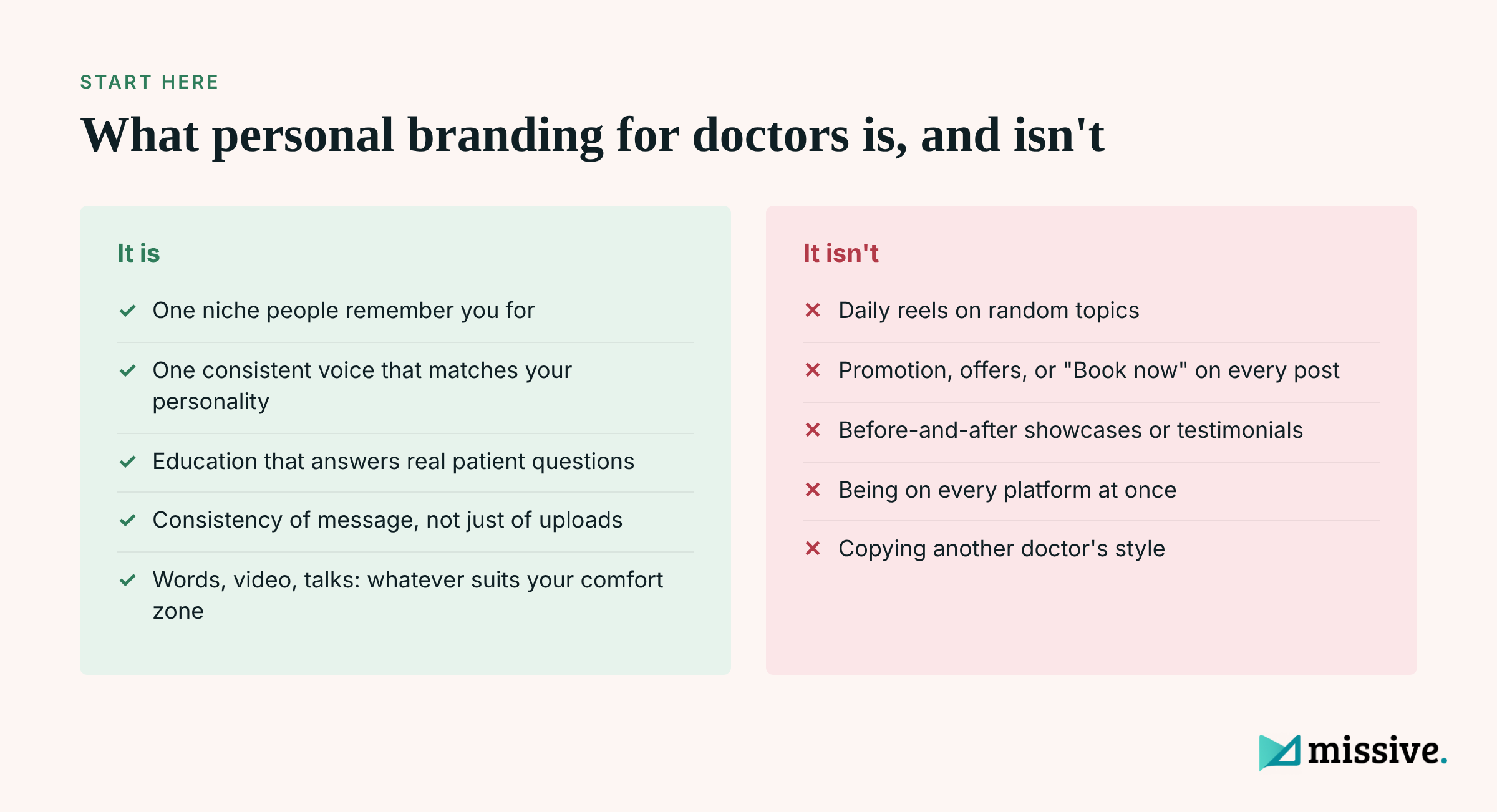
- Personal branding for doctors is how you want patients, peers, and search engines to remember you. Posting a reel every day is not a brand.
- Patients trust people before they trust clinics: in a 2025 rater8 survey, 35% of US adults said they had chosen a doctor based on the doctor’s social media presence.
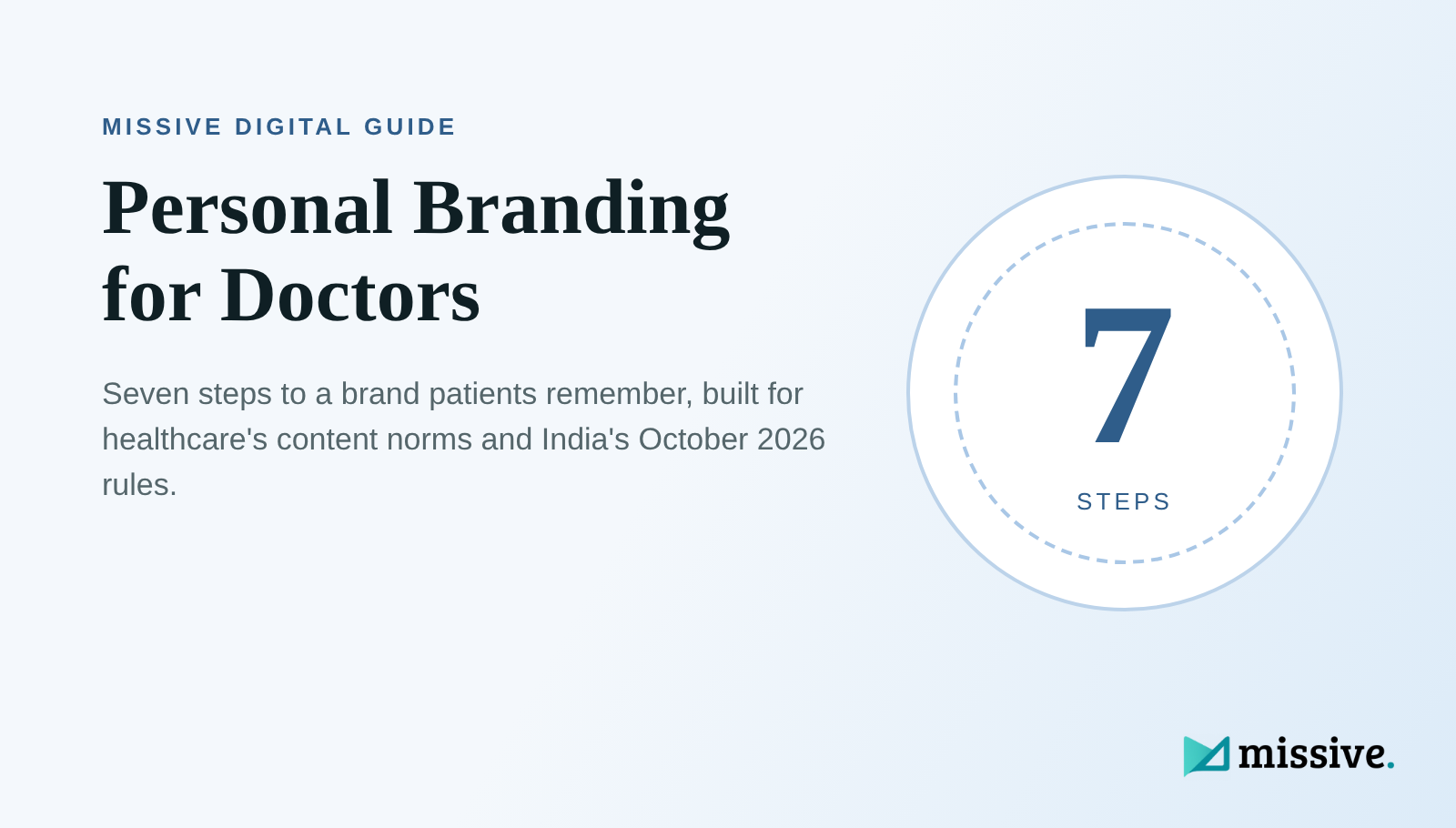
- Build it in seven steps: fix your niche, define your personality traits, set one branding goal, pick one or two channels, align with your clinic, plan education-first content, and track four basic metrics.
- India’s rules changed in October 2026. The NMC and the National Dental Commission now bar before-and-after photos, patient testimonials, procedure livestreams, AI-made patient stories, and “No. 1” or “100% success” claims. Education-led branding is the safe and effective path.
- Use AI as a support for drafts and ideas, never as a substitute for your clinical voice or your patients’ real experiences.
“Daag achhe hain.” “Kya aapke toothpaste mein namak hai?” When I put these taglines on screen at Ahmedabad Dental College, the room named every brand in seconds. Then I showed photos of well-known founders and creators, and the room named them just as fast. Nobody needed a logo. They remembered the person.
That is the job of a personal brand, and doctors need one more than most professionals. Patients don’t just trust a clinic; they trust the doctor behind it. In a 2025 rater8 survey of more than 1,000 US adults, reported by Medical Economics, 84% checked reviews before booking and 35% had chosen a physician based on the doctor’s social media presence.
Two things pushed me to turn that session into this guide. First, I see the same split in every room of doctors. A few are not camera shy, so they keep posting. Many others feel awkward on camera, aren’t comfortable putting themselves out there, and hold back, especially because healthcare has its own norms about what kind of content belongs on Instagram or LinkedIn. Second, in October 2026 the National Medical Commission (NMC) and the National Dental Commission turned many of those norms into formal rules. Some tactics that worked a year ago can now cost you your registration.
So this guide does two things. It walks you through the seven steps I share with healthcare professionals, with fill-in-the-blank exercises, whether you love the camera or would rather write. And it keeps every step inside the new rules.
What Personal Branding Means for Doctors
Personal Branding Is How You Want People to Remember You
A common definition calls personal branding “the intentional process of shaping and managing your public perception to highlight your unique skills, values, and experiences, ultimately influencing how others see and remember you.” I keep it shorter for doctors: personal branding is how you want people to remember you.
The key word is intentional. Every patient who leaves your clinic already carries an impression of you. A personal brand decides which impression travels: the calm pediatric dentist who makes kids laugh, or the orthopedic surgeon who explains sports injuries in plain Hindi.
Posting Every Day on Instagram or YouTube Is Not Personal Branding
Volume without direction is noise. A doctor who posts daily reels on random topics teaches the audience nothing about who to call for what. A doctor who posts twice a week on one theme, such as pain-free root canals, gets remembered for that theme. Consistency matters, but consistency of message matters more than consistency of upload.
Under the October 2026 NMC guidelines, “brand” also cannot mean promotion. The NMC allows factual, non-promotional health education and public health talks under your own name. It prohibits self-advertisement, solicitation, and superiority claims. That makes the doctor’s personal brand an education brand: you are remembered for what you teach and how you treat people, not for how loudly you sell.
Why Doctors Need a Personal Brand
Patients Trust People, Not Just Clinics
A clinic name on a signboard rarely builds loyalty. A face, a voice, and a way of explaining things does. Orthopedic and sports surgeon Dr. Manan Vora (@dr.mananvora) is a good example: his Instagram grid is built around myth-busting health topics, and his audience follows him, not a hospital chain.
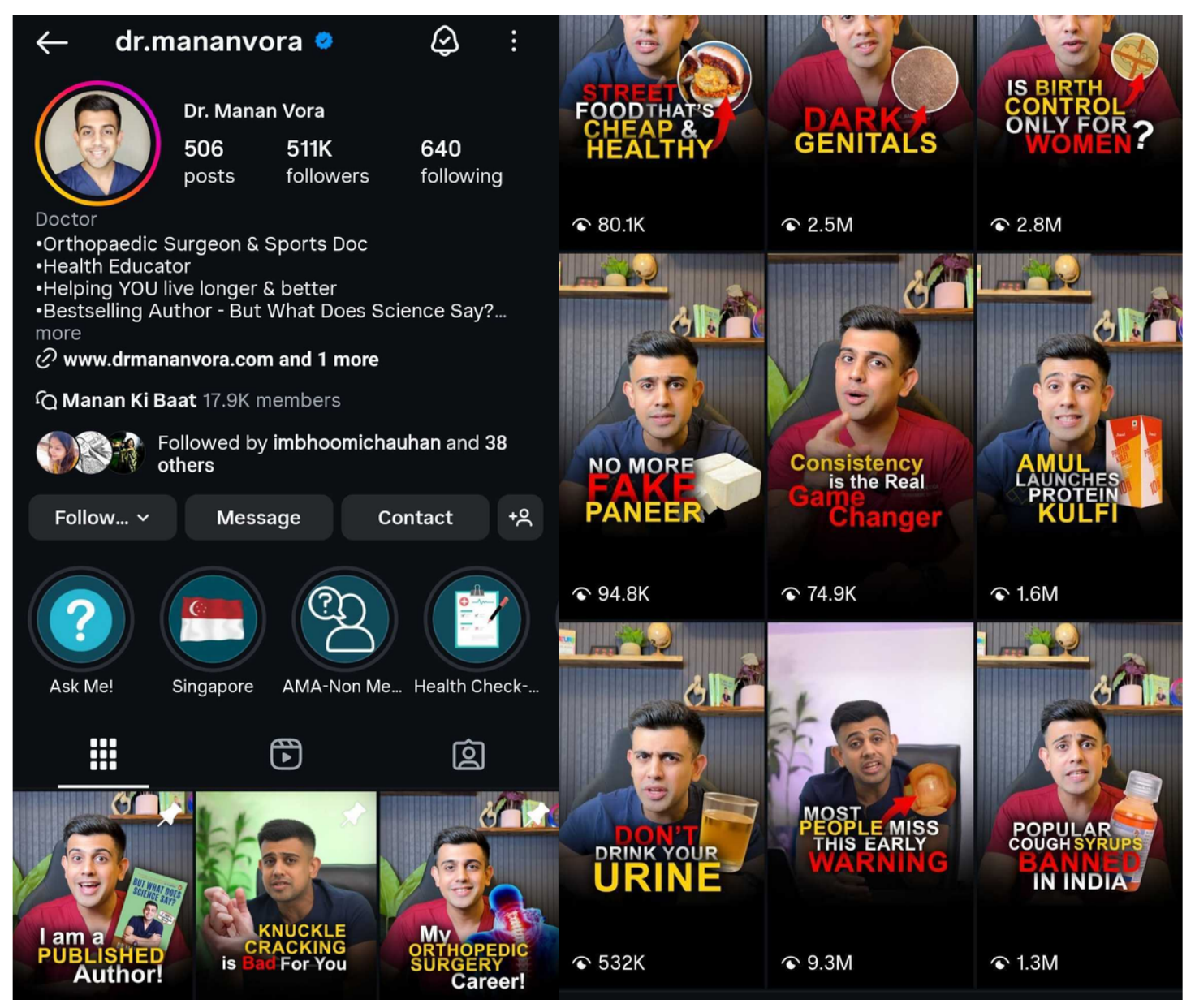
Source: Instagram, @dr.mananvora.
Google and AI Search Also Trust Doctors
When I searched “smile makeover tips by a doctor,” Google’s AI Overview cited a smile makeover guide published under a named dentist, Dr. Savita Chaudhry. Health is a “Your Money or Your Life” (YMYL) topic, and Google’s guidance on creating helpful, reliable, people-first content asks who created the content and whether that person has real expertise and experience. A doctor with a visible, consistent presence gives search engines and AI tools a clear author to trust.
I’ve written about this from the content side in how to add E-E-A-T to every part of a blog, and at Missive Digital it is the base of our healthcare SEO work.
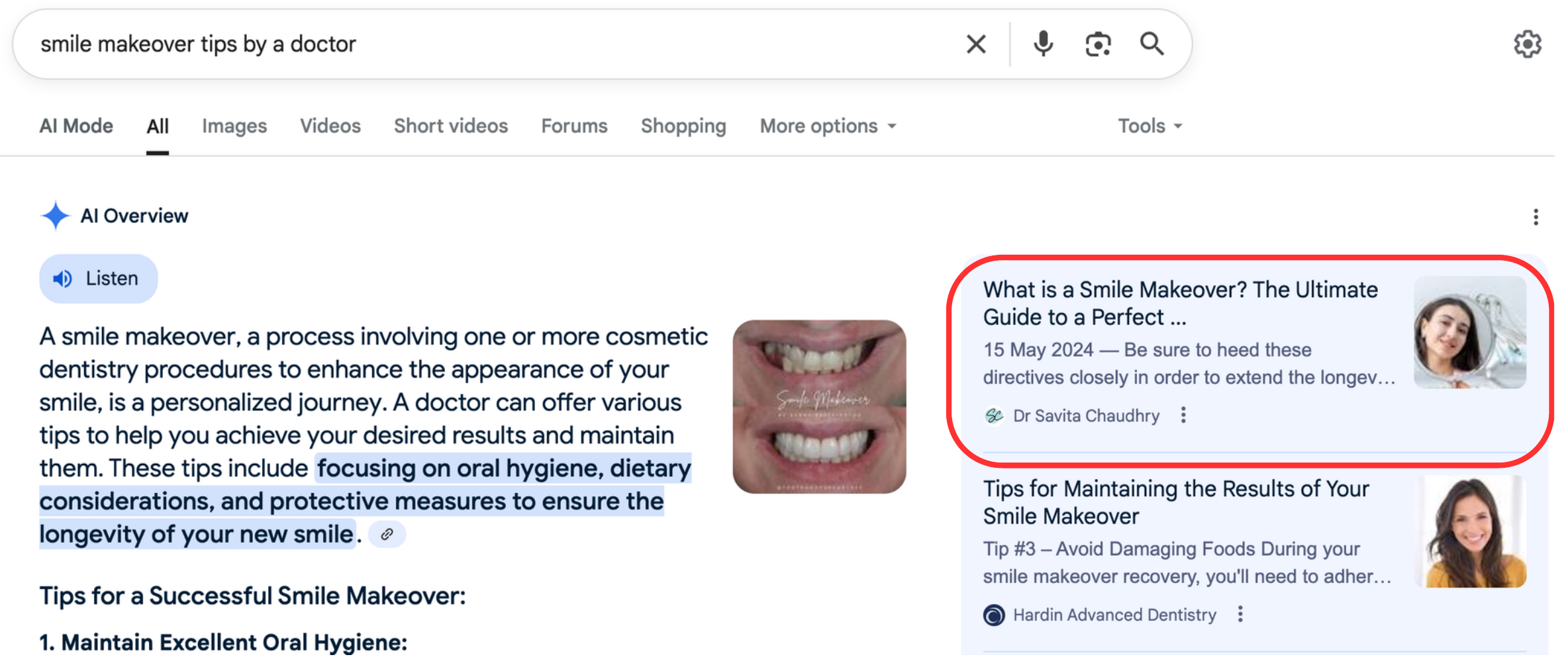
Source: Google Search, query “smile makeover tips by a doctor.”
Your Values, Voice, and Vibe Set You Apart in a Crowded City
In a city full of dentists, most clinics offer the same treatments. Pediatric dentist Prof. (Dr.) Rohan Bhatt (@drrohanbhatt) stands out through his warm, family-friendly content and his teaching role, not through a longer services list. When the clinical skills are similar, personality becomes the differentiator.
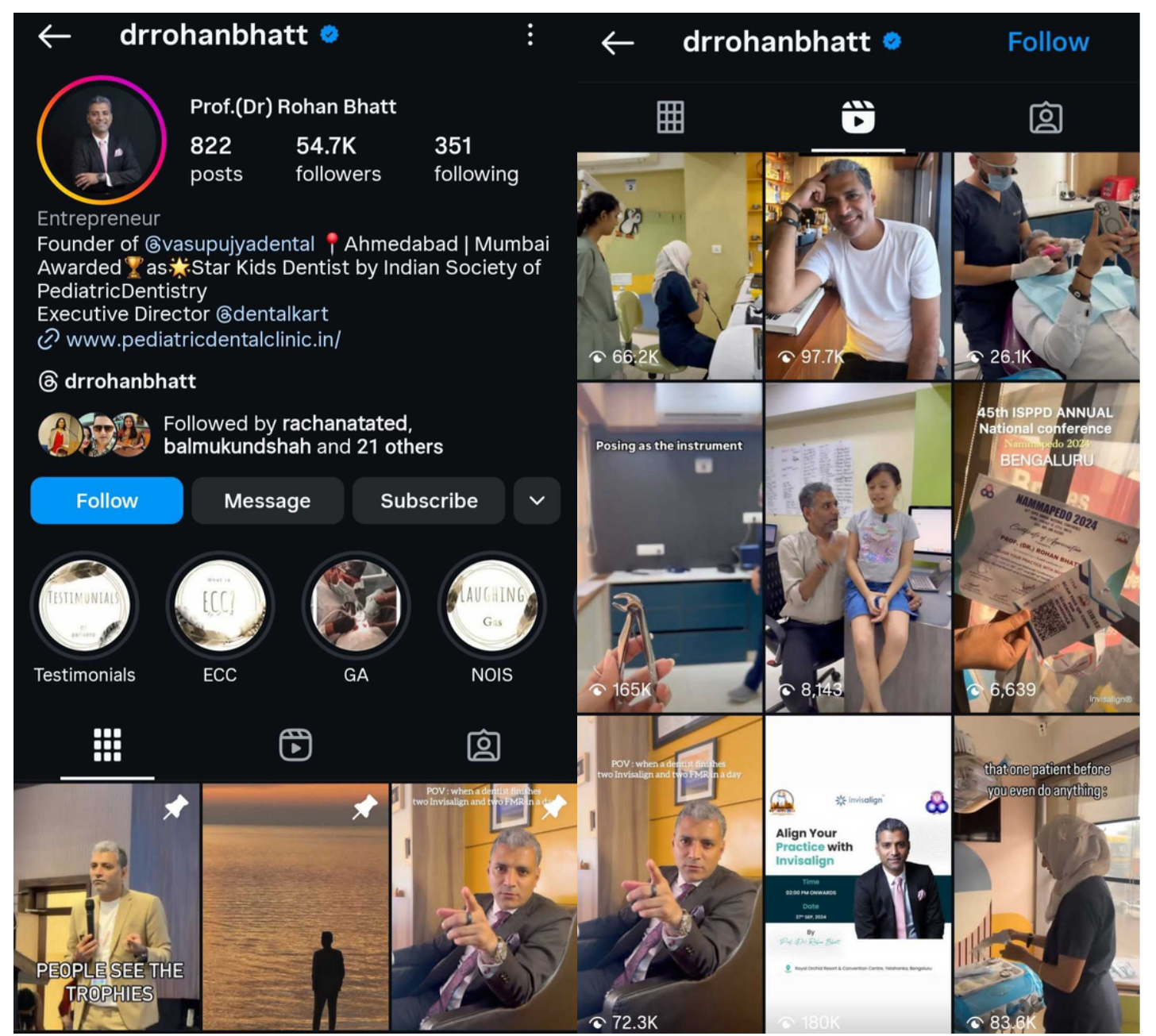
Source: Instagram, @drrohanbhatt.
People Who Know You Online Feel Comfortable Consulting You Offline
Ahmedabad pediatrician Dr. Reema Pandya (@dr.reemapandya) answers the questions parents actually Google: colic, baby food, newborn care. By the time a parent walks in, they already know how she talks and what she believes. The first consultation starts with trust instead of from zero.
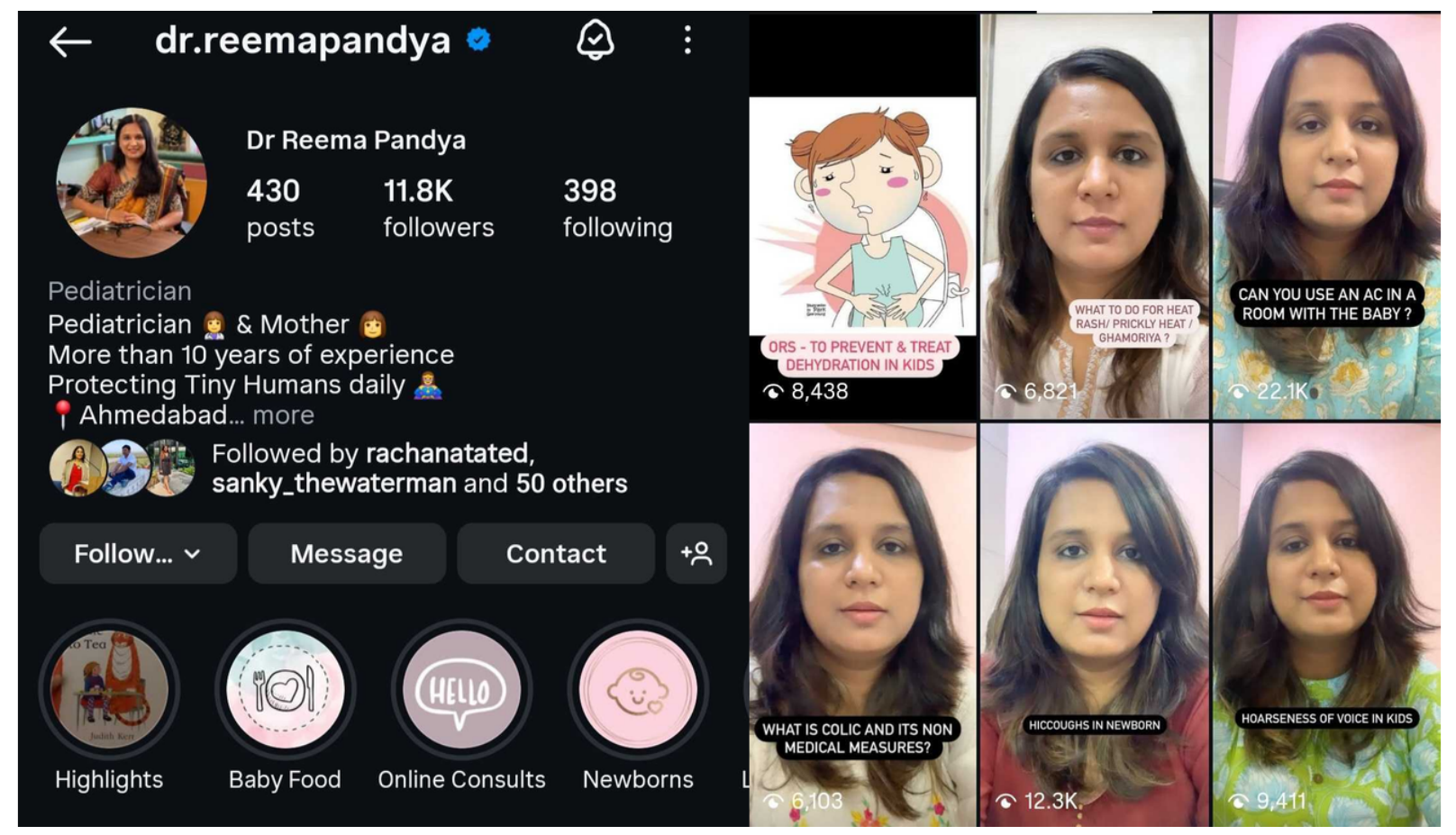
Source: Instagram, @dr.reemapandya.
A Personal Brand Builds Patient Loyalty and Word-of-Mouth
Dr. Rakshita Singh Bangar (@dr.rakshitasingh) built a large community by sharing her life as a doctor and educator. People share content from a person they relate to far more readily than a clinic ad, and every share is word-of-mouth at scale.
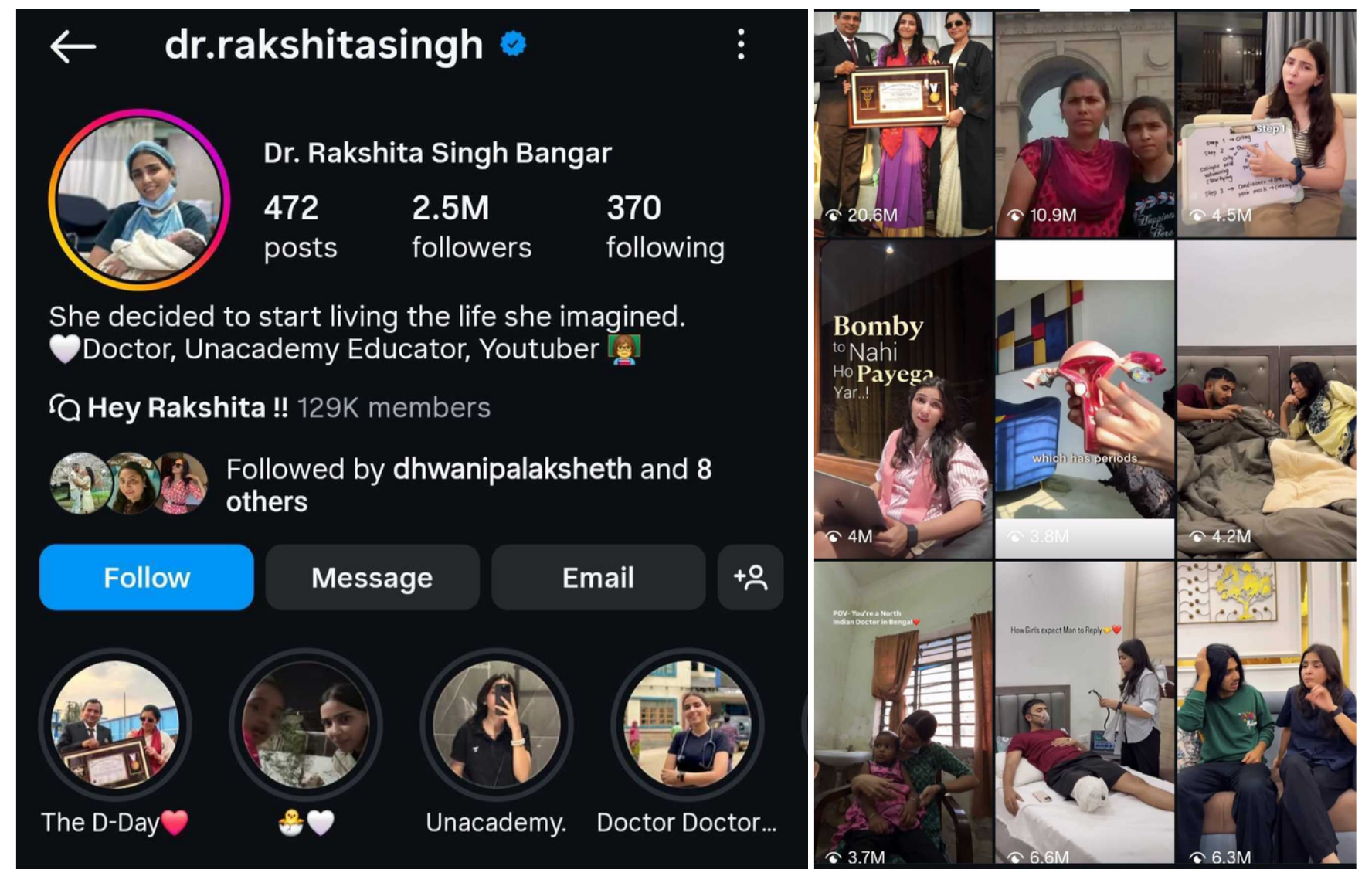
Source: Instagram, @dr.rakshitasingh.
A Personal Brand Opens New Career Opportunities
A brand doesn’t only bring patients. It brings speaking invitations, teaching roles, collaborations, and co-founder conversations. Dr. Lalit Ranjan Manik’s LinkedIn profile, for instance, shows how a doctor’s public positioning can extend into healthcare entrepreneurship as co-founder of MedTel Healthcare. If LinkedIn is your channel, our LinkedIn for doctors guide covers profile optimization step by step.
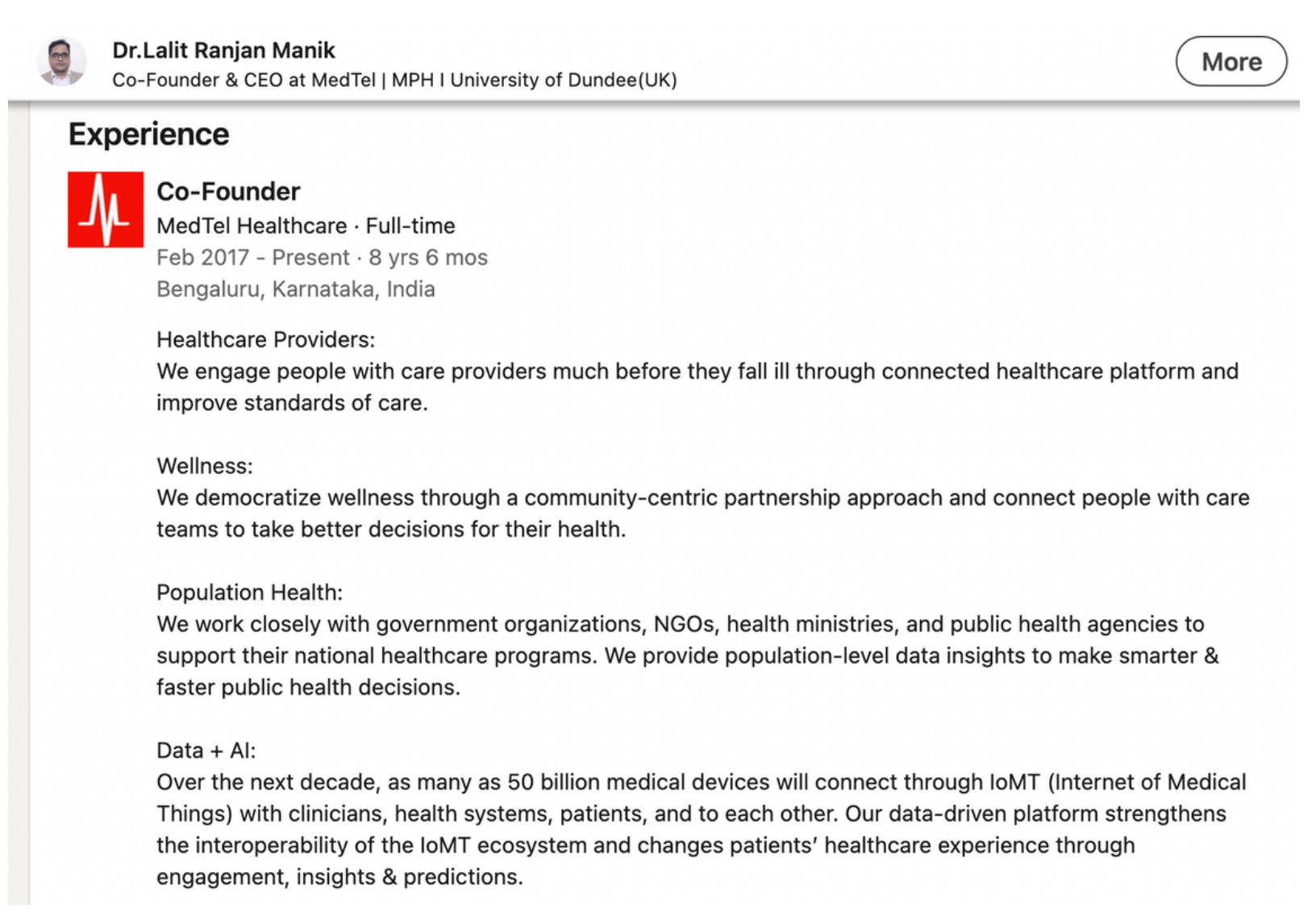
Source: LinkedIn, Dr. Lalit Ranjan Manik.
How to Build Your Personal Brand as a Doctor in 7 Steps
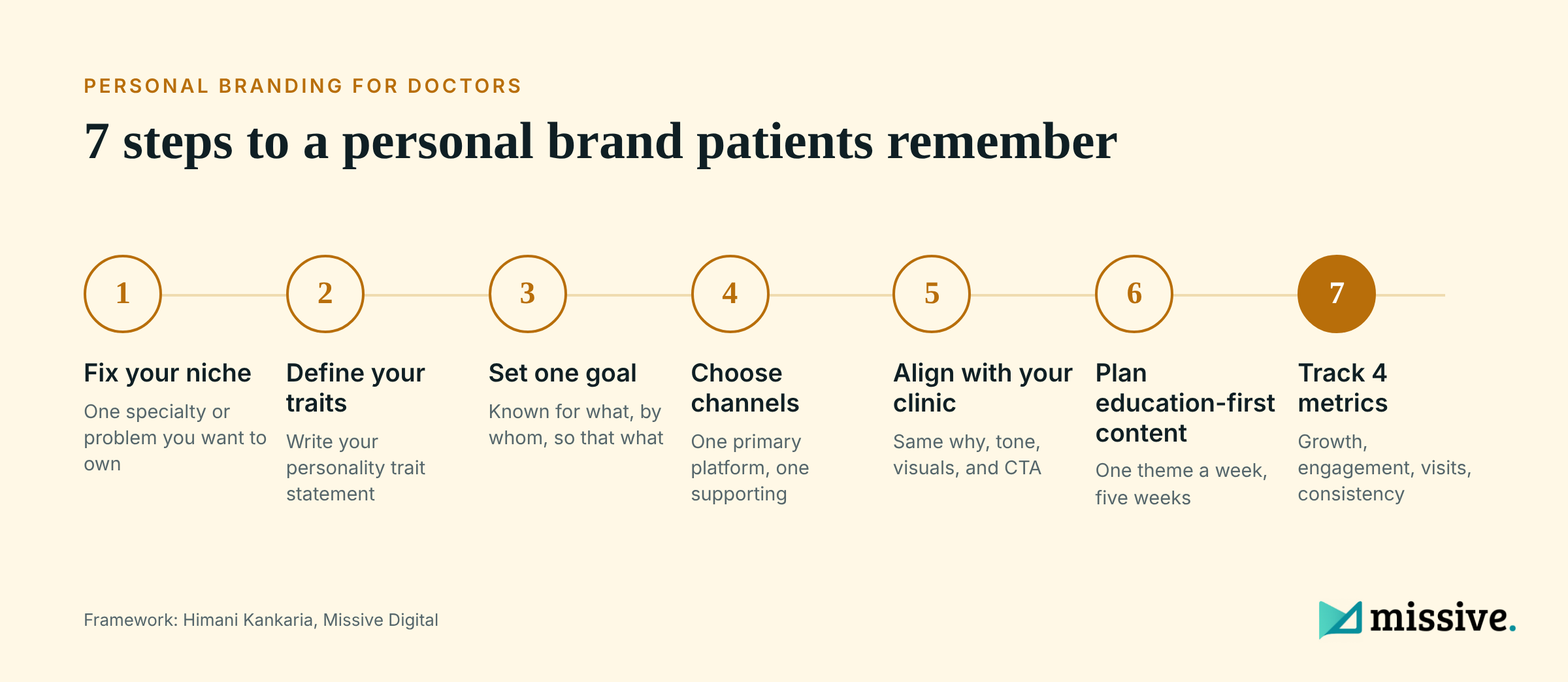
Step 1: Fix Your Niche
Personal branding is built on expertise, and expertise is built on a niche. Think about the brands you remember: Nike means sportswear, Lenskart means eyewear, Nykaa means beauty. Each one owns a single idea before it expands.
Medicine already works this way. Patients look for a cardiologist, a dermatologist, or a pediatrician, not a “doctor.” Dentistry has its own specialties to build on:
| Dental specialty | A brand angle you could own |
|---|---|
| Orthodontics | Aligners and braces for teenagers and working adults |
| Pediatric dentistry | Fear-free first dental visits for kids |
| Prosthodontics | Full-mouth rehabilitation and natural-looking smiles |
| Periodontics | Gum health and its link to overall health |
| Endodontics | Pain-free root canal treatment |
| Oral and maxillofacial surgery | Wisdom teeth and jaw surgery, explained simply |
| Oral medicine and radiology | Early detection of oral lesions and cancer screening |
| Public health dentistry | Oral hygiene education for schools and rural communities |
If you are still a student or a general practitioner, pick the area you most enjoy explaining. Your niche can sharpen over time, but it has to start somewhere.
Step 2: Define Your Personality Traits
Two dentists can share a niche and still feel completely different: one is funny, one is witty, one is sincere and soft-spoken. Your traits decide your tone, your visuals, and even your hooks, so write them down before you write a single post.
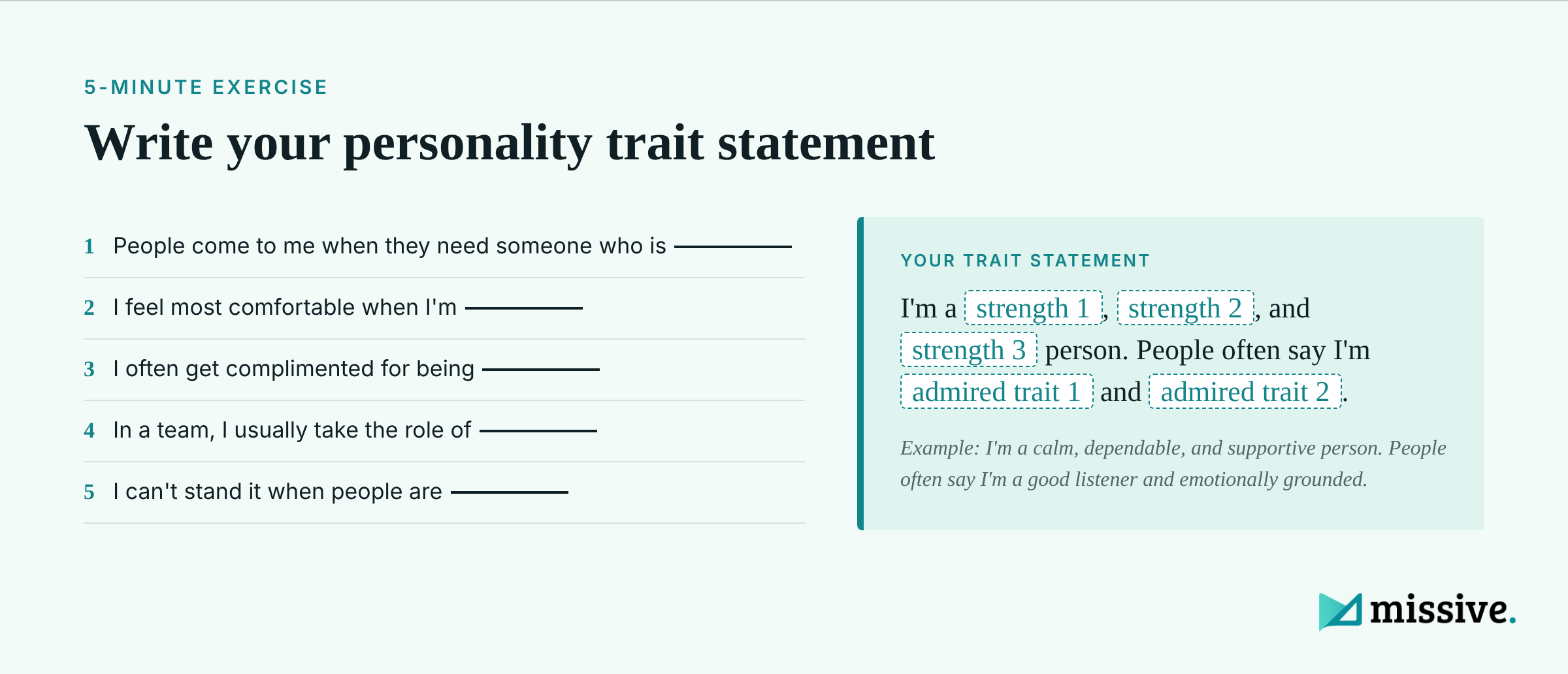
I run this five-minute exercise in every session. Complete these five sentences honestly:
- People come to me when they need someone who is __________.
- I feel most comfortable when I’m __________.
- I often get complimented for being __________.
- In a team, I usually take the role of __________.
- I can’t stand it when people are __________.
Here is one filled in: calm and dependable; helping one person at a time; a good listener; the supportive person; insensitive or rushed.
Now spot the patterns. In that example, the natural strengths are calm, supportive, and dependable, and the admired traits are good listener and emotionally grounded. Turn them into a trait statement:
I’m a [strength 1], [strength 2], and [strength 3] person. People often say I’m [admired trait 1] and [admired trait 2].
Example: I’m a calm, dependable, and supportive person. People often say I’m a good listener and emotionally grounded.
That doctor should not be doing loud, trending-audio reels. Calm explainer videos, patient-question answers, and reassuring captions will feel natural and stay consistent. If a podcast is part of that plan, our podcast marketing tips cover the planning, set-up, and clips.
Step 3: Identify Your Personal Branding Goal
A goal tells you what to post and what to skip. Answer three questions.
What do you want to be known for? Ask yourself: “If someone Googles me, what should they say I’m great at?” Examples: natural-looking smile design, pain-free root canals, aligner therapy, full-mouth rehabilitation.
Who do you want to reach or help? Be specific: young working professionals, parents of school-going kids, teenagers who need braces, or rural and underserved communities.
What outcome do you want? Become a local voice on oral health, educate people on preventive care, reduce dental fear, get invited to speak or train dental students, or make your specialty easier to find. Under the new NMC rules, keep the outcome about education and visibility, not about soliciting patients.
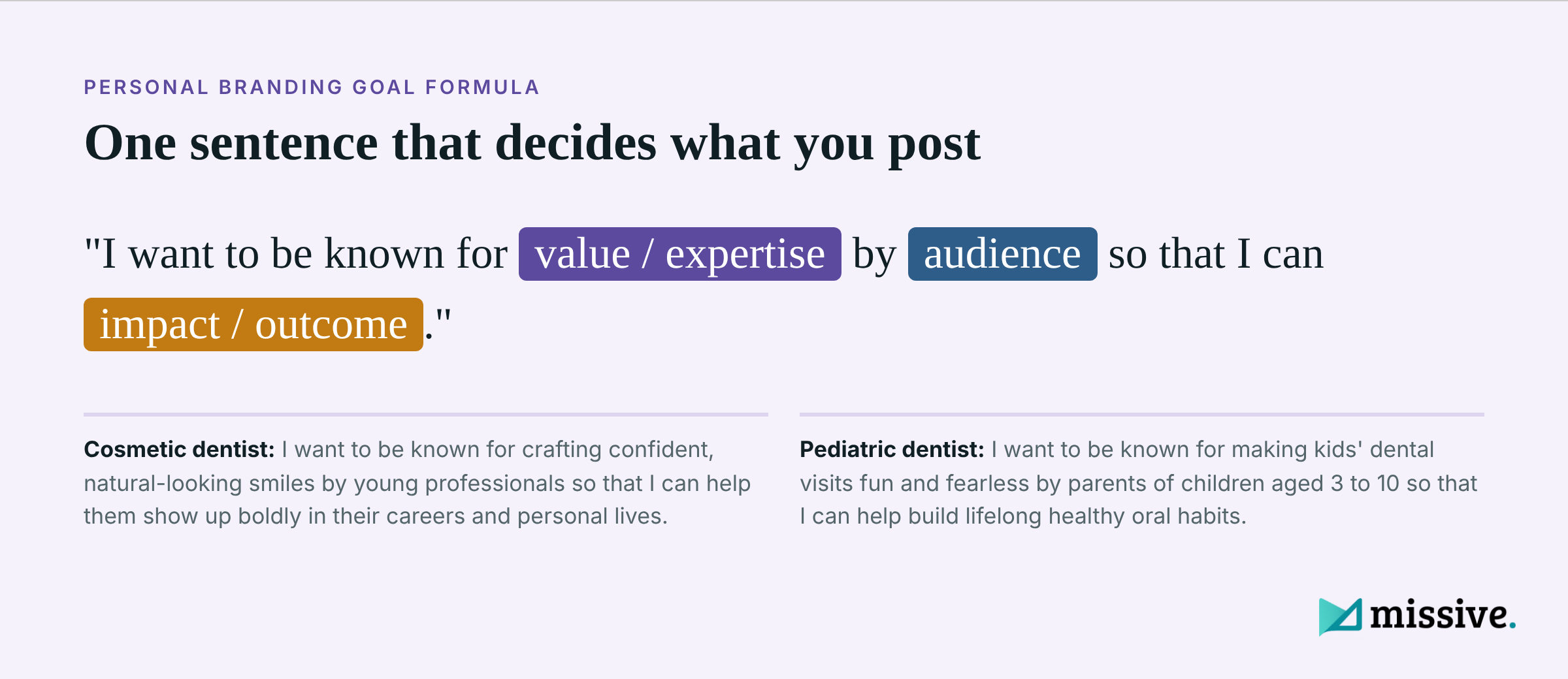
Then combine all three into one sentence:
I want to be known for [VALUE/EXPERTISE] by [AUDIENCE] so that I can [IMPACT/OUTCOME].
Example 1: I want to be known for crafting confident, natural-looking smiles by young professionals so that I can help them show up boldly in their careers and personal lives.
Example 2: I want to be known for making kids’ dental visits fun and fearless by parents of children aged 3 to 10 so that I can help build lifelong healthy oral habits.
Step 4: Choose Your Preferred Channels and Platforms
You don’t need to be everywhere. Pick one primary platform and, at most, one supporting channel. Here is how I match them to doctors:
| Channel or platform | Best for doctors who | Why it works |
|---|---|---|
| Personal website or blog | Want to be found on Google and AI search, or offer several services | Himani Kankaria: you own it, and doctor-authored pages give search engines a clear expert to cite |
| Enjoy short video and target millennials and Gen Z | Himani Kankaria: reels make a doctor's personality visible fast; keep it to education, not results showcases | |
| YouTube | Love explaining and teaching in depth | Himani Kankaria: long explainers are searchable for years and build authority across age groups |
| Want referrals, collaborations, and speaking or teaching roles | Himani Kankaria: peers, hospitals, and media vet doctors here before reaching out | |
| Facebook page or groups | Serve audiences older than millennials, especially in Tier 2 and Tier 3 cities | Himani Kankaria: community groups still drive local conversations in smaller cities |
| X (Twitter) | Want to raise public health voices and comment on news | Himani Kankaria: threads and opinions build authority among journalists and peers |
| Email newsletter | Want to nurture a loyal community over years | Himani Kankaria: high retention and a direct line no algorithm can take away |
| WhatsApp broadcast | Want quick, personal updates for an existing community | Himani Kankaria: direct and fast for reminders and health tips across all age groups |
| Quora, Reddit, or Medium | Want to be the go-to answer in a niche | Himani Kankaria: answering real questions builds credibility one thread at a time |
| Talks and events | Want community trust offline | Himani Kankaria: in-person talks build trust, especially in Tier 2 and Tier 3 cities |
To decide, ask yourself seven questions:
- Where is my audience already spending time?
- What is my content comfort zone: writing, talking to camera, or speaking on stage?
- How much time can I realistically give every week, consistently?
- Do I want to build trust or reach?
- Do I want to be searched on Google and YouTube?
- Does my vision include building a community?
- Do I want my brand only to be visible, or to support my practice or startup too?
Step 5: Align Your Personal Brand With Your Clinic or Startup
If you run a clinic or a health startup, your personal brand and the business brand should reinforce each other, not compete. I suggest five checks.
Align your why with your clinic’s why. Dr. Manan Vora’s profile, for example, connects his own purpose of helping people live longer and better with the wellness venture he co-founded.
Use the same tone everywhere. If you are warm and playful on Instagram, your clinic’s posts shouldn’t sound like a legal notice.
Match the visual identity. Use consistent colors, fonts, and templates. You can relax this on your personal account, but people should still recognize you.
Share stories that connect both. A post about why you started your clinic, or how your team handles anxious patients, builds both brands at once.
Align your call to action. Dentist Dr. Janu Shah (@dr.janu_shah) closes posts with engagement prompts such as “What do you want me to talk about next? Put it in the comments!” That keeps the CTA about conversation, not about booking. Under the NMC rules, soft CTAs like questions, saves, and follows are far safer than “Book now” offers or discounts.

Source: Instagram, @dr.janu_shah. Captions only; the videos are not embedded.
The same thinking guides our personal branding work at Missive Digital, where we align a founder’s voice with the company’s positioning before we write a single post.
Step 6: Plan Education-First Content
Start with a two-minute exercise I give every audience: write a post on “A day in my life as a doctor.” It forces you to use your own voice, it shows your values without self-promotion, and it needs no patient data.
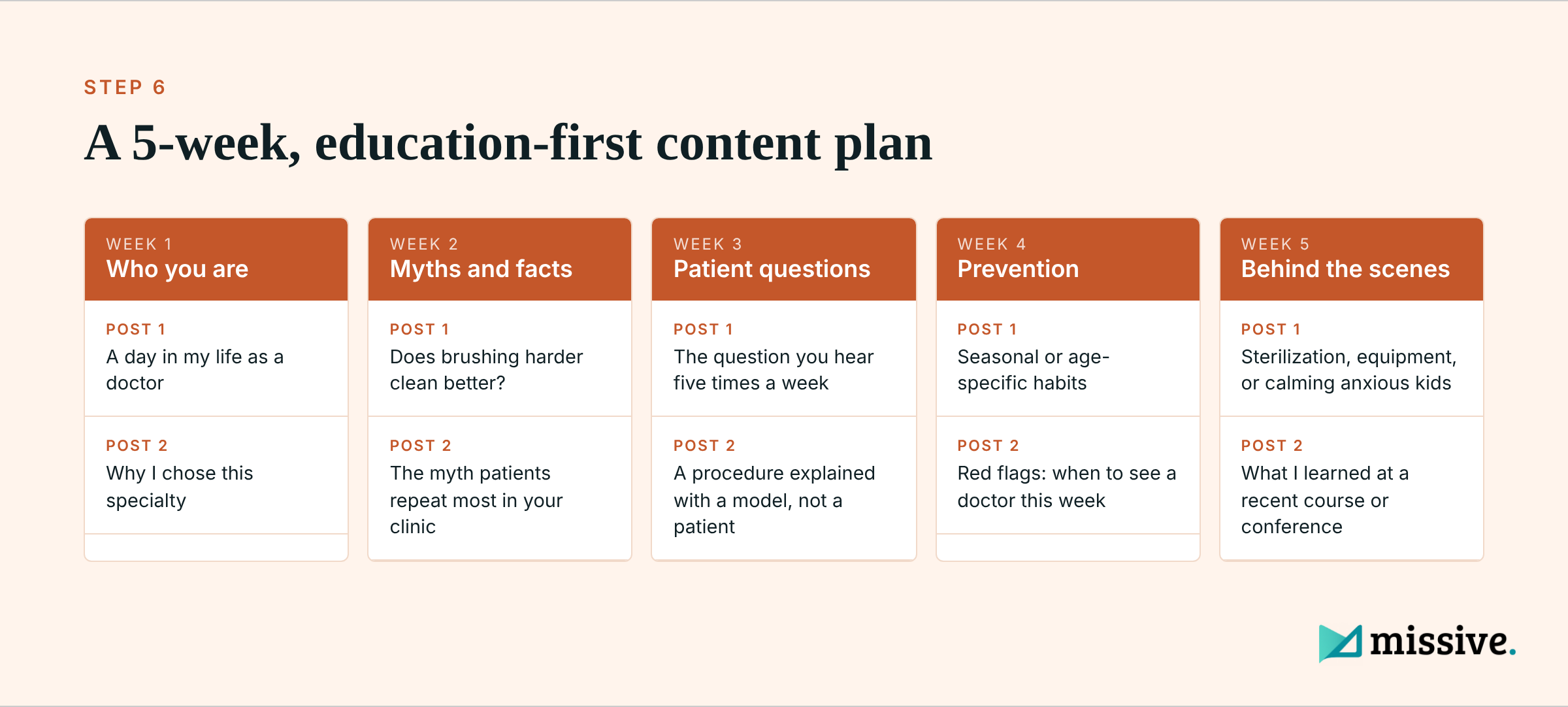
Then build a five-week plan around one theme per week. Ideas that fit the October 2026 rules:
- Myth versus fact: “Does brushing harder clean better?”
- Answer one patient question: the questions you hear five times a week
- Explain a procedure: what happens during a root canal, step by step, with illustrations or models, not real patients
- A day in my life: your routine, your team, your learning
- Why I chose this specialty: your story and your values
- Prevention tips: seasonal or age-specific oral health habits
- Red flags: symptoms that mean “see a dentist this week”
- Behind the scenes: sterilization, equipment, or how you calm anxious kids, without showing patients
- What I learned: a conference, a course, or a new study, explained simply
- Public health days: World Oral Health Day or No Tobacco Day, with practical advice
Canva’s free health and medical templates are a good starting point for consistent visuals; adapt them to your colors and fonts. If you use AI to brainstorm or draft, rewrite the output in your own words. I’ve explained how in how to (actually) humanize AI content.
Step 7: Monitor Four Basic Metrics
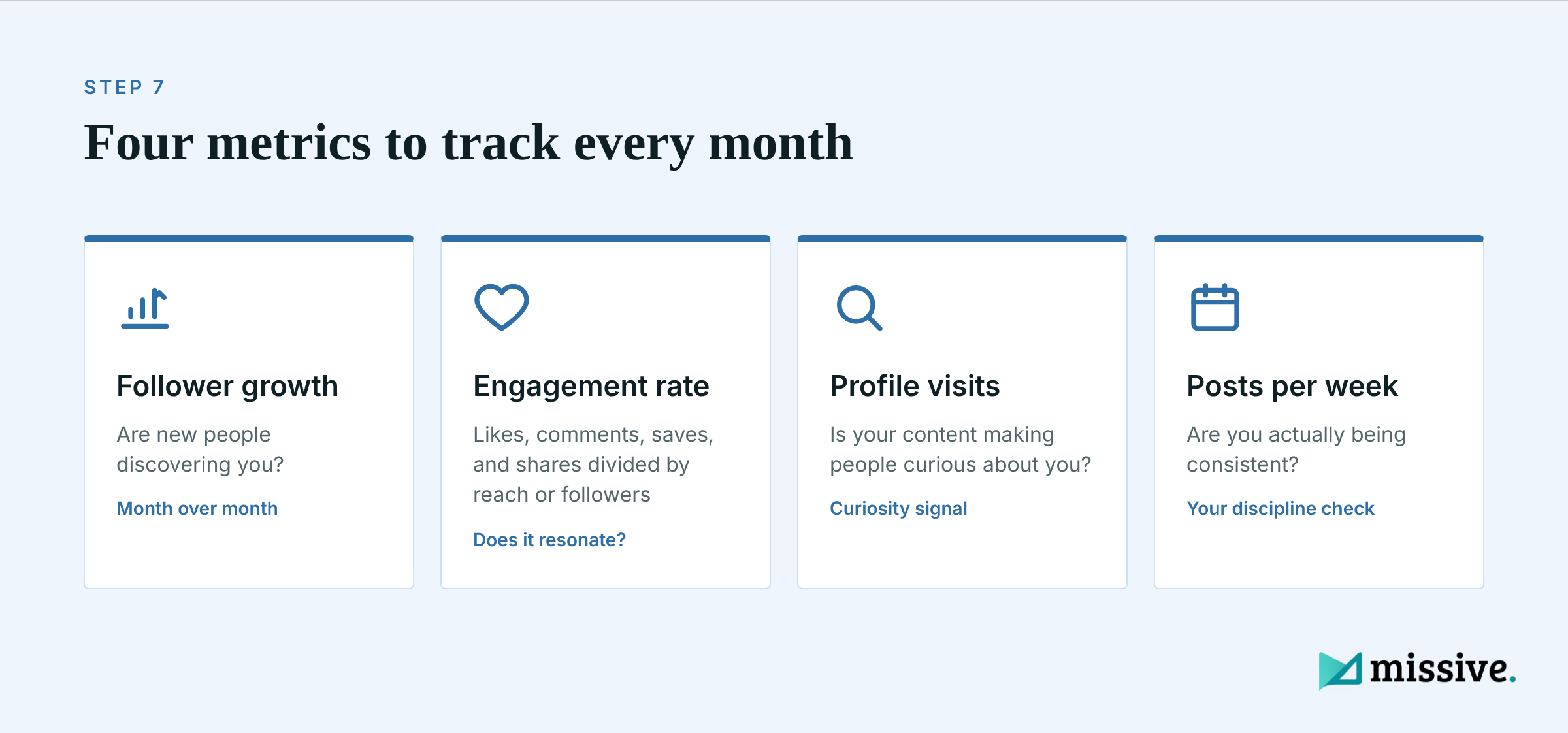
You don’t need a dashboard to start. Track four numbers every month, on whichever platform you chose:
| Metric | What it tells you |
|---|---|
| Follower growth | Whether new people are discovering you |
| Engagement rate | Whether your content resonates (likes, comments, saves, and shares divided by reach or followers) |
| Profile visits | Whether your content makes people curious about you |
| Posts per week | Whether you are actually being consistent |
Compare month over month, not post by post. When one theme consistently earns more saves or comments, make more of it. Never buy followers, likes, or reviews; the NMC guidelines explicitly prohibit procuring or manipulating them.
Dos and Don'ts of Personal Branding for Doctors
What Doctors Should Do
- Be consistent with your theme and your schedule.
- Stay authentic. Your trait statement from Step 2 is your filter.
- Focus on one theme at a time so people know what to remember you for.
- Engage with your audience meaningfully. Reply to questions in comments, but give general information and invite people to consult in person for anything specific.
- Use AI as a support, not a substitute. Brainstorm topics or tidy grammar with it; the clinical judgment and the voice must stay yours.
- Keep your content patient-safe. No identifiable faces, names, reports, or X-rays without valid consent, and even then only for educational purposes.
- Keep your content platform-compliant. Meta’s health and wellness advertising policies apply on top of medical council rules if you ever boost a post.
- Align with your clinic or startup brand in tone, visuals, and calls to action.
- Track what works with the four metrics from Step 7.
What Doctors Should Avoid
- Trying to be on every platform. Two channels done well beat five done badly.
- Copying others blindly. A format that suits a high-energy creator won’t suit a calm, soft-spoken specialist.
- Relying fully on AI content. It is often generic, and generic is the opposite of a brand.
- Sounding salesy, for example ending every post with “Book a call.”
- Ignoring visuals, such as unedited clinic photos or messy backgrounds.
- Using medical jargon without context. Explain it the way you would to a worried parent.
- Ghosting your audience after a burst of posting.
- Faking success or experience. It breaks trust, and under the new rules it can break your registration too.
What the October 2026 NMC and Dental Commission Rules Change
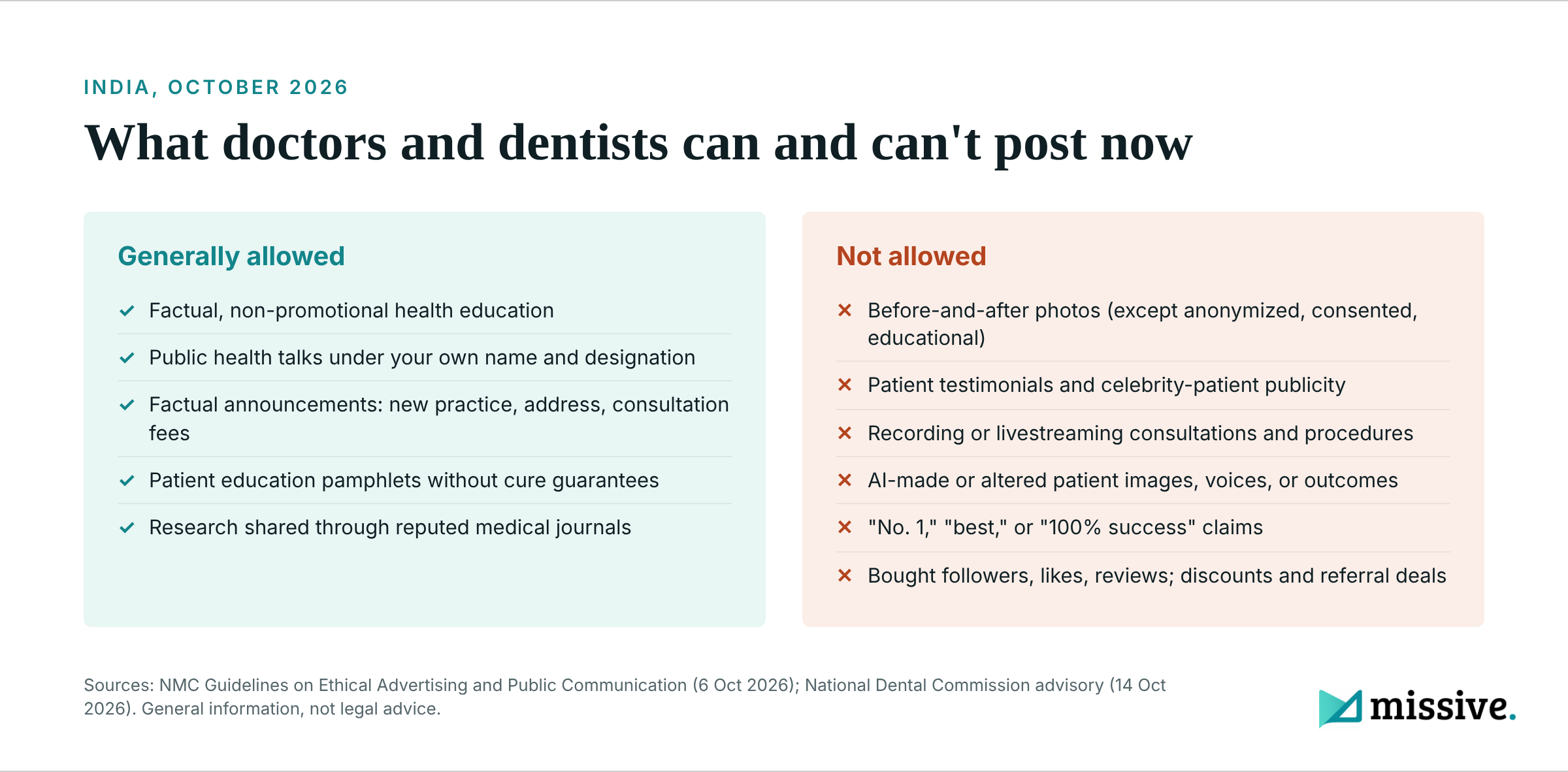
The NMC’s Guidelines on Ethical Advertising and Public Communication, issued by public notice on 6 October 2026, took effect immediately. On 14 October 2026, the National Dental Commission’s Ethics and Dental Registration Board issued an advisory to dentists citing the Revised Dentists (Code of Ethics) Regulations, 2014. Together, they draw a clear line:
| Generally allowed | Not allowed |
|---|---|
| Factual, non-promotional health education on social media | Before-and-after photos, except anonymized and consented for scientific or educational use |
| Public health talks on TV, radio, or digital media under your own name and designation | Patient testimonials and publicity about celebrity patients |
| Factual announcements: new practice, change of address, consultation fees | Recording or livestreaming consultations and procedures (Dental Commission advisory) |
| Health education pamphlets for patients, without cure guarantees | AI-generated or manipulated patient images, voices, testimonials, or outcomes |
| Research shared through reputed medical journals | "No. 1," "best," or "100% success" claims that can't be objectively verified |
| Fake or bought followers, likes, reviews, or ratings, and paid ranking manipulation | |
| Discounts, coupons, referral benefits, or influencer deals tied to bringing in patients |
Penalties are graded, from a warning and mandatory ethics training for a first violation up to removal from the medical register for one to three years for repeated violations. Read the full guidelines or check with your State Medical or Dental Council before you post anything you are unsure about. This section is general information, not legal advice.
Build a Brand Patients Remember, Not One They Scroll Past
I closed the Ahmedabad Dental College session with one line, and it still sums up this guide: don’t just create content; create an experience your target audience can’t resist. Be a thought leader. Be a brand.
For doctors in 2026, that experience is education. Fix your niche, know your traits, write one goal sentence, choose one or two channels, align with your clinic, teach consistently, and measure four numbers. Everything on that list is allowed under the new NMC and Dental Commission rules, and everything on it compounds.
Start today with the two exercises: your trait statement and your goal sentence. They take ten minutes and will shape every post you publish after them.
If you’d like a second pair of eyes on your positioning, channel choice, or first month of content, book a 30-minute consultation with me. You can also see how we approach LinkedIn marketing for doctors at Missive Digital.
FAQs
Focus on factual, non-promotional health education under your own name: myth-busting, answering common questions, explaining procedures with models or illustrations, and sharing your values and routine. Avoid before-and-after photos, testimonials, superiority claims, discounts, and anything that solicits patients. When in doubt, check the NMC guidelines or your State Medical Council.
As of October 2026, generally no. The NMC guidelines bar "before and after" photographs except for scientific or educational purposes with anonymized consent, and the National Dental Commission's advisory specifically warns dentists against posting them.
It depends on your audience and your comfort zone. Instagram suits short, personality-led education for younger audiences; YouTube suits in-depth explainers; LinkedIn suits referrals, collaborations, and teaching roles; Facebook groups still work well in Tier 2 and Tier 3 cities. Start with one primary platform.
Post as often as you can sustain for months, not weeks. Two or three focused posts a week on one theme will build a clearer brand than daily posts on random topics.
Yes, as a support for ideas, outlines, and grammar. Rewrite drafts in your own voice and verify every medical fact. The NMC prohibits using AI to create or manipulate patient images, voices, testimonials, or clinical outcomes, and requires AI-generated promotional content to be labeled as such.
Start with your specialty, then narrow to the problem or audience you most enjoy helping, such as fear-free dentistry for kids or aligners for working professionals. Write the goal sentence from Step 3; if it feels natural to say out loud, you have your niche.
Yes. Health is a YMYL topic, so search engines and AI tools look for content from identifiable, qualified experts. A consistent presence under your name, ideally with your own website, gives them a clear author to trust and cite.