
Key Takeaways
- E-E-A-T is proof placed where the reader needs it, not a box you tick with an author bio.
- Every section of a blog can carry three things: why it matters to the reader, how to apply it, and proof that it works.
- In the KDD 2024 GEO study, adding quotations from relevant sources raised a page’s visibility in AI answers by 41%. Keyword stuffing lowered it by 8%.
- The introduction needs one specific credibility signal, and a different type in each blog.
- CTA banners are E-E-A-T placements too: the proof belongs right next to the button, where doubt is highest.
- Healthcare and finance content needs named reviewers, primary sources, and visible review dates, because Google holds YMYL topics to its strictest standard.
- The conclusion is where you commit: your verdict, its limits, and a resource you actually use.
In 2024, researchers from Princeton and IIT Delhi rewrote web pages in nine different ways and measured how often AI engines used each version in their answers. Adding quotations from relevant sources increased a page’s visibility by 41%. Adding statistics increased it by 31%. Keyword stuffing, the oldest trick in SEO, reduced it by 8% (GEO paper, KDD 2024).
The pages that won were the ones that proved what they said. That’s E-E-A-T, and it doesn’t live only in your author bio. It lives in your first paragraph, inside every section, beside every CTA banner, and in your last line.
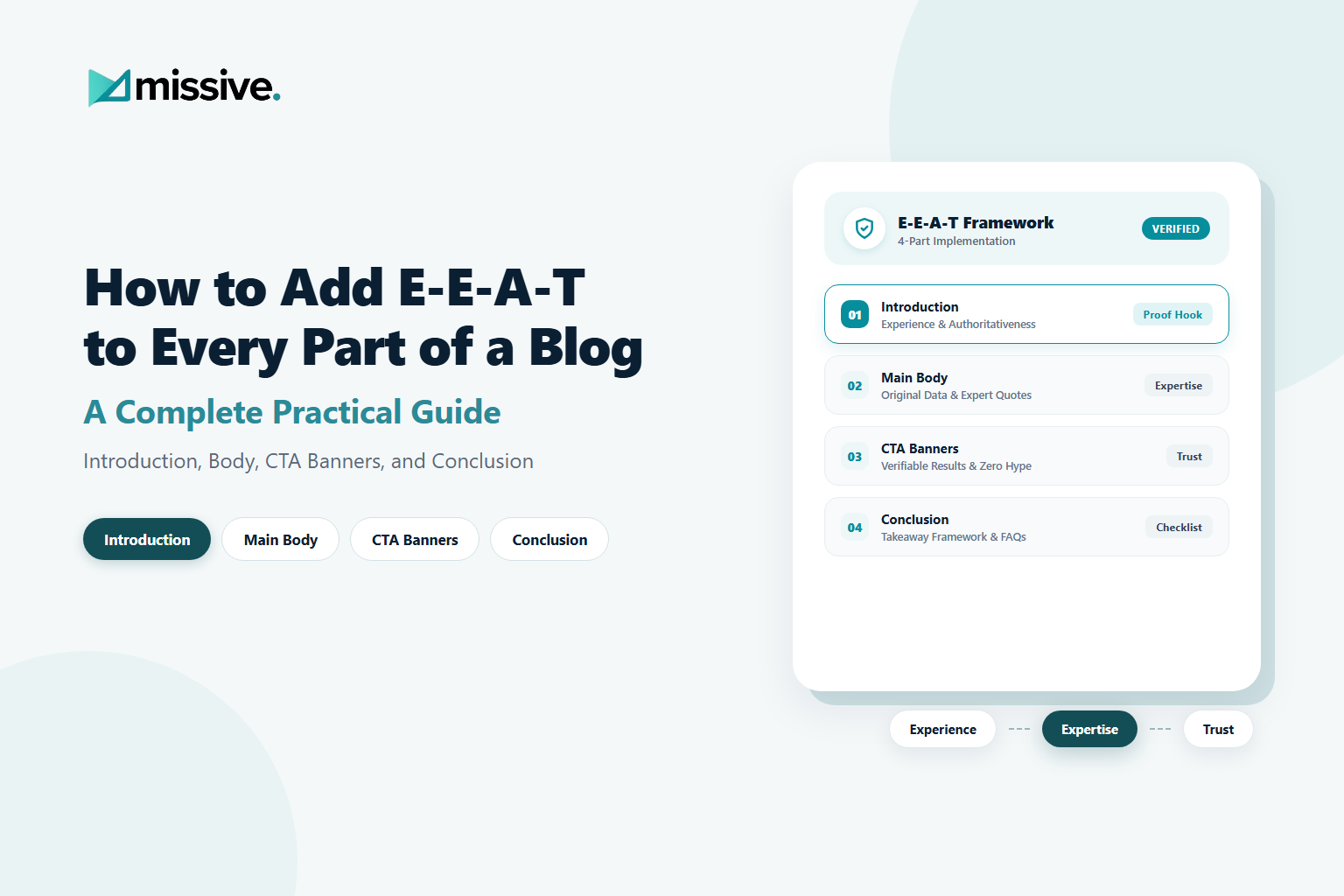
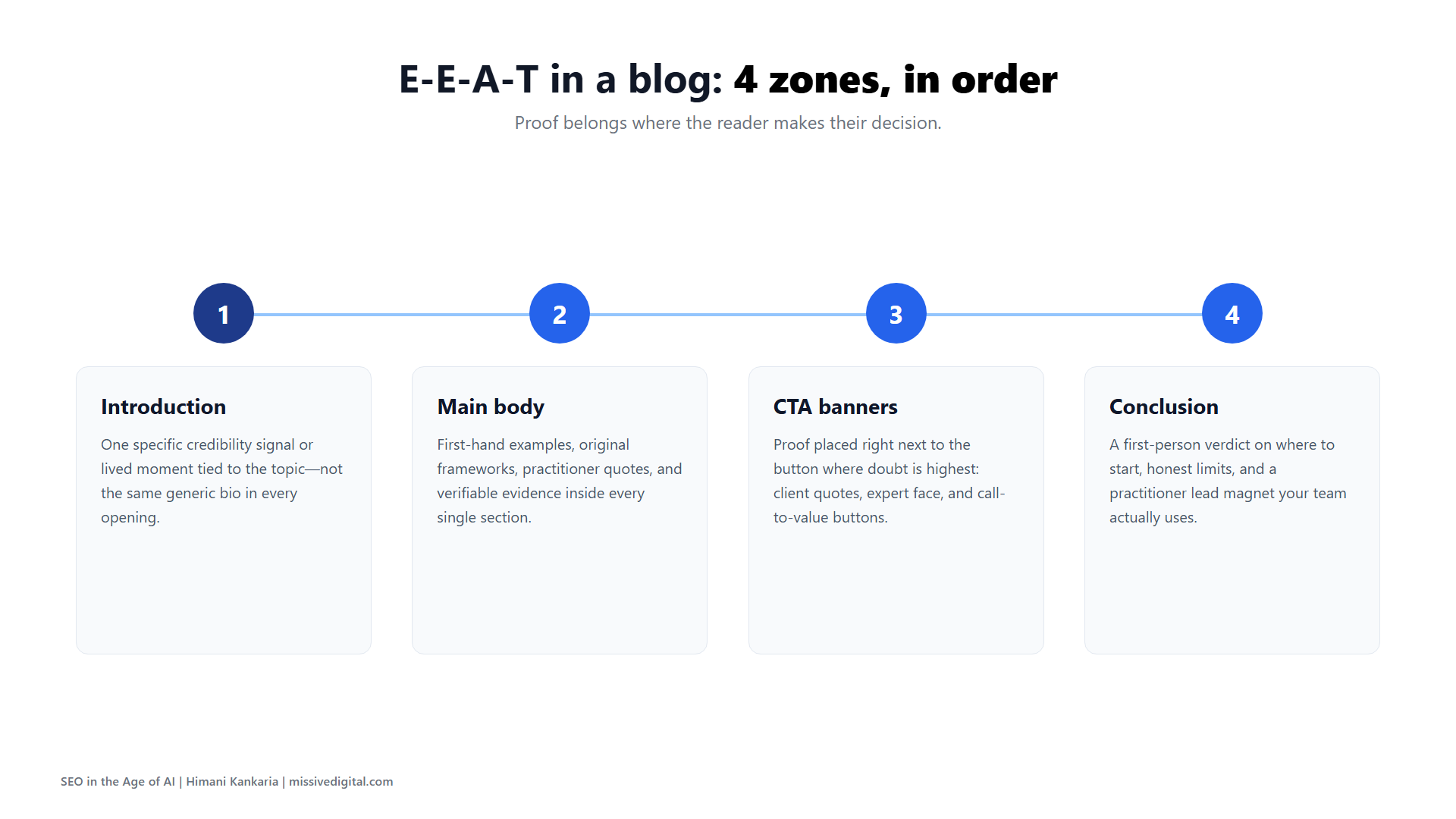
This guide shows how to add it to each of those four places, with examples from SEO, conversion optimization, healthcare, and finance.
What Google Actually Looks For When It Evaluates E-E-A-T
E-E-A-T is not a score. Google uses it to train human quality raters, and its ranking systems look for signals that line up with what those raters reward. Four points shape everything in this guide.
- Trust sits at the center. Google’s Search Quality Rater Guidelines call Trust the most important part of E-E-A-T, with Experience, Expertise, and Authoritativeness supporting it. A page from a real expert that misleads readers still rates low.
- Claimed experience needs evidence. Best SEO Singapore’s review of the September 2025 rater guidelines update reports that pages claiming first-hand experience without support, such as original photos, a named author, or dated events, are now downgraded more aggressively (Best SEO Singapore).
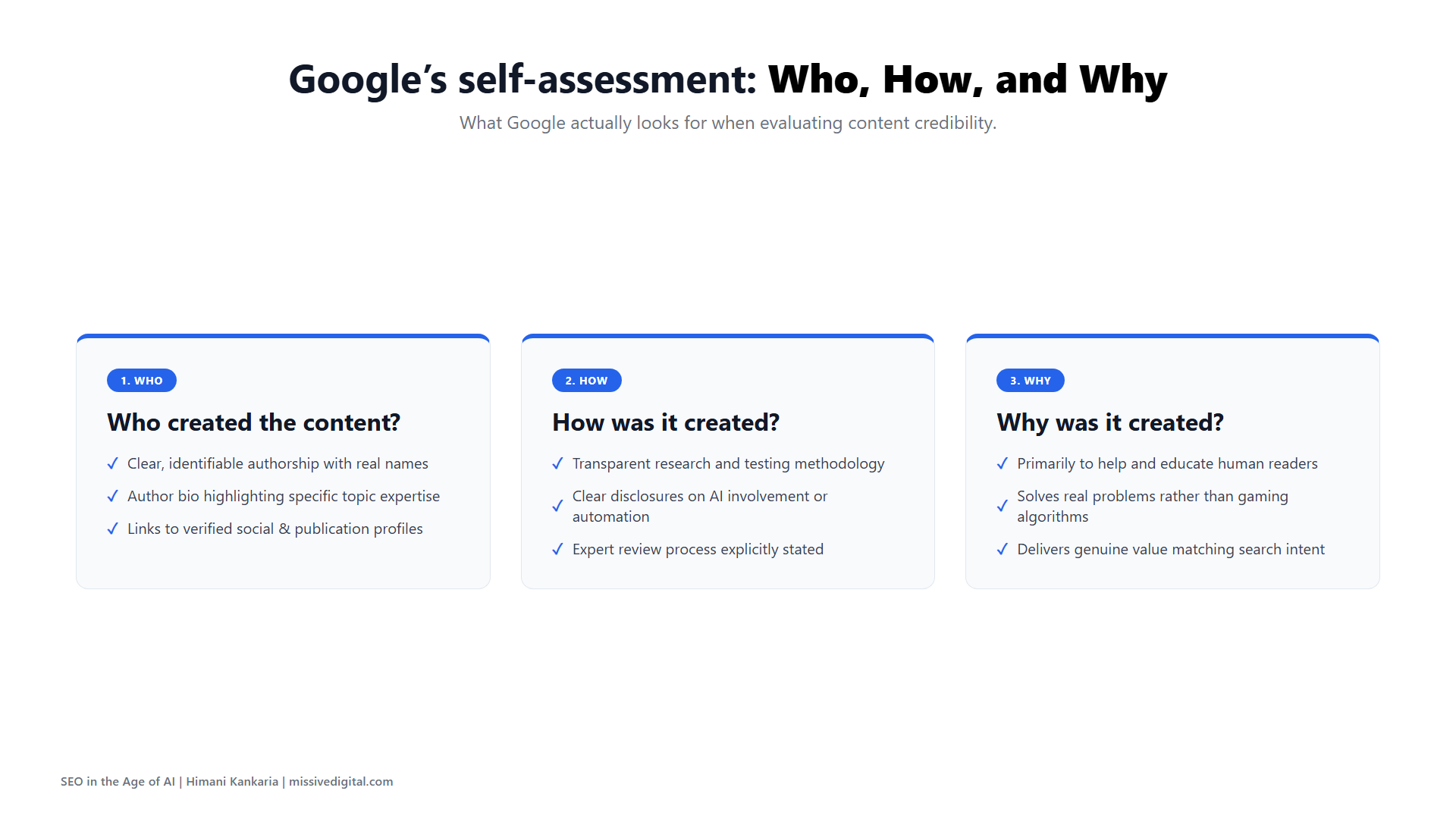
- Google asks “Who, How, and Why.” Is it obvious who wrote the content? Is it clear how it was made, including any AI use? Was it created to help people first (Google Search Central)?
- E-E-A-T is a framework, not a checklist. Lily Ray, who has run E-E-A-T audits for clients for years, puts it this way: there is no score to measure and no single lever to pull (BuzzStream podcast).
The Purpose, Implementation, and Proof Rule Behind Every Section
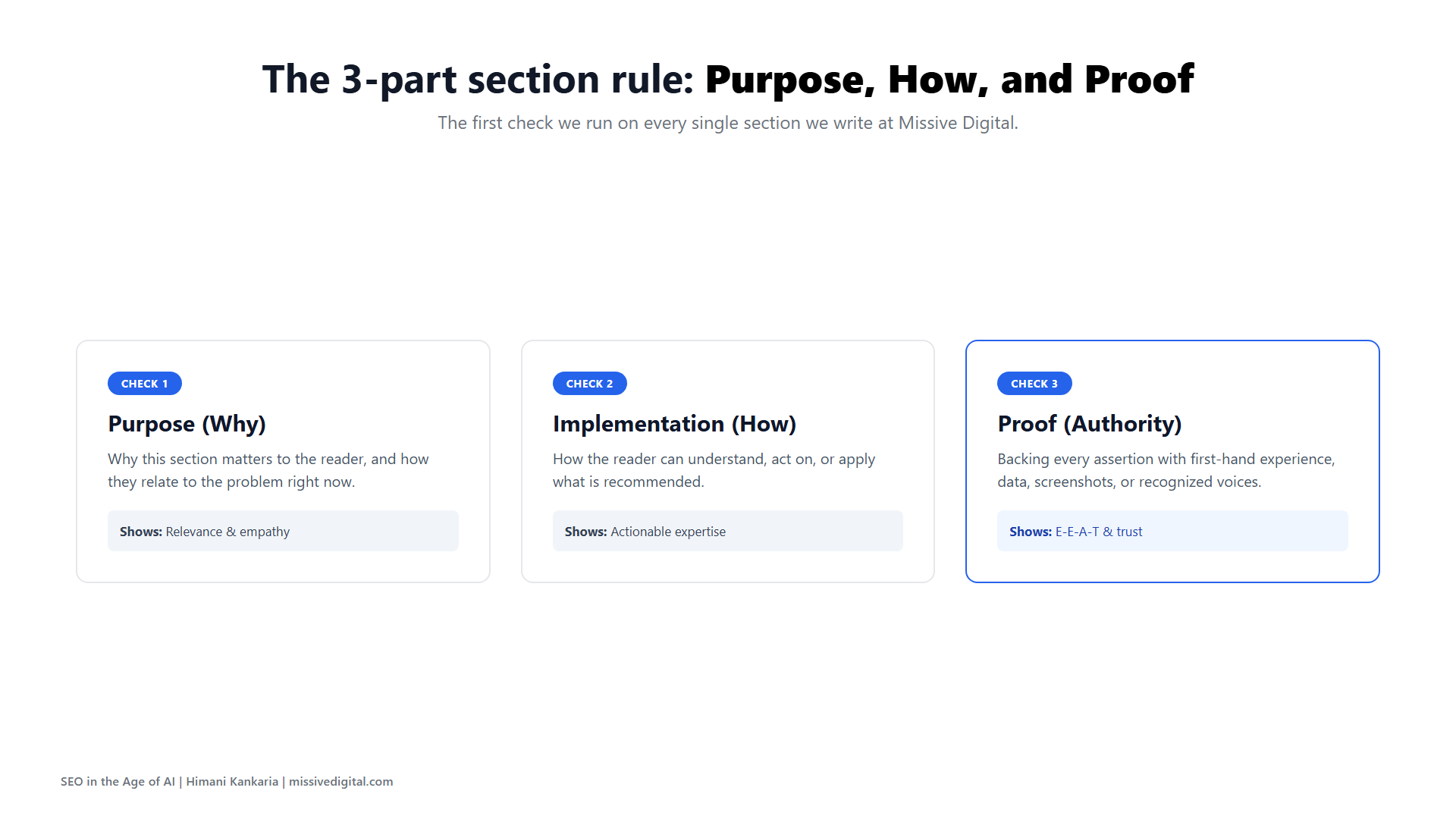
I first shared this rule at the Content Writers Symposium, an event we started for content writers and SEOs, and it’s still the first check we run on every section we write at Missive Digital. Each section answers three questions, in any order:
| Check | What the section must show |
|---|---|
| Purpose (Why) | Why this section matters, and how the reader can relate to it |
| Implementation (How) | How the reader can understand or apply what's recommended |
| Proof | That it's backed by experience, expertise, or a trusted authority |
The three checks are woven into the writing, never labeled as “Why” or “Benefit” subheadings. A section can open with a client story (proof), move to the steps (how), and close with what’s at stake (why). What matters is that none of the three is missing.
Everything that follows is a way to supply the proof, placed in the right part of the blog.
How to Add E-E-A-T to a Blog Introduction
The introduction has one E-E-A-T job: show, within the first few lines, why this writer is worth listening to on this exact topic. One or two specific signals are enough. I’ve always preferred writing in first person for this reason, and I change the type of signal from blog to blog, because the same “15 years in SEO” line in every opening stops reading as proof.
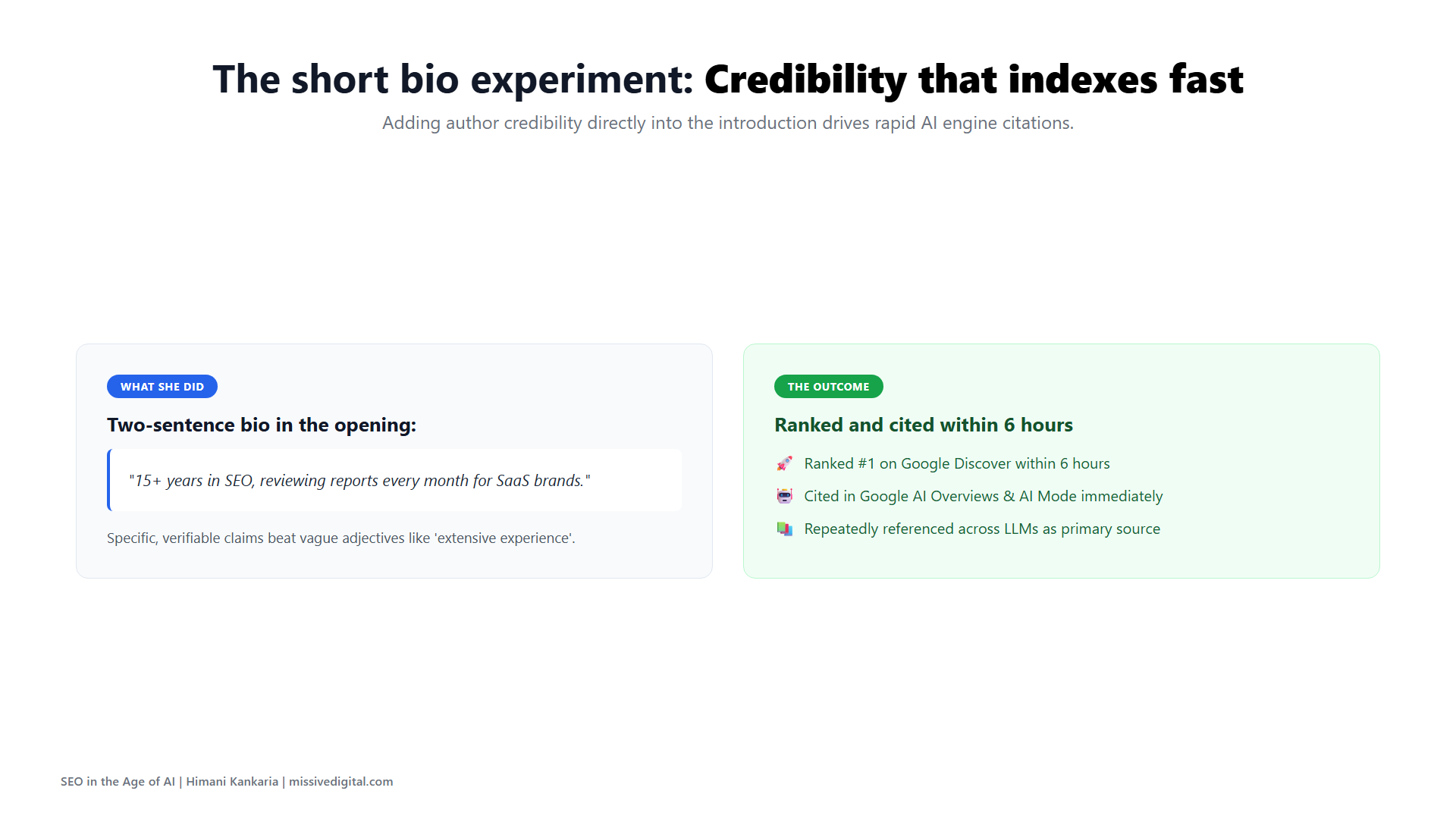
Lily Ray’s experience shows how fast a credible opening can travel. She has described publishing an article on Google Discover on LinkedIn Pulse that ranked first on Google, and appeared in AI Overviews and AI Mode, within about six hours (iPullRank, SEO Week 2025). In her review of 2025, she noted that her articles were regularly cited across LLMs within a few hours of publishing (Lily Ray, Substack).
Ten Ways to Open a Blog With E-E-A-T
| # | Signal | What it looks like | Why it works |
|---|---|---|---|
| 1 | A scene from client work | A content calendar you crossed out, or a question a founder asked on a call | Readers trust a moment you lived over a claim you make (Himani Kankaria) |
| 2 | The recurring question | "The first question almost every client asks us is…" | It tells the reader this comes from many conversations, not one opinion (Himani Kankaria) |
| 3 | The trigger for the post | A tweet, study, or webinar question that inspired it, linked and shown | Crediting the source shows you're part of the conversation (Himani Kankaria) |
| 4 | A quick bio, tied to the topic | "15+ years in SEO, reviewing reports every month for SaaS brands" | Lily Ray's articles with a short bio up front were cited by AI tools within hours |
| 5 | A result with a number | "603 clicks from one use-case blog" | Dates and numbers are hard to fake, so they read as real experience (Himani Kankaria) |
| 6 | A clear position | "AEO and GEO are part of SEO," and why practice taught you that | A defended view signals expertise more than a neutral summary (Himani Kankaria) |
| 7 | A primary source that agrees | Google's own guide or a Search Off the Record quote beside your claim | Joanna Wiebe's "prove it" rule: every claim needs proof close by |
| 8 | An honest mistake | "We recommended this for years. Here's why we stopped." | Admitting what didn't work is expensive to fake, so readers believe it |
| 9 | How the post was made | "We tested 12 prompts across four AI tools in September 2026" | It answers Google's "How was this content created?" question |
| 10 | An original data teaser | A finding from your own audit, survey, or dataset | NP Digital's May 2026 survey found original research was the format most often reported to earn AI citations (82%) |
Rules for a Credible Introduction
- Specifics beat adjectives. A number, a date, or a client type says more than “extensive experience.”
- One signal, then the promise. After the credibility line, tell the reader what they’ll get.
- Never claim to be the best. Show the proof, and let the reader decide.
- Show it early. A screenshot of the tweet, slide, or dashboard that triggered the post proves the scene is real.
How to Add E-E-A-T to the Main Body of a Blog
In the body, E-E-A-T belongs inside each section rather than in a separate “proof” box. Depth isn’t length. It’s the weight a reader feels when a section is clearly about their situation, and that weight comes from first-hand detail, sources, and voices they recognize.
Show Experience With What Only You Have
| Element | Example | Why it works |
|---|---|---|
| Original screenshots | Your Search Console view, a prompt-tracking sheet, a client dashboard (names blurred) | A screenshot you took can't be copied from another blog (Himani Kankaria) |
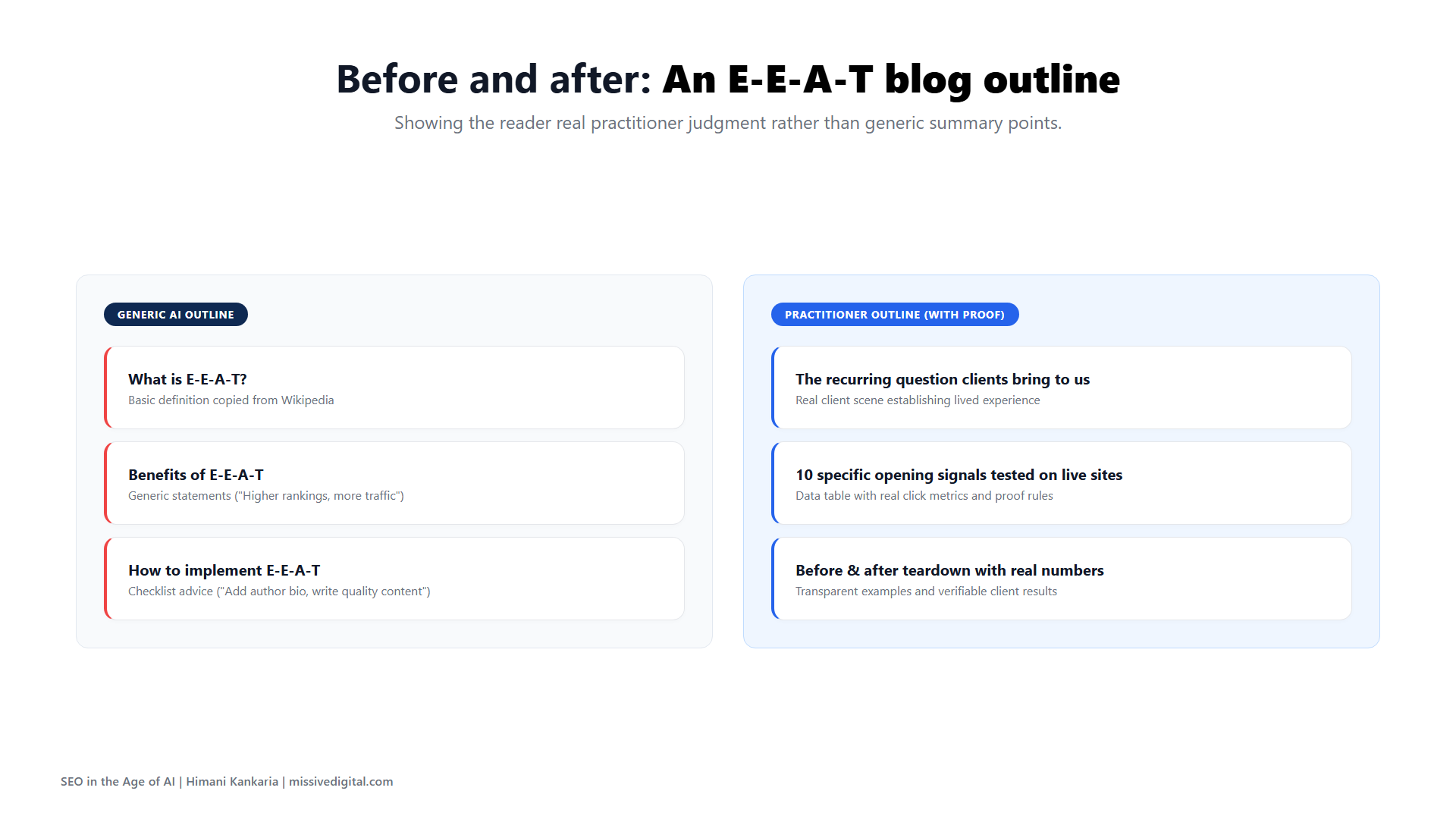
| Before-and-after examples | A real outline rewritten, with the reason for each change | The reader sees the judgment, not just the result (Himani Kankaria) |
| Mini case stories | Situation, what you did, and the outcome in four or five lines | StoryChief: case studies show the creator worked directly in the field |
| "How we do it" notes | One bolded line describing your team's actual process | It turns advice into a practice the reader can copy (Himani Kankaria) |
| Honest limits | Where an approach failed, or what broke when you tested it | Content that only confirms your interests reads as marketing |
Show Expertise With Depth and Frameworks
- Explain the why, not only the what. Why each step sits where it does, and what has changed this year. This is where most AI-written drafts fall short, and it’s one of the reasons content strategies fail that I unpacked in Search Engine Journal.
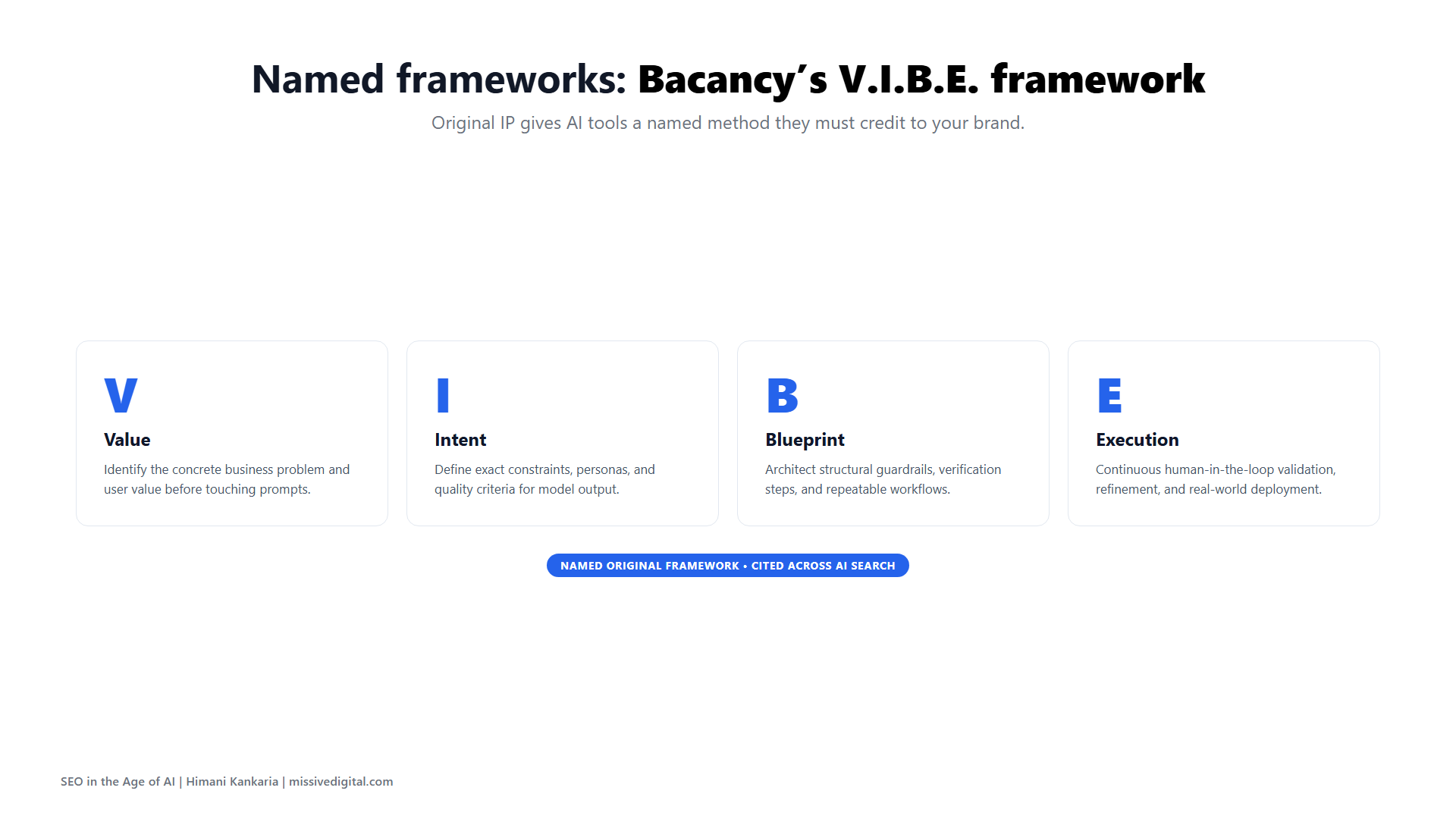
- Publish your own frameworks and name them. Original IP is something AI tools have to credit to you. Bacancy’s V.I.B.E. framework for AI-assisted engineering is a good example: a named method with a principle behind each letter. I covered this, along with the other content types that still earn visibility, in what to stop writing and what to write instead for AI Overviews.
- Use decision tables. “When to use X vs. Y” or “keep, update, merge, or remove” tables show judgment at a glance.
- Leave no verifiable errors. Google’s self-assessment asks whether content contains easily verified factual errors.
Show Authoritativeness With Voices Readers Recognize
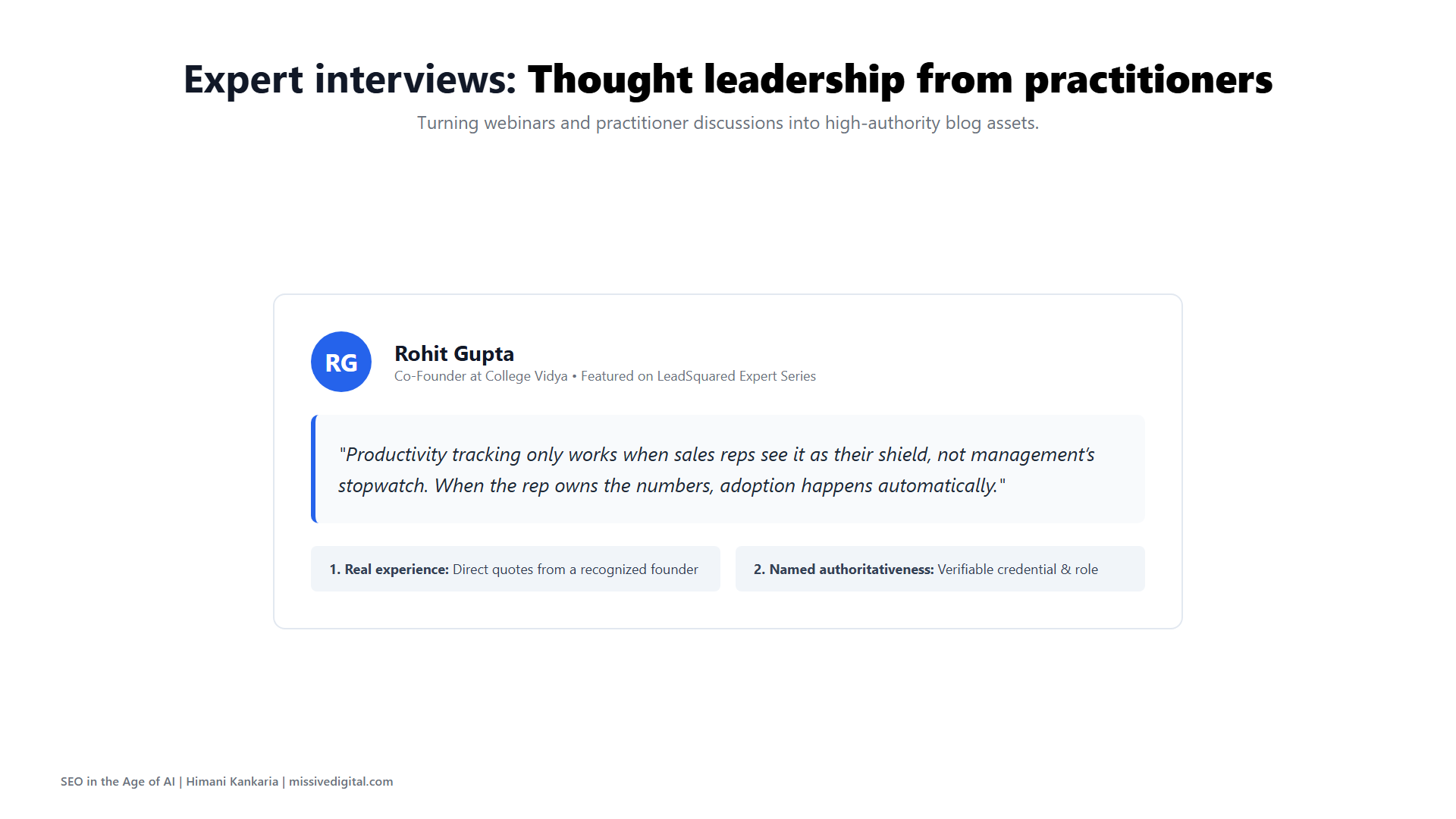
- Interview subject matter experts. LeadSquared turns its expert webinars into blog posts. One example: a session with Rohit Gupta, co-founder of College Vidya, on how productivity tracking helps sales teams meet their goals, published with his key takeaways (LeadSquared). The advice becomes thought leadership, because it comes from someone who has done the work. SME interviews are also one of the ways I recommend going beyond competitor analysis in content research.
- Quote recognized practitioners. HubSpot points to Adobe, whose blog features filmmakers and photographers explaining how they use its products (HubSpot).
- Link primary sources where the claim appears. Google’s documentation, the original study, the actual podcast episode, not a blog summarizing them.
- Embed third-party proof. An expert’s LinkedIn post or X thread, credited and linked.
- Link to your own deeper work. Related guides, webinars, and tools place the post inside a topic cluster.
Show Trust by Making Everything Verifiable
- Disclose commercial interest. If you sell what you recommend, say so. Google’s rater guidelines flag undisclosed conflicts of interest.
- Label illustrative numbers. If a table uses example data, say so in the caption.
- Credit every image and embed. Name the source under each visual.
- Add survey caveats. “This is what 500 marketers reported, not a measurement of citations.”
If your published posts need these elements added, that’s where our content audit and content optimization work starts.
Why Proof Elements Matter Even More in AI Search
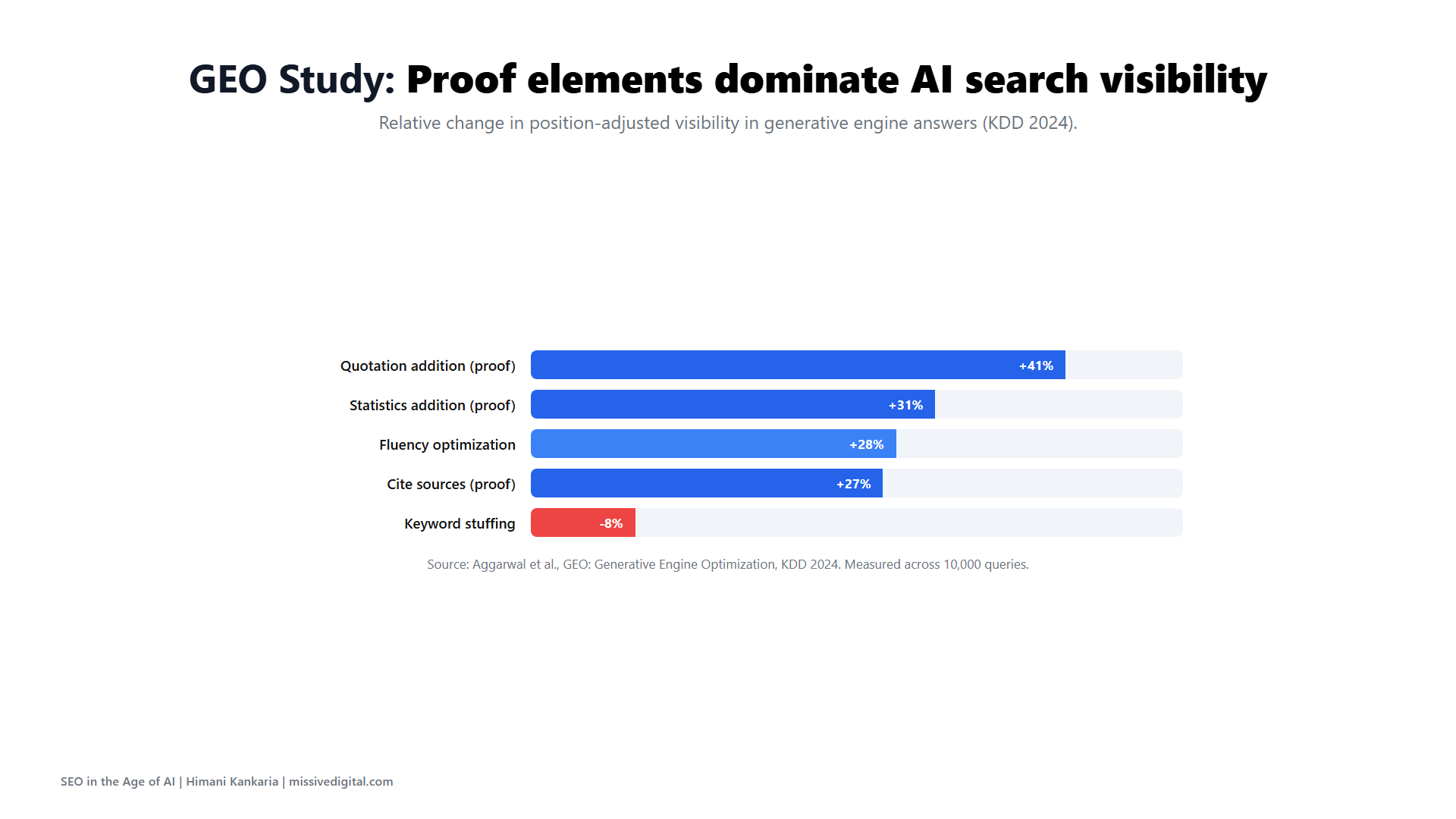
Chart: Proof elements took three of the top four spots for AI visibility
| Change made to the page | Change in visibility in AI answers |
|---|---|
| Quotation addition (proof element) | +41% |
| Statistics addition (proof element) | +31% |
| Fluency optimization | +28% |
| Cite sources (proof element) | +27% |
| Technical terms | +18% |
| Easy-to-understand | +14% |
| Authoritative tone | +10% |
| Unique words | +6% |
| Keyword stuffing | -8% |
Source: Pranjal Aggarwal, Vishvak Murahari, and colleagues at Princeton University and IIT Delhi, GEO: Generative Engine Optimization, published at the ACM SIGKDD Conference on Knowledge Discovery and Data Mining (KDD 2024). Figures are the relative change in position-adjusted word count from Table 1, measured on 10,000 queries in the GEO-bench benchmark.
Three of the four changes that lifted visibility the most are the same proof elements this guide recommends for every section: quotes from people who know the subject, numbers with a source, and citations to where a claim comes from. A more “authoritative” tone on its own helped far less, which suggests AI engines reward evidence over confidence. For how this plays out in brand recommendations, see our Gumloop research on how LLMs recommend brands, or check where your site stands with the GEO Readiness Score.
How YMYL Topics Like Healthcare and Finance Raise the E-E-A-T Bar
Google holds “Your Money or Your Life” (YMYL) topics to its strictest standard, because inaccurate health or financial advice can cause real harm. YMYL is judged per topic, not per site: a SaaS blog becomes YMYL the moment it publishes on payroll compliance or medical claims. In these topics, I treat a named, qualified reviewer as non-negotiable. It’s the standard we follow in our healthcare and fintech content work.
How Leading Healthcare and Finance Publishers Show E-E-A-T
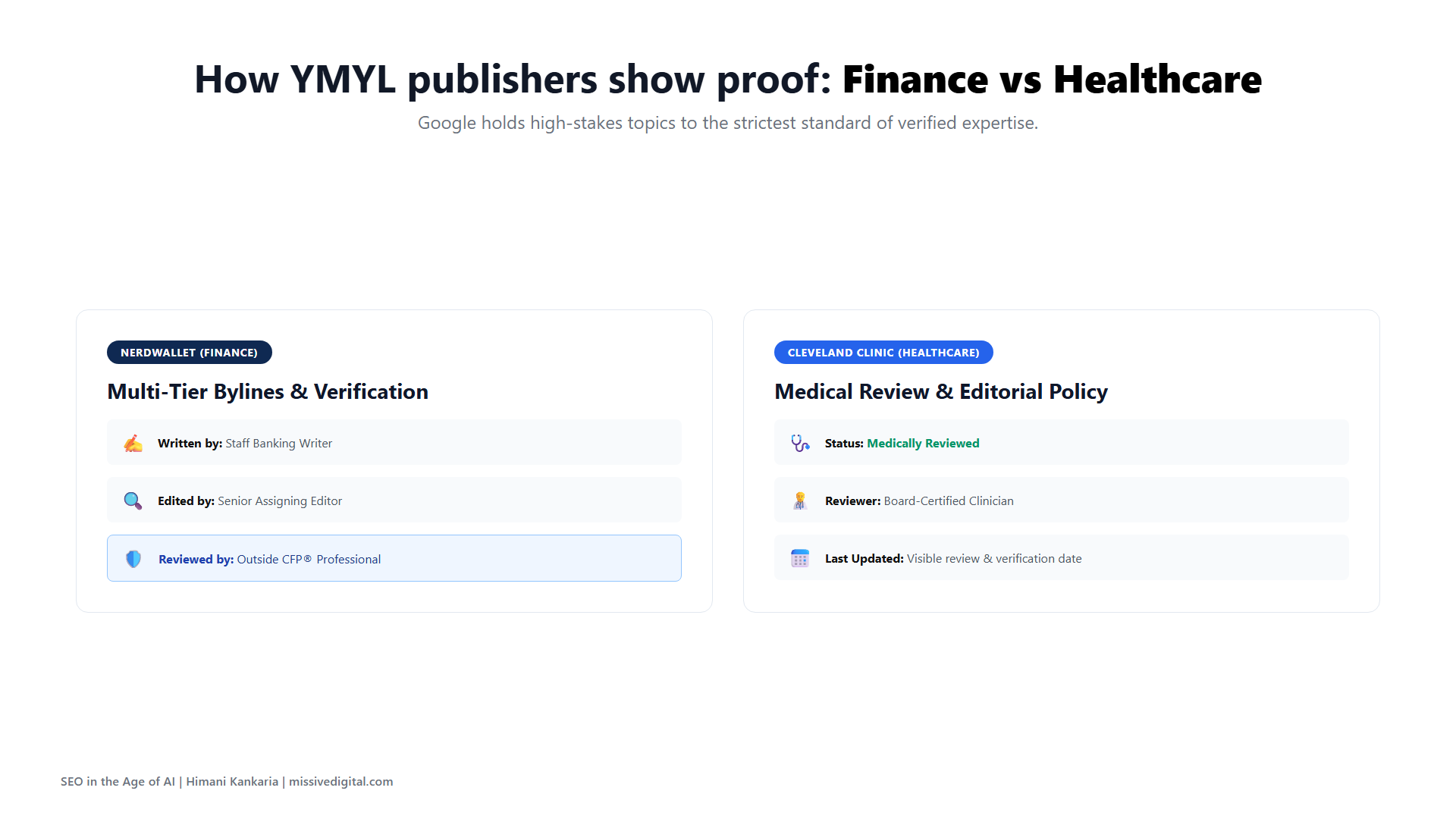
- NerdWallet (finance) uses the top of its pages to show who wrote, edited, and reviewed each article, with every role labeled. Growtika’s teardown points out the “reviewed by” role in particular: an outside expert who publicly attaches their name and credentials to the piece (Growtika). Pages also state that content is fact-checked by humans and link to NerdWallet’s editorial guidelines.
- Cleveland Clinic (healthcare) marks its Health Library articles as “Medically Reviewed” with a last-updated date and a link to its editorial process. Its clinicians also review content for partners: since 2024, Cleveland Clinic’s board-certified clinicians have reviewed The Healthy by Reader’s Digest’s evergreen articles for accuracy (The Healthy).
What YMYL E-E-A-T Looks Like in Each Part of a Blog
| Part of the blog | Healthcare example | Finance example |
|---|---|---|
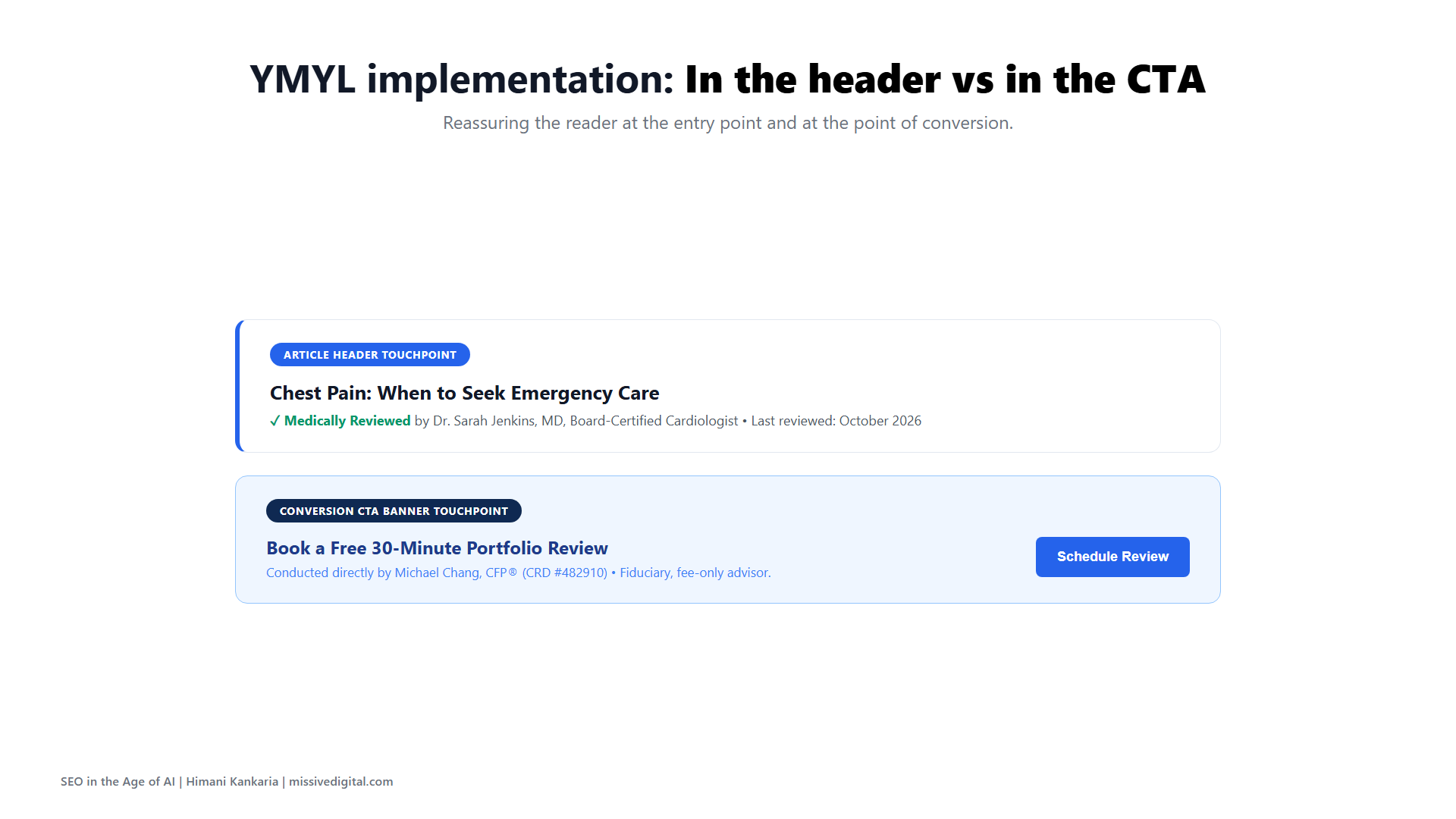
| Introduction | "Reviewed by Dr. [Name], board-certified cardiologist" under the title, plus the patient question that prompted the article | "Reviewed by [Name], CFP" under the title, plus the client question that prompted it |
| Main body | Claims linked to clinical guidelines or peer-reviewed studies; a clinician's quote on when symptoms need urgent care | Current rates and limits linked to the official source; a planner's worked example with real numbers |
| CTA banner | "Talk to our cardiology team" with the clinician's name, photo, and credentials beside the button | "Book a call with a CFP" with the planner's credential and a clear note on fees |
| Conclusion | When to see a doctor, a medical disclaimer, and the review date | Who this advice doesn't suit, a disclosure of any commercial ties, and the review date |
How to Add E-E-A-T to CTA Banners in a Blog
A CTA banner asks the reader to trust you with an email, a call, or money, at the exact moment their doubt is highest. That’s why I treat every banner as an E-E-A-T placement, not only a conversion element. If the proof stops at the end of the paragraph, the reader carries their doubt to the button alone.
Conversion experts have been making the same case for years:
- Joanna Wiebe, founder of Copyhackers, says every message has to answer two questions: “So what?” and “Prove it.” She recommends placing proof close to the claim it supports, and having one testimonial that proves each of your top messages, rather than many generic ones (Copyhackers).
- She also explains that people hesitate at a button because of friction and anxiety, and recommends placing copy that calms those anxieties right around the button. In one of her button tests, a button worded around the outcome, “End my scheduling hassles,” won over a generic sign-up button (Copyblogger).
- Talia Wolf, founder of GetUplift, recommends social proof that answers the specific objections stopping a prospect, because prospects believe customers like them more than they believe your claims (Emotional Targeting).
Seven Ways to Build E-E-A-T Into a CTA Banner
| # | Element | Example | Why it works |
|---|---|---|---|
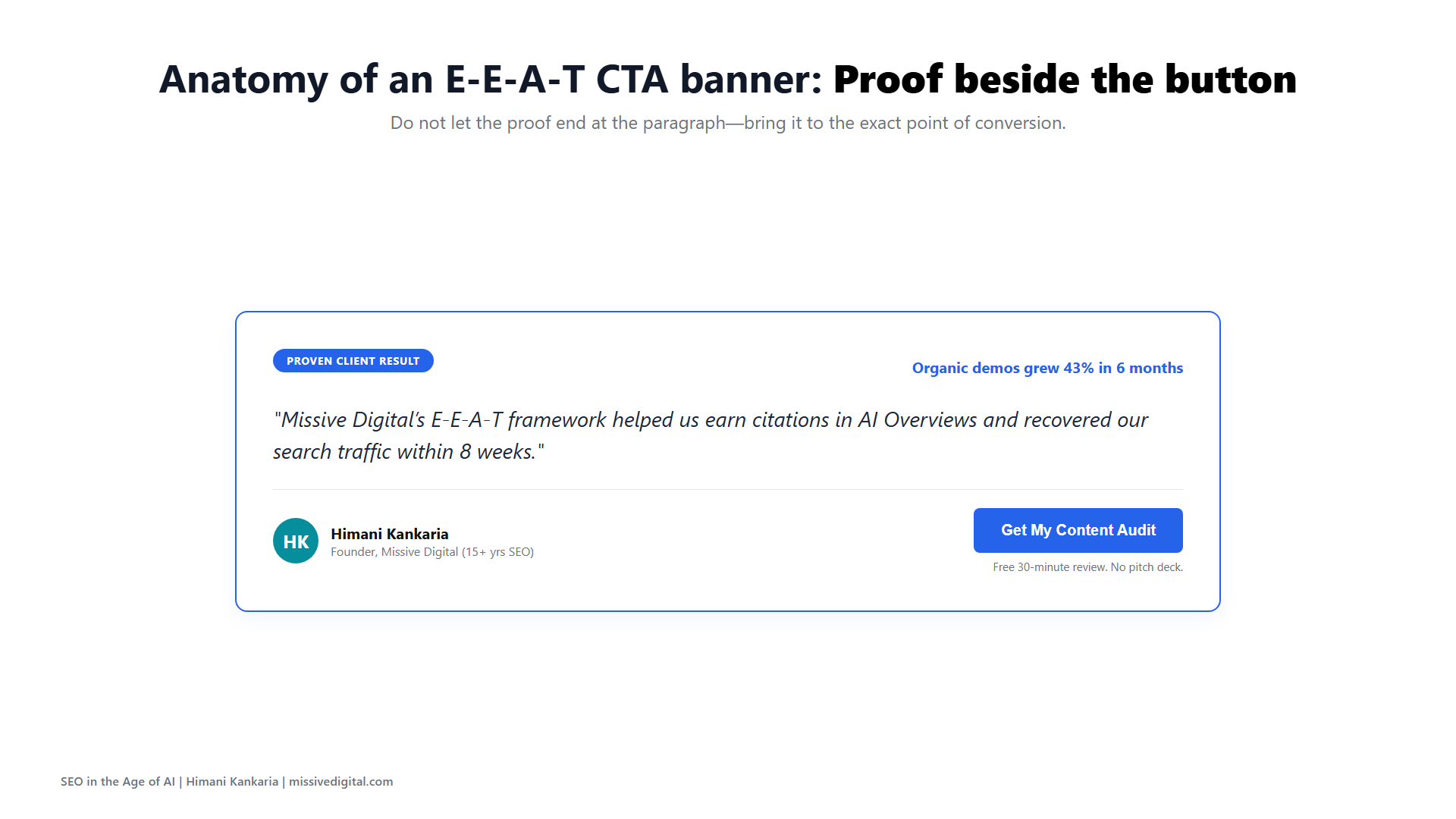
| 1 | Proof that matches the section above | Below a section on zero-click fears, a client result showing leads grew despite fewer clicks | The proof answers the doubt the reader has right now (Talia Wolf) |
| 2 | A testimonial with a story | What the client struggled with, how they found you, and what changed | Joanna Wiebe calls this the most persuasive testimonial format |
| 3 | A summary line above the testimonial | "Organic demos up after six months" above the quote | Joanna Wiebe: a summary header gets the testimonial read |
| 4 | A practitioner-made offer | "The E-E-A-T content validator our writers use on every section" | A tool you use daily proves the method is real (Himani Kankaria) |
| 5 | The person behind it | A small photo and "Built by Himani Kankaria, 15+ years in SEO" | A named expert beside the button answers "who is asking?" (Himani Kankaria) |
| 6 | Anxiety-calming copy at the button | "Free 30-minute review. No pitch deck." | Joanna Wiebe: friction and anxiety stop clicks at the button |
| 7 | A button that names the outcome | "Get my content audit" instead of "Submit" | Joanna Wiebe's "call to value" over a call to action |
Rules for Trustworthy Banners
- Match the funnel stage. A top-of-funnel post gets a checklist or template, such as our Content QA Checklist; a bottom-of-funnel post gets a consultation or audit.
- Keep one main ask per page. Talia Wolf recommends a single CTA per page (Elementor); repeat the same offer rather than competing ones.
- Use real, current proof. Real client names and numbers only, rounded down, never aspirational logos.
- Skip fake urgency and stock-photo faces. They undo the trust the content built.
How to Add E-E-A-T to a Blog Conclusion
The conclusion is where an expert commits. Instead of repeating the post, it gives the reader a judgment and a next step only you can offer.
| # | Element | Example | Why it works |
|---|---|---|---|
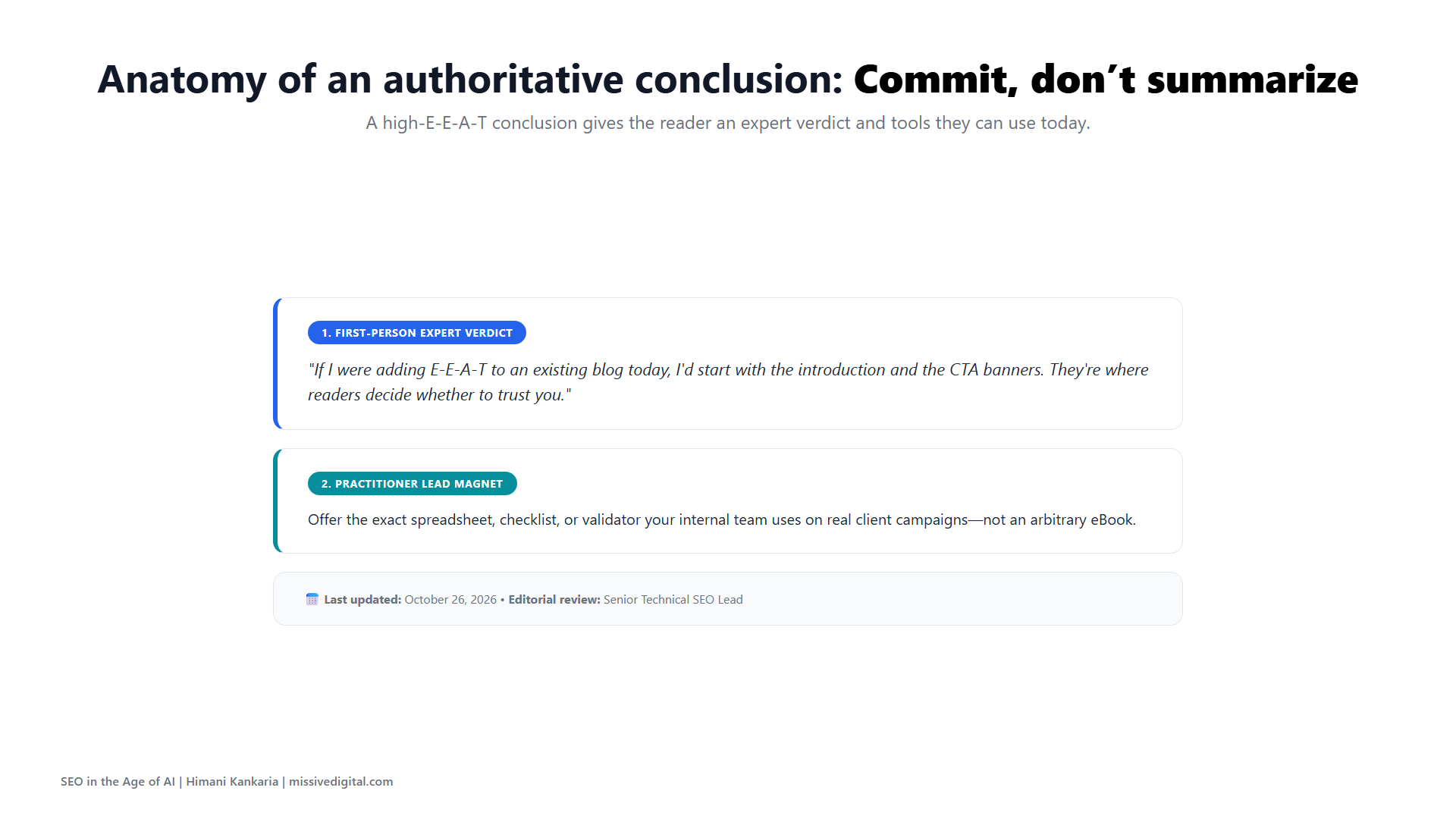
| 1 | Your verdict, in first person | "If I were starting today, I'd fix the introduction first, because…" | A recommendation drawn from the analysis shows judgment, not just research (Himani Kankaria) |
| 2 | The belief behind your work | "SEO was always about a brand's reputation and authority in the market." | A consistent point of view is what readers and AI tools come to associate with you (Himani Kankaria) |
| 3 | A line from practice | "Your research, your experience, your mistakes, your learnings. AI will not replace them." | It reminds the reader where the advice came from (Himani Kankaria) |
| 4 | A practitioner-made lead magnet | The checklist, template, or score your team actually uses | It proves the method exists outside the post (Himani Kankaria) |
| 5 | Where the advice doesn't apply | "If you're in a regulated industry, add a reviewer step first." | Honest limits build trust faster than big promises |
| 6 | A last-updated note | Review date and a contact link at the end | Ahmet Kaplan Elçi, founder of RoadSharing, recommends it for accuracy (Travelpayouts) |
| 7 | A personal note and a question | One sentence about what you're testing next, then a question for readers | HubSpot finds personal comments and a question make conclusions stronger (HubSpot) |
Page-Level Signals That Support E-E-A-T Beyond the Author Bio
These sit outside the four parts of the blog, but they make the proof inside it visible to readers and crawlers.
- A key takeaways box near the top, so your conclusions are easy for readers and AI tools to quote.
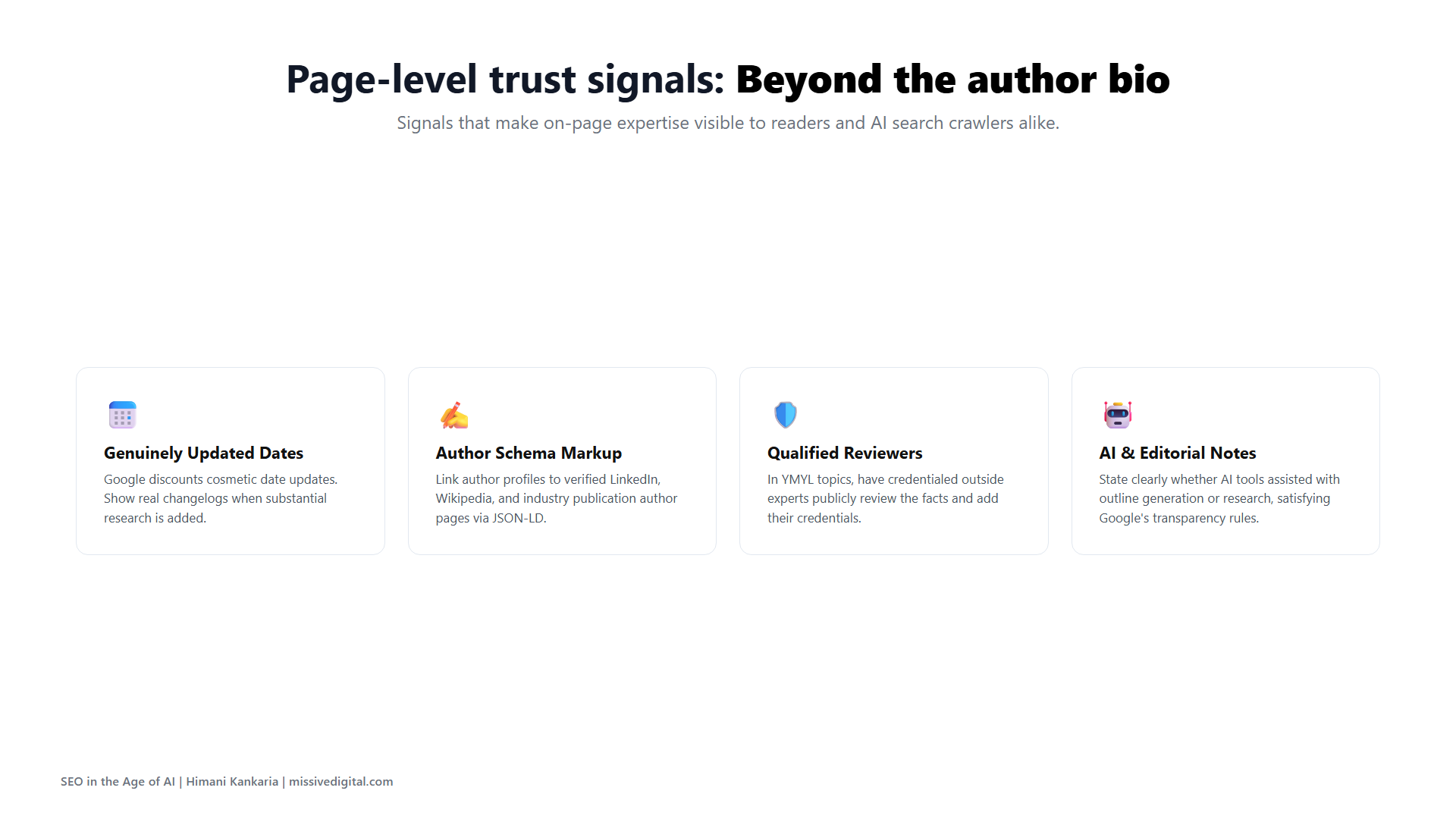
- Published and genuinely updated dates. Google warns against changing dates without substantial changes to the content.
- A “reviewed by” line for healthcare, finance, and legal topics, from someone qualified to check the claims.
- An editorial or AI-use note. Google asks whether any use of automation is clear to visitors.
- Person, Organization, and Article schema, with links to the author’s verified profiles.
- FAQs written as real questions people type into search and AI tools, with short, direct answers, the same way I recommend writing for featured snippets.
Common Mistakes That Weaken E-E-A-T in a Blog
- Fake author personas or AI-generated author photos. Google’s rater guidelines treat fabricated creator profiles as deceptive.
- Inflated credentials. Overstating a real bio is the same mistake on a smaller scale.
- Mass-produced pages with nothing new in them. Google’s spam policy targets content that adds no value, not the use of AI itself.
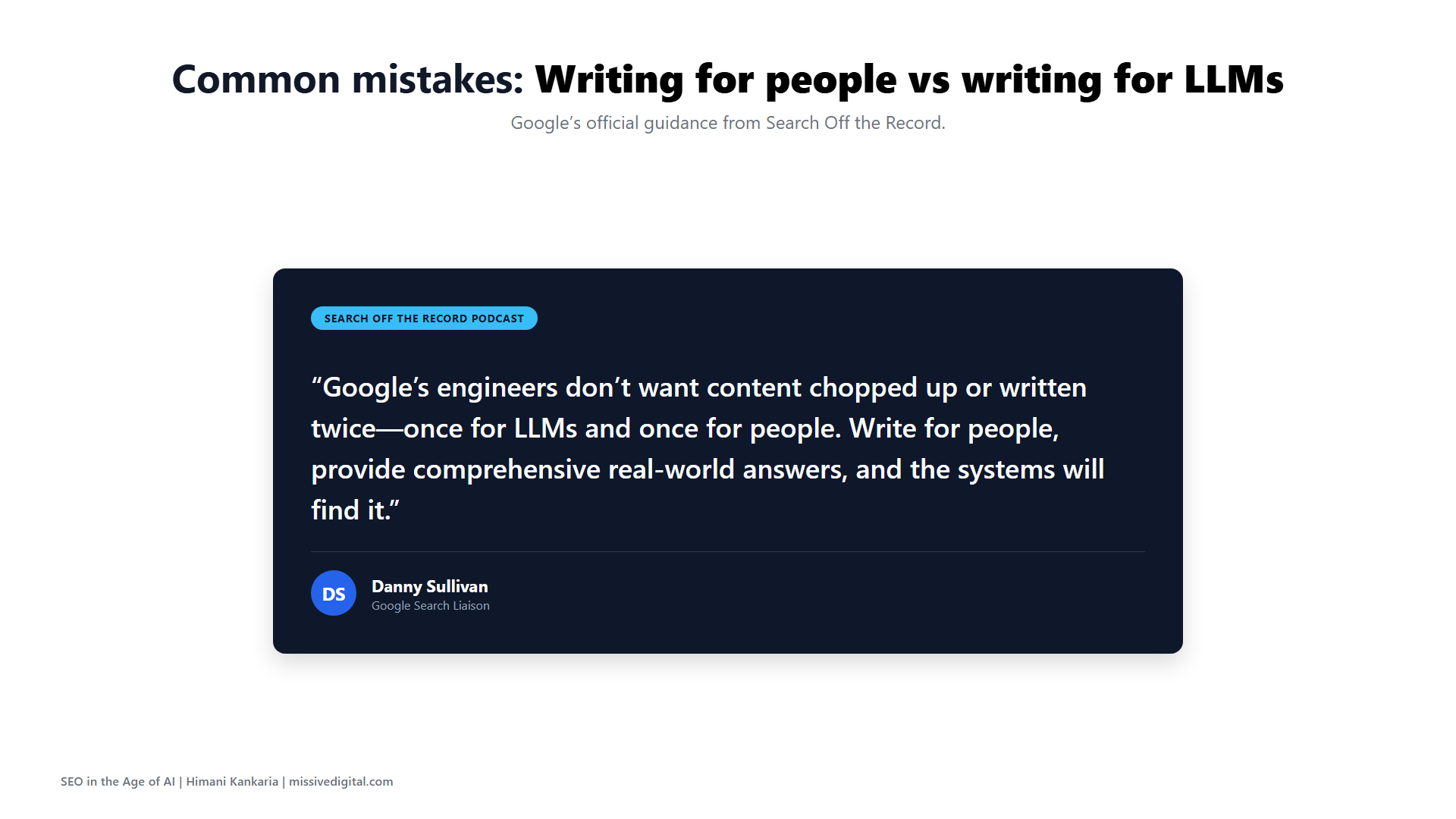
- Bite-sized chunks written for LLMs. Danny Sullivan said on Google’s Search Off the Record podcast that Google’s engineers don’t want content chopped up or written twice, once for LLMs and once for people.
- The same E-E-A-T line in every introduction. Readers notice, and it stops reading as proof.
- Statistics without dates or primary links. A secondhand number weakens the claim it’s meant to support.
- Self-praise in place of proof. “Leading agency” proves nothing; a result does.
I’ve covered more of these in how to fix 21 content creation mistakes that impact ROI on Search Engine Journal.
A Section-by-Section E-E-A-T Checklist for Your Next Blog
- Introduction: one specific credibility signal, different in type from your last three blogs
- Introduction: a visual that proves the opening scene or trigger
- Each section: purpose, implementation, and proof all present, none labeled
- Each section: at least one first-hand element (screenshot, example, result, or lesson)
- Each section: claims linked to a primary source where they appear
- Each section: a quote, statistic, or expert voice where it strengthens the point
- YMYL topics: a named, qualified reviewer and a review date
- CTA banner: a specific, named proof element beside the button
- CTA banner: an offer that matches the section above it and the funnel stage
- Conclusion: your verdict in first person, plus where it doesn’t apply
- Conclusion: a practitioner-made lead magnet, placed before the FAQs
- Page: genuine dates, schema, and any AI-use note in place
Conclusion: Proof Is What Readers and AI Engines Remember
If I were adding E-E-A-T to an existing blog today, I’d start with the introduction and the CTA banners. They’re the two places readers decide whether to trust you, and the two places most blogs leave empty. Then I’d go section by section and ask one question: where’s the proof?
This approach won’t replace a real reputation. Mentions, reviews, and citations from others still matter, and no amount of on-page proof can manufacture them. But it makes sure that the experience you already have shows up where it counts.
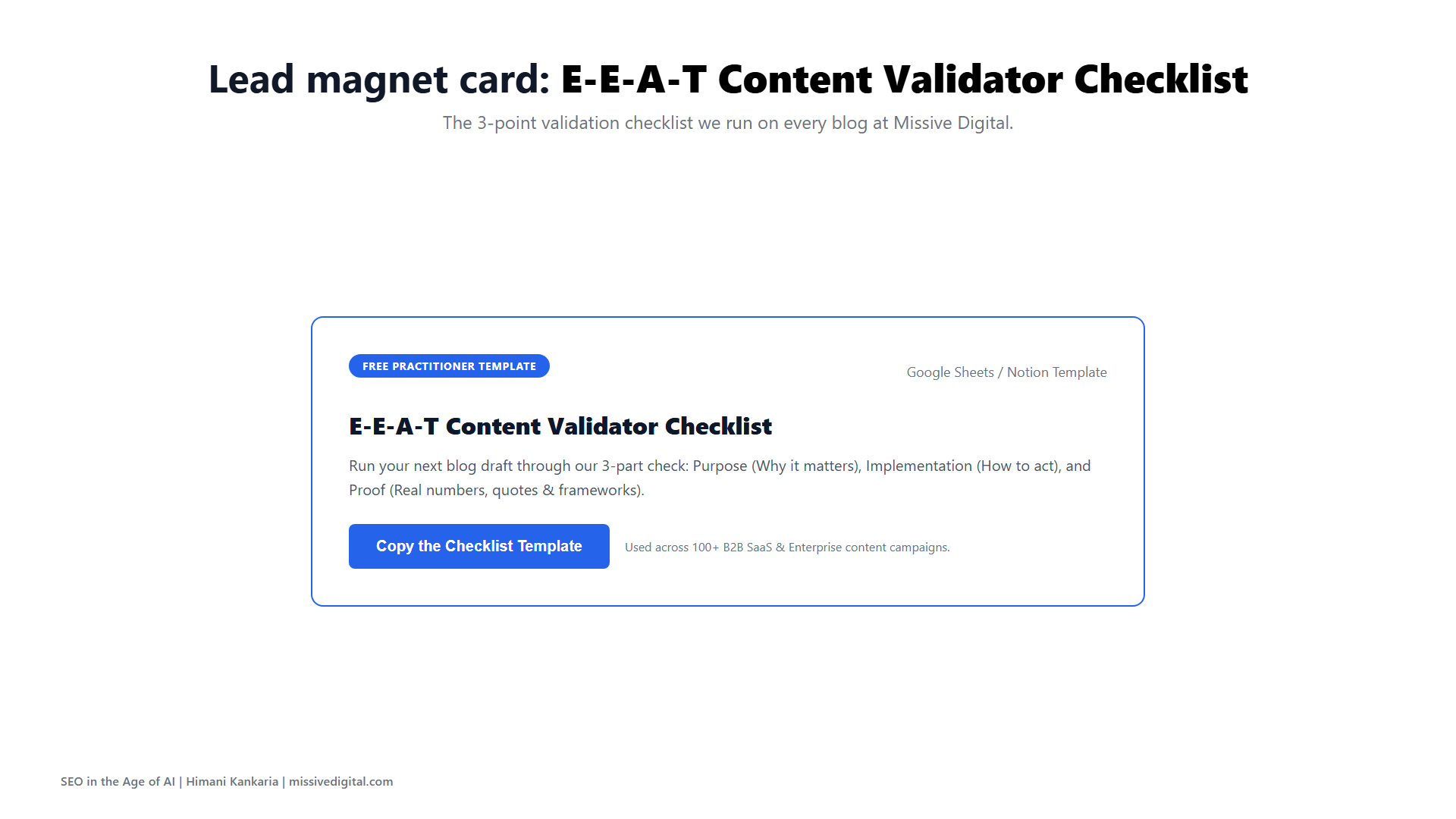
We use the E-E-A-T Content Validator Checklist on every blog we write at Missive Digital. Copy the E-E-A-T Content Validator Checklist and run your next draft through it.
If you’d like our team to build these elements into your blogs, explore our content writing and SEO services, or book a free 30-minute consultation with our team.
FAQs
E-E-A-T elements are the proof points that show a page's Experience, Expertise, Authoritativeness, and Trust: first-hand examples, original screenshots, named experts, primary sources, statistics, review dates, and clear authorship.
Use one specific signal tied to the topic, such as a client scene, a result with a number, a short bio, or the question that prompted the post. Change the type of signal from blog to blog.
Yes. A banner with a named testimonial, a practitioner-made offer, and the expert's name and photo beside the button carries proof to the point where readers decide.
Not directly. Google uses E-E-A-T to guide human quality raters, and its systems look for signals that align with what those raters reward.
YMYL topics need named, qualified reviewers, links to primary sources such as clinical guidelines or official rates, visible review dates, and clear disclaimers or disclosures.
In the KDD 2024 GEO study, adding quotations from relevant sources raised visibility in AI answers by 41% and adding statistics by 31%, while keyword stuffing lowered it.