
Key Takeaways
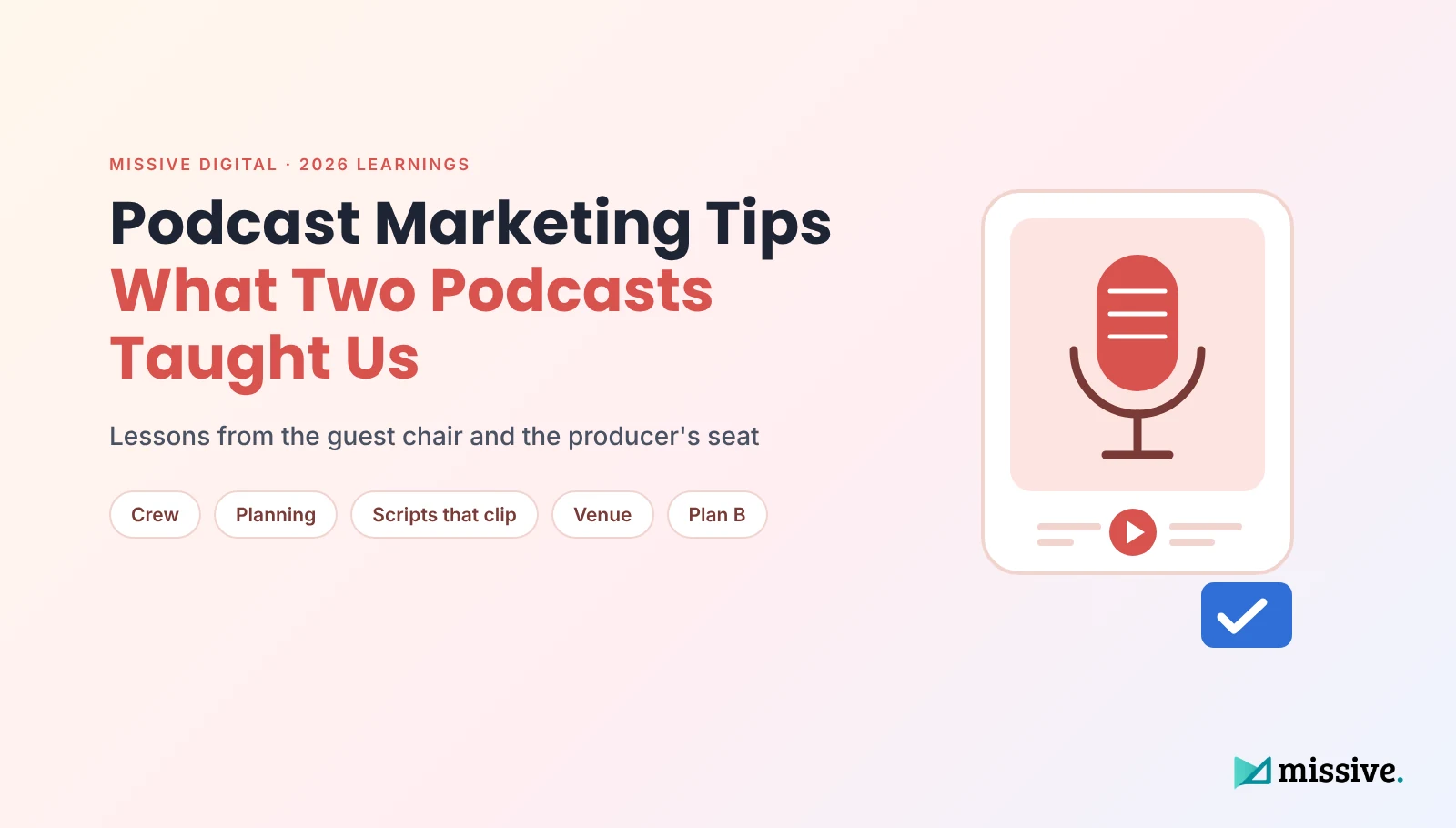
- A podcast is a crew project. Our August production needed a strategist, a host, a venue, a camera and sound team, an editor, and a distribution plan before a single reel went out.
- Planning takes as long as recording, and often longer. The 44 minutes viewers watch sit on top of weeks of research, scripting, and coordination.
- Script for the clip, but speak like a conversation. Write questions that pull out 30 to 60 second answers that stand alone as reels.
- Pick the venue for sound first, reconfirm it the day before, lock a technical set-up that cannot fail, and keep a Plan B for power, gear, people, files, and the venue itself.
- An online podcast and a webinar can start from the same session, but they need different plans, promotion, and success metrics.
- One episode is a month of content. The graphology episode produced Shorts that each passed 1,000 views and 10 hours of watch time on the full episode.
- Being a guest is podcast marketing too, and sponsors fit best when they are designed into the episode: an opening sound, an intro mention, and swag on set.
Every founder I speak with this year wants a podcast. Very few have asked what it takes to make one that people actually finish.
In 2026, I sat on both sides of the mic. Earlier this year, I was the first guest on Het Balar’s show, Link Up With Het, powered by Link Publishers, where we talked about AI, SEO, and content. In August, our team at Missive Digital produced a 44-minute founder episode for a graphology software company, from choosing the host to booking the venue to cutting the reels.
The two experiences taught us different things. As a guest, I saw how much a host’s team prepares so a conversation feels easy. As producers, we found out how many small things can go wrong between “let’s do a podcast” and a clip that reaches 1,000 views. These are the thirteen lessons we would hand any marketing team before its first episode.
There is a reason the rush is on: YouTube says more than 1 billion people watch podcast content on the platform every month. The audience exists. What separates the shows that grow from the ones that stall after episode three is everything you do before and after you hit record.
1. Treat Your Podcast as a Crew Project, Not a One-Person Task
The most common assumption we hear is that the founder will talk, someone will hold a phone, and an intern will post it. That is how episode one becomes the only episode.
When we produced the graphology episode in August, the founder only had to show up and talk. Behind him, our team finalized the host, booked and coordinated the venue, ran the shoot, edited the long version, cut reel bites, and planned where each clip would go. The founder’s expertise was the product; the crew made it watchable.
The guest seat taught me the same lesson from the other side. Het’s team had the questions, the setup, and the clip plan ready, so all I had to do was think and answer. That ease is designed by a team.
The Roles a Company Podcast Needs
You do not need a person for every role, but someone has to own each one.
| Role | What they own | Why it matters |
|---|---|---|
| Strategist | Goal, audience, episode themes, guest list | Keeps the show tied to pipeline, not vanity |
| Researcher and scriptwriter | Talking points, clip-worthy questions, hooks | Turns expertise into moments people share |
| Host or host coordinator | The person asking the questions and their prep | Chemistry decides whether viewers stay |
| Producer | Venue, schedule, gear, call sheet, Plan B | Absorbs the chaos so the guest does not feel it |
| Camera and sound | Angles, lighting, clean audio | Viewers forgive average video, never bad audio |
| Editor and designer | Long episode, reels, thumbnails, captions | Decides what the internet actually sees |
| Distribution lead | Posting calendar, collaborations, LinkedIn, email | Makes sure the episode reaches the right people |
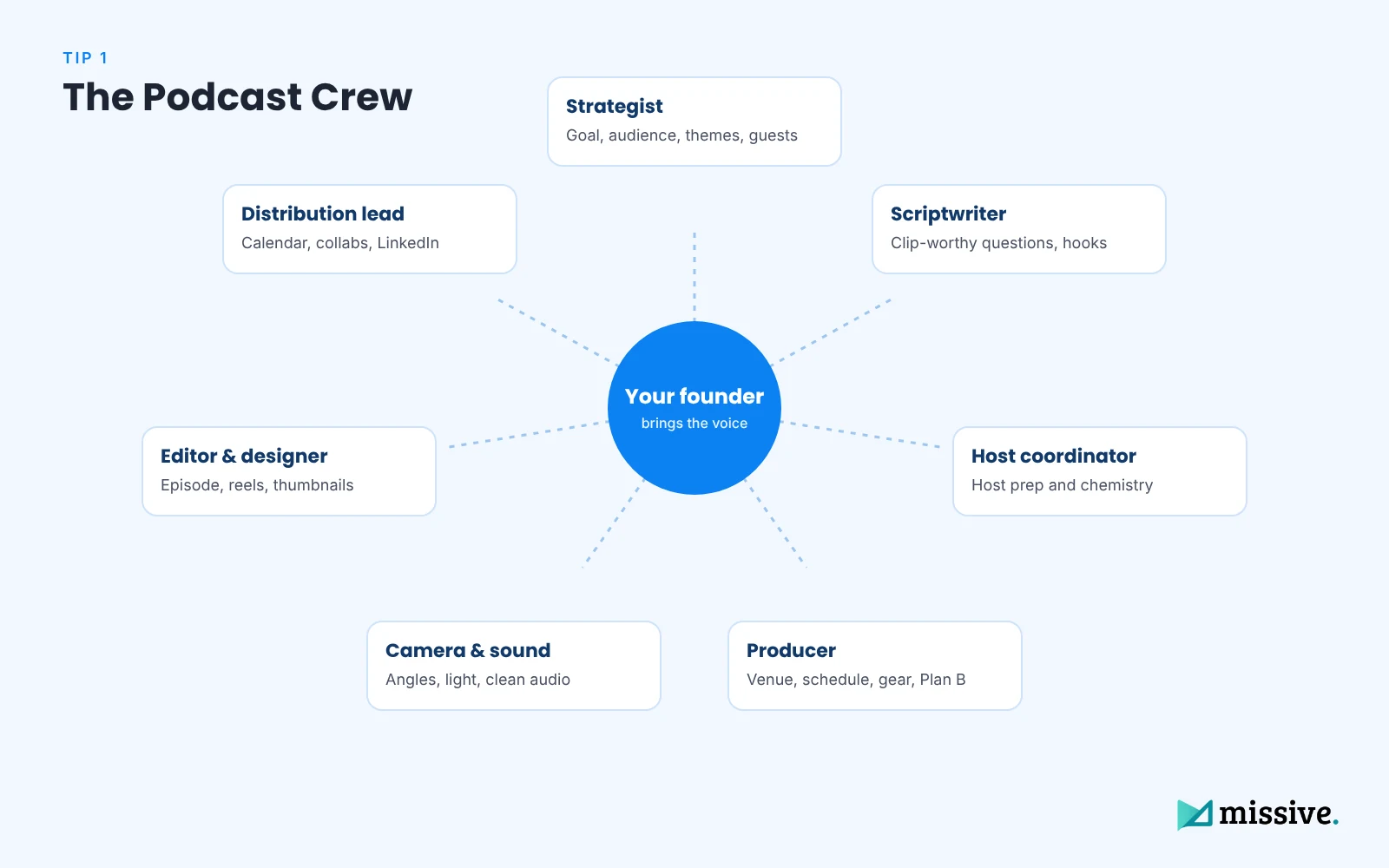
If your team cannot cover these roles in-house, this is where a partner like our podcast marketing team fits in: you bring the voice, we run the crew.
2. Give Planning as Much Time as Recording
A 44-minute episode feels like a one-day job. It is not. Most of our working time on the graphology podcast went into decisions made before anyone sat down: the topic angle, who should host, which questions would produce reels, where to shoot, and what the founder should avoid saying.
Execution needs its own runway too. Editing a long episode, cutting reels, writing captions, designing thumbnails, and scheduling collaborations with the guest’s accounts took far longer than the shoot itself.
A Realistic Timeline for One Episode
- Week 1: Strategy. Agree on the goal of the episode (awareness, leads, authority), the audience, and the one idea viewers should remember.
- Week 2: Research and script. Build the question flow, mark the clip moments, and share a briefing note with the guest.
- Week 3: Logistics. Lock the host, venue, date, gear, and backups. Run a tech check at the venue.
- Shoot day. Record, with time buffered for setup and retakes.
- Weeks 4 to 5: Post-production. Edit the long episode, then cut reels, Shorts, and LinkedIn clips.
- Weeks 5 to 8: Distribution. Release the episode and drip clips on a fixed rhythm.
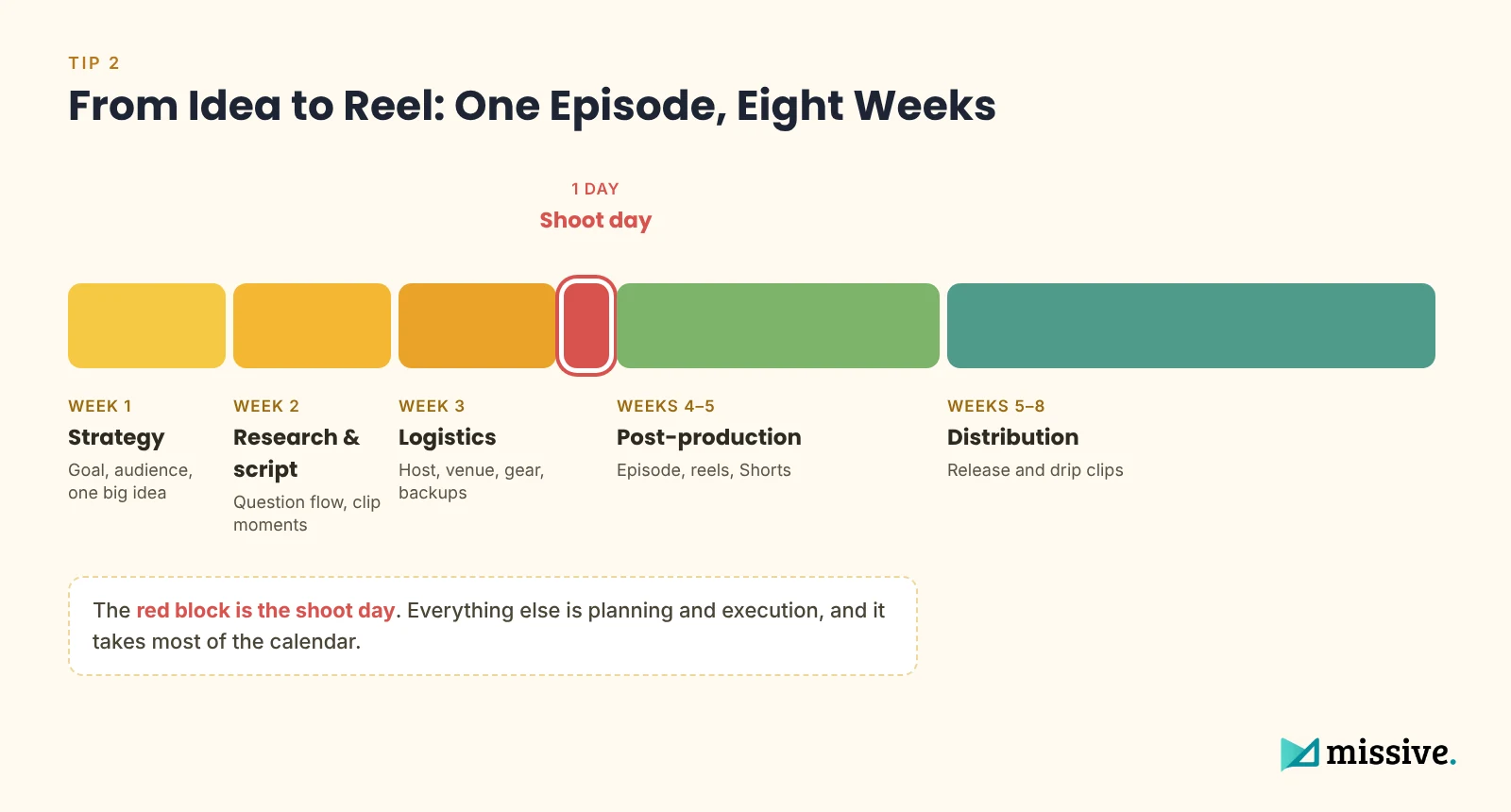
The point of the visual is the size of the shoot-day block. If your plan gives recording more space than planning and post-production, the plan is upside down.
3. Choose the Host for Chemistry, Not Just Credentials
For the graphology episode, finalizing the host was one of the first decisions, not the last. A founder with deep authority can still sound flat if the person across the table does not know when to push, when to pause, and when to let a story run.
What we looked for was a host who understood the subject well enough to ask a sharp follow-up, but was curious enough to ask the questions a beginner would. Graphology is a niche science; the host’s job was to make it feel personal to someone scrolling Instagram.
Steven Bartlett, host of The Diary of a CEO, makes a similar point in his conversation with Daniel Lubetzky on Build or Break. He describes stepping back from the mic so he has no urge to talk, letting silence do the work, and noticing that guests mirror the energy a host brings. A curious host gets a more honest guest.
Before you book a host, run a 15-minute practice chat with the guest. If the conversation does not flow over coffee, it will not flow on camera.
4. Script for the Reel, but Make It Sound Unscripted
This was the hardest balance in both podcasts. If the script is too loose, you get 44 minutes of pleasant talk and nothing that survives as a 30-second clip. If it is too tight, the guest sounds like they are reading, and viewers scroll away.
What worked for us was scripting the questions and the moments, never the answers. For the graphology episode, we did not ask the founder to explain the science in the abstract. We built questions around things people already wonder about: what your signature says about you, whether your handwriting hints at the right career, why some children write the way they do. Each question was designed to produce a short, self-contained answer that could stand alone as a reel.
In the Het Balar episode, I could see the same design from the guest chair. Het’s questions were open enough for me to tell real stories, but each one had a clear point. That is why the team could later cut separate clips on customer retention (my answer was “plans before promises”), on what AI still misses in content, and on website navigation as a technical SEO mistake. One conversation, at least three standalone ideas.
How to Write a Podcast Script That Clips Well
- Open with a hook, not a bio. Jay Acunzo recommends a two-to-three-minute cold open that drops listeners into the middle of a story and sets the stakes before any introductions. Plan the question that will produce that moment.
- Mark three to five “clip moments” in the outline. These are questions that invite a contrarian opinion, a number, a mistake, or a story.
- Use bullet points, not sentences. The B2B podcast agency Content Allies recommends bullet-outline scripts for expert interviews so the host sounds prepared but the guest still sounds natural. That matches what we saw.
- Rehearse the topics, not the lines. A quick call to walk the guest through the flow removes nerves without killing spontaneity.
- Ask for the short version. If an answer runs long, ask “If you had to say that in one line?” You will often get your best reel.
The same principle drove the results on the graphology brand’s social channels: curiosity beat explanation. We wrote about why that works in our piece on emotional marketing, and podcast clips follow the same rule.
5. Pick the Venue for Sound First and Looks Second
A beautiful room with an echo will cost you more in editing than a plain room with soft furnishings. When we booked and coordinated the venue for the graphology podcast, the questions that mattered most were not about the backdrop.
We also learned that booking a venue is not the same as having one. On the day of the graphology shoot, the venue we had finalized changed the location on us. The new space was still under construction, and our client was furious, rightly so. Those first minutes of panic were next level: a founder ready to record, a crew with gear in hand, and a room that was not what we had signed up for.
What saved the day was the venue team’s customer service. They owned the problem instead of arguing about it, the founder of the venue stayed with us through a night shoot, and the interiors of the space they arranged were good enough that the final episode looks exactly as we planned. The episode you can watch today gives no hint of that evening.
The lesson we took away: reconfirm the exact address, room, and condition of the venue 24 hours before the shoot, ask for current photos or a quick video call walkthrough, and choose venue partners on how they handle problems, not only on how the room looks in their portfolio.
Our Venue Checklist
| Check | What to look for | What goes wrong if you skip it |
|---|---|---|
| Acoustics | Carpets, curtains, sofas, low ceilings | Echo that no plugin fully removes |
| Outside noise | Traffic, construction, lifts, neighbors | Retakes and lost answers |
| AC and fans | Can they be switched off during takes? | A constant hum under every word |
| Power | Enough sockets near the set, a backup source | Cameras dying mid-answer |
| Light | Window direction at your shoot time | Faces that change color across the episode |
| Space | Room for two cameras, a third angle, and crew | Cramped framing and tripping hazards |
| Brand fit | Can you add props, books, or product cues? | A set that looks like any other podcast |
| Access | Parking, lifts, entry time, booking buffer | A late start that eats your recording window |
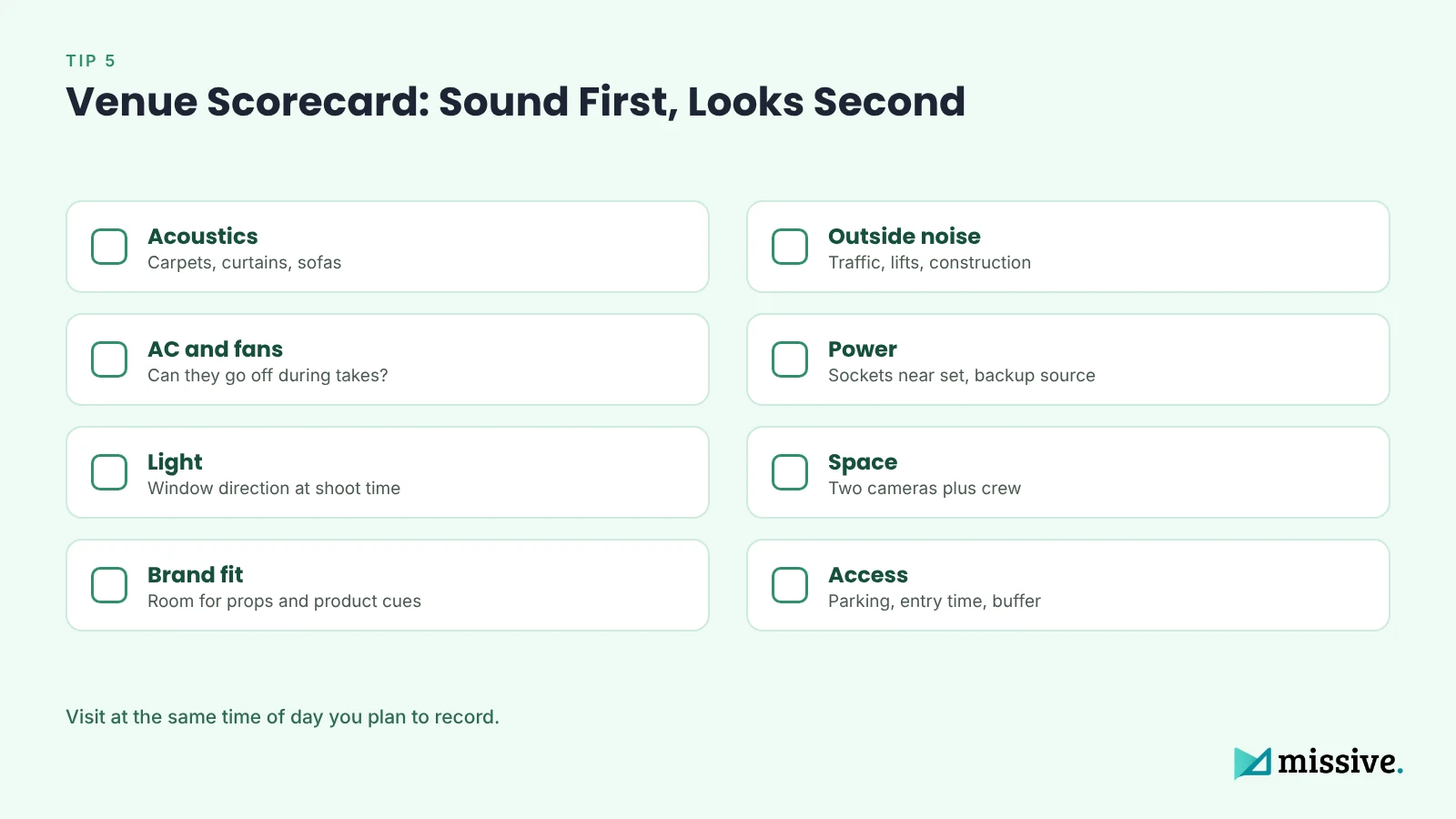
Visit the venue at the same time of day you plan to record. The quiet room you saw at 11 a.m. can sound very different at 5 p.m.
6. Plan an Online Podcast Differently, and Do Not Plan It Like a Webinar
If you host your podcast online, the venue problem disappears, and a new set of decisions takes its place. You are no longer designing one room; you are depending on two or three homes or offices, each with its own internet, light, and background noise. That also gives you a choice most in-person shows do not have: the same online session can be built as a podcast or run as a webinar.
The catch is that the two are planned and executed very differently. We ran both for the graphology brand in the same season, so we saw the gap up close. The podcast needed a host, a venue, a script with clip moments, and an editing plan. The webinar needed none of that; it needed people in seats. Filling it took 7 WhatsApp messages, 4 email campaigns, targeted LinkedIn outreach, and paid Meta campaigns, which brought in 67 registrations and 25 live attendees, a 37.3% attendance rate.
Podcast or Webinar: Decide Before You Plan
| Podcast | Webinar | |
|---|---|---|
| Main goal | Authority and reach over time | Live engagement and leads now |
| Success depends on | The conversation and the clips | Registrations and live turnout |
| Promotion happens | After recording | Before the event |
| Audience interaction | Comments on clips, later | Live Q&A, polls, chat |
| Script | Questions with clip moments | Slides, agenda, demo, CTA |
| Edit | Heavy: episode, reels, Shorts | Light: recording and highlights |
| What lasts | Episode and a month of clips | Replay, lead list, follow-up emails |
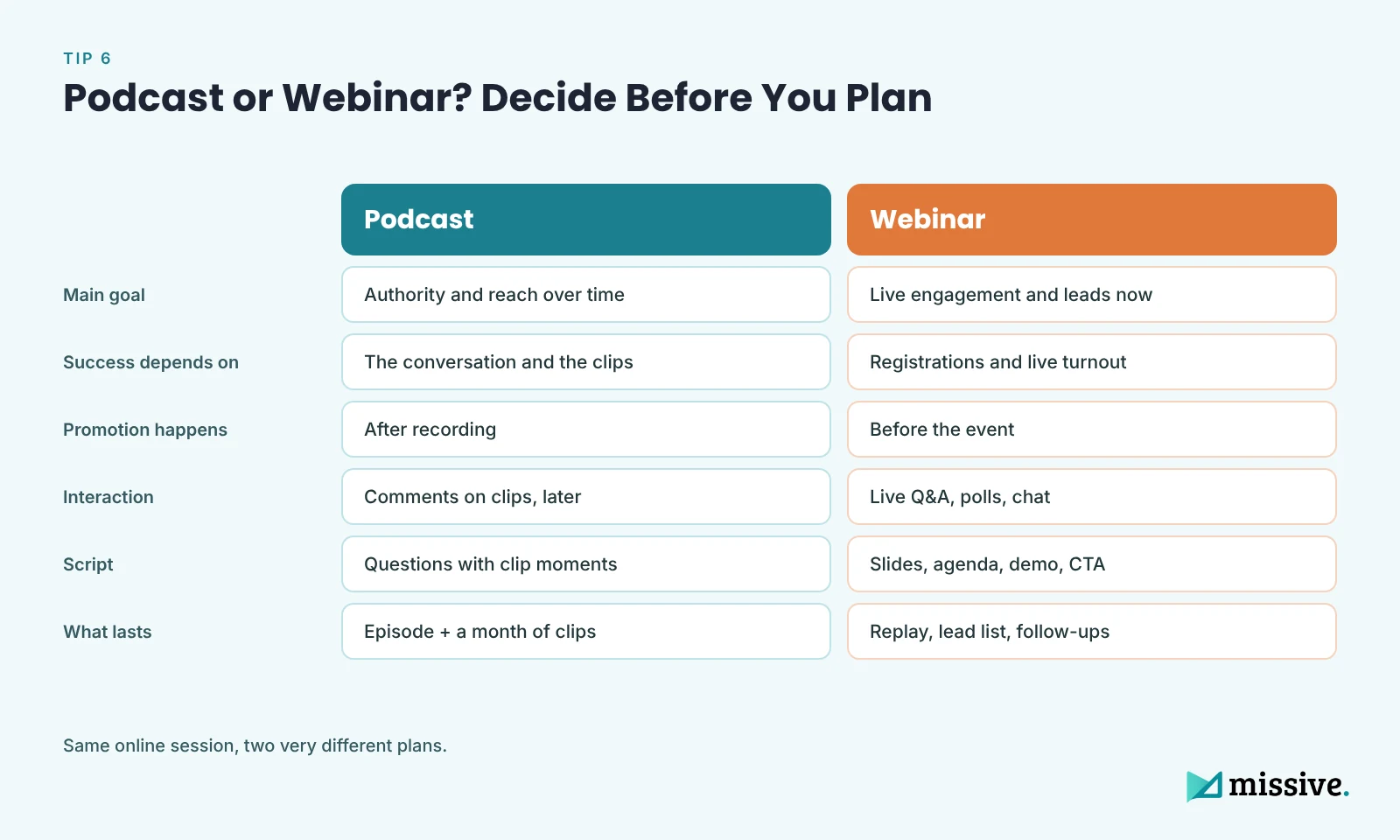
If You Host Your Podcast Online
- Send the guest a setup kit a week before: wired headphones, a wired mic if possible, a plain background, and a light source facing them.
- Run a 10-minute tech check the day before on the same device and internet the guest will use.
- Record each person’s audio and video separately so one weak connection does not ruin the episode.
- Agree on a hand signal or one-word cue for pauses and retakes, since you cannot read the room the way you can in person.
- If you plan to stream it live, treat it as a webinar first and the podcast as the edited version that comes later. Trying to make one session do both jobs usually means it does neither well.
7. Lock the Technical Set-Up, Because No Failure Can Be Accepted
You can reshoot a bad question. You cannot reshoot a founder’s best answer, delivered once, with real emotion, if the mic was muted or the camera stopped recording at minute 38. On a podcast shoot, the technical set-up is the one area where we accept zero failure.
That standard came straight from our own shoot. Once the guest is in the chair, every minute spent fixing a cable, a camera that overheated, or a mic that picked up the AC is a minute of energy the conversation never gets back. The set-up has to be finished and tested before anyone sits down.
Tim Ferriss describes the same discipline in a walkthrough of his own podcast setup: several spare SD cards, fresh batteries for long interviews, and extra XLR cables, because loose fittings caused his only real in-person recording problems. He sums it up with a line he credits to Navy SEALs: “Two is one and one is none.” You do not need his kit list. You do need the mindset: the technology should be invisible to the guest and impossible to fail.
Video: Tim Ferriss shares his podcast setup, on his YouTube channel
Our Technical Set-Up Checklist
| Area | What we set up | The check before the guest arrives |
|---|---|---|
| Audio | A dedicated mic per speaker, recorded on separate tracks, with a lapel mic as a second source | Record 2 minutes, play it back on headphones, check levels peak well below clipping |
| Cameras | One wide shot plus one close shot per speaker, same frame rate and white balance | Confirm each camera's recording time limit, card space, and that it does not overheat on long takes |
| Lighting | Key and fill light on each face, no mixed daylight and warm bulbs | Check skin tones on the monitor at the actual recording time |
| Sync | A clap or slate at the start of every take | Confirm every camera and recorder caught it |
| Power | Mains plus charged batteries for every device | Know which socket is on which circuit, and where the backups are |
| Monitoring | One crew member on headphones for the entire recording | Agree on a silent signal to pause if something sounds wrong |
| Storage | Large, formatted cards in every device | Plan the card swap and the double backup before anyone leaves |
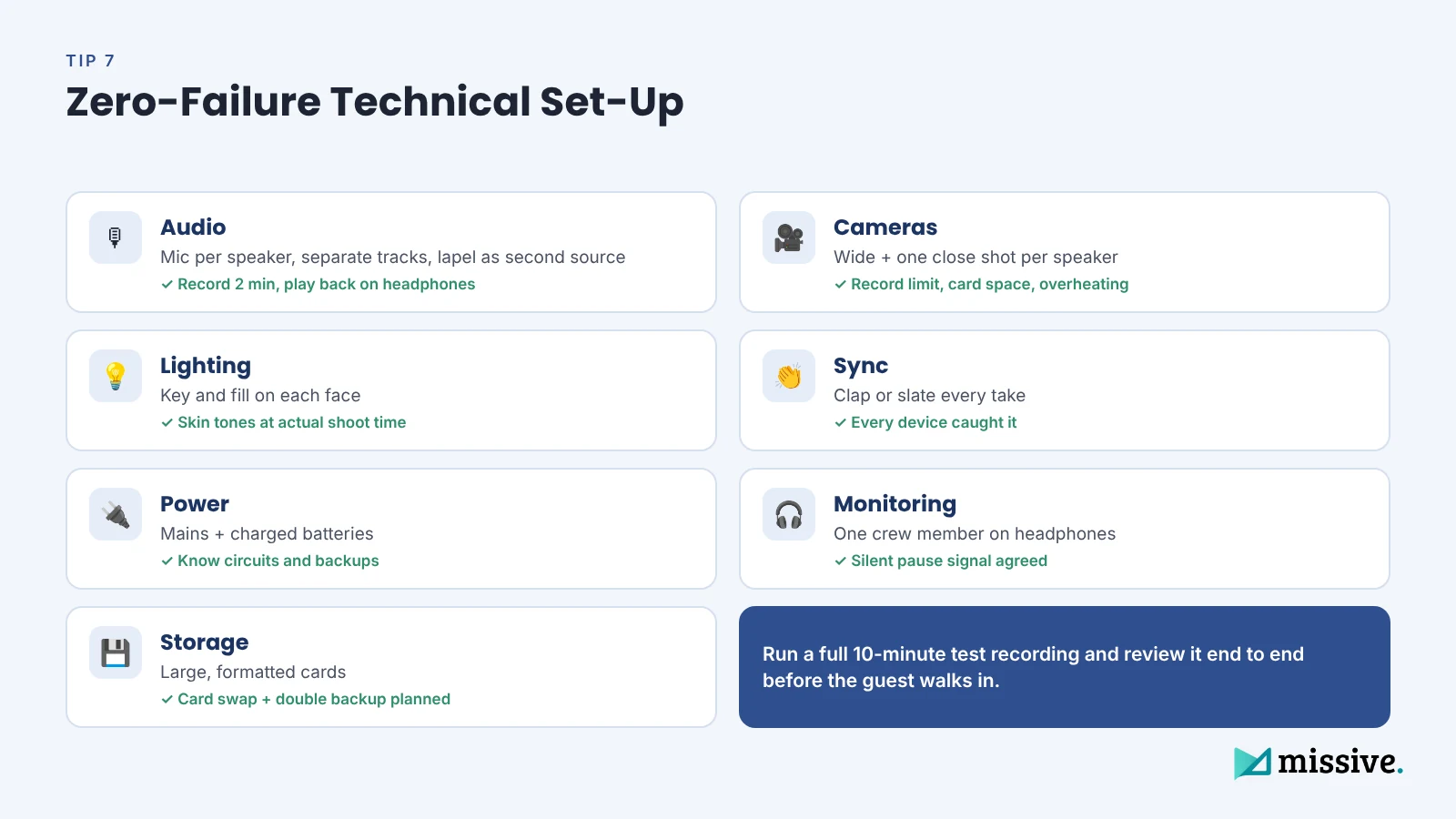
The single most useful habit: do a full 10-minute test recording on the set, then watch and listen to it end to end before the guest walks in. Most technical failures show up in that test, when fixing them costs nothing.
8. Have a Plan B for Almost Everything
If there is one lesson I would underline twice, it is this one. On a shoot day, every moving part depends on another: the guest depends on traffic, the cameras depend on power, the audio depends on batteries, and the edit depends on files that were copied correctly.
Professional podcasters plan for this as a matter of routine. The team behind the Changelog podcast, for example, asks every guest to make a local recording of their own voice as a backup, even though their recording platform already captures local audio. Two copies of the most important thing is the cheapest insurance in podcasting.
The Plan B List We Now Use
| If this fails | Plan B |
|---|---|
| Main microphone or its battery | Spare charged batteries, plus a lapel mic recording separately |
| Main camera | A second camera or phone rolling as a wide shot all the time |
| Power at the venue | Fully charged batteries for every device and a power bank kit |
| Guest arrives late or cancels | A buffer slot in the booking and a backup date already agreed |
| Host falls ill | A second person briefed on the question flow |
| Internet for a remote guest | Double-ender recording, where each side records locally, so a weak connection does not ruin the audio (Riverside explains the method here) |
| Memory card corruption | Copy every card to two drives before you leave the venue |
| A clip gets no traction | Two alternate hooks and captions written in advance for each reel |
| The venue changes or is not ready | A second venue shortlisted as a fallback, and the first one reconfirmed the day before |
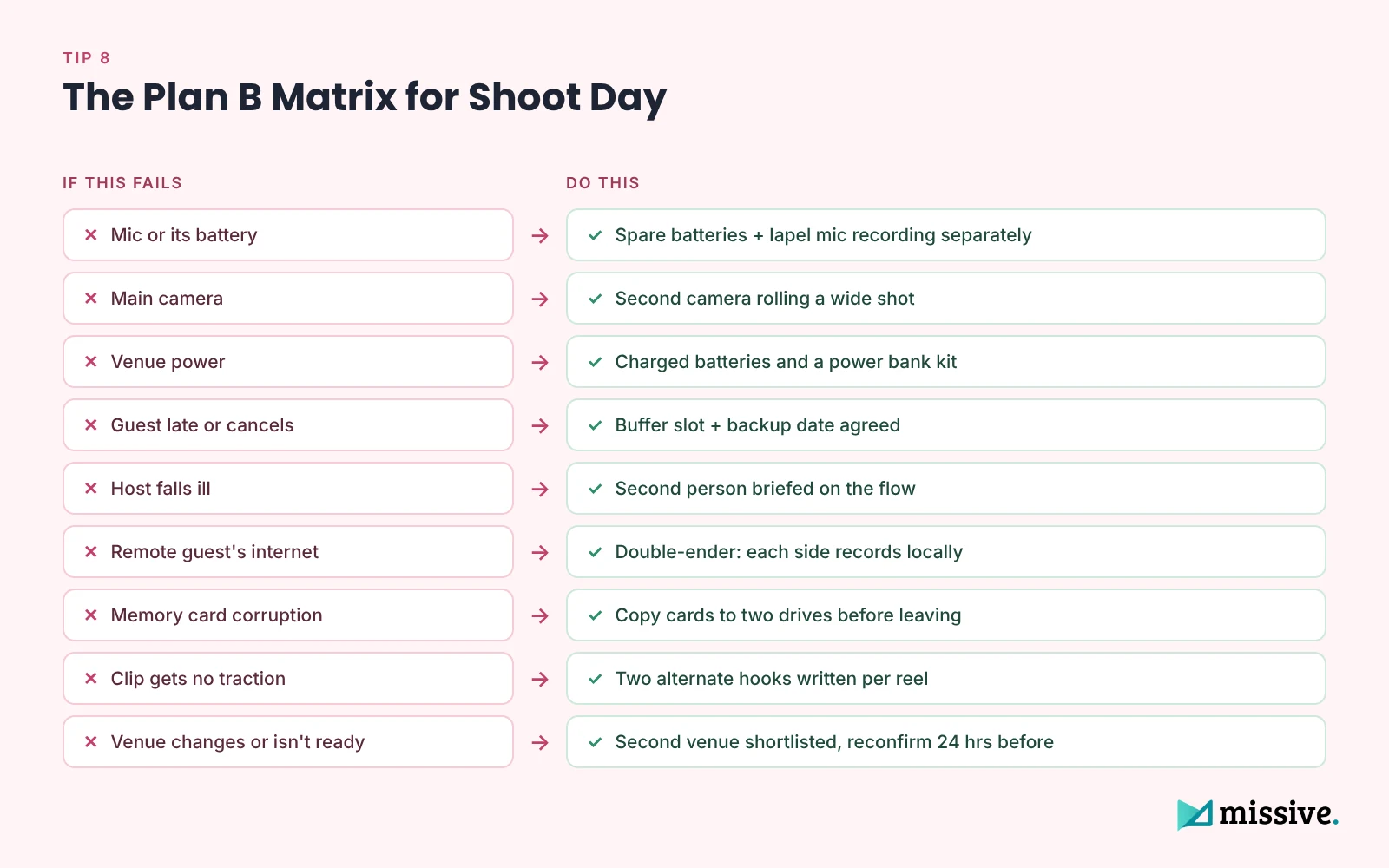
None of this is expensive. What it costs is a planning meeting, and that meeting is what keeps a shoot day from turning into a reshoot day.
9. Plan the Clips Before You Plan the Episode Release
Most people who will ever meet your podcast will meet it as a 30-second clip, not as the full episode. So the clip plan is not an afterthought; it is the main distribution plan.
For the graphology brand, we cut the 44-minute episode into short reel bites and collaboration videos, then adapted each one for Instagram, Facebook, LinkedIn, and YouTube Shorts instead of producing separate content for each. On YouTube, four Shorts each passed 1,000 views, with the top one at 1,699, on a channel that had been nearly dormant. The full episode earned 10 hours of watch time from 109 views, which works out to roughly 5.5 minutes per viewer. The clips brought people in; the episode kept the serious ones.
We also learned that length matters more than polish. Across the brand’s social channels, reels of around 10 seconds with a strong opening question consistently beat longer educational videos. You can read the full story in our graphology brand case study.

A Simple Clip Plan for One Episode
- 8 to 10 short clips of 10 to 45 seconds for Reels and Shorts, each opening on a question or a bold line
- 3 to 5 longer clips of 60 to 90 seconds for LinkedIn, where a professional angle travels further
- Collaboration posts with the guest’s and host’s accounts so the clip reaches both audiences
- Two hook options written for every clip, so you can repost with a new opening if the first one stalls
10. Use the Guest Seat as Podcast Marketing Too
Not every company needs its own show to benefit from podcasts. Sitting in someone else’s guest chair puts your thinking in front of an audience that someone else has already built.
What stood out to me on Link Up With Het was how long one recording kept working. Het’s team released the full episode and then posted clips over the following weeks, each with its own angle, and our team reposted them from the Missive Digital page and my profile. A single afternoon of conversation turned into weeks of reasons for people to look us up.
The same thing happened with a third podcast I joined this year, The Search Session with Gianluca Fiorelli from Advanced Web Ranking. Their team cut a 1:21 Short from our conversation on what quality content actually means today, and that Short now introduces the full episode to people who would never have found a long interview.
Video: Himani Kankaria on The Search Session by Advanced Web Ranking, February 2026
How to Be a Guest That Hosts Want to Clip
- Arrive with three stories, not thirty points. Hosts can only clip what is said clearly and briefly.
- Take one clear position. “Plans before promises” worked as a clip because it was a stance, not a list.
- Share and reshare. Comment on every clip the host posts, and repost from both your personal profile and your company page.
- Give the host’s team what they need. A short bio, a headshot, and the links you want mentioned save them time and get you described correctly.
If your leaders are building a profile through podcasts, the guesting work fits naturally into a wider personal branding plan, and on LinkedIn it helps to know the post types founders should avoid when sharing those clips.
11. Design Sponsors Into the Format, Not on Top of It
Production costs add up quickly once you count the crew, the venue, the gear, and the editing. Sponsors can fund a season and, when they fit the audience, add credibility to the show. The mistake is treating them as an ad break bolted on at the end.
The sponsor moments that work best are planned into the episode from the start:
| Where | What it looks like | Why it works |
|---|---|---|
| Opening sound | A short sonic logo or sound sting from the sponsor before the intro | Listeners start to link the sound with the show |
| Host intro mention | "This episode is brought to you by..." in one natural line | Credits the sponsor before attention drops |
| On-set swag | Branded mugs, notebooks, mic flags, a backdrop, or the product on the table | Stays visible in every clip cut from the episode |
| Closing sound and CTA | The sponsor's sound plus one clear call to action at the end | Gives interested listeners a next step |
| Clip captions | A sponsor tag on the reels and Shorts | Extends the deal beyond the full episode |
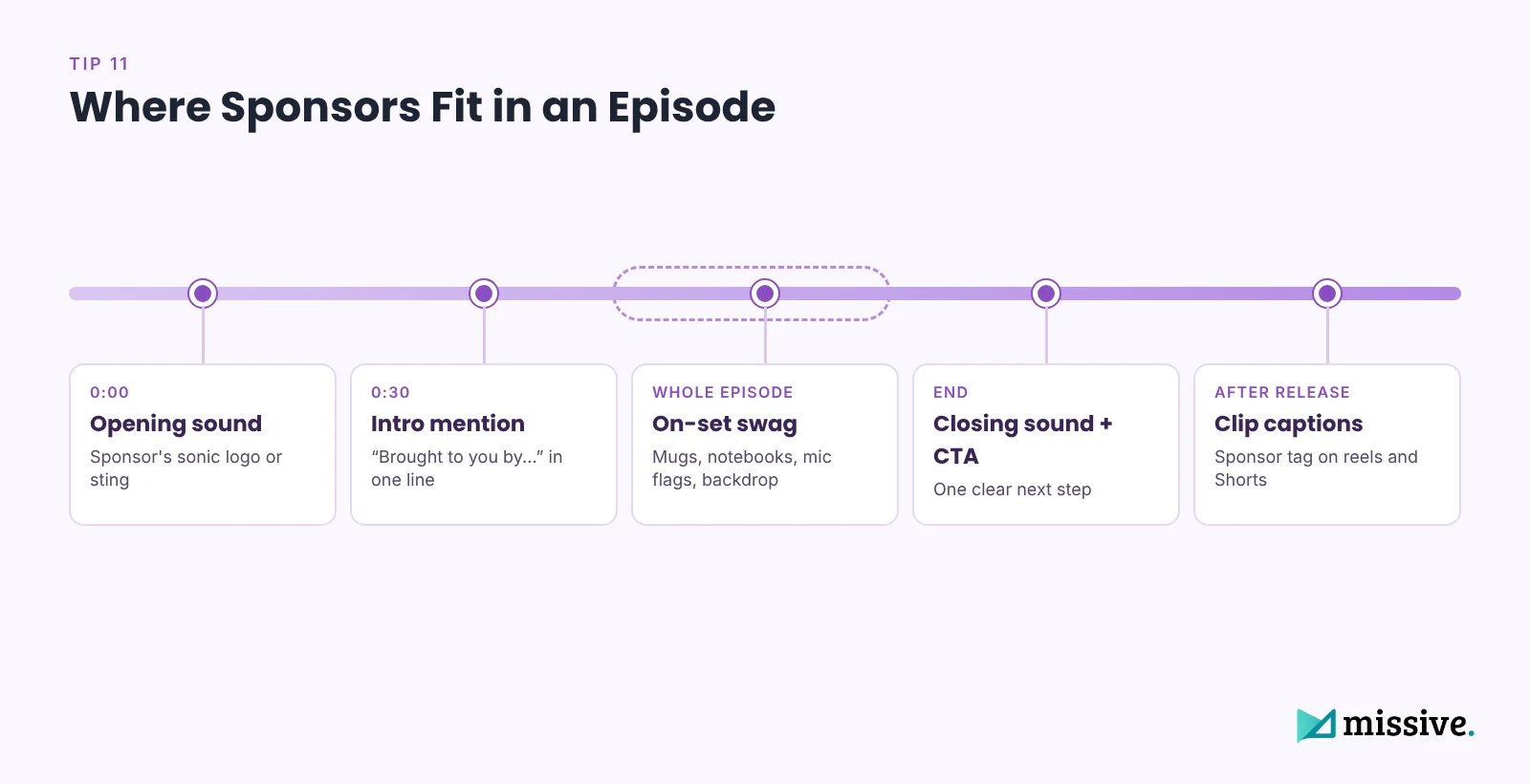
Keep it to one or two sponsors per episode, and choose sponsors whose buyers overlap with your listeners. The host matters as much as the ad: in a spring 2026 study by Cumulus Media and Signal Hill Insights, 52% of weekly podcast listeners said a host’s influence matters most to them, more than double the share who said the same of social media influencers. A sponsor read in the host’s own words, used sparingly, should make the episode feel more valuable, not more crowded.
12. Publish on a Rhythm People Can Expect
A brilliant episode followed by three months of silence teaches your audience not to wait for you.
Steven Bartlett makes this point in a short clip shared by Podcast Collective, where he credits his growth to uploading consistently every Monday. Raj Shamani, host of India’s Figuring Out, adds the other half of the rule in his interview with Simi Shah: his team discards any episode that does not help the listener think better. Consistency gets you the habit; a quality bar keeps it.
Video: Tip from Steven Bartlett on publishing consistently, clipped by Podcast Collective
For a company podcast, this does not have to mean a weekly episode. It can mean one episode a month and two clips every week in between. The rhythm matters more than the volume, and LinkedIn is usually where B2B clips earn the most conversations, which is why we plan podcast distribution alongside our LinkedIn marketing work.
13. Measure Attention and Conversations, Not Only Views
Views tell you a clip was seen. They do not tell you whether anyone cared.
On our own episode, the number that told us the most was not the 109 views; it was the average of about 5.5 minutes per viewer on a niche topic. That is the kind of number a founder can take to a sales meeting.
Daniel Sanchez of Sweet Fish Media makes the same argument in his list of podcast metrics that leave out downloads: track the relationships the show builds with ideal clients and referral partners, the content you repurpose from each episode, and how widely guests share it. He compares judging a podcast by downloads to judging sales reps only by the dials they make. For a company podcast, that early signal is often a prospect who says, “I saw your episode.”
What to Track for Each Episode
| Metric | Where to find it | What it tells you |
|---|---|---|
| Average view duration | YouTube Studio | Whether the conversation holds attention |
| Clip saves, shares, and comments | Instagram, LinkedIn insights | Which ideas people want to keep or pass on |
| Profile visits and follows after a clip | Platform analytics | Whether clips build an audience, not just views |
| Mentions in sales calls and DMs | CRM notes, team feedback | Whether the podcast reaches buyers |
| Leads or registrations from episode CTAs | Forms, UTM links | Whether the podcast moves pipeline |
Conclusion: A Podcast Is a Production, Not a Conversation You Record
If I had to sum up both podcasts in one line, it would be this: the conversation is the easy part. What makes it work is the crew around it, the weeks of planning, a script that sounds unscripted, a venue that sounds good, a technical set-up that cannot fail, a Plan B for the things that will go wrong, and a clip plan that keeps the episode alive long after shoot day.
Start small. One well-produced episode with a clear goal and ten strong clips will do more for your brand than six rushed episodes nobody finishes. Then keep the rhythm and track the attention, not just the views.
Your voice, our crew!
Planning your first company podcast, or your first appearance as a guest? Book a free 30-minute consultation with our team, and we will map out the crew, timeline, and clip plan your show needs.
FAQs
Plan before you record, build a small crew with clear roles, script questions that produce short standalone answers, choose a quiet venue, test your technical set-up end to end, keep backups for gear and files, and plan your clips before release. Most first podcasts struggle because of planning gaps, not because of the guest.
For a single founder episode with clips, plan for about eight weeks from strategy to the last clip: roughly three weeks of planning, one shoot day, and four to five weeks of editing and distribution. The recording itself is the shortest stage.
Script the questions and the clip moments, not the answers. Use bullet points instead of full sentences, brief the guest on the flow rather than the wording, and ask for one-line summaries when answers run long.
A 40 to 60 minute conversation usually gives you 8 to 10 short clips for Reels and Shorts plus 3 to 5 longer clips for LinkedIn, if the script was built with clip moments in mind.
A dedicated mic per speaker on separate tracks with a lapel mic as backup, a wide camera plus one close camera per speaker, key and fill lighting, a clap or slate for sync, charged batteries, one person monitoring audio on headphones, and enough card space. Run a 10-minute test recording and review it before the guest arrives.
Check acoustics, outside noise, whether the AC can be switched off, power sockets and backup, natural light at your shoot time, space for cameras and crew, and easy access. Visit at the same time of day you plan to record, and reconfirm the venue 24 hours before the shoot.
No. A podcast builds authority over time through the conversation and its clips, and most promotion happens after recording. A webinar aims for live engagement and leads, so most of the work goes into registrations before the event. Decide which one you are making before you plan.
Plan sponsor moments into the format: a short sponsor sound at the start or end, a one-line mention in the host's intro, branded swag on set, a closing call to action, and a sponsor tag on clips. Keep it to one or two sponsors whose buyers overlap with your listeners.
Yes. Guesting puts your thinking in front of an audience the host has already built, and every clip the host posts gives you a reason to reshare and start conversations. Arrive with a few clear stories and one strong position so the host's team can clip you easily.