
I have a confession. When Zomato sends me one of its witty push notifications, I often screenshot it and put it on my WhatsApp Status. I haven't ordered anything. I don't even tag Zomato. And yet those Statuses get more replies than almost anything else I post. Friends reply with laughing emojis, their own favourite notifications, or just "haha, so true".
Here are two that landed on my phone recently:
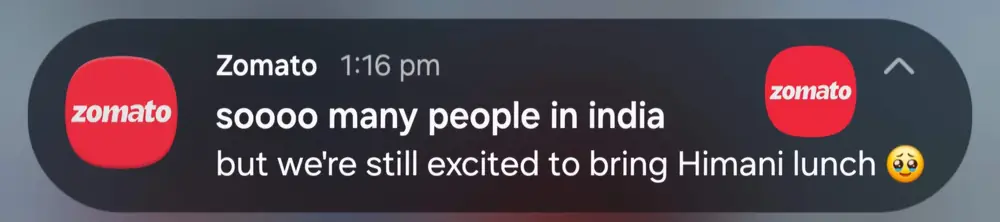
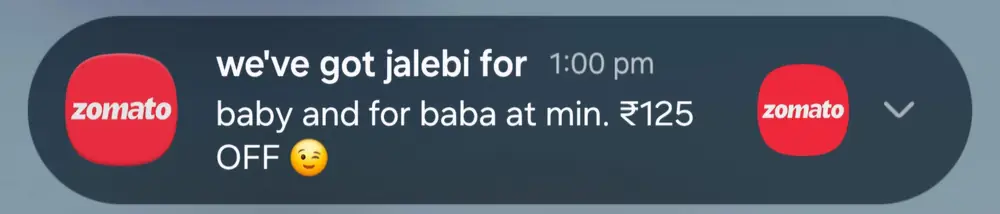
The first one used my name and made me feel singled out among a billion people. The second turned a plain discount into a wink. Neither one pushed me to order on the spot, but both made me smile, and both made it to my Status.
I'm not the only one. One of my team members once tagged Zepto on social media, simply because a line of its copy made them laugh. And at home, we love the paper bags Blinkit delivers in, because they come with fun things for the kids to do.
None of these moments looked like a sale. No coupon was redeemed, no cart was checked out. So if emotional marketing doesn't show up in the sales dashboard, why do the world's smartest brands keep pouring money into it?
The short answer: it does sell. Just not the way most dashboards are built to see. In this post, we look at why emotional marketing gets underestimated, what brands actually get from it, which businesses use it best (in both B2C and B2B), and how to measure it.
The short version
- Emotional marketing works on memory, so it pays off over months and years, not in this week's click report.
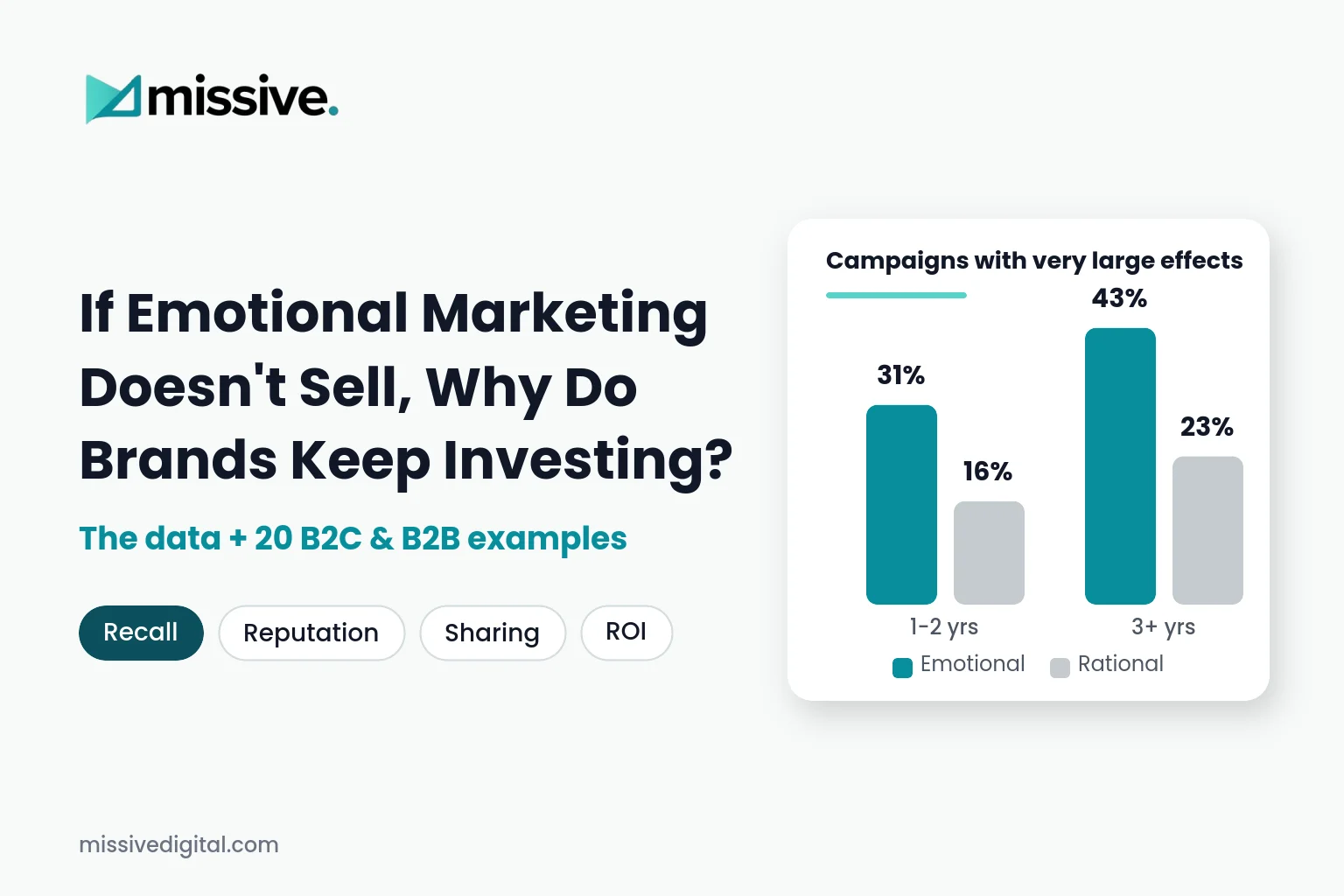
- In the IPA's effectiveness database, emotional campaigns were about twice as likely as rational ones to report very large profit gains.
- It builds five things sales teams love: recall, reputation, free reach, customer love and pricing power.
- It works in B2B too. Business buyers weigh personal value twice as heavily as business value.
- You can measure it, with brand lift, share of search and marketing mix modelling instead of CTR.
What is emotional marketing? A simple definition (with the triggers that power it)
Emotional marketing is marketing designed to make people feel something, such as joy, nostalgia, pride, belonging, trust or even fear, so they remember a brand and choose it later. Rational marketing tells people what a product does. Emotional marketing gives them a reason to care.
It works through emotional triggers: the specific feelings a message is built to spark. Here are the ones you'll see in the examples below.
| Emotional trigger | What it does for a brand | Brands in this post that use it |
|---|---|---|
| Humour | Makes content shareable and memorable | Zomato, Zepto, Old Spice, Duolingo, Mailchimp |
| Warmth and generosity | Builds goodwill and preference | Cadbury, Coca-Cola |
| Self-worth | Creates a deep personal bond | Dove, Always |
| Pride and identity | Lets customers say who they are | Nike, Zoho, Tata Steel |
| Trust and safety | Lowers the risk of a big purchase | Volvo |
| Fear | Makes people care about a hidden problem | HP |
| Belonging | Turns customers into a community | Spotify Wrapped, Share a Coke |
| Surprise and delight | Turns a routine touchpoint into a talking point | Blinkit, Volvo Trucks, Caterpillar |
A strong emotional appeal in marketing doesn't replace facts. The best campaigns pair a feeling with a product truth, as you'll see.
Why emotional marketing looks like it doesn't sell (hint: your dashboard can't see it)
Emotional marketing rarely loses money. It loses arguments. It loses them in review meetings, because the reports on the screen are built to count clicks, and emotion doesn't work through clicks. It works through memory.
Last-click attribution credits the wrong moment
Picture a normal week. On Monday, a food app sends you a notification that makes you laugh. On Thursday, you're hungry, you search for dinner, tap a search ad from that same app, and order. Most attribution reports hand 100% of the credit to Thursday's search ad. Monday's notification, the reason you thought of that app first, gets nothing.
That's last-click attribution, and it systematically undervalues anything that works earlier in the journey. Emotional marketing almost always works earlier.
Dark social: the WhatsApp shares your analytics never see
Every time I put a Zomato notification on my WhatsApp Status, it gets replies. Not one of those conversations shows up in Zomato's analytics. Private, untrackable sharing like this is called dark social, and it's bigger than most people assume. A RadiumOne study found that dark social made up 69% of all sharing worldwide, against 31% for Facebook and every other public channel combined. In a WhatsApp-first country like India, it's hard to believe the real share is any lower.
The practical fix is simple: add a "How did you hear about us?" question to your sign-up or checkout flow. It catches word of mouth that no pixel ever will.
Emotional marketing ROI grows the longer you wait
The strongest evidence comes from Les Binet and Peter Field. In The Long and the Short of It, they analysed 996 campaigns from the IPA Effectiveness Databank, the UK's archive of award-winning effectiveness cases, and found marketing works on two clocks:
- Sales activation (offers, targeted ads) creates quick, visible spikes that fade fast.
- Brand building (broad, emotional communication) lifts baseline sales slowly, but the gains last and stack up.
They later found campaigns need about six months for long-term effects to appear and overtake short-term ones. The chart below shows what happens when you wait: IPA data shows the advantage of emotional campaigns grows the longer you measure.
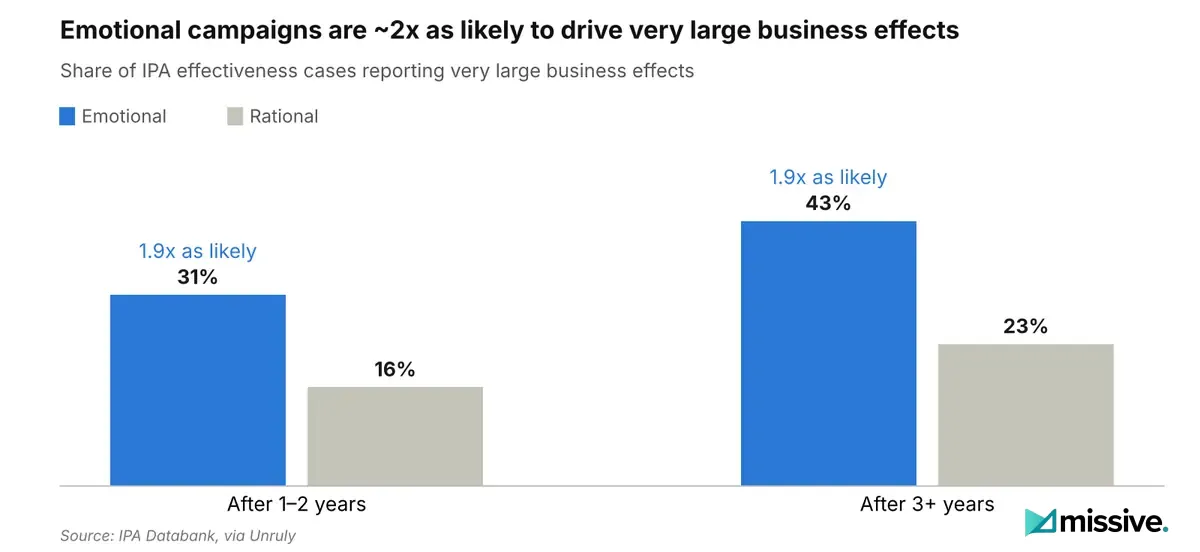
The longer you measure, the bigger emotional marketing's lead becomes in absolute terms. Judge it on a two-week window and you'll undervalue it every time.
5 business benefits of emotional marketing that never show up in a click report
An emotional connection doesn't close today's sale. It makes tomorrow's sales easier, cheaper and more profitable. Here are the five returns that show up again and again.
1. Brand recall: be the first name people think of when the need hits
When you're hungry at 9 pm, you don't open five apps and compare. You open the one that comes to mind first. Being that first name is worth more than any discount, because it wins the moment of need without paying for it.
Brands earn that slot by showing up often, in a voice you'd recognise without the logo, at the moments the need appears: mealtimes, match nights, festivals. Binet and Field found that campaigns creating very large salience effects (being top of mind) were almost twice as likely to deliver top-box short-term sales growth and long-term share growth.
2. Brand positioning: own one word in your customer's mind, the way Volvo owns safety
Ask anyone what Volvo stands for and they'll say "safety". That's positioning, and it's priceless, because buyers don't have to think twice.
Volvo earned it the hard way. In 1959, its engineer Nils Bohlin perfected the three-point seatbelt, and Volvo gave the patent to the world for free. It then repeated the safety story for decades. Volvo estimates the seatbelt has saved over a million lives, and more than 60 years later it still owns the word. Closer home, Fevicol has done the same with "strength", one funny, unbreakable bond at a time.
3. Emotional engagement: get screenshotted, tagged and shared for free
People don't share discounts. They share things that make them look funny, smart or in on the joke. When a customer screenshots a clever line and tags the brand on X or Instagram, they become an unpaid ambassador, with more credibility than any ad.
Amul is the masterclass. Its topical ads began in 1966 and hold the Guinness World Record for the longest-running advertising campaign. The team went from one topical a month to five a week, so there's always something fresh to share. Six decades on, people still wait to see what the Amul girl will say about the week's news.
4. Earned reach: let your customers do the media buying
Shareable content does your media buying for you. Spotify Wrapped is the gold standard: it turns each user's own listening data into a story built for Instagram Stories. In 2025, Wrapped reached 200 million engaged users within 24 hours and was shared more than 500 million times, 41% more than the year before. Every one of those shares was an ad Spotify didn't pay for.
5. Pricing power and emotional loyalty: why people pay more for brands they love
People pay more for brands they feel connected to, and forgive them more. A loyal customer will shrug off a late delivery or a price hike that would send someone else to a competitor.
The numbers back it up. Kantar's BrandZ research finds that brands with high pricing power can charge 70% more, and counts emotional connection as part of what makes a brand "meaningful". Even price-driven shoppers will pay 14% more for brands they see as meaningfully different. In a market as price-sensitive as India, that's a serious margin advantage.
Emotional marketing examples: how B2C and B2B brands turn feelings into revenue
Every category uses emotion differently. Consumer brands use it to stand out on crowded shelves and home screens. B2B brands use it to be remembered long before a buyer is ready to sign. Here's how the best do it, and what it earned them.
B2C emotional marketing examples that moved real sales
Zomato, Zepto and Blinkit: how humour and tiny delights win food delivery and quick commerce
When every app delivers the same biryani in about the same time, personality is the only real difference left. So these brands talk like a witty friend instead of a store.
Zomato built exactly that voice: humour, pop-culture references and conversational copy rather than hard sales pitches, timed to meals, festivals and cricket matches. The proof is in my phone: those notifications are the most-replied-to Statuses I post.
Zepto runs its marketing on one test. Its Chief Brand Officer, Chandan Mendiratta, says the brand's north star is whether an idea will earn media, and that Zepto doesn't spend much on marketing. When it put up billboards next to Shaadi.com's, the banter went viral and pulled brands like Faasos and CashKaro into the joke, while the founders of both companies played along on LinkedIn.
Blinkit turned something disposable into something families keep. Its illustrated brown bags became drawing sheets, and Blinkit shared a compilation of kids across India using them as colouring books. A bag your children draw on is brand recall that lives on the kitchen counter for days.
If your brand wants this kind of voice, it starts with a clear social media marketing plan, not one-off viral attempts.
Cadbury and Coca-Cola: how warmth and generosity sell everyday FMCG products
Groceries and snacks are bought on autopilot. Emotion is what breaks the habit and gets a brand picked over the one next to it.
During Diwali 2021, small shops were still struggling after the lockdowns, and they held over 70% of Cadbury's gifting stock. So Cadbury Celebrations gave its ad space away. Using AI, it let Shah Rukh Khan name neighbourhood stores in geotargeted ads, covering 2,000+ local shops, and anyone could create a free ad for their favourite store. Gifting sales helped lift household chocolate penetration to a three-year high of 9.4%. Cadbury sold more chocolate by being generous.
Coca-Cola's "Share a Coke" swapped its own logo for people's names, turning a bottle into a gift. In the US, Coke's sales had fallen for 11 years in a row; after the campaign, US sales rose 2.5%, the first increase in more than a decade. About 80 countries have since run it.
Volvo: how trust sells a big-ticket purchase like a car
A car is a big, anxious purchase, often made for the family. Trust matters more than horsepower.
Volvo keeps building on its seatbelt story. In 2026, VML France launched "A Bit of Volvo in Every Car", pointing out that every buckled seatbelt forms a "V" across the chest. The aim was to make safety an emotional brand commitment again, in a market full of technical claims.
Dove, Always and Old Spice: how self-worth and humour grow personal care brands
Personal care is about how people feel about themselves, so the brands that win speak to that feeling rather than the formula. It's also where emotional video marketing has produced some of the most-watched ads in history.
Dove's "Real Beauty" campaign, launched in 2004, replaced models with real women. Over its first ten years, Dove's sales grew from $2.5 billion to $4 billion. Its "Real Beauty Sketches" film, where a forensic artist draws women from their own descriptions and then a stranger's, became the most-watched video ad of its time, with more than 114 million views in its first month.
▶ Watch: Dove Real Beauty Sketches (3 min)
Always took on a playground insult, "like a girl", and turned it into a rallying cry. The #LikeAGirl film became the world's top viral video with 85 million views. In Canada, purchase intent among teens jumped from 40% to 60%, brand share rose 1.4 points, and the campaign returned $2.56 for every dollar spent, with pricing and distribution unchanged.
Old Spice went the other way: absurd humour to shake off its "grandpa's brand" image. "The Man Your Man Could Smell Like" targeted the women who often buy body wash for the household. Body wash sales grew 27% over six months and were up 107% in one month, and Old Spice became the No. 1 men's body wash brand.
Nike and Duolingo: how identity and pride build sportswear and tech brands
In these categories, what you buy says who you are. Brands that stand for something give customers a way to say it.
Nike's "Dream Crazy", made for the 30th anniversary of "Just Do It", celebrated athletes who pushed their sports forward. It faced early boycotts, yet pushed Nike's stock to an all-time high and created $6 billion in brand value, the most successful campaign in the brand's history.
Duolingo turned its green owl into an "unhinged" social media star, moving most of its marketing to organic social. In the quarter after Duo faked his own death, daily active users rose 49% year on year to 46.6 million, and the CEO called the marketing team incredibly efficient.
B2B emotional marketing examples that won over "rational" buyers
Why B2B buyers are more emotional than you think
At Missive Digital, we work mostly with B2B, SaaS and tech companies, a world where many people assume buyers are purely rational. The research disagrees.
Google and CEB's Marketing Leadership Council surveyed 3,000 purchasers of 36 B2B brands and found that buyers saw almost no difference in business value between the leading brands in an industry. When every vendor looks equally capable on paper, something else decides the deal. The same study found that the personal value a B2B solution offers has twice the impact of its business value on the purchase decision.
The reason is risk. A B2B buyer's reputation, and sometimes their job, rides on the choice. So trust, confidence and pride carry real weight, even in a procurement process run on spreadsheets. That's the case for emotional marketing in B2B. If you sell to businesses, this is why your B2B content marketing should build a brand buyers feel good about, not just a feature list.
Volvo Trucks, HP, Mailchimp and Caterpillar: global B2B brands that made buyers feel something
Volvo Trucks, "Live Test" series. Trucks are bought by committees comparing spec sheets, so Volvo Trucks made the specs unforgettable. To launch five new models, it ran a series of stunt films, ending with "The Epic Split": Jean-Claude Van Damme doing a split between two reversing trucks to show the precision of Volvo Dynamic Steering. It also aimed wider than buyers, reaching the drivers and colleagues who influence the purchase. The series drew over 100 million YouTube views, lifted brand recall and awareness, and Q4 2013 sales rose 23%. It won the Creative Effectiveness Grand Prix at Cannes.
▶ Watch: Volvo Trucks, The Epic Split (75 sec)
HP, "The Wolf". Few people worry about printer security, so HP made them feel the threat. It cast Christian Slater as a hacker who breaks into a company through its printers, in a thriller-style series aimed at IT and security leaders. Awareness rose 25% around the world, and 73% of customers said they were more likely to buy the new printer.
Mailchimp, "Did You Mean Mailchimp?" Mailchimp leaned into the fact that people mispronounced its name. It built nine surreal, unbranded spoofs (think "FailChips" and "MaleCrimp") so curious people would search and land on Mailchimp. After the campaign, awareness rose 20% and brand affinity rose 18%, with 3.8 million organic searches. It won a Cyber Grand Prix at Cannes in 2017.
Caterpillar, "Built for It". Caterpillar wanted to prove precision without a spec sheet, so five of its machines played a giant game of Jenga with 600-pound blocks. The "Stack" video passed 1.5 million YouTube views and 28.3 million estimated Twitter impressions.
▶ Watch: Caterpillar, Stack (3 min)
Zoho and Tata Steel: Indian B2B brands winning with stories, not spec sheets
Zoho: a brand story people retell for free. Zoho's emotional pull comes less from ads and more from how it's built. Founder Sridhar Vembu moved to rural Tenkasi, and Zoho set up offices in rural Mathalamparai in Tamil Nadu and Renigunta in Andhra Pradesh. By 2020, around 500 employees worked from rural offices. Despite being a unicorn, Zoho has stayed fully bootstrapped.
For an Indian business owner choosing between Zoho and a global software giant, that story adds pride, trust and a sense of supporting local jobs. The goodwill became visible in 2025. Zoho's messaging app Arattai saw sign-ups spike 100x over three days, and the Education Ministry made Zoho Office Suite its default for internal documents.
Tata Steel: selling steel on imagination. Steel is about as commoditised as products get, which is exactly why Tata Steel sells on emotion. It moved from "We Also Make Steel" to #WeAlsoMakeTomorrow, with children imagining the world of the future, and launched the campaign's second phase, on sustainability, in October 2026. Branding pays here too: a Philip Kotler case study found Tata Steel's branded products commanded a 15% premium over competing brands.
How to measure emotional marketing ROI (without relying on clicks)
If you judge a brand campaign by click-through rate, you'll kill it every time. Emotional marketing is measurable, just with different tools and a longer clock. Start with the benchmarks, then track the metrics that actually move.
Emotional marketing statistics every CMO and CEO should know
| What the research found | Why it matters | Source |
|---|---|---|
| Fully connected customers are 52% more valuable than customers who are just highly satisfied | Satisfaction isn't loyalty; emotional connection is what shows up in lifetime value | Harvard Business Review |
| Moving customers from satisfied to fully connected earns 3x the return of moving them from unconnected to satisfied | The biggest gains come after the basics are fixed | Harvard Business Review |
| Only 5% of B2B buyers are in-market at any time; 95% won't buy for months or years | Most of your future buyers aren't shopping yet; you need to be remembered when they start | B2B Institute and Ehrenberg-Bass |
| The best-performing B2C budget split is about 60% brand building, 40% activation | All-performance budgets leave long-term growth on the table | Binet and Field, IPA |
| For B2B, the optimal split is about 46% brand, 54% activation | Even B2B needs close to half its budget on brand | Binet and Field for LinkedIn's B2B Institute |
4 ways to track the emotional impact of your marketing
- Brand lift studies. Survey people who saw the campaign and people who didn't, then compare awareness, consideration and preference. It's how Always showed teen purchase intent moving from 40% to 60%, and how Mailchimp proved its 20% awareness lift.
- Share of search. Divide searches for your brand by searches for all brands in your category. It's fast, free with Google Trends, and predictive: Les Binet's IPA research found share of search can predict market share, sometimes up to a year ahead, with a lead of nine to 12 months for car brands. Your SEO team can set this up alongside your keyword tracking.
- Social sentiment and earned media. Track mentions, tags, shares and the tone of conversation, not just follower counts. For WhatsApp-heavy markets, pair it with a "How did you hear about us?" question to catch dark social.
- Marketing mix modelling (MMM). A statistical model that separates the slow, baseline lift from brand building from the quick spikes of activation. It's the most robust way to put a rupee value on emotional marketing, and to defend its budget in the boardroom.
7 emotional marketing strategies you can use for your brand
You don't need a Super Bowl budget or a superstar. The brands above share a handful of habits any business, B2C or B2B, can copy.
- Pick one emotion and own it. People remember brands by a single association, so spreading yourself across five feelings means owning none. Volvo owns safety, Amul owns wit, Dove owns self-worth. Choose the feeling that fits your product and repeat it everywhere.
- Stay consistent for years, not weeks. Memory builds through repetition. Amul has been at it since 1966, and its longevity is its moat. If you change your voice every quarter, you reset the clock every quarter.
- Design small moments of delight. Push notifications, emails, delivery bags and invoices already reach every customer, so adding personality costs almost nothing. Blinkit's bags and Zomato's notifications prove a tiny touchpoint can become the most memorable thing about a brand.
- Write for the screenshot. Ask of every line: would someone put this on their WhatsApp Status or tag us for it? If yes, you've earned free reach. Spotify built Wrapped for exactly this and got 500 million shares in a day.
- Tie the emotion to a real product truth. Emotion without substance gets laughs, not sales. The Epic Split proved precise steering; Caterpillar's Jenga proved control. Make the feeling dramatise something true about what you sell.
- Balance brand and performance. Keep your offers and lead generation running, but protect a real share for brand building: roughly 60% for B2C and 46% for B2B is the research-backed starting point. A steady content marketing plan is a practical way to fund the brand side steadily.
- Measure over the right time frame. Long-term effects take around six months to show. Track share of search, brand lift and sentiment quarter by quarter, and don't kill a campaign because it didn't spike sales in week one.
So, does emotional marketing sell? Yes, just not on day one
Emotional marketing sells. It just doesn't sell in the moment you're watching.
The notifications I put on my WhatsApp Status, the Zepto line my teammate tagged, the Blinkit bags my kids play with: none of them triggered a purchase that day. But they put those brands at the front of our minds, gave us a reason to trust them, and made us a little more willing to pay. The sale comes weeks later, when you're hungry, or need groceries, or are signing a software contract, and you pick that brand without thinking twice.
That's why the smartest brands, from Zomato to Volvo Trucks, keep investing in it. They aren't buying clicks. They're buying memory, and memory is what wins the sale.
Want to build a brand people remember, share and choose? Book a free 30-minute call and let's talk.
FAQs about emotional marketing
Emotional triggers are the specific feelings a campaign is built to spark, such as humour, nostalgia, pride, belonging, trust, fear or surprise. Each does a different job: humour drives shares, trust lowers purchase risk, and pride lets customers express who they are. Pick the trigger that matches your product truth and your audience.
Yes, mostly over the long term. In the IPA's effectiveness database, 31% of purely emotional campaigns reported very large profit gains, compared with 16% of purely rational ones, and the gap widens over three years or more. Campaigns like Share a Coke, Dove Real Beauty and Old Spice all reported clear sales growth.
Yes. Google and CEB research found that personal value has twice the impact of business value on B2B purchase decisions. Volvo Trucks, HP, Mailchimp, Zoho and Tata Steel all show that business buyers respond to emotion too.
Look beyond clicks. Use brand lift studies, share of search, social sentiment and marketing mix modelling, and judge results over months and years rather than days.
About the author
Himani Kankaria is the Founder of Missive Digital, an organic digital marketing agency for B2B, SaaS and tech companies. She speaks at global conferences including BrightonSEO, Whitespark Local Search Summit and Semrush events, and is a regular contributor to Search Engine Journal. She writes research-led, search-intent-based content for B2B brands.
How we researched this post
We prioritised original research (the IPA Effectiveness Databank analyses by Les Binet and Peter Field, Harvard Business Review, Kantar BrandZ, Google and CEB, and the LinkedIn B2B Institute), then award-verified case studies from WARC and Cannes Lions, and company statements. Campaign figures are reported as published by those sources. Figures were gathered in October 2026.
Sources
- Les Binet and Peter Field: The Long and the Short of It (summary)
- IPA: The next chapter for The Long and the Short of It
- Neuroscience Marketing: IPA emotional vs rational campaigns
- Unruly: IPA long-term effects of emotional campaigns
- MediaPost: HBR, The New Science of Customer Emotions
- Think with Google: From Promotion to Emotion
- Marketing Week: The 95:5 rule
- LinkedIn: How B2B marketing really drives growth
- WARC: Share of search can predict market share
- WARC: Volvo Trucks Live Test series
- WARC: Cadbury Celebrations, Not Just A Cadbury Ad 2.0
- WARC: Nike Dream Crazy
- Strategy: CASSIES Grand Prix, Always #LikeAGirl
- Kantar: Meaningfully Different framework