
Key Takeaways
- Rankings, impressions, and clicks no longer show what SEO delivers, because 68% of US Google searches now end without a click.
- The SEO KPIs to report in 2026 sit in four pillars: Brand Visibility, Traffic, Conversions, and Engagement.
- A brand mention and a citation in an AI answer are two different KPIs, and you should track both.
- GA4’s AI Assistant channel and Search Console’s Generative AI report, both launched in 2026, cover most of the tracking for free.
- Every SEO report should open with conversions, not clicks.
The Telecom AIO/GEO Conundrum
Don’t worry, you’re not alone.
I’ve been doing SEO and content for over 15 years, and I review SEO reports every month for the SaaS, technology, and eCommerce brands we work with at Missive Digital. In the last year, almost every one of those reports has shown the same thing: better work, fewer clicks.
When I presented my webinar on SEO in the Age of AI in January 2026, one slide got the loudest reaction. It said “Bosses & Clients be like… You’re fired!”
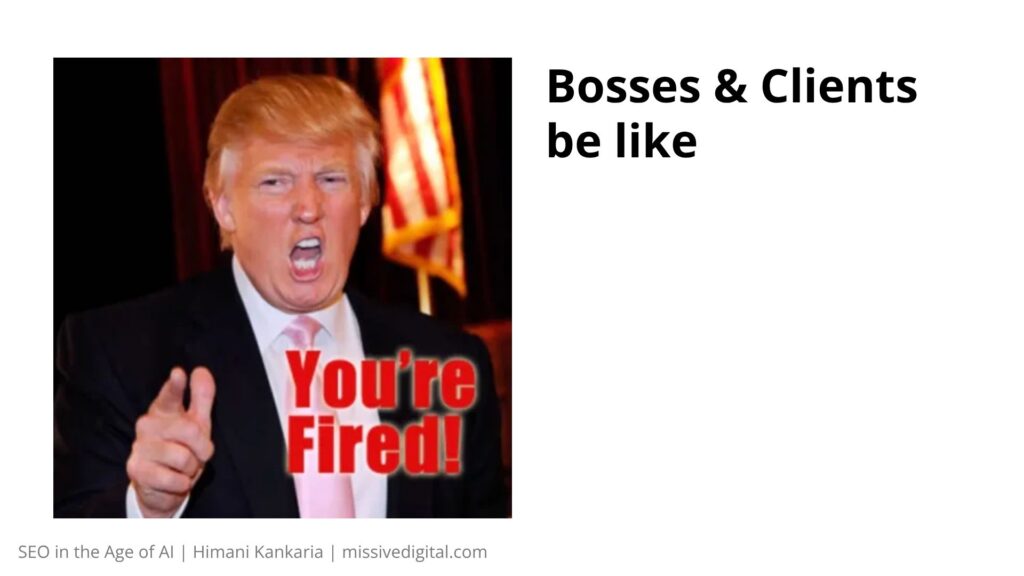
Everyone laughed because everyone has lived it.
Here’s what I tell my team and our clients: the problem is not your SEO. The problem is your SEO report.
In this blog, I’m sharing the four-pillar SEO KPI framework we use for our AI SEO clients. For each of the 17 KPIs, you’ll get what it measures, where to track it, and how to read it.
Prefer watching? I’ve covered the same topic in this video.
Why Rankings, Impressions, and Clicks Stopped Working as SEO KPIs
Rankings, impressions, and clicks stopped being reliable SEO KPIs in 2025, for three reasons.
- Rankings are no longer one number. For “content optimization services,” Missive Digital shows second on desktop. On mobile, it shows below a sponsored block and an AI Overview. Rankings now differ by device, browser, and location.
- Impressions can change without any user behaving differently. Around September 10, 2025, Google stopped supporting the &num=100 parameter that rank trackers used. Search Console impressions fell overnight, and Brodie Clark charted a 47% week-over-week decline on one site.
- Clicks fall even when visibility grows. We call it the crocodile effect. Impressions go up, clicks go down, and the two lines open like a crocodile’s mouth.
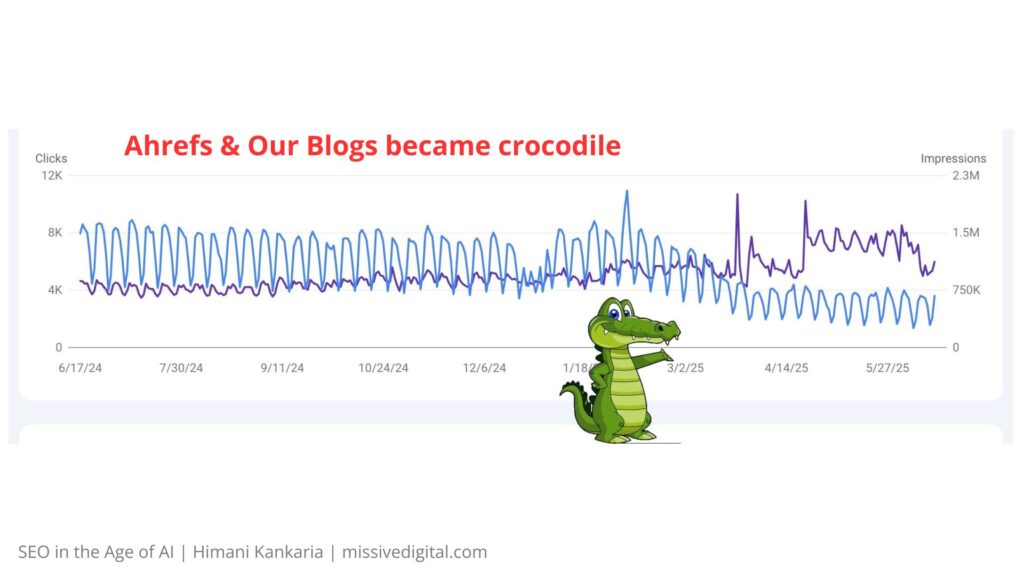
The crocodile is getting bigger. When Ahrefs first studied it, an AI Overview meant a 34.5% lower click-through rate for the top-ranking page. In their 2026 update across 300,000 keywords, it is 58%.
In my January webinar, I quoted Rand Fishkin’s prediction that zero-click experiences would become the majority of online journeys. By June, SparkToro’s own data showed that 68% of US Google searches ended without a click, up from about 60% in 2024.
So the question is no longer “how do we get the old numbers back?” The question is “what do we measure now?”
What Are the SEO KPIs to Measure in 2026?
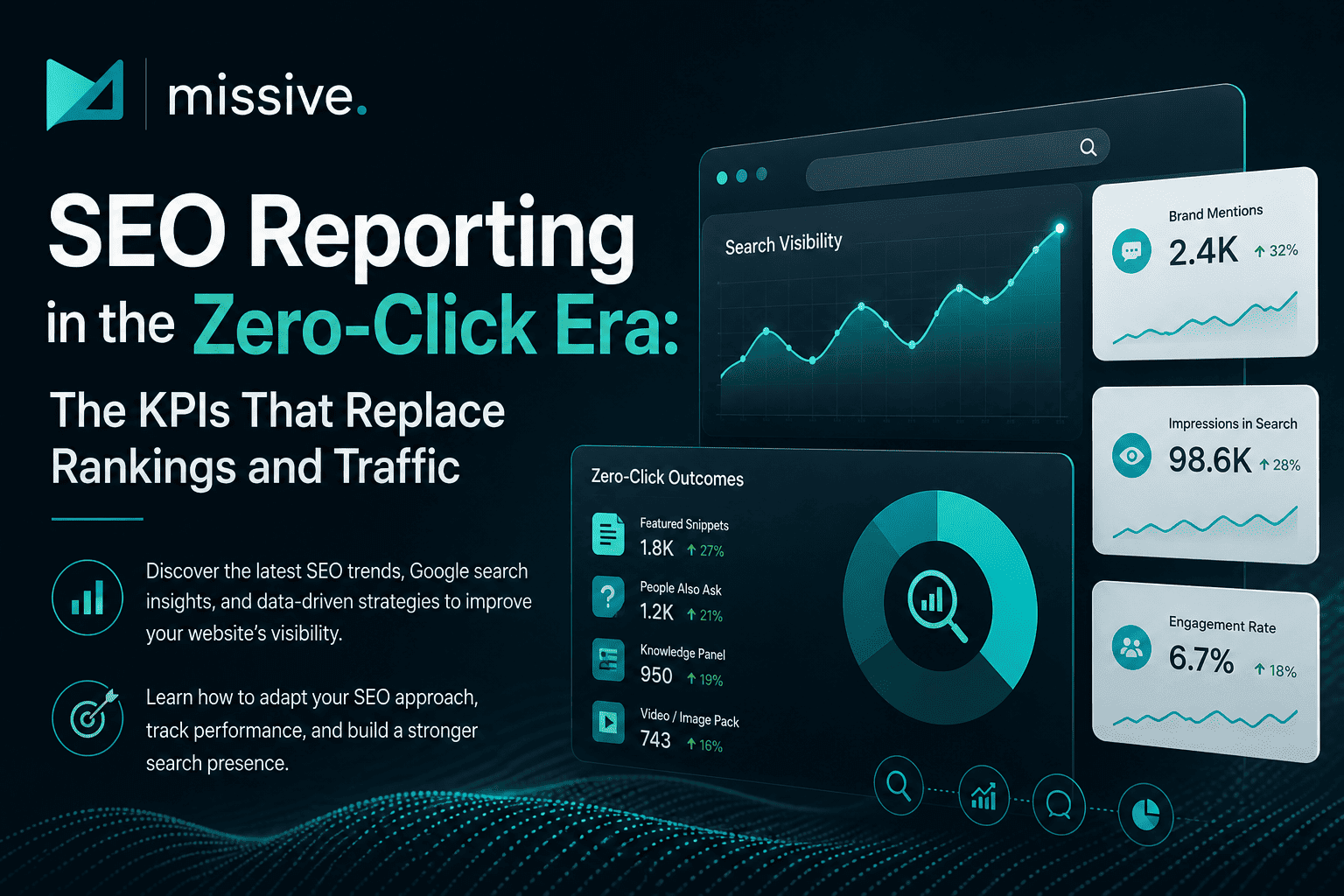
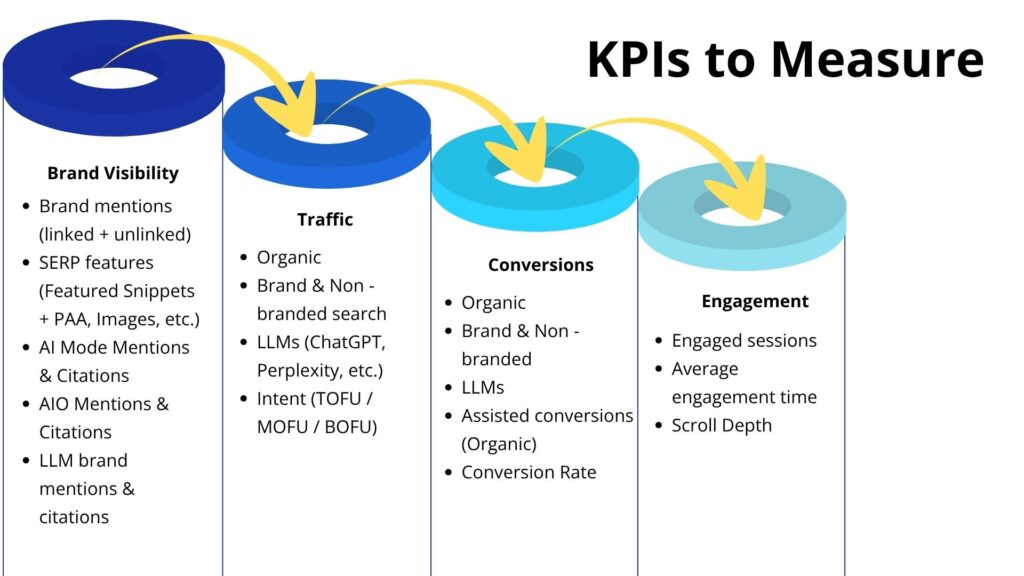
The SEO KPIs to measure in 2026 fall into four pillars: Brand Visibility, Traffic, Conversions, and Engagement.
At Missive Digital, we track them in this order because that’s how results flow now. Someone sees your brand in an AI answer, visits your website later, converts if the page does its job, and stays if the experience is good.
| Pillar | The question it answers | KPIs |
|---|---|---|
| Brand Visibility | Is our brand showing up where our audience searches, with or without a click? | Brand mentions, SERP features, AI Overview mentions and citations, AI Mode mentions and citations, LLM mentions and citations |
| Traffic | Who is still clicking, and from where? | Organic traffic, branded vs non-branded traffic, LLM traffic, traffic by intent |
| Conversions | Is SEO bringing business? | Organic conversions, branded vs non-branded conversions, LLM conversions, assisted conversions, conversion rate |
| Engagement | Was the page worth the click? | Engaged sessions, average engagement time, scroll depth |
That’s 17 KPIs. You can track almost all of them with Google Search Console, GA4, a heatmap tool, and one spreadsheet.
Now let me break down each pillar.
Pillar 1: Brand Visibility KPIs
Brand visibility KPIs measure how often your brand shows up where your audience searches, whether or not anyone clicks. In the zero-click era, this is the first pillar because everything else flows from it.
| KPI | What it measures | Where to track it |
|---|---|---|
| Brand mentions (linked + unlinked) | How often other websites name your brand | Google Alerts, Ahrefs, or Semrush |
| SERP features | Featured Snippets, People Also Ask, and image results you own | Search Console and your SEO tool |
| AI Overview mentions & citations | Whether Google's AI Overview names or links you | Search Console Generative AI report |
| AI Mode mentions & citations | Whether Google's AI Mode names or links you | Search Console Generative AI report |
| LLM mentions & citations | Whether ChatGPT, Perplexity, and Gemini name or link you | Prompt tracking sheet or an AI visibility tool |
1. Brand Mentions (Linked + Unlinked)
Brand mentions count how often other websites name your brand, with or without a link to you.
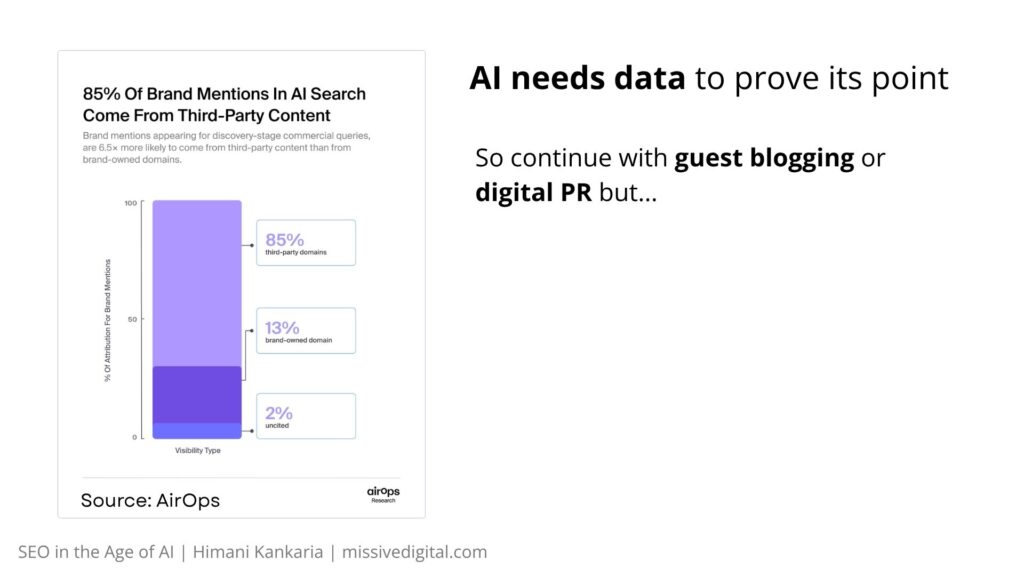
This KPI comes first because third-party websites are where AI tools learn about you. AirOps found that 85% of brand mentions in AI search come from third-party content, and only 13% from the brand’s own domain.
Where to track it: Google Alerts for a free start, or the brand mention reports in Ahrefs or Semrush.
How to read it: Mentions on websites in your niche matter more than the total count. And a mention counts whether the link is dofollow, nofollow, or missing.
2. SERP Features
SERP features are the places you appear on Google beyond the blue link: Featured Snippets, People Also Ask, images, and videos.
They keep your brand visible above the organic results, and the same answer-first structure that wins a snippet also makes a page easier for AI to quote. I’ve shared how we do this in my guide on optimizing for Featured Snippets.
Where to track it: The Search appearance filter in Search Console, plus the SERP features report in your SEO tool.
How to read it: Count the features you own for your priority queries, month over month.
3. AI Overview Mentions & Citations
This KPI tracks whether Google’s AI Overview names your brand or links your page.
A mention and a citation are not the same thing. A mention is when the AI names your brand in its answer. A citation is when it links your page as a source. You can have one without the other, so track both.
Citations still earn clicks. Seer Interactive’s 2026 study found that pages cited in an AI Overview get about 2.1% CTR, against about 0.9% for pages on the same results page that are not cited.
Where to track it: The Generative AI performance report in Search Console, which Google launched in June 2026. It shows impressions in AI Overviews and AI Mode by page, country, device, and date.
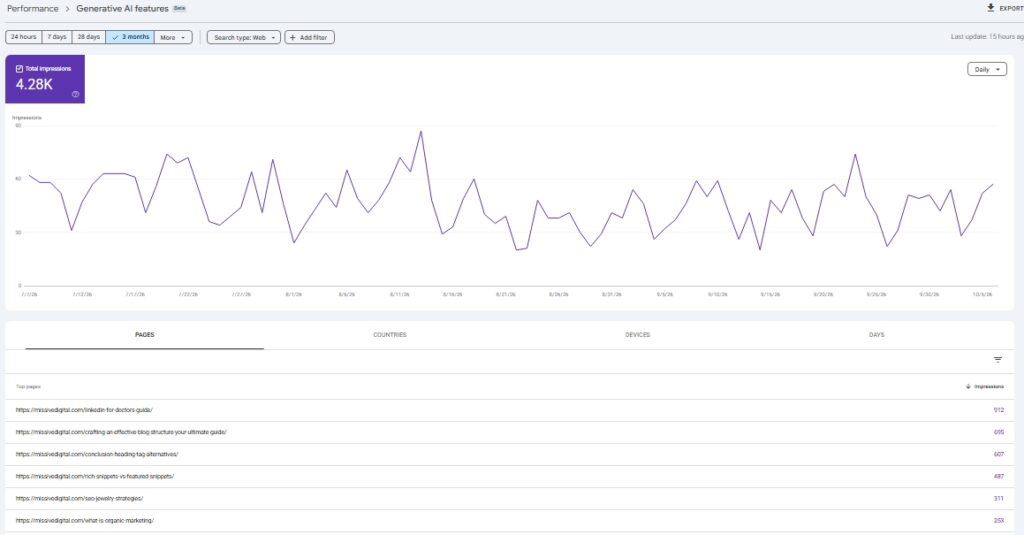
How to read it: Rising AI impressions with flat clicks is expected, not a problem. Look at which pages earn the impressions, and build more like them.
4. AI Mode Mentions & Citations
This KPI tracks whether Google’s AI Mode, the conversational search experience, names your brand or links your page. Google said at I/O 2026 that AI Mode had crossed one billion monthly users.
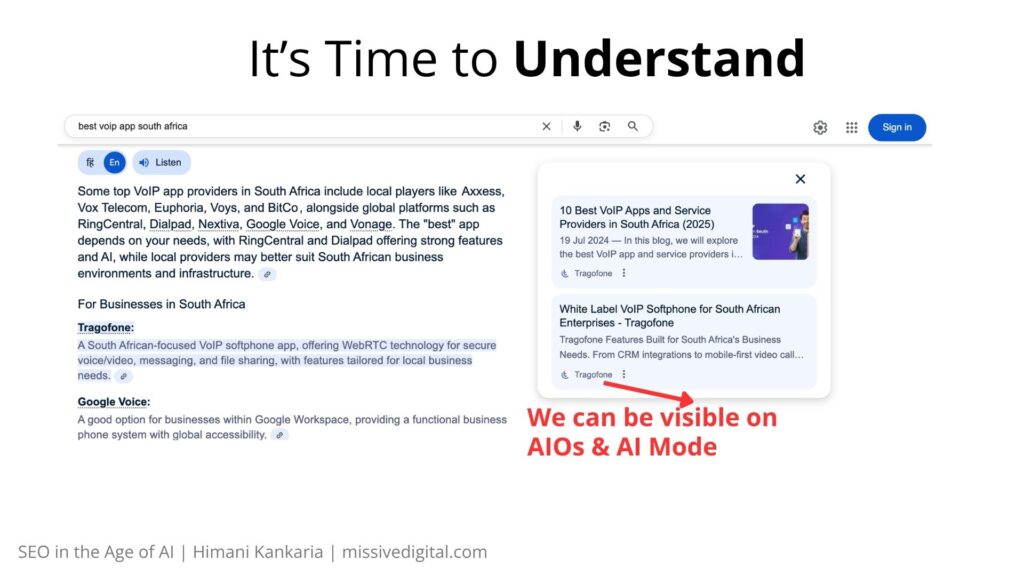
Here’s what a mention and a citation look like together. For “best voip app south africa” in AI Mode, the answer names Tragofone under “For Businesses in South Africa,” and the sources panel links two Tragofone pages.
The reader now knows the brand and what it does, without a single click.
Where to track it: The same Generative AI report in Search Console. It combines AI Overviews and AI Mode, and it shows impressions without the queries.
How to read it: Since you can’t see the prompts in Search Console, track the share of your priority prompts where you appear, using the sheet below.
5. LLM Mentions & Citations
This KPI tracks whether ChatGPT, Perplexity, Gemini, and other LLMs name your brand or link your page.
No free tool reports this, so we use a prompt tracking sheet. Pick 20 to 30 prompts your ICPs would ask, and check them every month on each platform.
| Prompt | Platform | Brand mentioned? | Page cited? | Competitors mentioned |
|---|---|---|---|---|
| best voip app south africa | Google AI Mode | Yes | Yes, 2 pages | Axxess, Vox Telecom, RingCentral |
| [prompt 2] | ChatGPT | |||
| [prompt 3] | Perplexity |
Where to track it: The prompt tracking sheet, or a tool such as Ahrefs Brand Radar, Peec AI, or Profound when you have the budget.
How to read it: AI answers change from person to person, so don’t read the sheet like a ranking report. Are you mentioned in more prompts this quarter than last quarter? That’s the number to report.
If you’re mentioned but not cited, the content structure is usually the gap. That’s what our Citation Architecture Framework is built to fix.
Pillar 2: Traffic KPIs
Traffic KPIs measure who still clicks through to your website, and from where. Total organic traffic alone hides the story, so we split it four ways.
| KPI | What it measures | Where to track it |
|---|---|---|
| Organic traffic | Sessions from organic search | GA4 Traffic acquisition |
| Branded vs non-branded traffic | Clicks from brand searches vs all other searches | Search Console branded queries filter |
| LLM traffic | Sessions from ChatGPT, Perplexity, Gemini, and other chatbots | GA4 AI Assistant channel |
| Traffic by intent | Sessions to TOFU, MOFU, and BOFU pages | GA4 content groups |
1. Organic Traffic
Organic traffic is the number of sessions that come from organic search results. In GA4, this includes clicks from Google’s AI Overviews and AI Mode, because Google counts them under Organic Search.
Where to track it: GA4 > Reports > Acquisition > Traffic acquisition, on the Organic Search row.
How to read it: Expect a decline on informational pages, for the reasons I covered above. Don’t judge this number alone. Judge it by the three splits below.
2. Branded vs Non-Branded Traffic
Branded traffic comes from searches that include your brand name. Non-branded traffic comes from everything else.
This split matters more than ever. People who see your brand in an AI answer often come later by searching your name or typing your URL. Analytics records that visit as branded organic or direct.
Orbit Media tracked the same 86 websites from January 2023 to July 2026. Total sessions stayed flat, but organic search fell from around 46% of sessions to 32%, while direct rose to 34%.
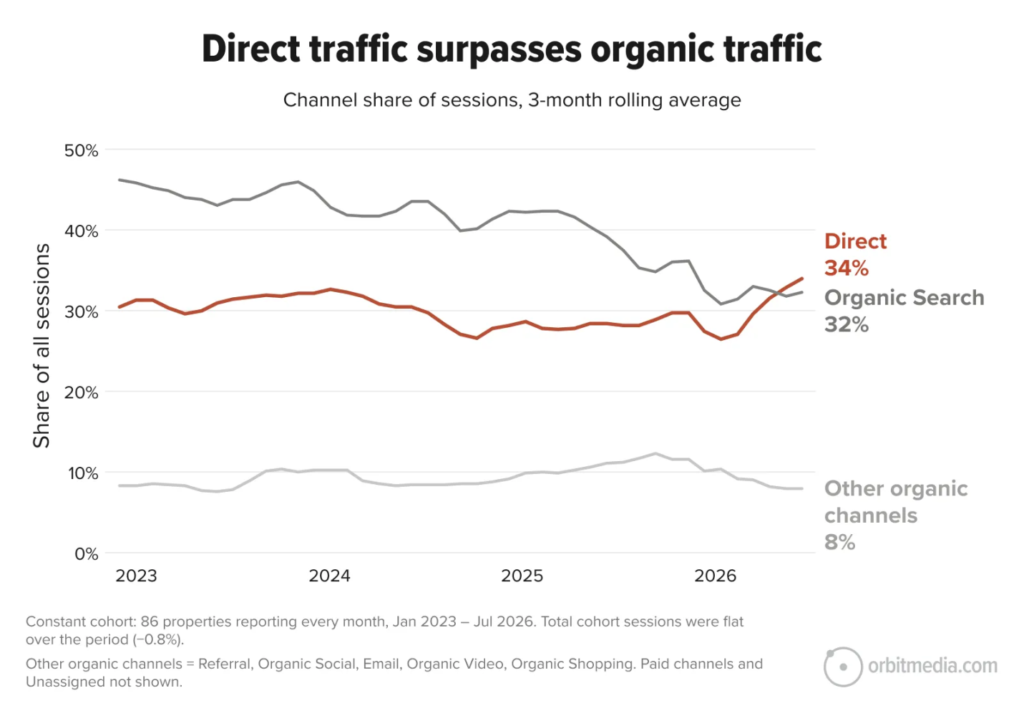
Image Credit: Digital Marketing Tips
The visitors didn’t disappear. They changed the door they walk in through.
Where to track it: The branded queries filter in the Search Console Performance report. Google announced it in November 2025 and expanded it to all eligible sites in March 2026. It separates branded and non-branded queries without any regex.
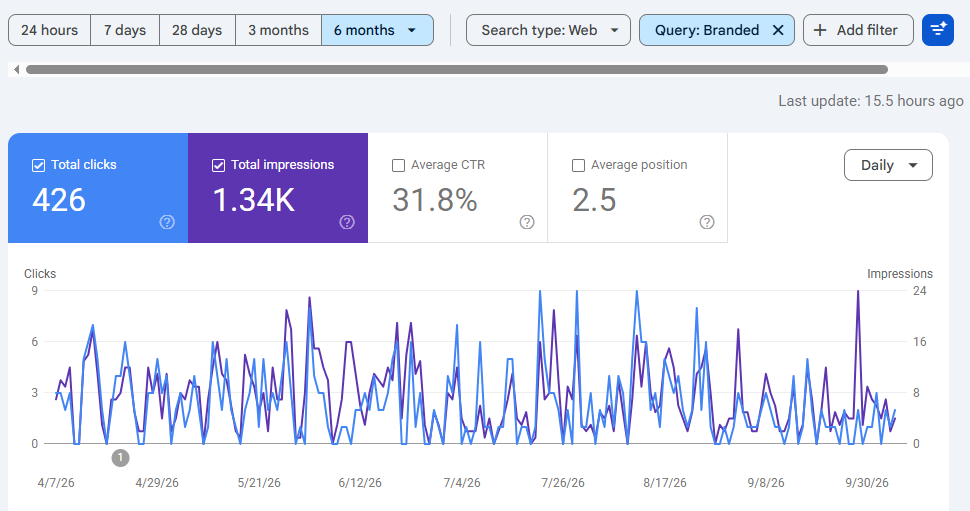
How to read it: Branded growth is the earliest sign that your AI visibility is working. Report it next to direct traffic, so the client sees both doors.
3. LLM Traffic
LLM traffic is the number of sessions that come from AI chatbots such as ChatGPT, Perplexity, Gemini, and Claude.
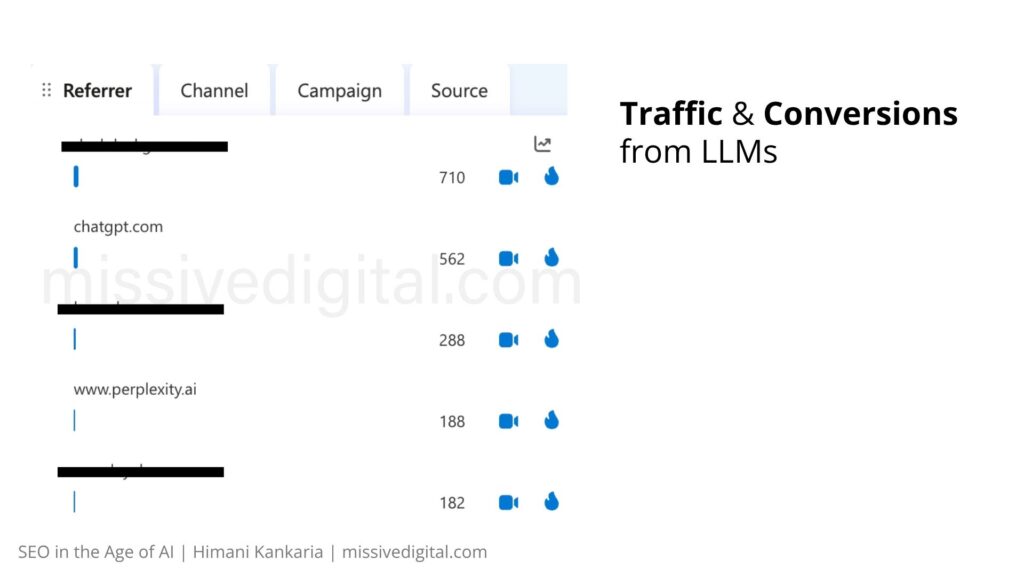
Here is the referrer report of one of the websites we work on. chatgpt.com is the second-biggest referrer with 562 sessions, and perplexity.ai sends another 188.
Where to track it: The AI Assistant channel in GA4. In January, we needed a custom regex channel for this. In May 2026, Google added it to GA4’s default channel group, with no setup. Go to Reports > Acquisition > Traffic acquisition and look for the AI Assistant row.
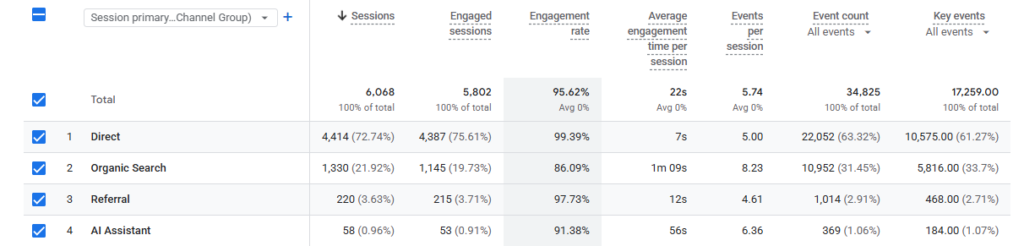
How to read it: It will be a small share, and it should grow. Read it as the minimum, not the total, because of two limitations:
- Clicks from Google’s AI Overviews and AI Mode are counted under Organic Search
- AI visits that arrive without a referrer land in Direct
4. Traffic by Intent (TOFU, MOFU, BOFU)
Traffic by intent splits your sessions by the funnel stage of the landing page: top, middle, or bottom.
TOFU traffic falls first, because AI Overviews mostly answer informational searches. Ahrefs found that 99.2% of the keywords that trigger an AI Overview have informational intent.
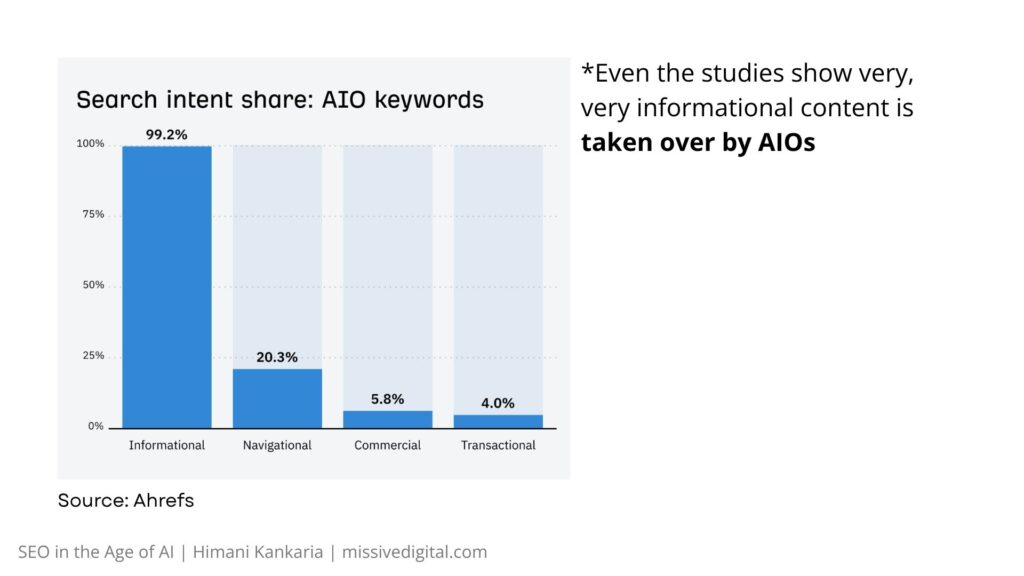
Say your TOFU traffic drops 30%, but your branded and BOFU traffic grows. The total looks flat or down, while the traffic that converts is going up. Without the intent split, you’d report that month as a failure.
Where to track it: Tag every landing page as TOFU, MOFU, or BOFU, and set it up as a content group in GA4 or a mapping sheet in Looker Studio.
How to read it: Accept the TOFU decline, and protect and grow MOFU and BOFU. If those two are falling as well, that’s the real problem to solve.
Pillar 3: Conversion KPIs
Conversion KPIs measure whether SEO is bringing business. This is the pillar your boss or client cares about the most, so it should open every report.
| KPI | What it measures | Where to track it |
|---|---|---|
| Organic conversions | Leads, sales, or sign-ups from organic search | GA4 key events |
| Branded vs non-branded conversions | Conversions from brand searches vs discovery searches | GA4 landing pages + Search Console |
| LLM conversions | Conversions from AI chatbot visitors | GA4 AI Assistant channel |
| Assisted conversions | Conversions where organic helped but wasn't the last click | GA4 Attribution paths + a form field |
| Conversion rate | Conversions divided by sessions, per channel | GA4 session key event rate |
1. Organic Conversions
Organic conversions are the leads, sales, demo requests, or sign-ups that come from organic search sessions.
Where to track it: GA4 key events, filtered to the Organic Search channel. Make sure every form, call, and purchase that matters is marked as a key event first.
How to read it: This is the headline number of your report. If clicks are down and organic conversions are steady, SEO is doing its job with less traffic.
2. Branded vs Non-Branded Conversions
This KPI separates conversions from people who searched your brand name from conversions by people who discovered you through a non-brand search.
It tells you two different things. Non-branded conversions show how well SEO finds new customers. Branded conversions show how much demand your visibility is creating elsewhere, including in AI answers.
Where to track it: GA4 doesn’t show the search query, so this is an estimate. Take key events by landing page in GA4, and match them to the pages that get mostly branded or mostly non-branded clicks in Search Console.
How to read it: Watch the ratio over time. Growing branded conversions with flat non-branded ones usually means your brand is being recommended somewhere you can’t see.
3. LLM Conversions
LLM conversions are the conversions from visitors who came through AI chatbots.
These visitors are fewer, but they convert better. They’ve already asked their questions and compared the options before landing on your website.
Orbit Media analysed 97 GA4 accounts with 29 million sessions in 2026. AI referrals were only about 0.5% of the traffic, but those visitors converted at around three times the rate of other visitors.
We’ve seen it in our own work too. For a VoIP client, ChatGPT-driven traffic grew 3,600% and sales-qualified leads grew 300%.
Where to track it: GA4 key events, filtered to the AI Assistant channel.
How to read it: Compare the conversion rate with Organic Search, not the volume. A channel with 2% of your sessions and 8% of your leads deserves its own line in the report.
4. Assisted Conversions
Assisted conversions are the conversions where organic search was part of the journey but not the last click.
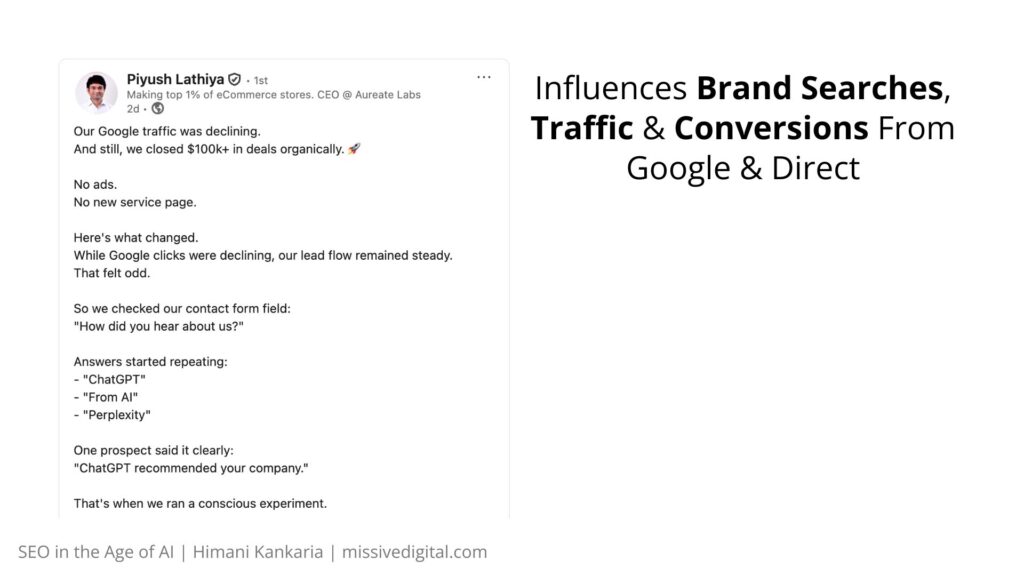
This is where AI-influenced deals show up. Piyush Lathiya, CEO of Aureate Labs, shared this on LinkedIn. Their Google traffic was declining, and they still closed $100k+ in deals organically, with no ads and no new service page.
So they checked the “How did you hear about us?” field of their contact form. The answers kept repeating: ChatGPT, AI, Perplexity.
The SEO work created the demand, and another channel got the credit in analytics.
Where to track it: GA4 > Advertising > Attribution paths for the journeys GA4 can see. For the ones it can’t, add “How did you hear about us?” to your contact form. It takes five minutes.
How to read it: Count how many leads name an AI tool each month. That number is the strongest proof you can put in front of a client.
5. Conversion Rate
Conversion rate is the number of conversions divided by the number of sessions, for each channel.
It turns a declining-clicks story into an honest win. Say organic sessions fall from 10,000 to 8,000, and conversions hold at 150. Your conversion rate has gone from 1.5% to about 1.9%.
Where to track it: Session key event rate in GA4, by channel.
How to read it: Track it per channel and per funnel stage. A rising rate on BOFU pages means your remaining traffic is the right traffic.
| KPI | What it measures | Where to track it |
|---|---|---|
| Engaged sessions | Sessions where the visitor actually engaged | GA4 Engagement reports |
| Average engagement time | How long the page was in focus | GA4 Pages and screens |
| Scroll depth | How far down the page visitors go | Microsoft Clarity or Google Tag Manager |
1. Engaged Sessions
An engaged session, in GA4, is a session that lasts longer than 10 seconds, includes a key event, or has two or more page views.
Where to track it: GA4 > Reports > Engagement, filtered by landing page.
How to read it: A low share of engaged sessions on a high-traffic page means the page isn’t matching the intent of the people landing on it.
2. Average Engagement Time
Average engagement time is how long your page was actually in focus on the visitor’s screen, not just open in a tab.
Where to track it: GA4 > Reports > Engagement > Pages and screens.
How to read it: Compare pages of the same type. A blog and a pricing page shouldn’t share a target.
3. Scroll Depth
Scroll depth is how far down the page your visitors go.
Where to track it: Microsoft Clarity, or a scroll trigger in Google Tag Manager at 25%, 50%, and 75%. GA4 tracks scroll only at 90% by default, which is too late to be useful.
How to read it: Find the section where most people stop, and fix that section first.
Remember, it’s not Search Engine Optimization. It’s Search Experience Optimization.
What an SEO KPI Report Looks Like, Before and After
Report the four pillars in reverse: Conversions first, then Traffic, then Brand Visibility, and close with Engagement and next month’s plan. You track visibility first because it comes first. You report conversions first because that’s what the business hired SEO for.
Here’s the same month reported in two ways.
| Comparison | Old report | Four-pillar report |
|---|---|---|
| Headline | Organic clicks down 18% | Organic conversions up 9%, conversion rate up from 1.4% to 1.9% |
| Second line | 12 keywords dropped in rankings | Branded search clicks up 22%; 310 sessions and 11 leads from LLMs |
| Third line | Impressions down 40% | Brand cited in 14 of 25 tracked AI prompts, up from 8 |
| What the client hears | "SEO is not working" | "SEO is bringing business from new places" |
And don’t hide the clicks chart. Show the crocodile chart early and say it in plain words: more people are seeing us, fewer need to click, and this is happening across the industry.
FAQs About SEO KPIs in the AI Search Era
The most important SEO KPIs in 2026 are organic conversions, conversion rate, branded search traffic, and brand mentions and citations in AI answers. They sit within four pillars: Brand Visibility, Traffic, Conversions, and Engagement.
Keyword rankings are useful for diagnosis, but not as a headline KPI. Rankings now differ by device, browser, and location, and an AI Overview can sit above the first organic result.
Open Reports > Acquisition > Traffic acquisition in GA4 and look for the AI Assistant row. Google added this channel to the default channel group in May 2026, and it needs no setup.
Use the Generative AI performance report in Google Search Console, launched in June 2026. It shows impressions in AI Overviews and AI Mode by page, country, device, and date. For the prompts themselves, keep a prompt tracking sheet.
Report conversions and conversion rate first, then branded search and LLM traffic, then AI visibility. Explain the click decline with industry context: 68% of US Google searches ended without a click in early 2026, according to SparkToro.
Change Your SEO KPIs Before Your Client Changes Their SEO Agency
Clicks will keep getting harder to earn. That is not in our hands.
What is in our hands is what we measure, what we report, and how well we explain it. The SEOs who keep reporting only rankings and clicks will keep getting the “You’re fired” slide. The ones who report brand visibility, traffic quality, conversions, and engagement will keep getting budgets.