
Key Takeaways
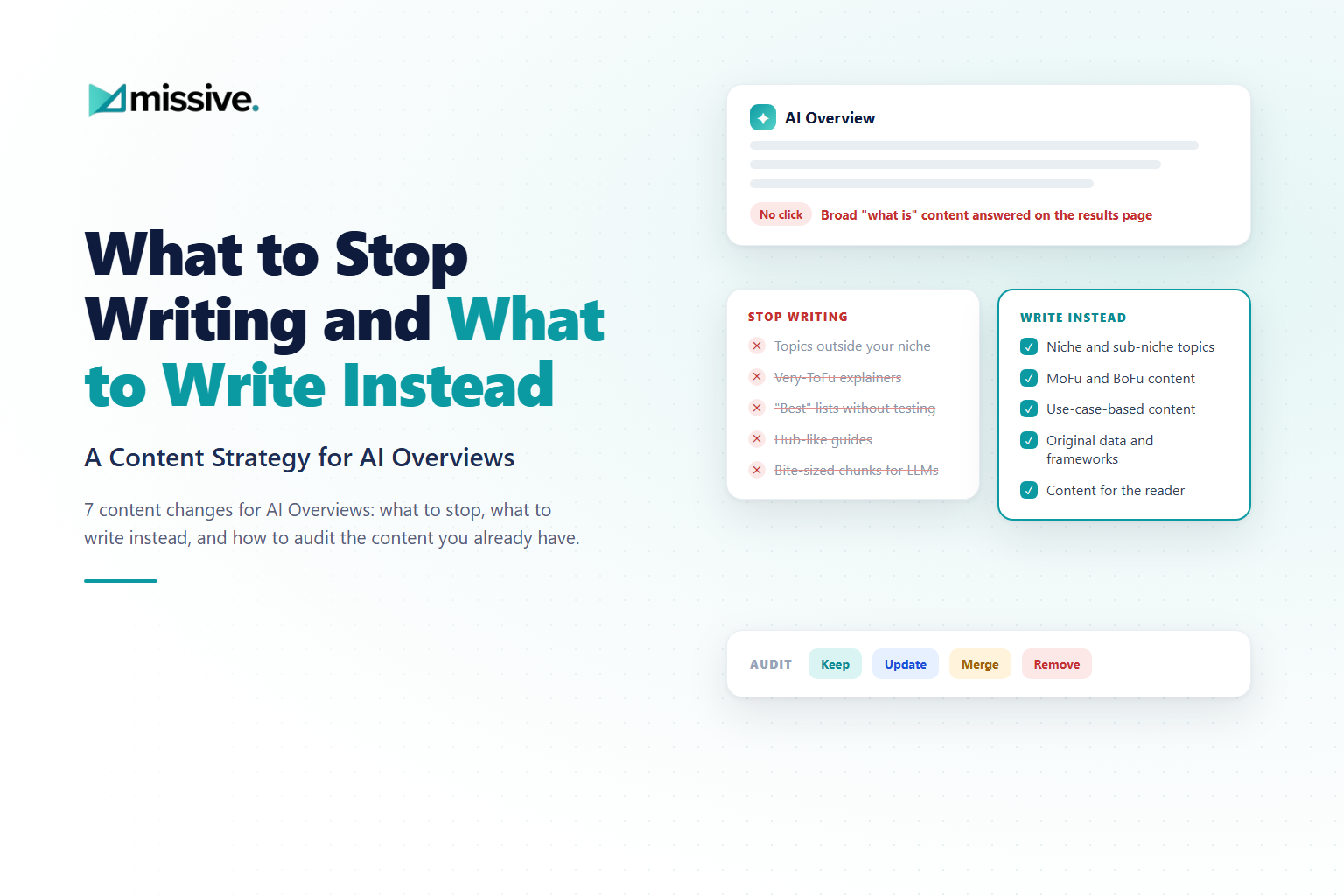
- AI Overviews answer broad, informational content on the results page, so that content earns fewer clicks every quarter.
- Stop writing outside your niche, very-ToFu explainers, “best” listicles without first-hand experience, hub-like guides, and bite-sized chunks made for LLMs.
- Write niche and sub-niche topics, MoFu and BoFu content, use-case-based pieces, and content with E-E-A-T elements such as original data and frameworks.
- Calling yourself “the best” doesn’t work. In a June 2026 study, brands were left out of the AI recommendation 69% of the time when their own listicle was cited.
- Start with the content you already have: keep, update, merge, or remove.
The Most Useful Content Advice I Give Now Starts With the Word "Stop"
When a content team shares its calendar with me for review, they expect me to add topics. These days, I mostly cross them out.
“What is [our category]?” Crossed out. “Top 10 tools for [our category].” Crossed out. “The ultimate guide to [everything].” Crossed out.
The team didn’t do anything wrong. These were the right topics for years, and I recommended many of them myself. They stopped being right when AI Overviews started answering them on the results page.
I’ve consulted SEO and content teams for more than 15 years, from startups to large companies, and I’ve never had to un-teach this much, this fast. AEO and GEO are a part of the SEO we do at Missive Digital, and as the demand for them grows, “what do we stop writing?” has become as important as “what do we write?”
I first shared my list in the webinar on SEO in the Age of AI in January 2026. Google has rolled out two updates since then, and several new studies have come out. So this is the updated version: seven changes, each with what to stop, what to write instead, and the proof behind it.
Why Does Your Content Strategy Have to Change for AI Overviews?
Your content strategy has to change because AI Overviews now answer the most common types of content on the results page itself, and the click that used to follow is disappearing.
| What changed | The data |
|---|---|
| Most searches end without a click | 68% of US Google searches in early 2026, up from about 60% in 2024, according to SparkToro |
| The top result gets far fewer clicks when an AI Overview shows | 58% lower click-through rate, in Ahrefs' 2026 update of its 300,000-keyword study |
| AI Overviews are no longer limited to "what is" searches | They show on about 86% of question queries and 95% of comparison queries, in Seer Interactive's 2026 data |
| Being cited still pays | Pages cited in an AI Overview get about 2.1% CTR, against 0.9% for pages that aren't cited, in the same Seer data |
So there are two jobs now. Stop spending on content that AI answers fully. And make the content you do publish worth citing.
The seven changes below cover both.
7 Content Strategy Changes for AI Overviews: What to Stop and What to Write Instead
A content strategy for AI Overviews comes down to seven changes. Each one replaces a content type that AI can answer on its own with one that needs you.
| # | Stop writing | Write instead |
|---|---|---|
| 1 | Topics outside your niche | Your niche, then your sub-niche |
| 2 | Very-ToFu explainers | MoFu and BoFu content tied to your product or service |
| 3 | "Best" listicles without first-hand experience | Comparisons based on what you've actually used or tested |
| 4 | Hub-like guides that cover everything | Focused pieces with one intent and next steps |
| 5 | Generic topics for everyone | Use-case-based, hyper-personalized content |
| 6 | Content built only on other people's statistics | Content with E-E-A-T elements: original data, frameworks, experience |
| 7 | Bite-sized chunks made for LLMs | Content structured for the reader |
1. Stop Writing Outside Your Niche. Go From Niche to Sub-Niche
Writing outside your niche means publishing topics your business has no real expertise in, only because they have search volume.
HubSpot is the example everyone remembers. Its blog went from a CRM and marketing resource to covering things like “.net vs. .com” domain extensions. When Google’s updates hit in late 2024, Search Engine Land reported its organic traffic falling from 13.5 million to 8.6 million in one month. The same thing happened to Zapier.
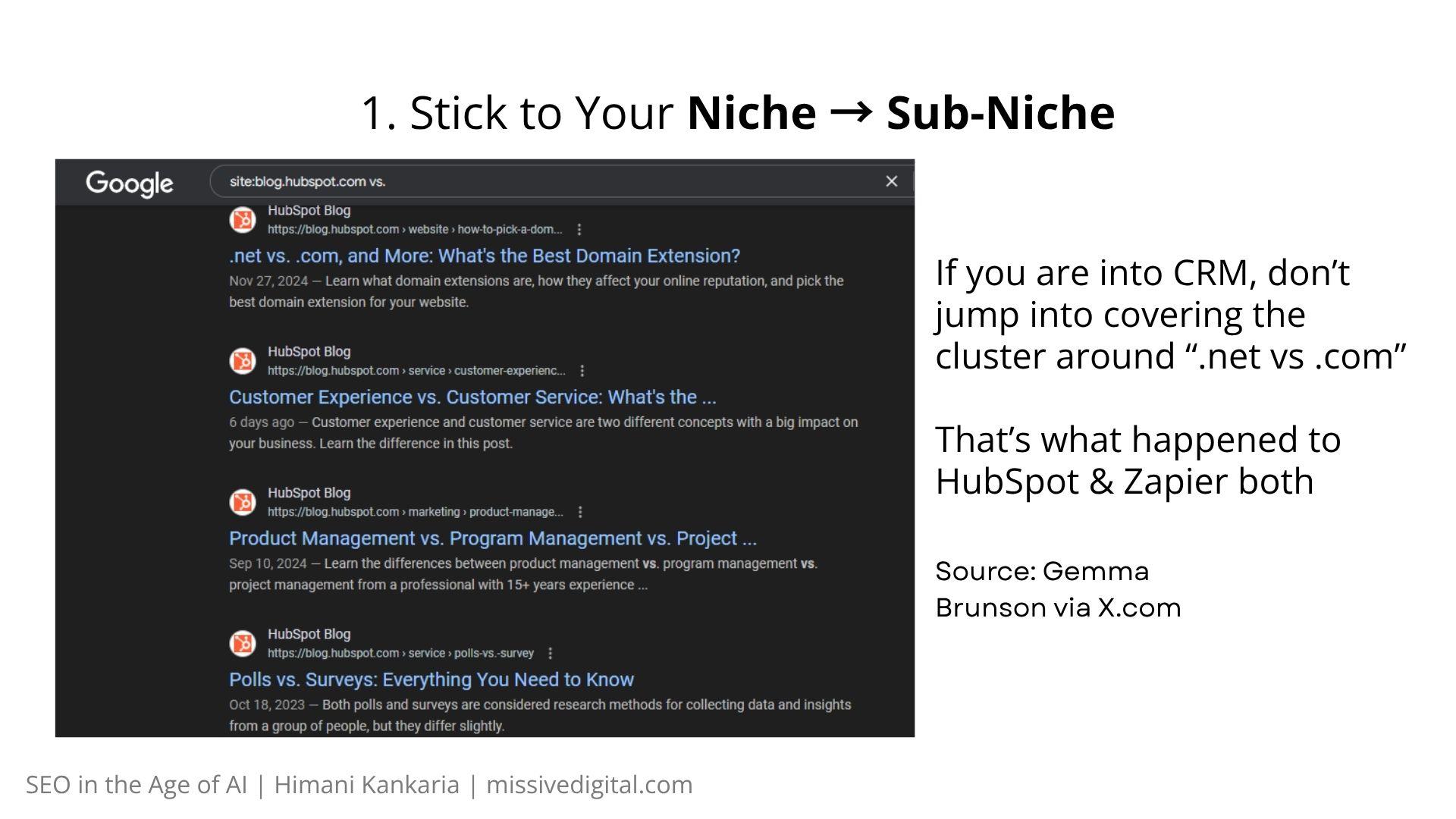
If you are into CRM, don’t jump into covering the cluster around “.net vs .com.” It doesn’t bring buyers, and it tells Google and AI tools that you’re not sure what you’re about.
What to write instead: go deeper, not wider. If your niche is CRM, your sub-niches are CRM for banking, CRM for real estate, CRM migration, CRM adoption. Each sub-niche has fewer searches and far more buyers.
How to act on it:
- Write down the three to five topics your business can claim real expertise in
- Check every planned topic against that list before it enters the calendar
- Look for the sub-niches inside each topic, by industry, company size, or use case
2. Stop Writing Very-ToFu Content. Move Down the Funnel
Very-ToFu content is the “what is” layer: definitions and basic explainers that any source can answer the same way.
Here’s how I showed the funnel in the webinar, with a CRM brand as the example.
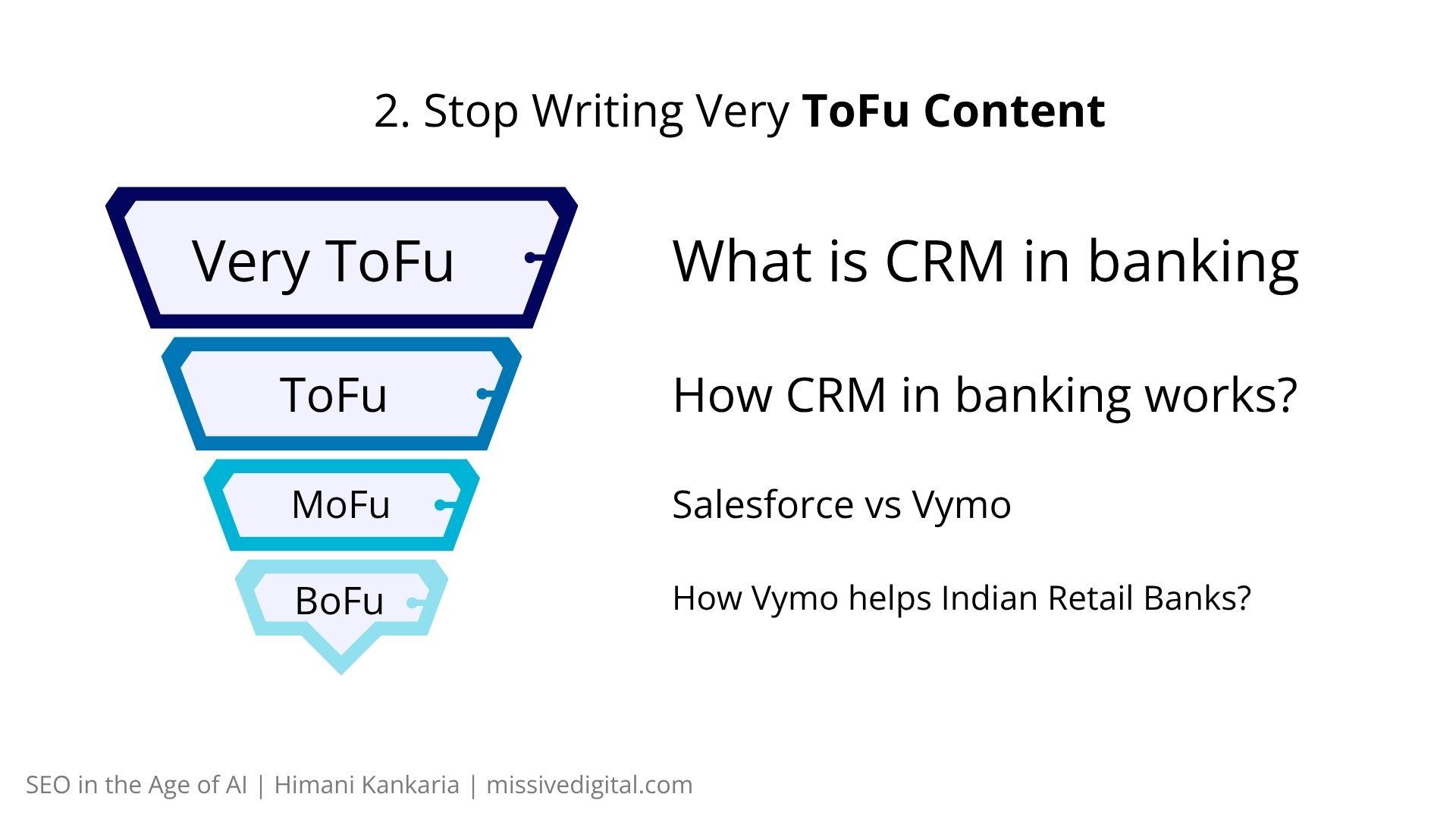
| Funnel stage | Example topic | Should you write it? |
|---|---|---|
| Very ToFu | What is CRM in banking | No. AI answers it fully |
| ToFu | How CRM in banking works | Only with your own process, data, or point of view |
| MoFu | Salesforce vs Vymo | Yes, with first-hand detail |
| BoFu | How Vymo helps Indian retail banks | Yes. Only you can write this |
Why stop at the top? Because that’s where AI Overviews took over first. Ahrefs found that 99.2% of the keywords that trigger an AI Overview are informational. And once a keyword gets an AI Overview, the traffic follows it down.
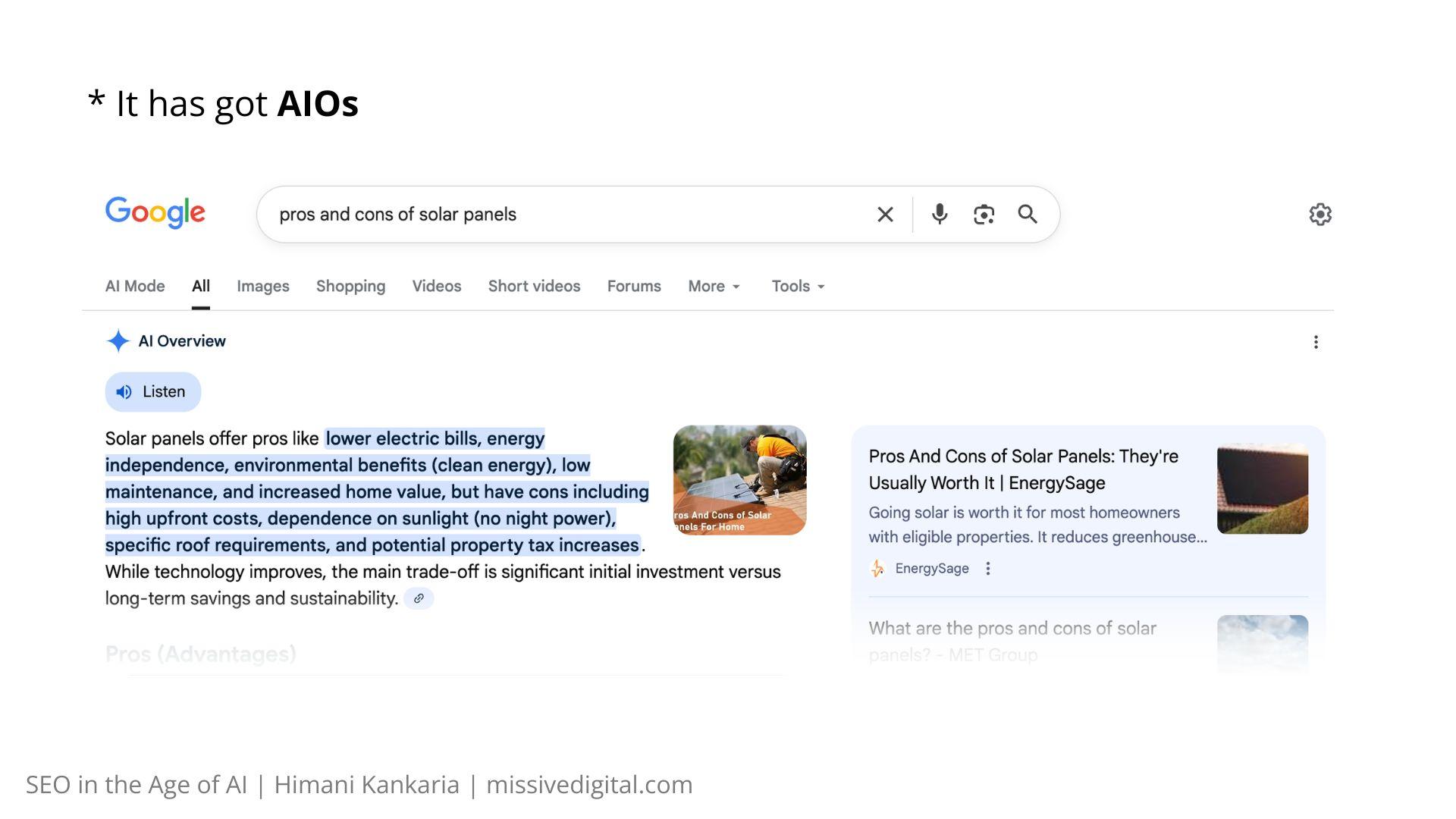
In the example I shared, a renewable energy website was losing traffic on exactly these topics: 31.9% down on “how many solar panels do I need,” and 18.3% down on “biomass energy advantages and disadvantages.”
One update since the webinar. Moving down the funnel doesn’t hide you from AI Overviews anymore, since they now show on most comparison searches too. What protects MoFu and BoFu content is that AI can’t write it without you. Your product details, your customers’ results, and your experience are things it has to cite.
How to act on it:
- Tag every existing and planned topic as very ToFu, ToFu, MoFu, or BoFu
- Stop new very-ToFu pieces, unless you’re adding something no one else has
- Shift that budget to comparisons, use cases, and “how [your product] helps [this customer]” pages
3. Rethink "Best" Articles. Write Only From First-Hand Experience
A “best” article is a listicle that ranks tools, products, or providers in a category, such as “best video editing apps for Android.”
I flagged these in the webinar with one example: a tech website losing traffic across its “best” articles, from 11.7% down on “best android phone camera” to 26% down on “best chrome extensions.”
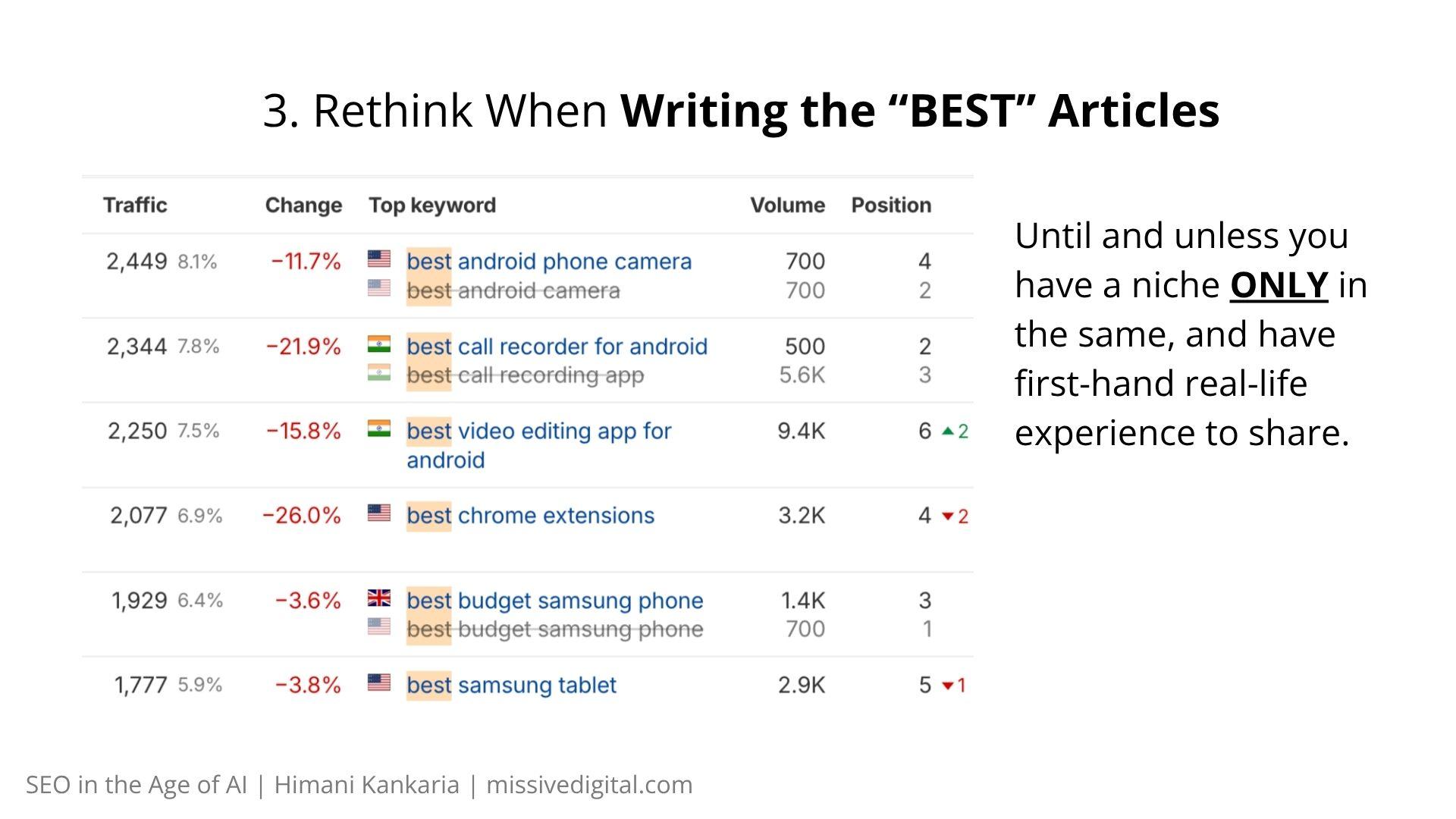
Since then, it has become a much bigger story. Lily Ray’s research found that:
- In January 2026, Google demoted several B2B and SaaS websites that had published self-promotional “best” listicles at scale. They lost between 29% and 49% of their organic visibility in weeks.
- In her June 2026 study of 100 “best [category]” searches, when Google’s AI Overview cited a brand’s own listicle, the brand itself was left out of the recommendation 69% of the time.
Read that second point again. Your “best” listicle can get cited and still send the recommendation to your competitors.
The format is not the problem. Listicles still rank when someone searches for options. The problem is a list written by someone who hasn’t used the things on it, or who has a reason to put themselves first.
What to write instead: write a “best” article only when your niche is ONLY that category and you have first-hand, real-life experience to share. Say what you tested, how you tested it, and who each option is right for.
How to act on it:
- Audit your existing “best” articles, and remove or rewrite the ones with no real testing behind them
- Replace “best overall” with “best for [specific use case],” which is also how people ask AI tools
- Earn your place on other people’s lists through digital PR and reviews, since others calling you the best is what counts
4. Stop Writing Hub-Like Content. Give Each Piece One Intent
Hub-like content is one long page that tries to cover every angle of a topic, with a table of contents that reads like five different articles.
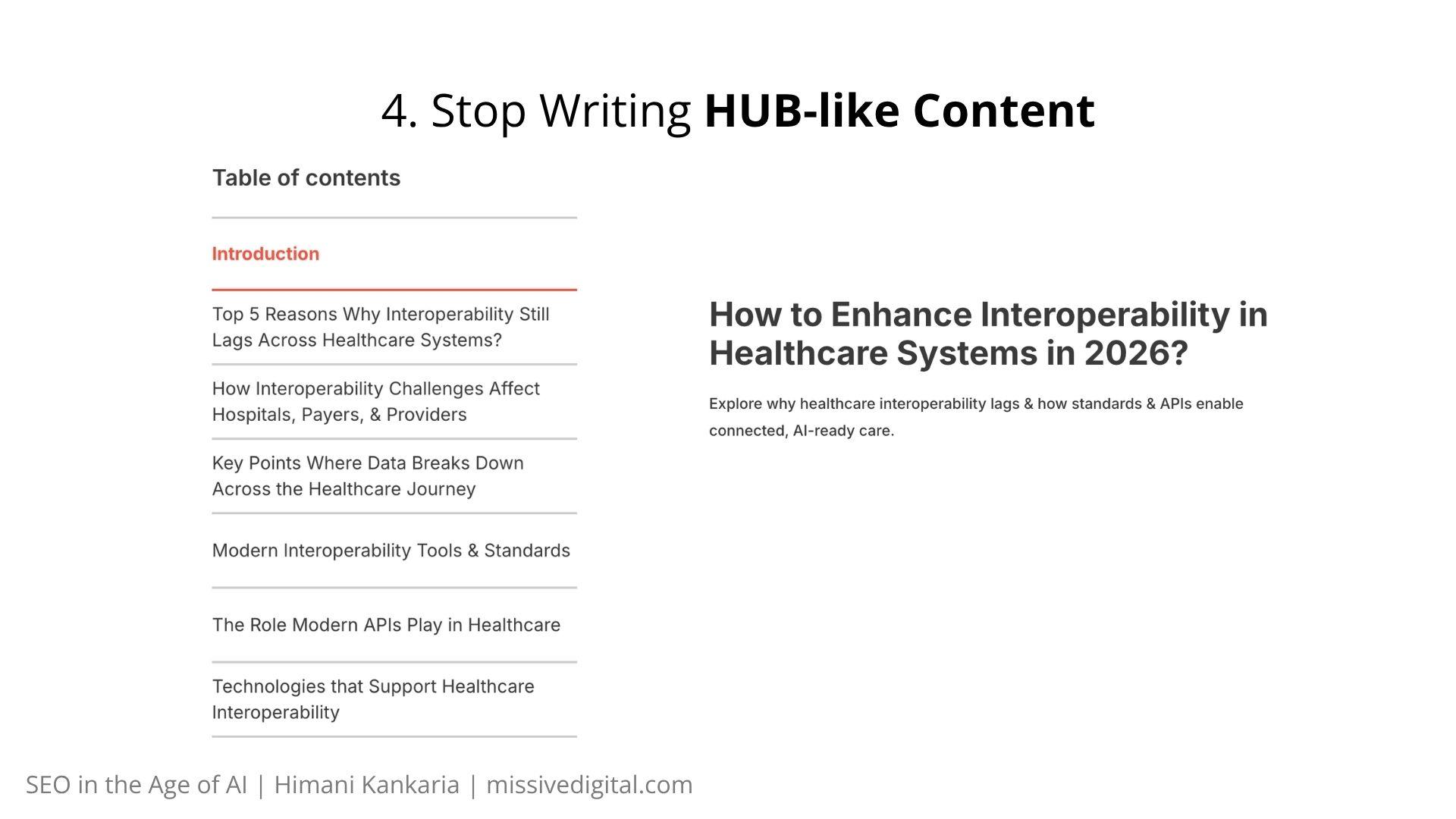
Here’s a real outline we reviewed, for a blog titled “How to Enhance Interoperability in Healthcare Systems in 2026?” On the left is the original outline. On the right is what I recommended.
| Original outline | My recommendation |
|---|---|
| Introduction | 1. Introduction: why interoperability still breaks in 2026 |
| Top 5 reasons why interoperability still lags | 2. What interoperability really means, plus the real-world impact of poor interoperability |
| How interoperability challenges affect hospitals, payers, and providers | 3. Interoperability challenges healthcare leaders still face |
| Key points where data breaks down across the healthcare journey | 4. Steps to enhance interoperability and solve those challenges, with the tech stack, standards, and role of AI inside the steps |
| Modern interoperability tools and standards | 5. Conclusion with the next steps for the audience |
| The role modern APIs play in healthcare | |
| Technologies that support healthcare interoperability |
Look at what the title promised: HOW to enhance interoperability. The original outline takes the reader through six sections on reasons, effects, tools, APIs, and technologies before any steps appear. The reader who came for “how” has to dig for it.
The recommended outline follows one line of thought: why it matters, what it means, what’s hard, how to fix it, what to do next. The tools and standards didn’t disappear. They moved inside the steps, where the reader needs them.
How to act on it:
- Read your title, then check that every H2 helps deliver what it promises
- Move background sections inside the steps they support, or cut them
- If a section could be its own article for a different reader, make it one
For the full method, read my guide on creating an effective blog structure.
5. Stop Writing for Everyone. Create Use-Case-Based, Hyper-Personalized Content
Use-case-based content answers one specific need for one specific kind of reader, in place of one broad topic for everyone.
My own example is a small one. I wrote a blog on 5 alternatives to writing “Conclusion” in your blog’s headings. It’s not a guide to blog writing. It solves one narrow problem for writers and editors. It became our second most-clicked page after the homepage, with 603 clicks.
This matters even more in AI search. Google has said the average AI Mode query is three times longer than a traditional search. People describe their role, their company, and their problem, and the AI looks for content that fits that situation.
We saw this in our Gumloop research as well. ChatGPT recommended a tool that didn’t rank on Google’s page 1, because that tool had content for the exact use case in the prompt.
How we do it at Missive Digital: we have weekly sync-ups with our clients’ product teams to understand the product, and with their sales teams to understand the type and quality of leads. The use cases we write about come from those calls.
How to act on it:
- For every broad topic in your calendar, ask “for whom, and to do what?”
- Turn one broad piece into two or three use-case pieces for different ICPs
- Put the use case in the title, the way your customer would describe it
To find these use cases for your own audience, follow the steps in my blog on keyword research for AI search.
6. Stop Relying on Other People's Statistics. Integrate E-E-A-T Elements
E-E-A-T elements are the parts of your content that come from your own experience, expertise, and authority: original data, your own frameworks, real examples, and lessons from your mistakes.
A blog that only collects statistics from other websites gives AI nothing new. It already has those statistics. What it doesn’t have is what you learned doing the work.
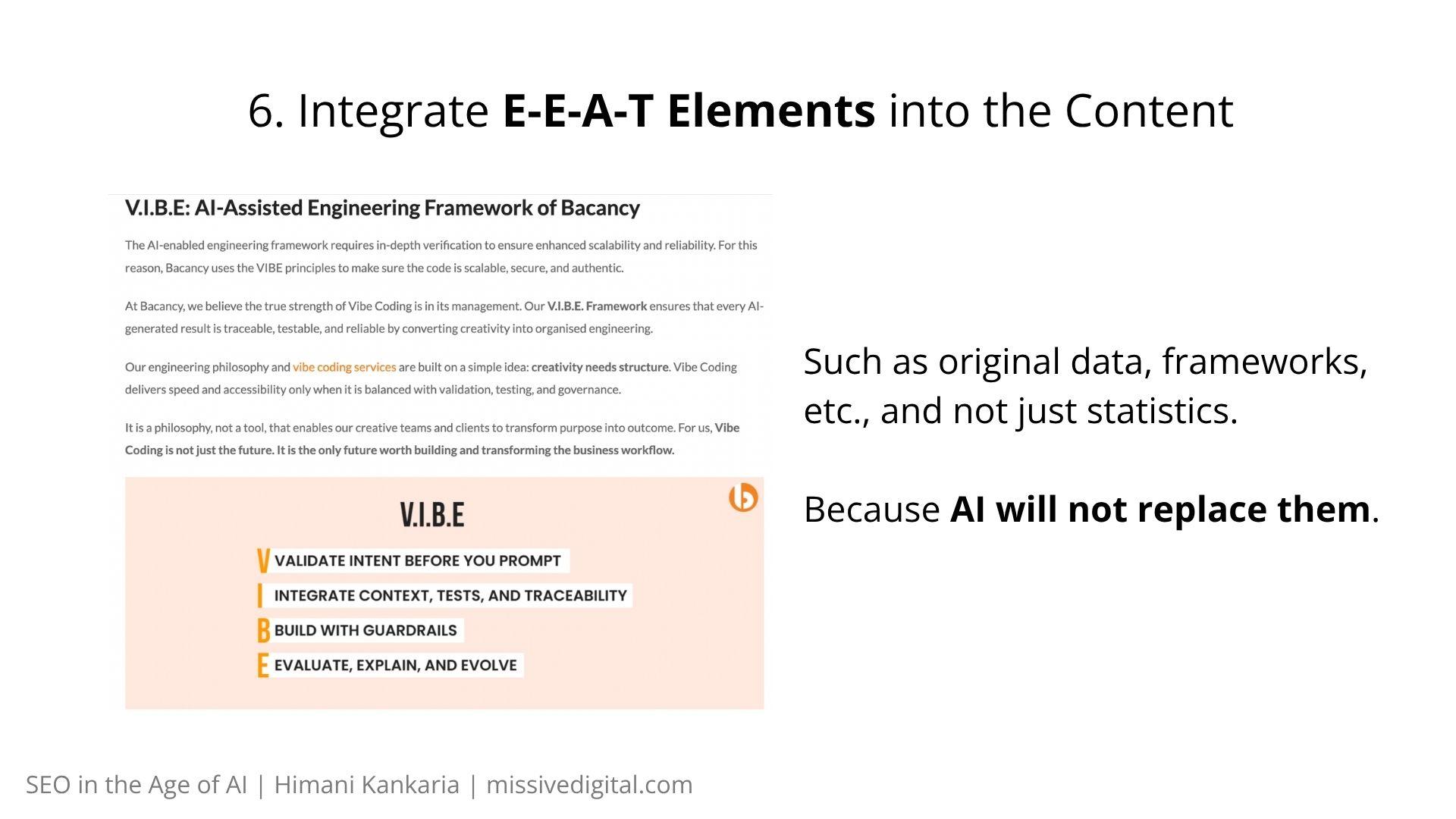
Here’s an example I like. Bacancy didn’t just write about vibe coding. They published their own V.I.B.E. framework for AI-assisted engineering, with a principle behind each letter. That’s something an AI tool has to credit to them.
The research since the webinar points the same way:
- In NP Digital’s May 2026 survey of 500 marketers, original research was the content format most often reported to earn AI citations, at 82%.
- In Andy Crestodina’s October 2026 survey of 1,000 marketers, publishing original data had the highest share reporting strong results from AI search, yet only 26% of marketers are doing it.
So it works, and most of your competitors aren’t doing it yet.
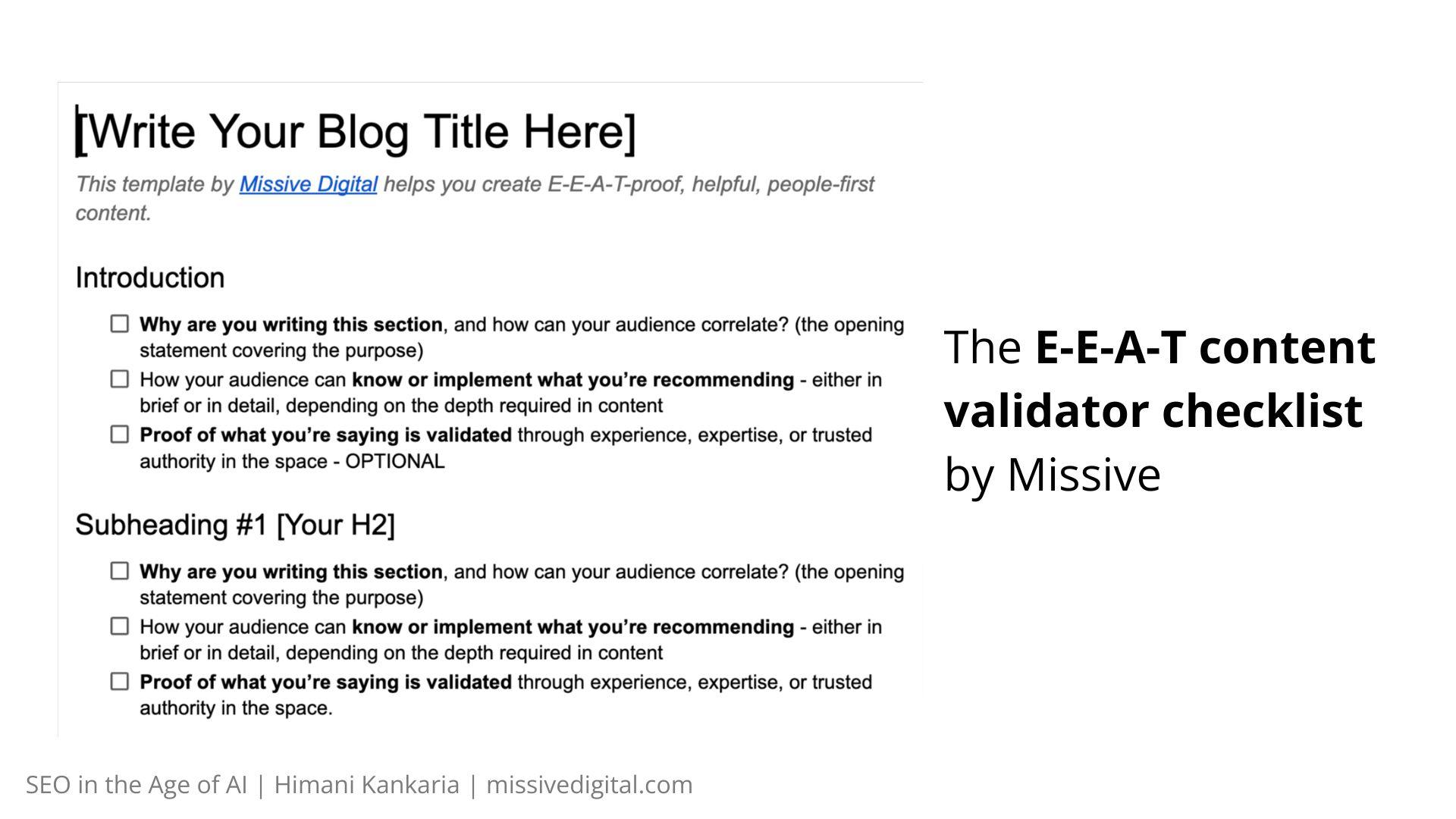
How we do it at Missive Digital: every section of every blog goes through our E-E-A-T content validator. It asks three things:
| Check | What the section must show |
|---|---|
| Purpose | Why you're writing this section, and how your audience can relate to it |
| Implementation | How the audience can know or apply what you're recommending |
| Proof | That what you're saying is validated through experience, expertise, or a trusted authority |
Your research, your experience, your mistakes, your learnings. AI will not replace them.
7. Stop Writing Bite-Sized Chunks for LLMs. Write for the Reader
Content chunking means breaking your content into tiny paragraphs and question-style subheadings because you’ve heard that LLMs prefer it.
I was asked about this before the webinar: “Can we create bite-sized content the way AI gives?” My answer was NO. A big NO.
Google has said the same. In the Search Off the Record podcast of January 2026, Danny Sullivan said he had spoken to Google’s engineers about it, and that they don’t want you to turn your content into bite-sized chunks or to make two versions, one for LLMs and one for people.
SEO was always platform-agnostic. We focused on Google, and we still got traffic from Bing and DuckDuckGo. Create for users, and platforms will follow.
This doesn’t mean structure is bad. Answering the question early, using clear headings, and adding a table where it helps are all good for the reader. The difference is who you’re doing it for.
And remember, AI can give you the ingredients. It’s humans who add the flavour. So humanize your content, always.
I’ve shown how to do that, beyond the AI humanizer tools, in my guide on how to (actually) humanize AI content.
How to Apply These Changes to the Content You Already Have
You don’t need to start over. Most of the gain comes from sorting your existing content into four decisions: keep, update, merge, or remove.
| What you find | Decision | What to do |
|---|---|---|
| MoFu and BoFu pages in your niche | Keep | Strengthen them with E-E-A-T elements and current examples |
| ToFu pages in your niche with rising impressions and falling clicks | Update | Add your own data, process, or point of view, so the page is worth citing |
| Several thin or overlapping pages on one topic, or one hub-like guide | Merge or restructure | Combine thin pages into one focused piece, and split hub-like guides by intent |
| "Best" listicles with no first-hand testing | Update or remove | Rewrite from real experience, or take them down |
| Topics outside your niche | Remove | Redirect to the closest relevant page, or noindex |
Step 1: Pull Your Pages From Search Console
Export all pages with their clicks and impressions for the last 12 months, and compare them with the 12 months before.
Step 2: Tag Every Page
Add three columns: niche fit (yes or no), funnel stage (very ToFu to BoFu), and content type (explainer, listicle, hub, use case, comparison).
Step 3: Start With the "Crocodile" Pages
Sort for pages where impressions went up and clicks went down. Google is showing these pages, often inside AI Overviews, but they aren’t earning the click. They’re your best candidates for an update.
Step 4: Decide, Using the Table Above
One caution before you remove anything. Check each page’s backlinks and whether it assists conversions. A page with no clicks can still be doing a job.
If you haven’t done one before, my guide on how to do a website content audit walks through it in five steps.
How we do it at Missive Digital: we don’t plan new content for a client until we’ve audited what already exists. More often than not, the fastest results come from fixing the pages they already have. You can see how we approach it on our content audit services page.
Build Your Content Strategy for AI Overviews Around What Only You Can Write
Every change in this blog comes back to one idea. AI can answer anything that’s already been written a hundred times. It can’t answer with your experience, your data, your product, or your customers’ results.
So stop competing with AI on the content it does well, and write the content it has to come to you for.
To make that easier, here’s the checklist our writers use on every section they write.
And if you’d like us to audit your content and build this strategy with you, explore our content consulting or book a free consultation.
Don’t just create content. Create an experience your target audience can’t resist.
FAQs About Content Strategy for AI Overviews
Informational, top-of-funnel content is the most affected. Ahrefs found that 99.2% of the keywords that trigger an AI Overview are informational, and Seer Interactive's 2026 data shows AI Overviews on about 86% of question queries.
No. Stop writing very-ToFu content that only defines a term. Keep ToFu content where you can add your own process, data, or point of view, because that's what makes a page worth citing.
Only when they're based on first-hand experience. Google demoted websites with self-promotional listicles in January 2026, and Lily Ray's June 2026 study found brands were left out of the AI recommendation 69% of the time when their own listicle was cited.
No. Google's Danny Sullivan said in January 2026 that Google doesn't want content broken into bite-sized chunks for LLMs, or separate versions for LLMs and people. Structure your content for the reader.
Content with something original in it: your own data, frameworks, real examples, and first-hand experience. In NP Digital's May 2026 survey, original research was the format most often reported to earn AI citations.