
I went to Google to search for “how to humanize AI content.”
I saw dozens of AI tools to humanize your AI-generated texts.
I was like, “Come on, if you needed AI to humanize content, why do you even want to humanize it?”
AI may humanize text; on the other hand, AI trains itself to detect AI-written content. So you don’t need another AI tool for it.
Especially when Google has now started asking quality raters to assess if the main content of the page is auto- or AI-generated, and if that’s the case, it should be rated as the lowest, as per the tweet by Aleyda Solis from Search Central Live, Madrid.
I’ve spent 15 years of my career utilizing content strategy, writing, and optimization to build SEO and other marketing strategies. I’ve realized that marketing has always been user-focused and platform-driven, not the other way around.
So it’s time you start bringing your human insights or flavour to make your content game sustainable for decades.
But how are you gonna do it? Let’s learn from some examples.
1. You decide your content approach and not AI.
Approaching your content means determining,
- What message do you want to deliver?
- How do you want to say it?
- What format, style, and tone will you use based on your audience and goal?
For example, let’s talk about this content. As I mentioned above, I searched for it on Google, and there was not a single article explaining how to actually humanize ChatGPT-generated content but talking about the tools that can help you humanize it.
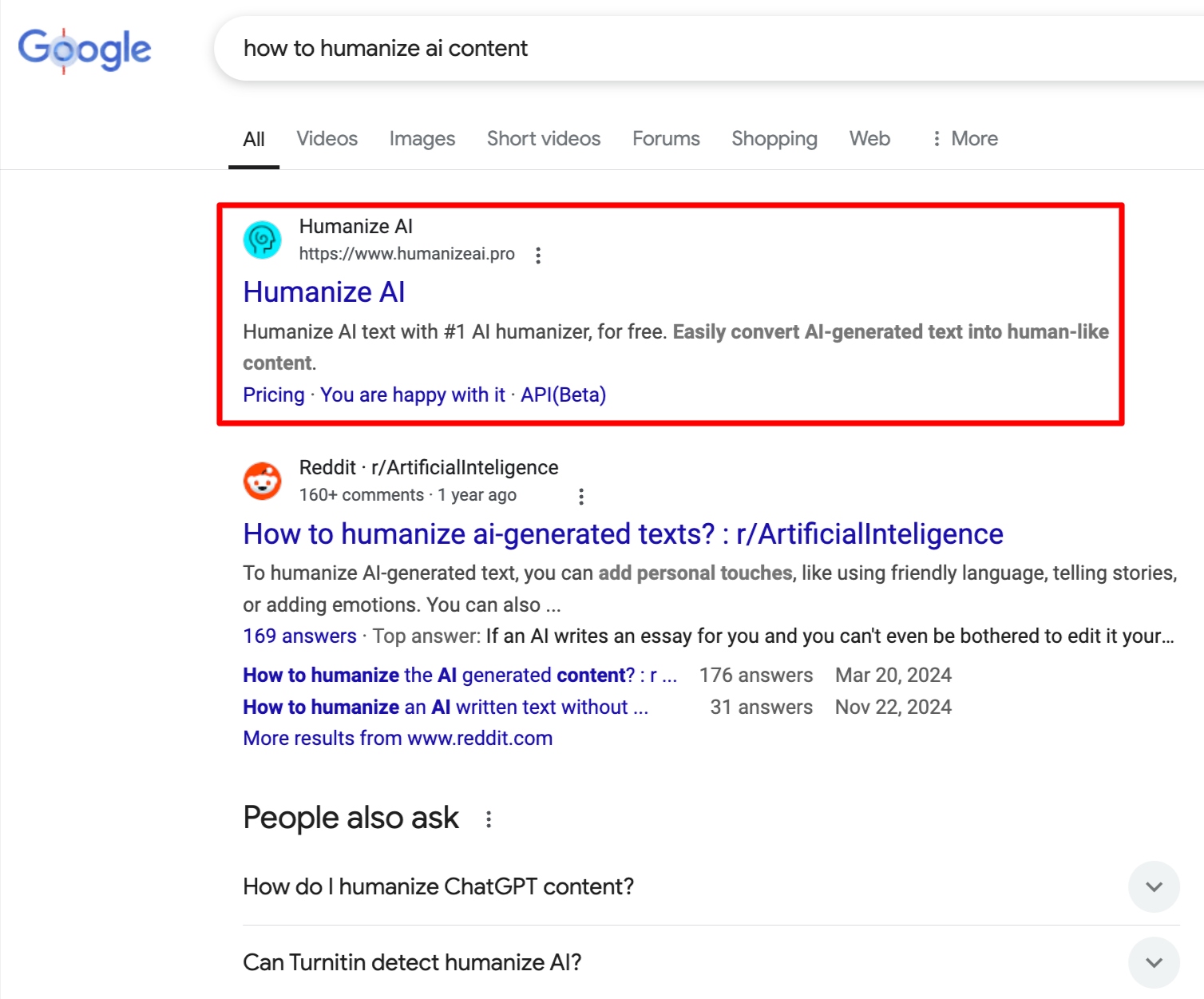
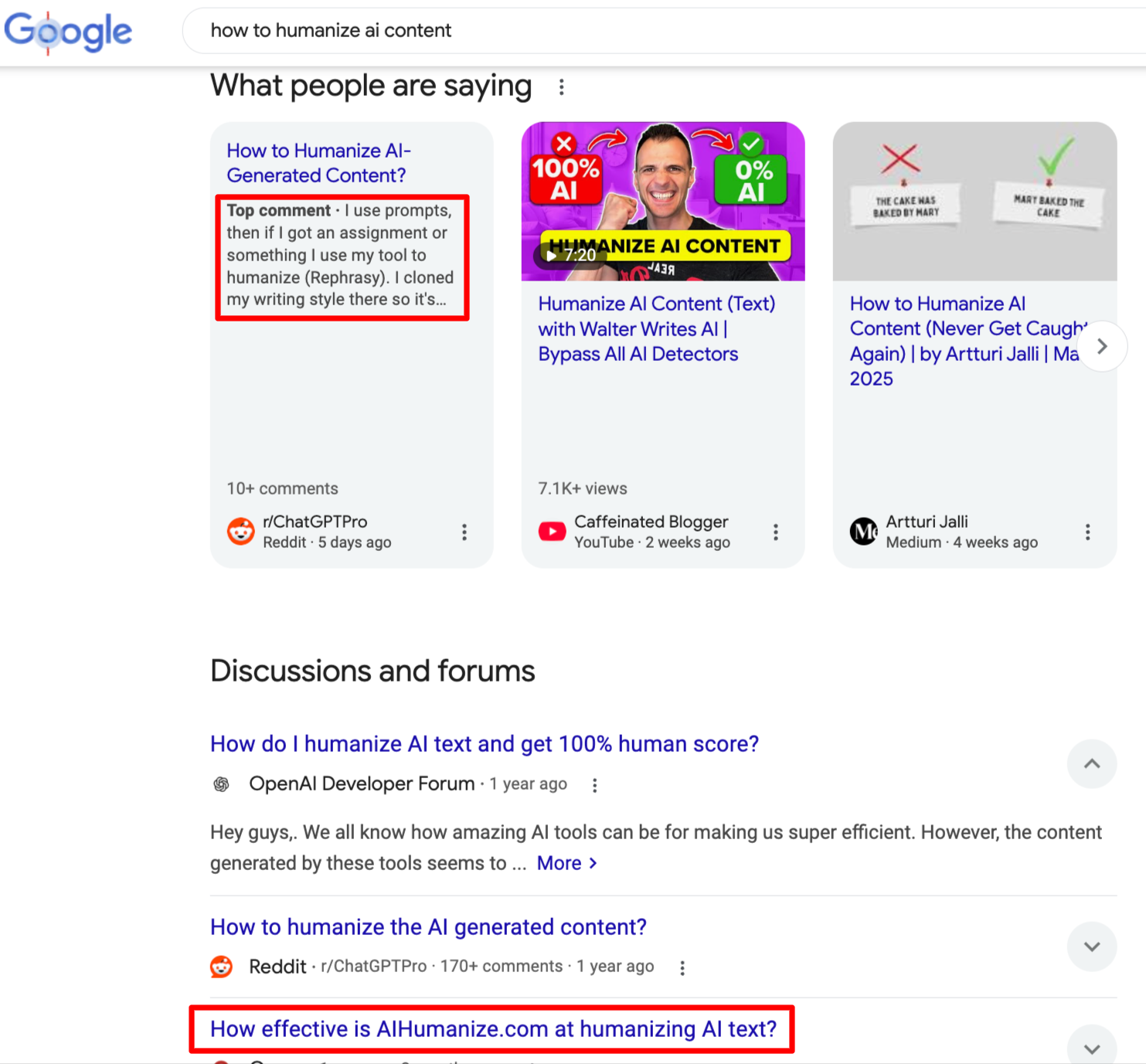
Everyone is looking to know how AI tools can help in humanizing AI content
So my approach to writing this content became opinion-based: “I want to let SEOs, content strategists, and content writers know that humanizing content means actually humanizing it and not using AI to do it for you again because it will not help you gain sustainable results.”
For one of our clients into diamond jewelry, we wanted to write their first content on diamond gift ideas during Women’s Day, and the approach we took was-
“Diamond jewelry gift ideas for Indians on Women’s Day, categorized by the special role a woman plays in your life.”
And this is how it looked like:

For our diamond jewelry client at Missive Digital, we changed the content approach to humanize AI content
Now, let’s take another example. You want to write a blog on “Why sleep is important for productivity.”
You can approach this blog in the following ways:
- Scientific: Research studies, expert opinions, data-driven facts
- Storytelling: Personal experience or relatable burnout story
- Relatable: Memes, daily-life analogies, pop culture references
- Inspiring: Quotes, lifestyle perspective, wellness angle

In short, even if you want AI to create content for you, your content approach can humanize the readability of your AI-generated text.
2. You create your content outline before you ask AI.
Before AI, most writers (including me) used to research on Google SERPs on what competing blogs are covering in terms of blog sections and subsections before we create ours.
Then, we used to try the Skyscraper technique to create better content than the rest.
Then AI entered, and we literally stopped creating outlines on our own and started asking AI to do it for us.
And that’s why almost all content on Google SERPs looks the same nowadays.
Let’s take a look at different Table of Contents from different blogs on “React vs Angular:”
Below is the website #1
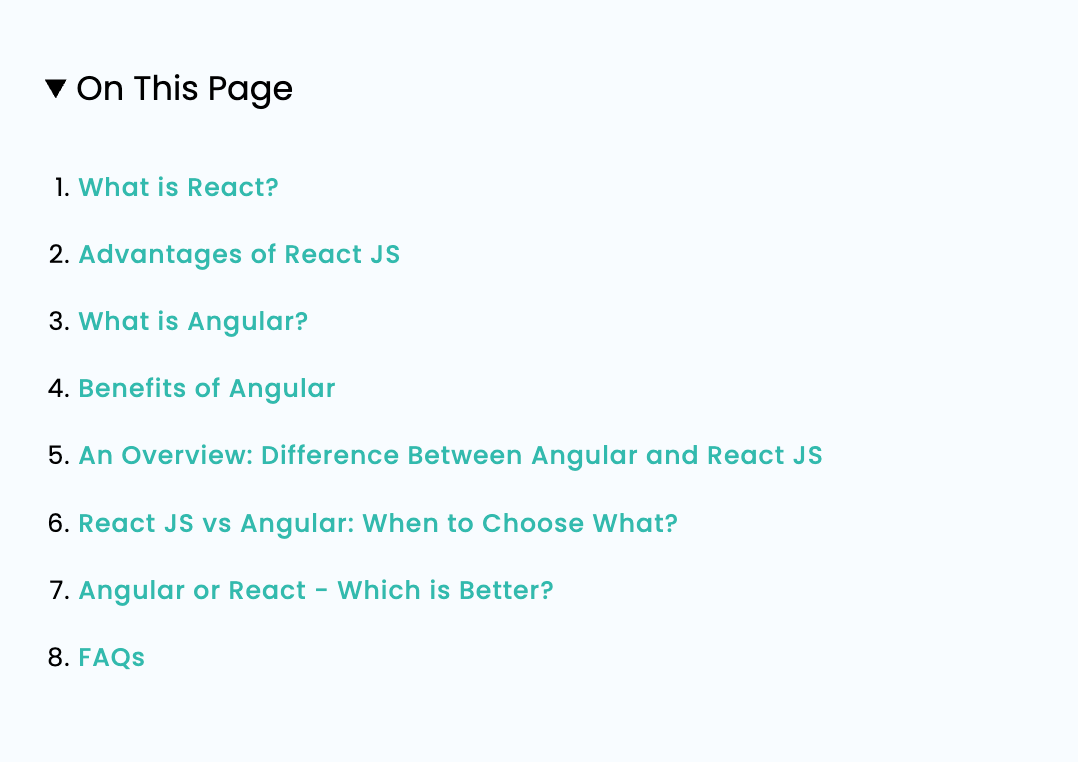
Outline by AI looks the same
Below is the website #2
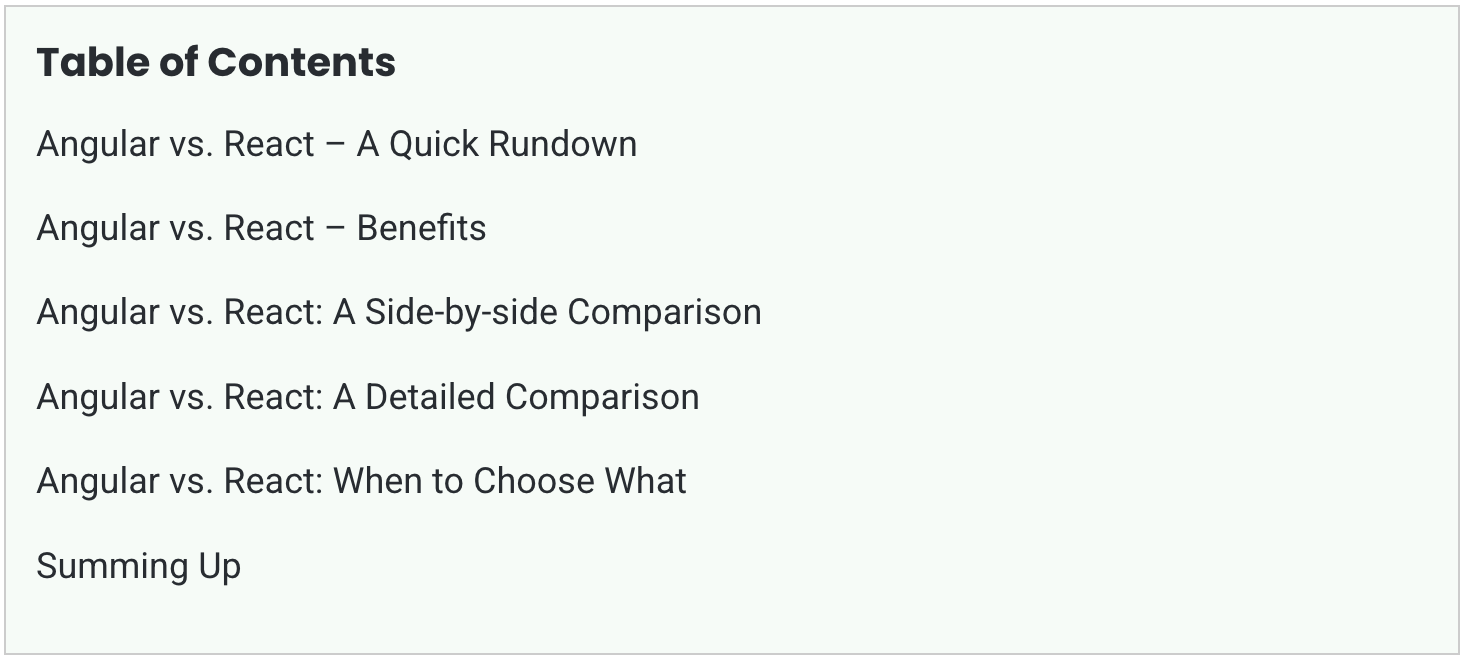
Outline by AI looks the same
I’m not saying that these outlines are incorrect or irrelevant for the target audience, but create your version before you go to AI so that you can have a different flow.
I would love to test this: Start with the comparison table right after the introduction that covers the definition, benefits, challenges, features, comparison, and when to choose.
Based on your content approach and target audience, decide the tentative flow you feel your audience will want to follow.
If you don’t create the outline, AI may make mistakes because they are not subject matter experts; they can bring it up as per the data scrapped from the web and cannot even predict what we want to put out as a message.
Take a look at how I struggled to explain ChatGPT when writing a case study for a local SEO software company.
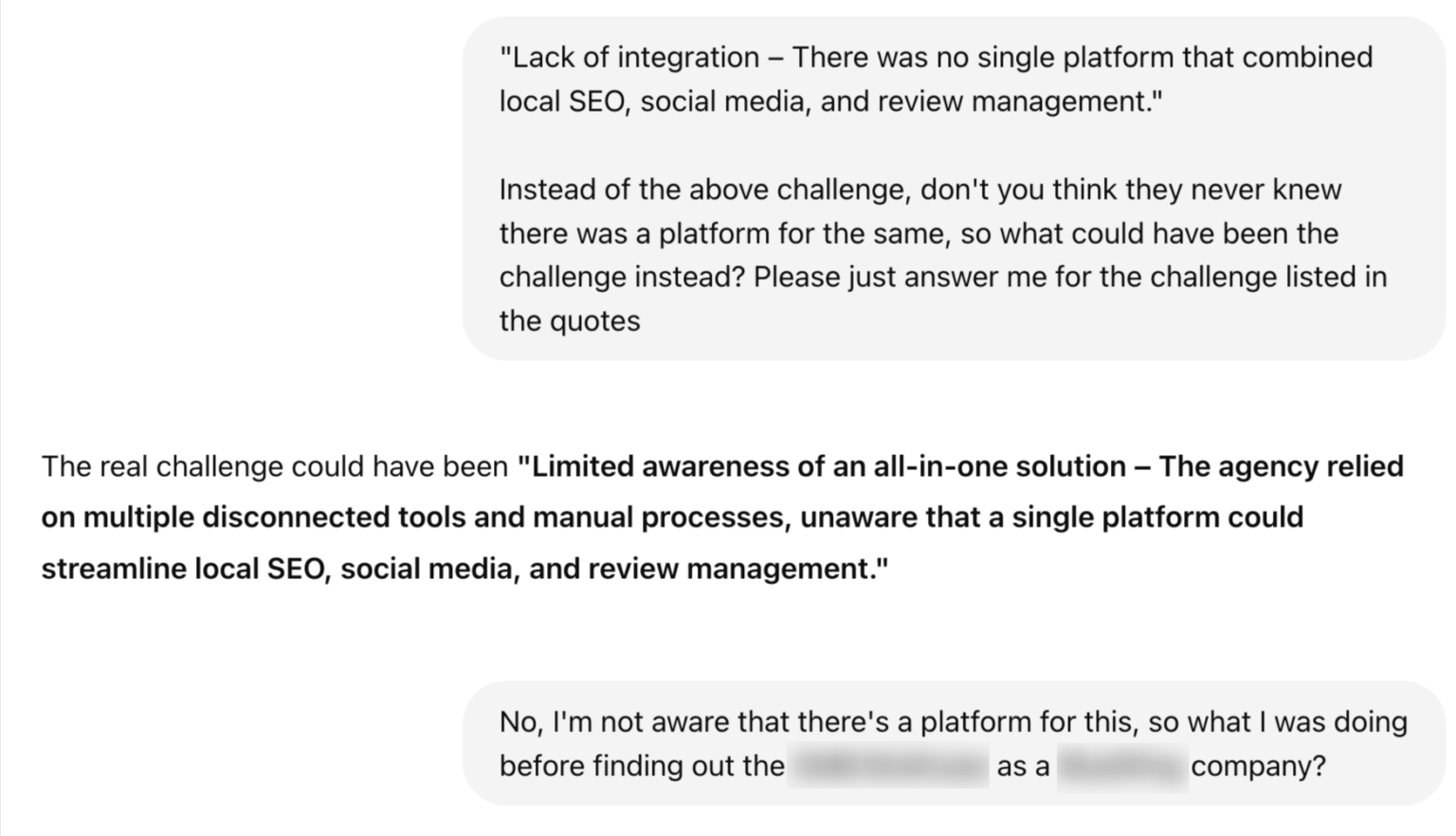
You’ll be able to do this ONLY IF… YOU have decided your content approach and not AI.
3. Make your subheadings in sentence format now on.
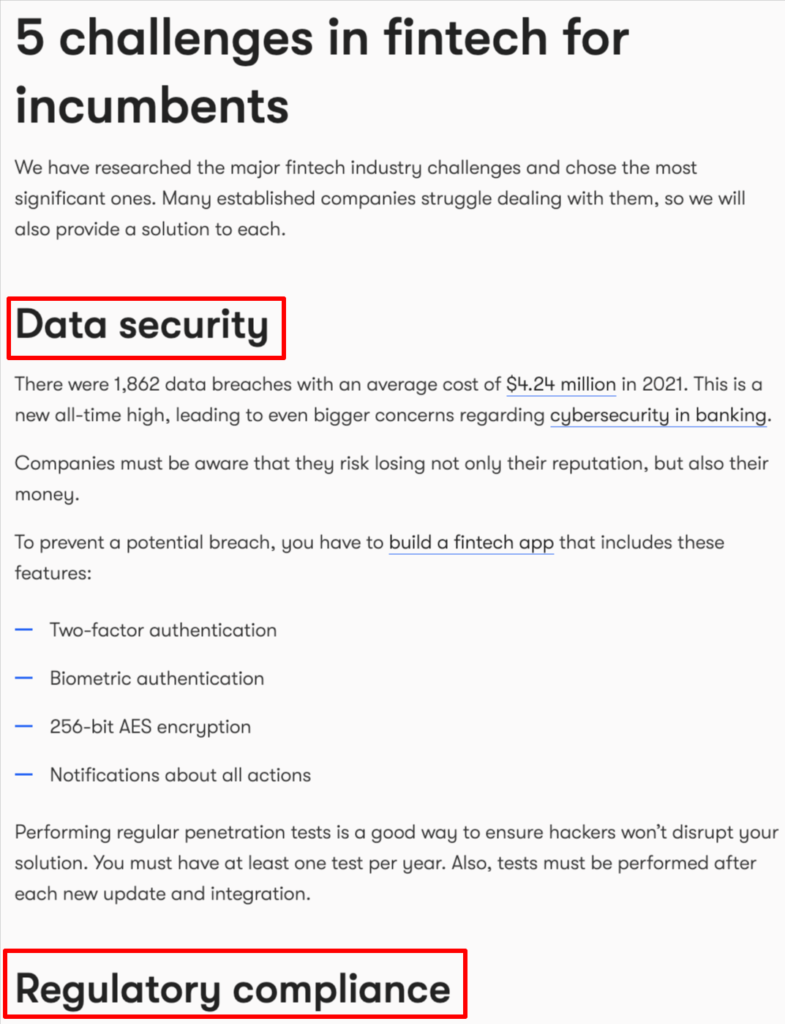
To be honest, not just me but my review team at Missive Digital and even all of the content editors out there are tired of reading those bland subheadings.
Here is an example of a blog with such bland subheadings that are not reader-friendly:
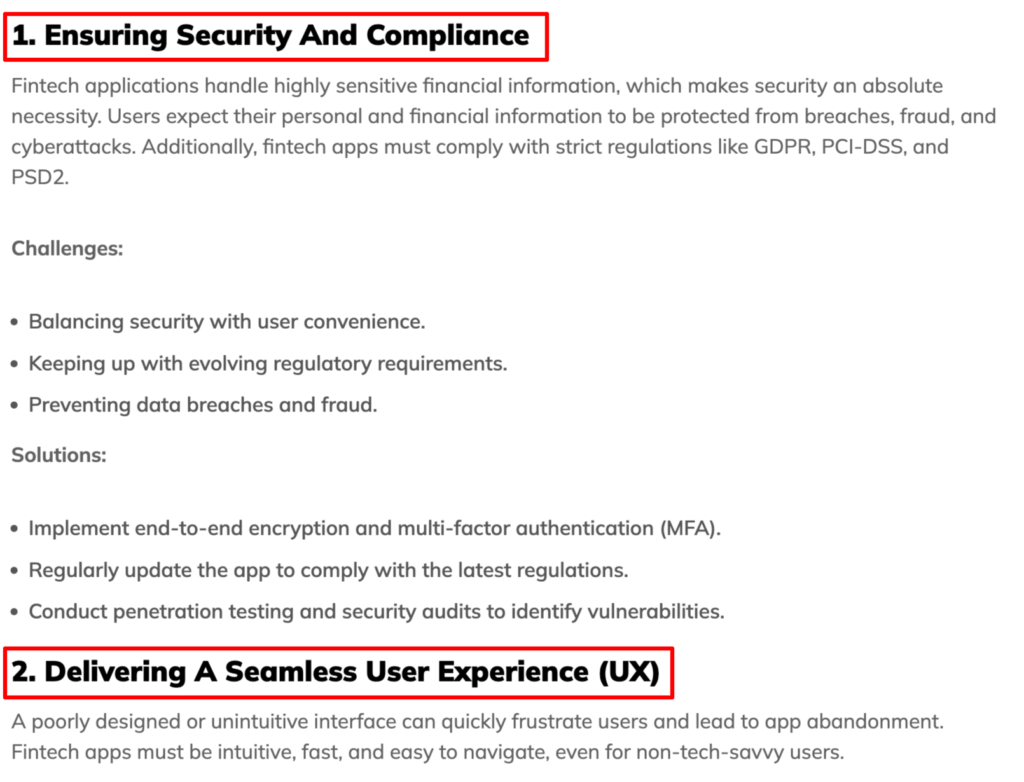
Here is another example of the same topic but with better subheadings:
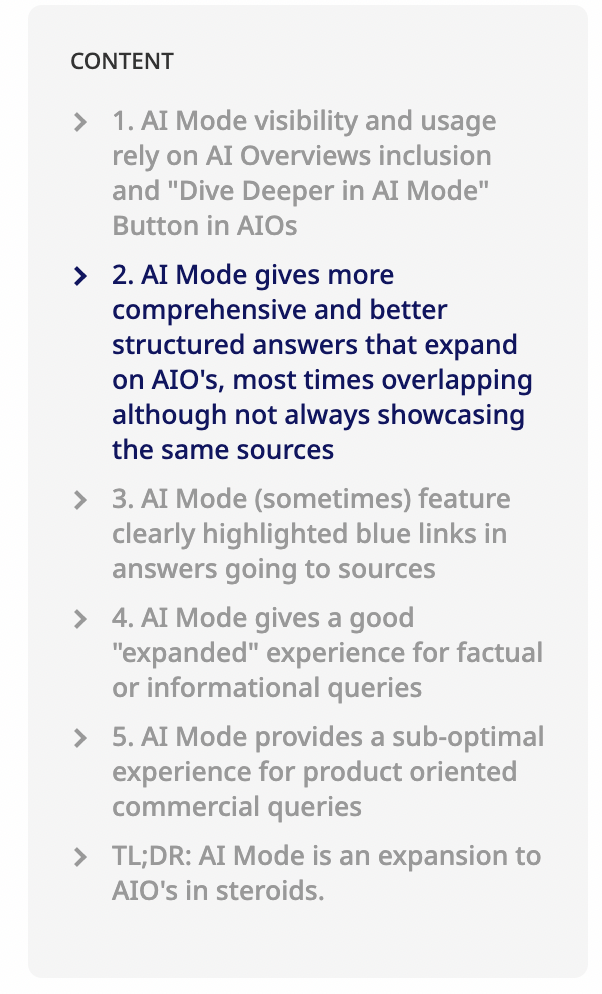
The way it brings to all the content by Aleyda Solis, an SEO inspiration.
Below is the screenshot of the Table of Contents from Aleyda’s blog on “5 Early Observations about The New Google AI Mode in Test.”
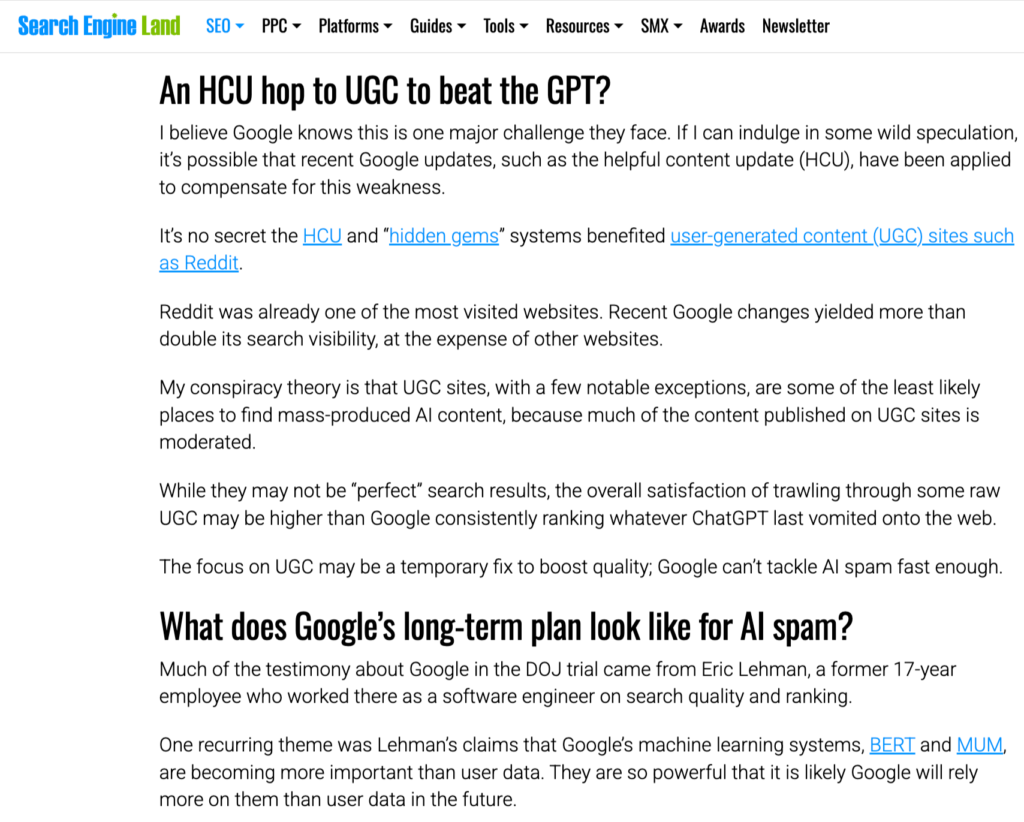
Even that’s the same thing followed by Mark Williams-Cook in most of his articles. Here is an example from Google’s shifting approach to AI content: An in-depth look.
So, when you write your subheadings in sentence format, here is why it’s considered a smart move:
- It doesn’t sound AI.
- Your readers instantly know what to expect in each section.
- It keeps your blog scannable while delivering value since we know how busy people are to read entire blogs.
- Google understands your content better.
- It gives your blog a more conversational and friendly tone.
- Readers who see clear, engaging subheadings are more likely to continue reading rather than bouncing off your site.
In short, humanize your content by writing subheadings in sentence format from now on. No questions asked.
P.S. Ask AI to make subheadings conversational for you. Simple.
4. Bring your research, data, expert opinions, etc., which are not AI.
With SearchGPT and AI overviews, finding the data you want has become easier. But only for statistics or research studies.
But I doubt if ChatGPT, Claude, Perplexity, or Gemini is reading the text of the research studies available only on PDFs, which we can read after downloading them.
For example, I downloaded this research from Gartner’s CMO Leadership Vision 2025.
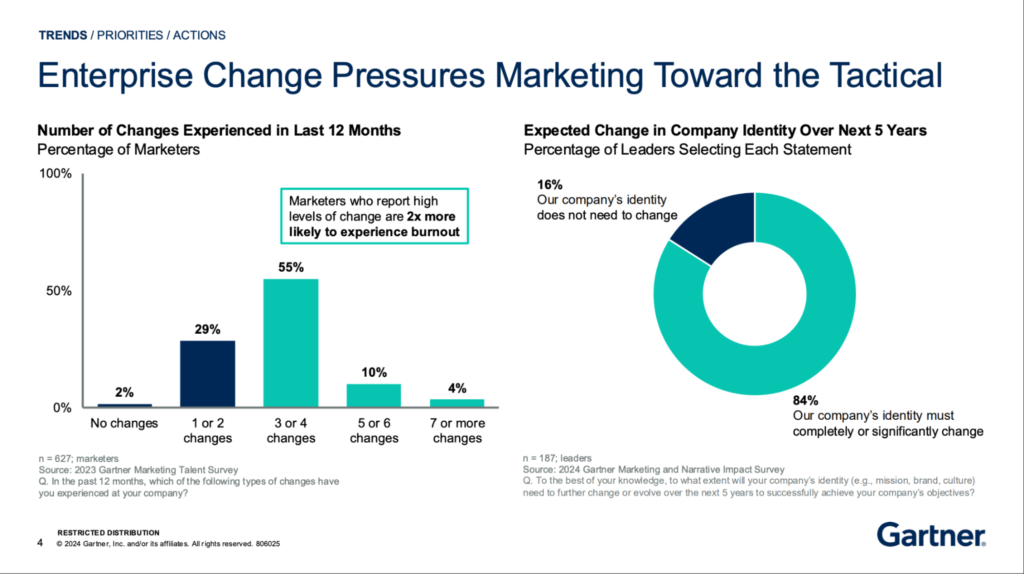
As of now, if someone has covered everything that this Gartner research has included, then only AI Overviews or AI Tools can showcase.
So if you want such unique data to be added to your content, it’s YOU who has to research, read, and bring it to the content.
What if you want a specific message from a particular expert? You will need to read their blogs, watch their videos, personally reach out to them, and so much more to quote them.
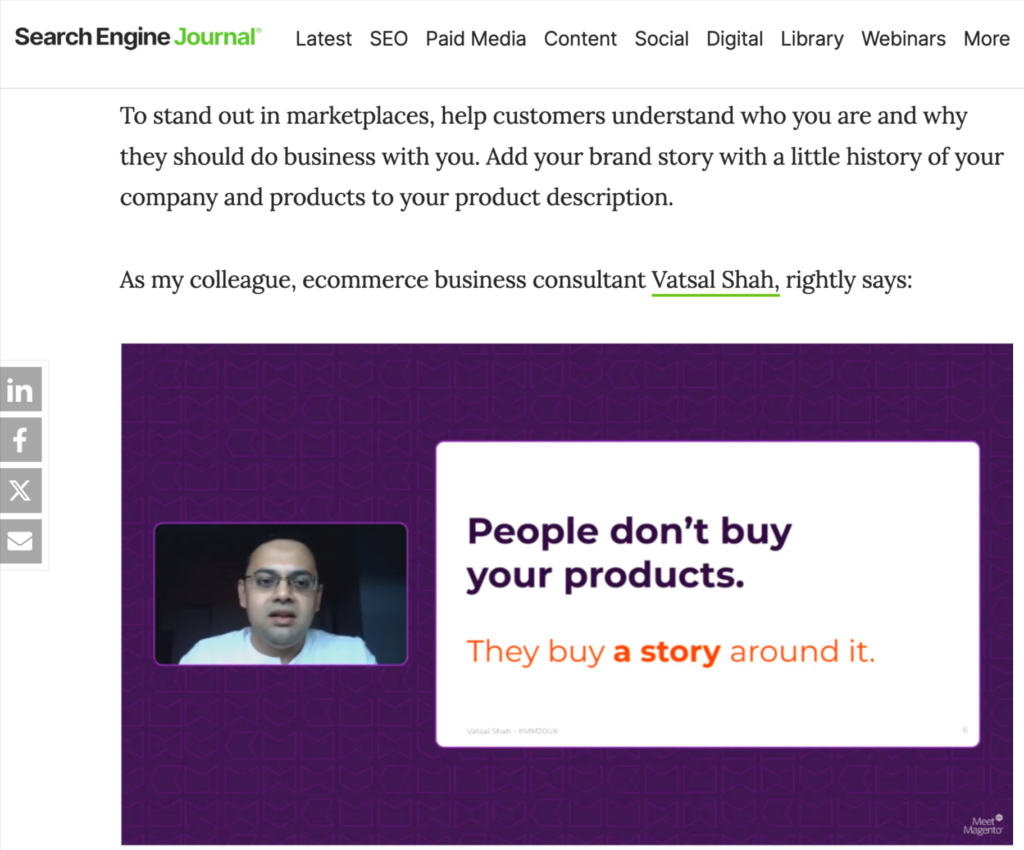
When I wrote my first article on the Search Engine Journal, “13 Tips for Writing Product Descriptions That Convert,” I quoted Vatsal Shah from his talk at Meet Magento Indonesia. He said, “People don’t buy your products. They buy a story around it.”
Also, the content head at iFour Technolabs (one of our content consulting clients), Kapil Panchal, has been grabbing expert recommendations on their blogs since 2020.
Here is a screenshot from a blog on “Top 7 Project Management Software Recommendations by Expert.”
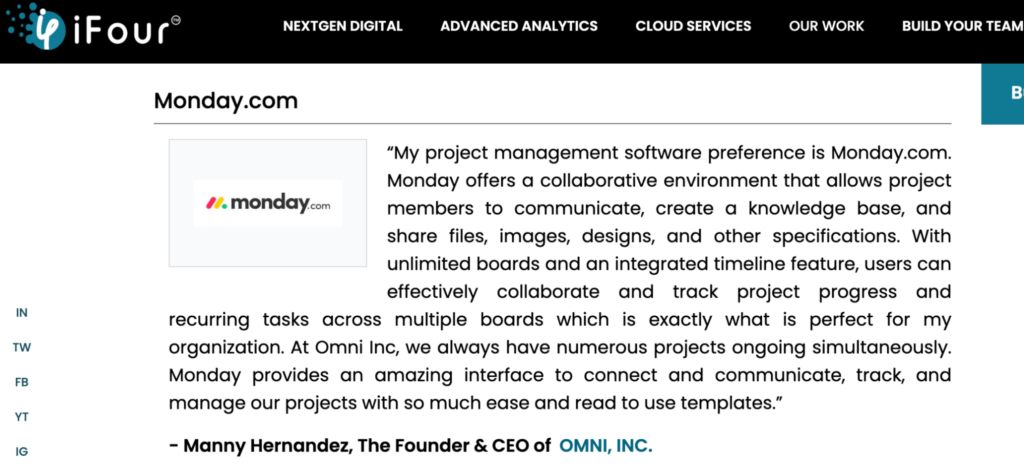
These expert quotes are not for the search engines but for the audiences to find value in your content, which is not available in any AI tool.
This also makes your content more human and even ticks your E-E-A-T requirements.
Note: We’ll discuss the expert part in detail later in this blog at point no. 8.
5. Write your introduction and conclusion yourself.
Nobody can better decide how to start and end a movie better than the writer or the director.
Similarly, only a content strategist or a writer can decide how the content should be started and ended.
However, your content approach directly shapes both the introduction and the conclusion of your blog. It sets the stage and ties everything together in a way that aligns with your tone, audience, and goal.
Think of it as setting a tone for a conversation:
- The introduction is your first impression.
- The conclusion is the lasting impression.
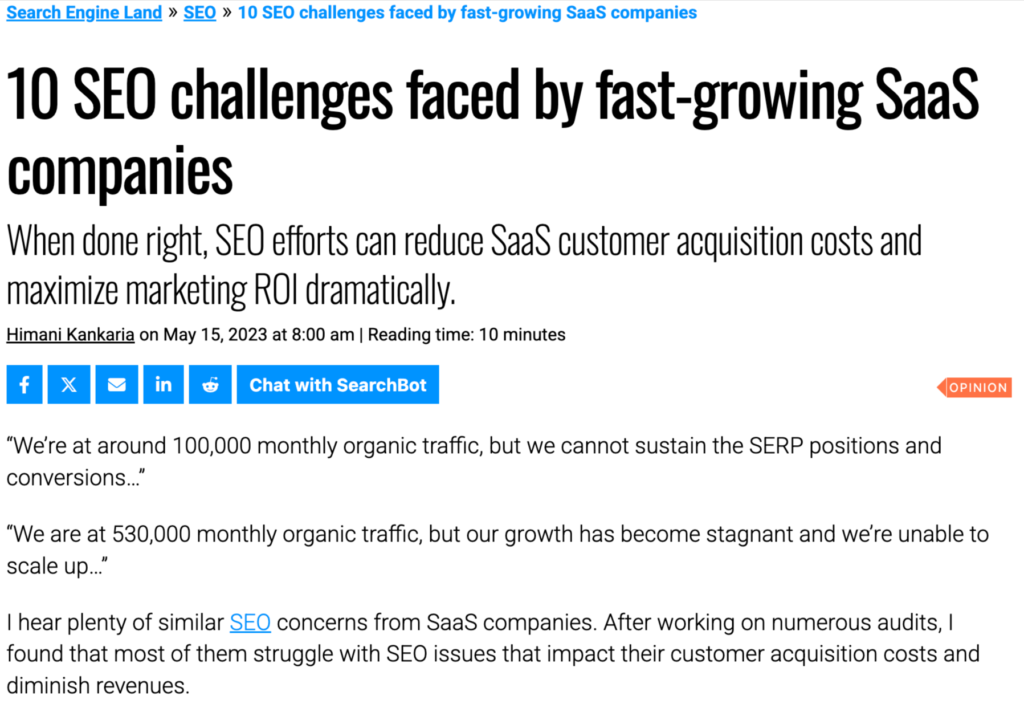
Here is the introduction from my article on “10 SEO challenges faced by fast-growing SaaS companies” at Search Engine Land, where my introduction started with “After working on numerous audits, I found that most of them struggle with SEO issues that impact their customer acquisition costs and diminish revenues.”
The article ended with a conclusion: “For SaaS companies, focusing on performance marketing and outbound lead generation strategies is expected.
But when done right, SEO has the capability to reduce your customer acquisition costs and maximize marketing ROI dramatically.”
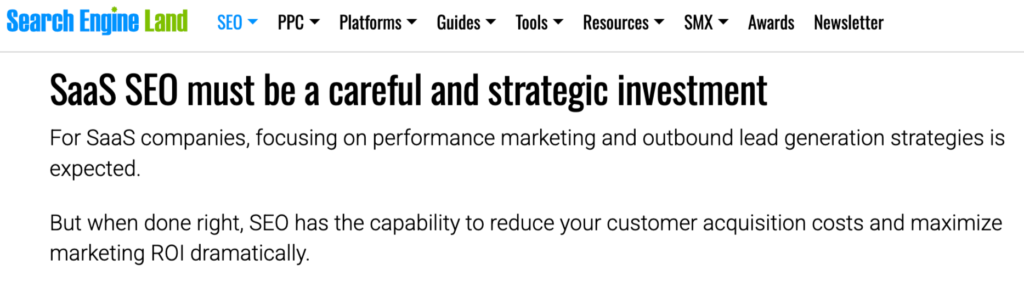
See, if you don’t feel confident about your conclusion, you can definitely ask AI to make it better for you, but it should be YOUR thoughts on how AI should conclude your blog.
Also, if you have a conclusion section to be added to your content, make sure you don’t write “Conclusion,” “Wrapping Up,” or “Final Thoughts,” even if it’s evergreen content.
Make the best use of conclusion heading tags by using these suggestions:
- Encourage your audience to take action
- Invoke your audience’s thinking process
- Guide them with the next step
- Include proof to support your suggestions
- Write a thought-provoking, fact-based one-liner statements
Personalizing this heading also ensures you’ve taken the time and effort to bring value to your audience.
6. Let mistakes happen in your content since humans make mistakes.
By mistakes, I don’t mean making mistakes in facts or research. But in the way we write content.
We used to create SOPs where we used to mention the consistency in how subheadings start, readability score, clarity from Grammarly, and that subheadings shouldn’t be lengthy, and so much more.
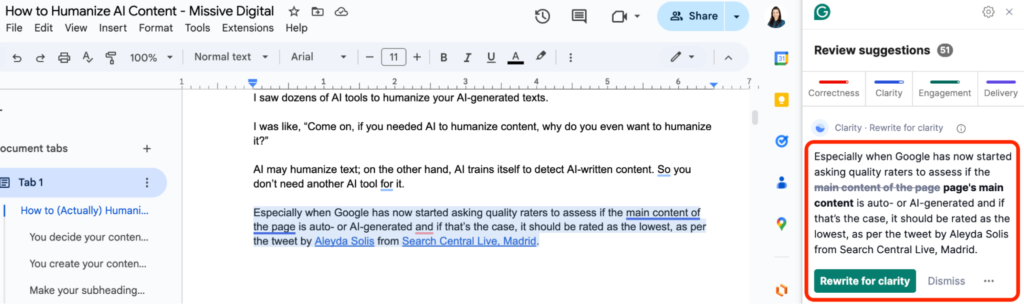
But gone are the days because the user expectations have changed with the search engines that have evolved with the evolving AI.
It’s okay if you don’t make your content more crisp.
It’s okay if your sentences are lengthier.
It’s okay if your readability score is not as per your expectations.
It’s okay if your content has some grammatical errors.
It should attract YOUR target audience and engage them throughout your content.
That’s the end goal that we, all content marketers, should have, and that’s what will grab us some love from the search engines and even AI Search.
7. Proofread hard to avoid ChatGPTish or AI-generated flavors.
Oh, strict proofreading is definitely required to make your content humanized.
See, everybody knows everyone uses AI, and everybody can now easily detect the language AI gives. But we are here to make it sound more human so that your target audience engages more, which will drive you better content ROI.
So you definitely need to know the red flags and keep them at bay:
- No “em dashes (—)”, please
- No colons in the title tags, please
- No terms like “navigate,” “landscape,” “unleash,” “discover,” “delve,” and more.
Create your own list to avoid such robotic terms in your content to have the most humanized version.
8. Write in 1st-person experience & not just language.
I understand that not all content writers are subject matter experts in the niche they are writing on.
That’s where you start using AI, but that’s not a problem at all. The problem starts when the audiences don’t enjoy reading your content.
They feel disconnected, and your message will not be passed effectively and will not give a lasting impression.
Disconnection leads to disengagement, which further leads to poor blog performance.
That’s where authority comes into play.
Authority in the content comes with experience, and experience can come either by working on something or learning from someone.
I’ll share two content examples here explaining the experience gained in both the scenarios:
1. When you have gained authority over the years of experience
Recently, Lily Ray, a seasoned SEO legend, wrote a blog on “Top 10 Ways to Optimize For Google Discover in 2025” on LinkedIn Pulse, and within 7 hours, it got into featured snippets, AI Overviews, AI Mode, and even SearchGPT.
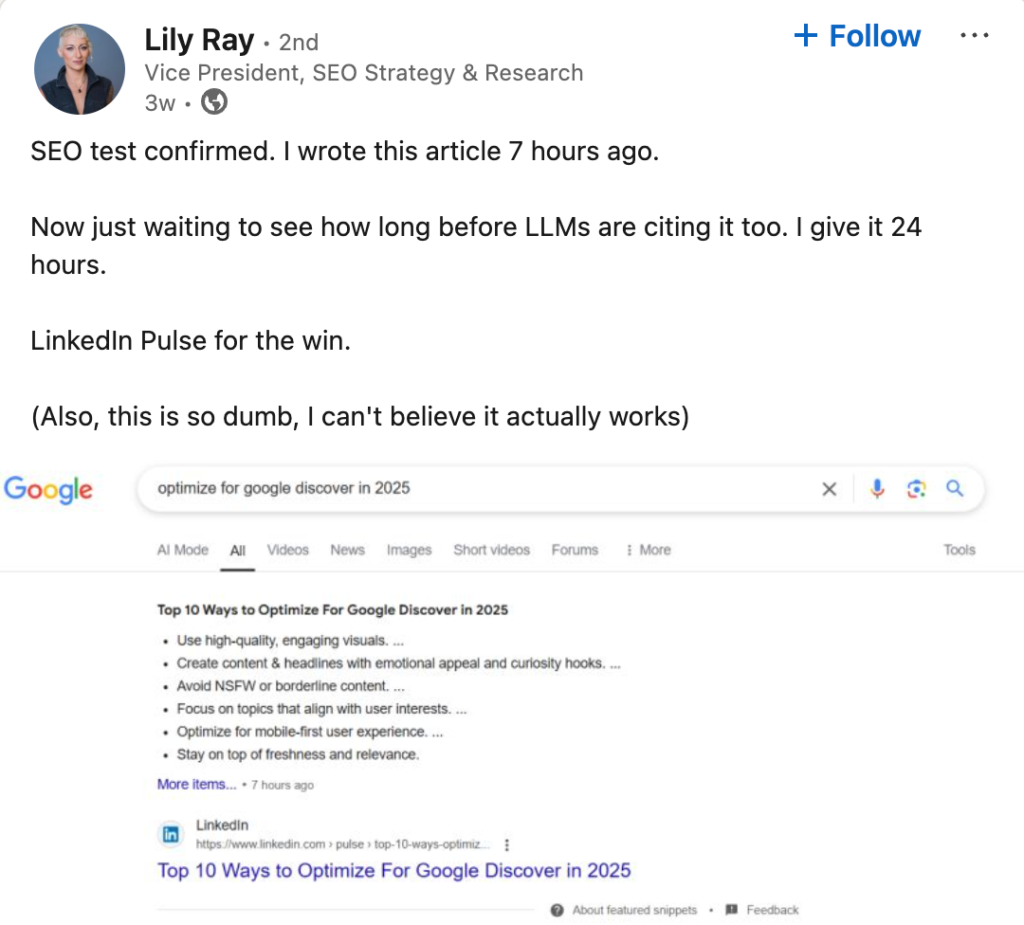
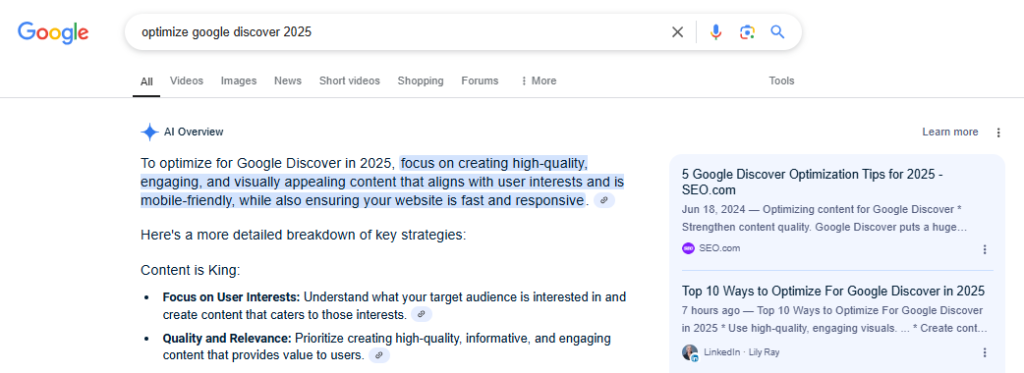
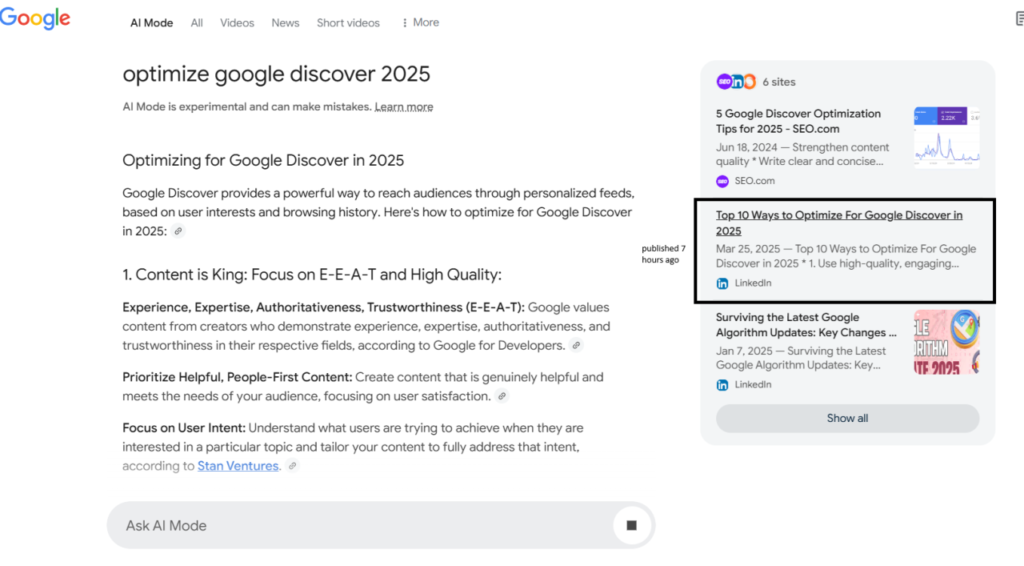
How did that happen?
She shared how authoritative and credible she is to talk about this topic in the introduction itself, and also, her LinkedIn profile is attached as the author, which also works as the cherry on top.
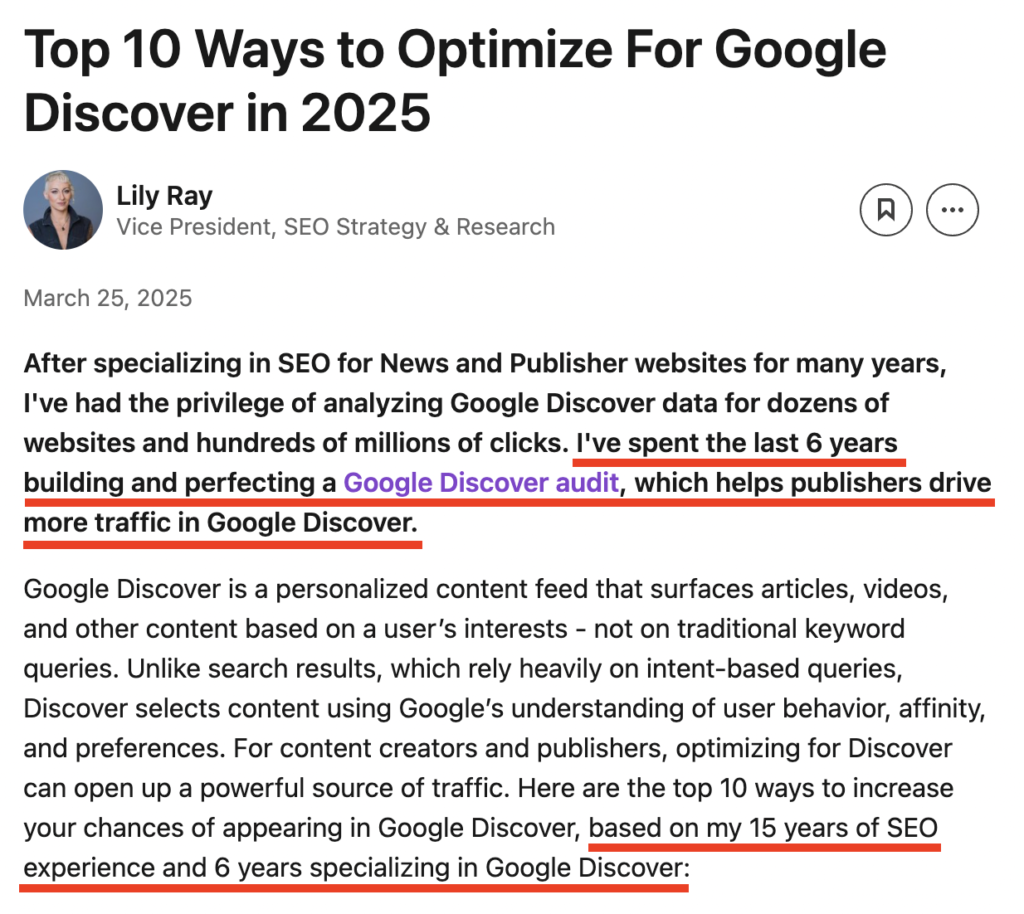
This is what we call a killer example of E-E-A-T to be used in the content. She used her own learnings and experiences to approach this content.
2. When you have gained experience by learning from someone
What if you don’t have experience or expertise in a niche?
You need to bring the subject matter experts to share their experience, expertise, and knowledge on the niche.
In this content on Supplier Relationship Management (SRM): Strategy, KPIs, and Tools, see how Nidhi Agarwal, the content editor at LeadSquared uses the authority, experience, and expertise of Mr. R. K. Agrawal, a steel industry veteran with 48 years of experience in steel manufacturing and has served as an Executive Director at SAIL.
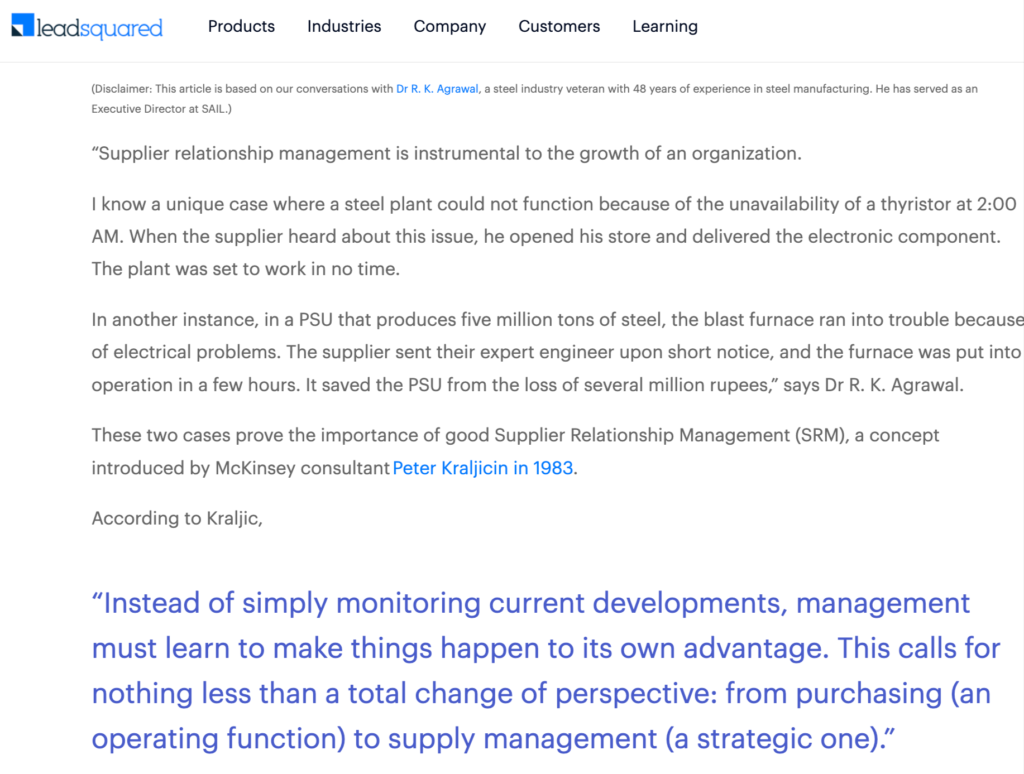
In short, whose experience you utilize in your content doesn’t matter, it needs to be 1st-hand experience.
What matters is how much value you bring to the table for your target audience, even by humanizing your AI-generated content.
How are you going to humanize your AI content? By using a tool or bringing any of the above aspects
I know that AI is going to be everything going forward, but what AI cannot bring are the ideas, thought processes, approaches, and most importantly, a leader’s experience.
Use AI to turn your thoughts into words and not vice versa to make sure your content performs no matter how many updates Google or AI brings.