
Key Takeaways
- LLMs recommend the brands they can connect to a specific use case, not simply the brands that rank highest on Google.
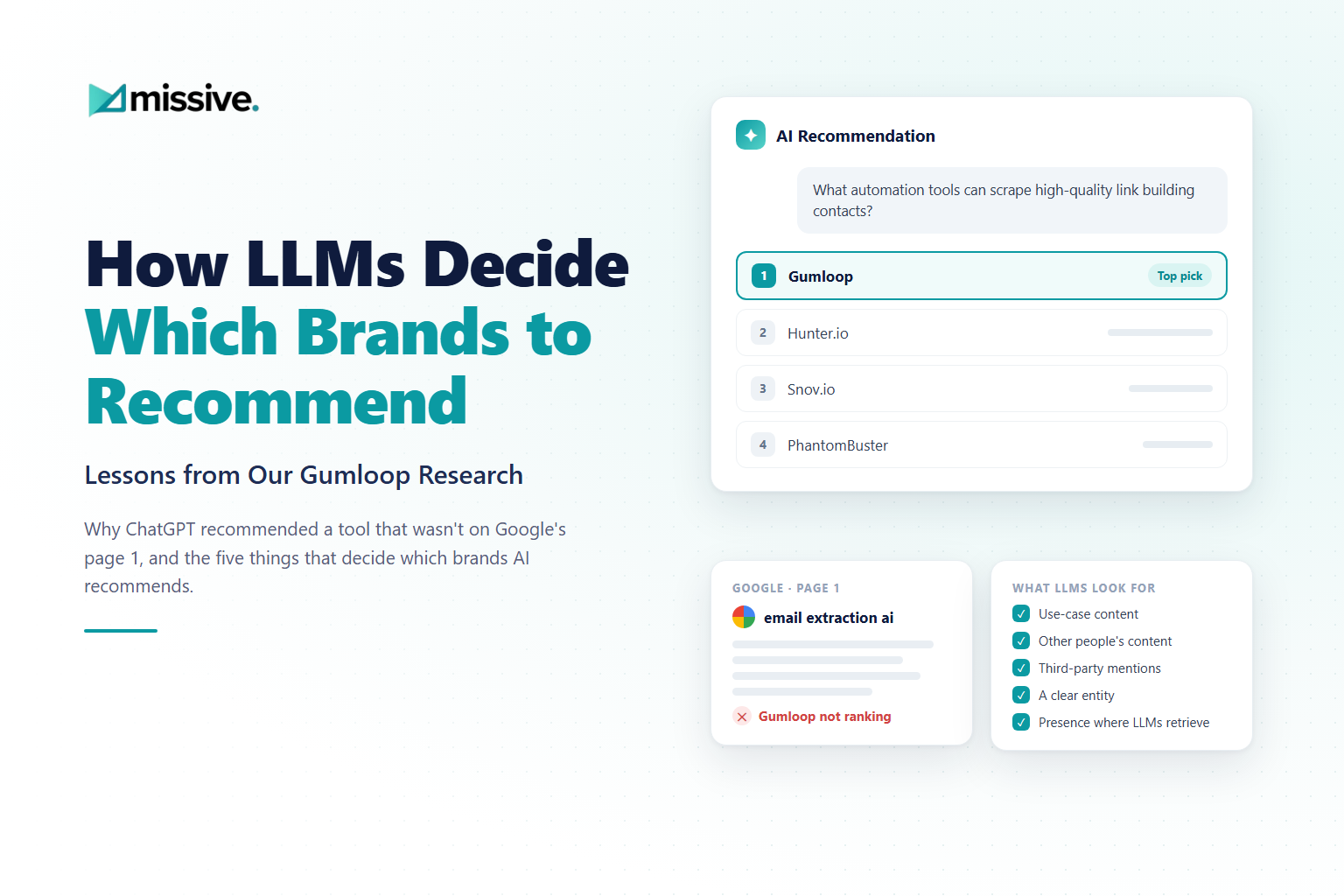
- In our test, ChatGPT put Gumloop first for two link building tasks. Gumloop was not on page 1 of Google for either.
- What Gumloop did have was its own use-case content and other people’s tutorials about those use cases.
- Five things decide which brands LLMs recommend: use-case content, other people’s content about you, third-party mentions, a clear entity, and presence where LLMs retrieve.
- You can run the same test for your own brand in about an hour.
Why Would ChatGPT Recommend a Brand That Doesn't Rank on Google?
That’s the question my team and I were left with after a small experiment.
It’s also the question we now hear most from clients. At Missive Digital, AEO and GEO are a part of the SEO we do, not a separate service, and the demand for them has grown sharply over the last year. Almost every brand we speak to asks the same thing: how do we get ChatGPT and Google’s AI to recommend us?
You can’t answer that without first knowing how LLMs decide whom to recommend. So this is something we had to understand for our own work, not just out of curiosity.
I’ve been doing SEO and content for over 15 years, and for most of that time the rule was simple: rank on page 1, and you get found. So when we started testing prompts on ChatGPT for our own link building work at Missive Digital, I expected to see the usual names on top.
I didn’t. One tool, Gumloop, showed up first for two different tasks. And when we searched Google for those same tasks, Gumloop wasn’t on page 1 at all.
I shared this research in my webinar on SEO in the Age of AI in January 2026, and it got more follow-up questions than any other section.
So in this blog, I’m breaking it down: what we asked, what we found, the five things that decide which brands LLMs recommend, and how you can run the same test for your brand.
One honest note before we start. This was a small test, not a large study. But every pattern we saw has since shown up in research covering thousands of brands, and I’ve linked that research wherever it applies.
How Do LLMs Fetch the Data Behind a Recommendation?
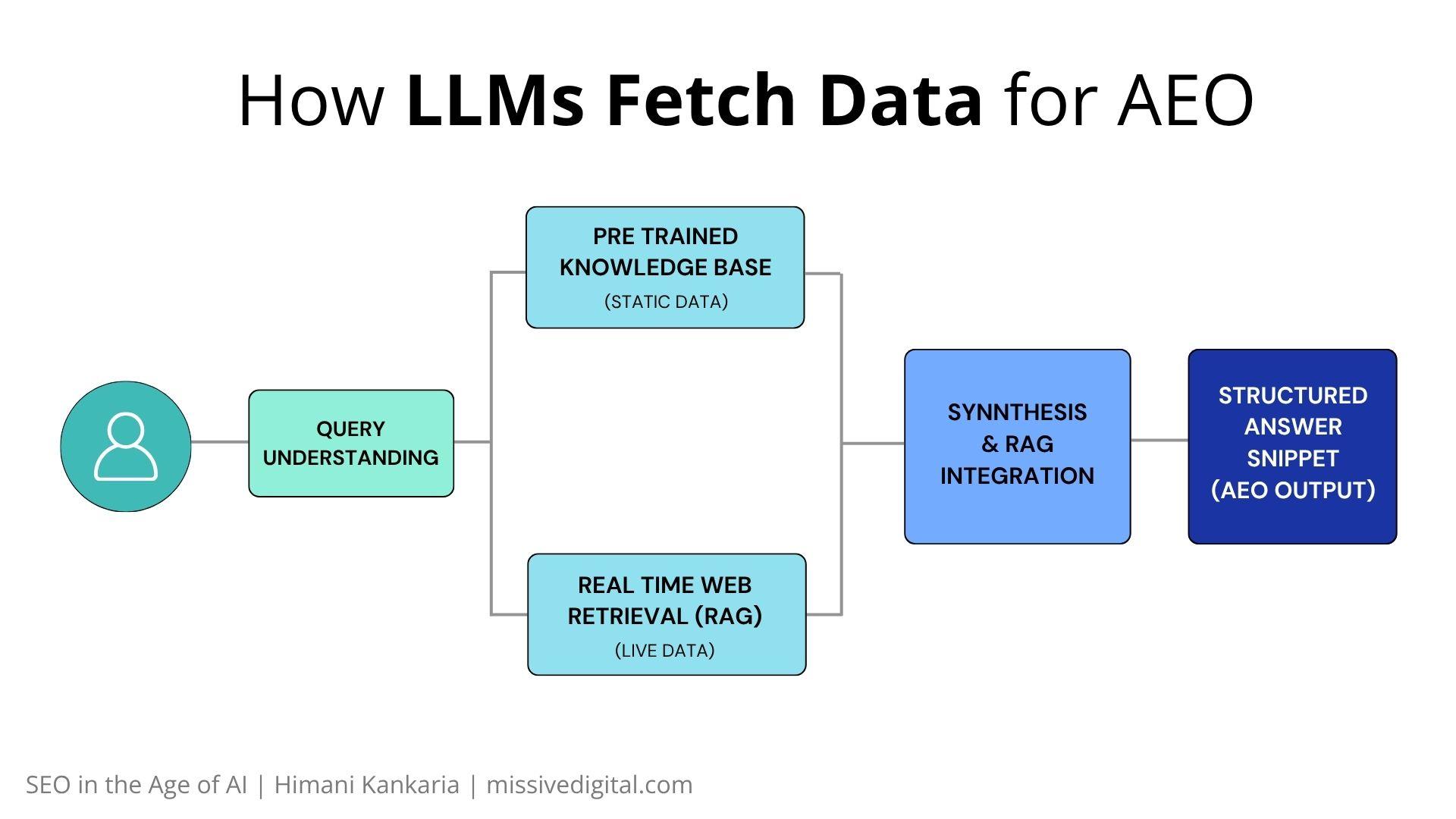
LLMs build a recommendation from two sources: what they learned during training, and what they retrieve from the web at the moment you ask.
| Source | What it is | What gets a brand in |
|---|---|---|
| Pre-trained knowledge | Static data the model learned from the web up to its training cut-off | Being described often, and consistently, across many websites |
| Real-time web retrieval (RAG) | Live searches the model runs while answering | Having specific, crawlable pages that match what the model searches for |
The model then combines both into one answer. So a brand can be recommended because the model already “knows” it, because it found the brand just now, or both.
And the model doesn’t search your exact prompt. It breaks the prompt into smaller searches, called query fan-out. A 2025 analysis found that ChatGPT runs a web search for about 31% of prompts, with a little over two searches each time.
Keep these two sources in mind. They explain almost everything we found next.
Our Gumloop Research: What We Asked, and What We Found
We asked ChatGPT to recommend automation tools for four link building tasks, then compared its answers with Google’s page 1 for the same tasks. Here’s the experiment in four parts.
1. What We Asked ChatGPT
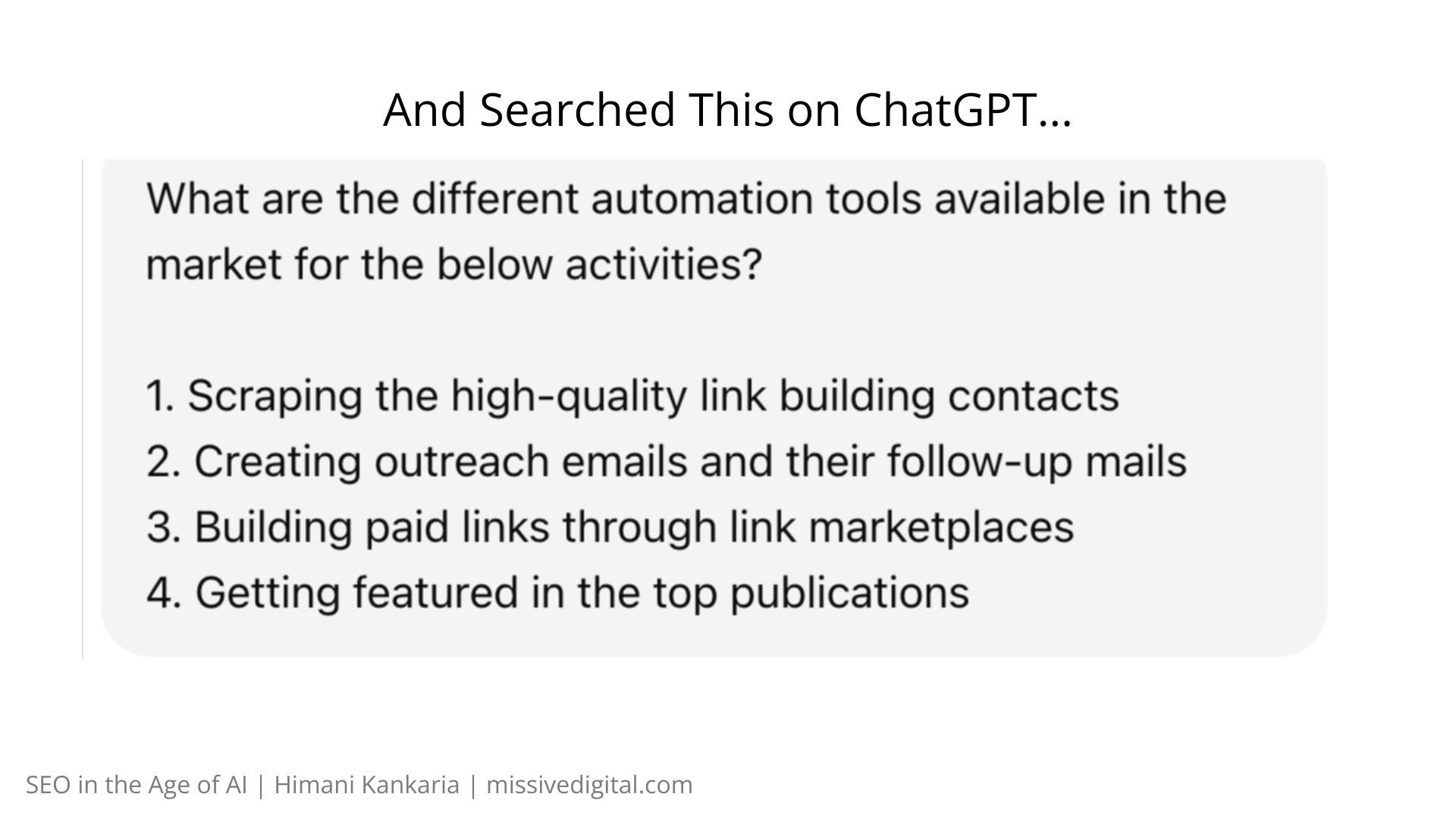
We were looking for tools to automate parts of our own link building process, so the prompt was a real one:
“What are the different automation tools available in the market for the below activities? 1. Scraping the high-quality link building contacts 2. Creating outreach emails and their follow-up mails 3. Building paid links through link marketplaces 4. Getting featured in the top publications”
2. What ChatGPT Recommended
ChatGPT gave five tools for each task. Look at who came first for the first two.
| Task | First recommendation | Other tools listed |
|---|---|---|
| Scraping link building contacts | Gumloop, described as AI-powered web scraping for extracting emails and URLs | Hunter.io, Snov.io, PhantomBuster, Scrapy |
| Creating outreach emails and follow-ups | Gumloop AI, described as AI-generated custom outreach and follow-ups | Lemlist, Mailshake, Reply.io, GMass |
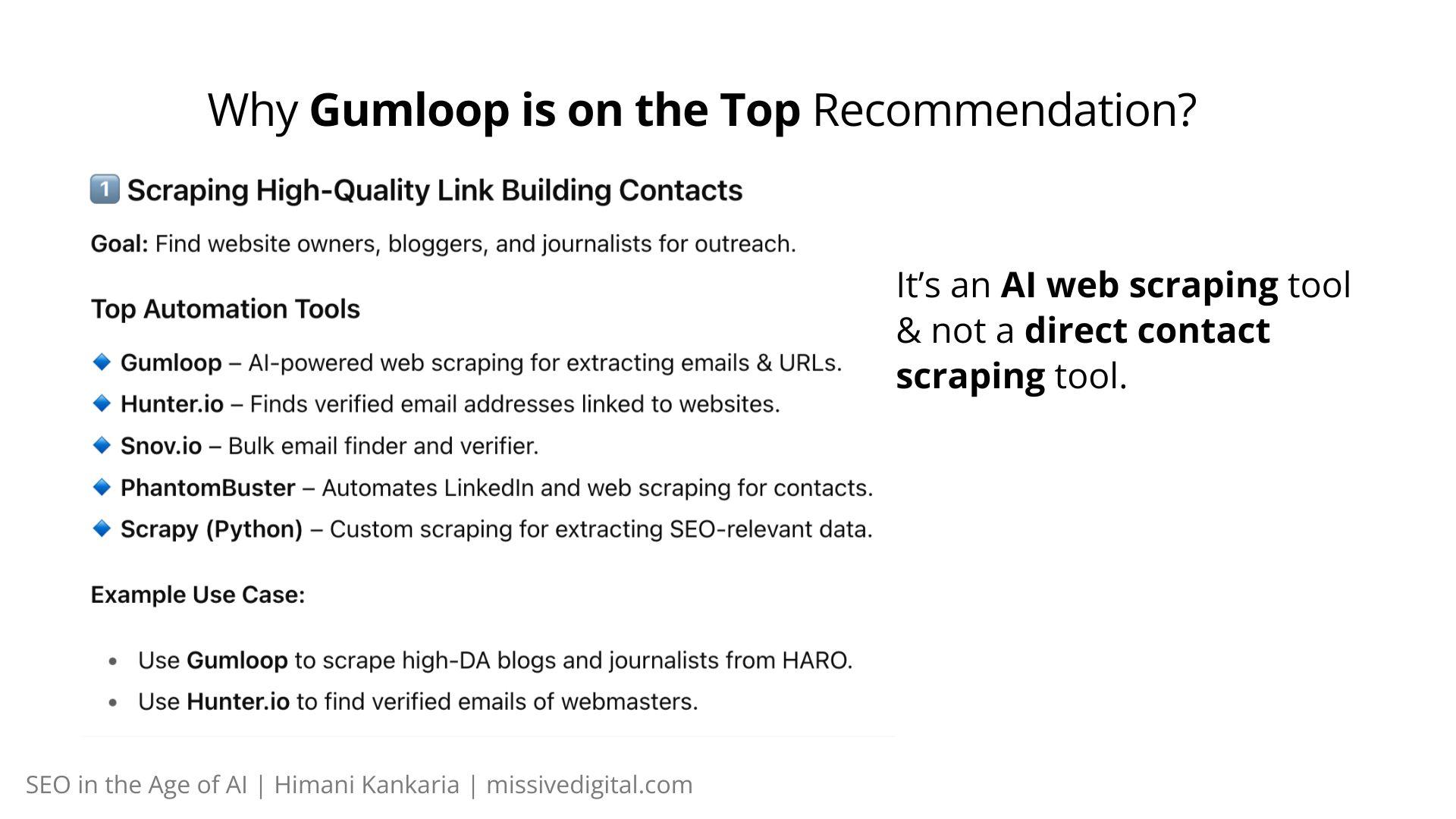
This surprised us for a reason. Gumloop is an AI automation platform. It is not a contact-finding tool like Hunter.io, and it is not a cold email tool like Lemlist. Yet ChatGPT placed it above tools that were built for exactly those jobs.
3. What Google Showed for the Same Tasks
Next, we searched Google for the keywords behind those two tasks.
| Google search | Who ranked on page 1 | Was Gumloop there? |
|---|---|---|
| email extraction ai | Extracta.ai, a Chrome Web Store extension, Parabola, Parsio | No |
| automated cold email outreach | Lemlist, Smartlead, Saleshandy | No |
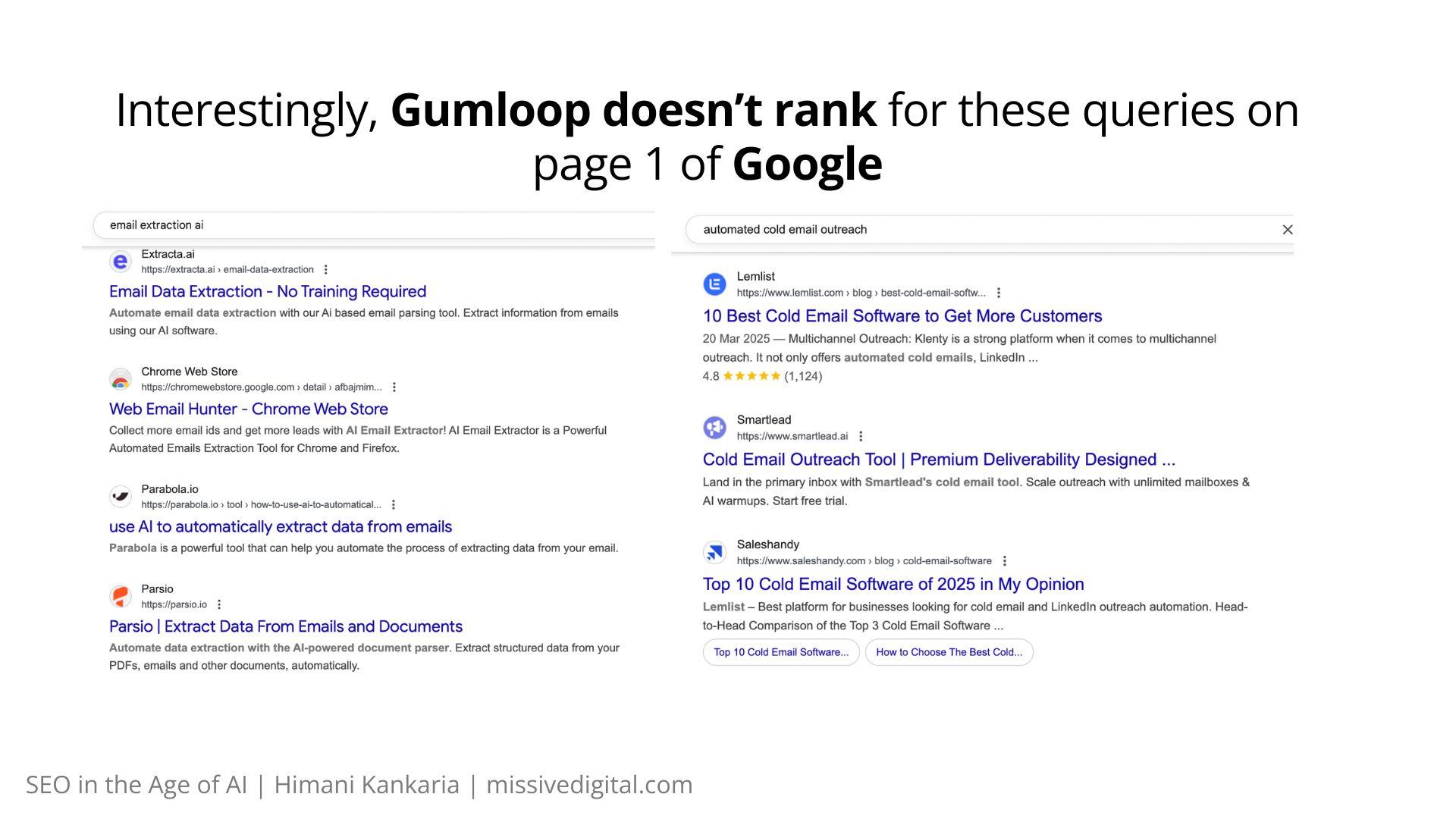
So the brand ChatGPT recommended first was not visible on page 1 of Google for either task. By traditional SEO logic, it shouldn’t have been in the conversation.
4. What We Found When We Searched the Brand With the Use Case
Then we searched “gumloop email extraction,” and the picture changed completely.
- Gumloop’s own documentation had a page for its “Extract Data” feature, explaining how to pull structured information from unstructured text.
- Gumloop’s template library had a ready-made workflow called “Email PDF Attachment Extractor.”
- Other people’s YouTube videos covered the same use cases: one creator on automating cold email workflows with Gumloop, another on extracting data with it, and a third on automating a YouTube channel.
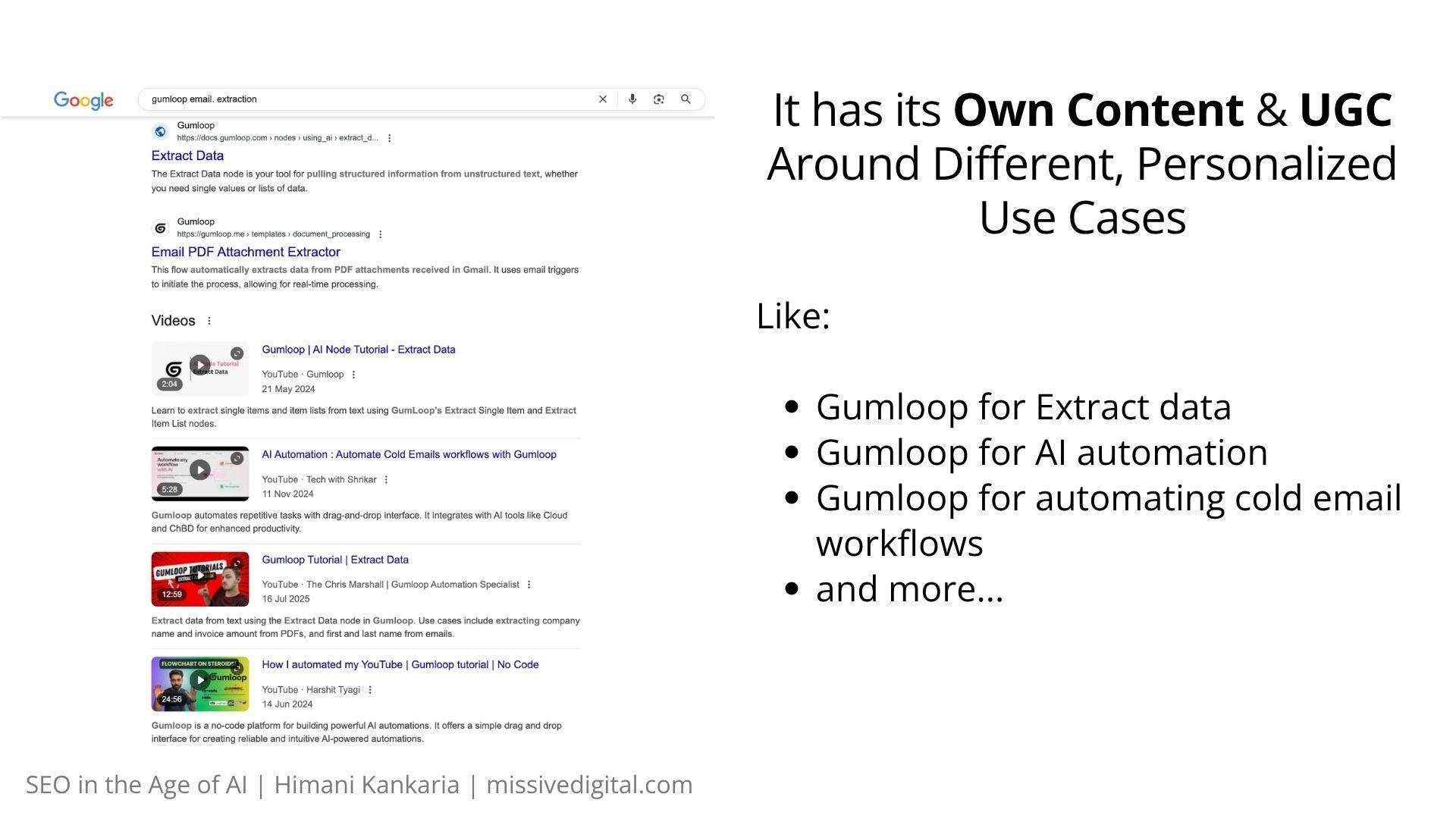
Gumloop had its own content AND user-generated content around specific, personalized use cases: Gumloop for extracting data, Gumloop for AI automation, Gumloop for cold email workflows.
It didn’t rank for the category keyword. It was simply the brand most clearly connected to the task.
5 Things That Decide Which Brands LLMs Recommend
From our research and the larger studies published since, five things decide which brands LLMs recommend: use-case content on your own website, other people’s content about you, third-party mentions in your niche, a clear entity, and presence in the places LLMs retrieve from.
| # | Factor | What Gumloop had | What it feeds |
|---|---|---|---|
| 1 | Use-case content on your own website | Documentation and templates for each task | Real-time retrieval |
| 2 | Other people's content about you | YouTube tutorials by independent creators | Both |
| 3 | Third-party mentions in your niche | Not checked in our test; shown by the larger studies | Pre-trained knowledge |
| 4 | A clear entity | A clear description of what it does for each task | Both |
| 5 | Presence where LLMs retrieve | Indexed pages and videos for the use cases we checked | Real-time retrieval |
1. Use-Case Content on Your Own Website
Use-case content is a page that shows how your product or service solves one specific task for one kind of user.
Gumloop didn’t have a page targeting “email extraction AI.” It had a documentation page for extracting data and a template for extracting data from email attachments. When ChatGPT looked for a tool that could do the task, those pages matched the task itself.
This is the same reason I keep saying: stop writing very-ToFu content, and create more use-case-based, hyper-personalized content. LLM prompts are long and specific, so a specific page wins over a generic one.
How to act on it:
- List every task your product or service handles, for each ICP
- Create one page per task: a use-case page, a template, a how-to, or a documentation page
- Name the task in the title the way your customer would say it
How we do it at Missive Digital: we have weekly sync-ups with our clients’ product teams to understand the product, and with their sales teams to understand the leads coming in. Most of our use-case topics come out of those calls, not out of a keyword tool.
2. Other People's Content About You
This is user-generated content: tutorials, reviews, walkthroughs, and discussions that other people create about your brand.
For Gumloop, it was YouTube. Independent creators had published tutorials on the exact use cases ChatGPT recommended it for. That’s not Gumloop saying it can automate cold emails. That’s other people showing it.
The larger studies agree on where this content matters most:
- Peec AI analysed 30 million cited sources in March 2026. Reddit and YouTube were the two most-cited domains, and the only two in the top five of all five AI platforms studied.
- Ahrefs’ follow-up to its 75,000-brand study found that YouTube mentions had the strongest correlation with AI brand visibility of any factor it measured.
How to act on it:
- Work with creators and customers to publish tutorials on your real use cases
- Take part in the Reddit and community threads where your category is discussed, with useful answers and not pitches
- Bring your social media team into SEO planning, so video and social content cover the same use cases as your pages
3. Third-Party Mentions in Your Niche
A third-party mention is any time another website names your brand, with or without a link.
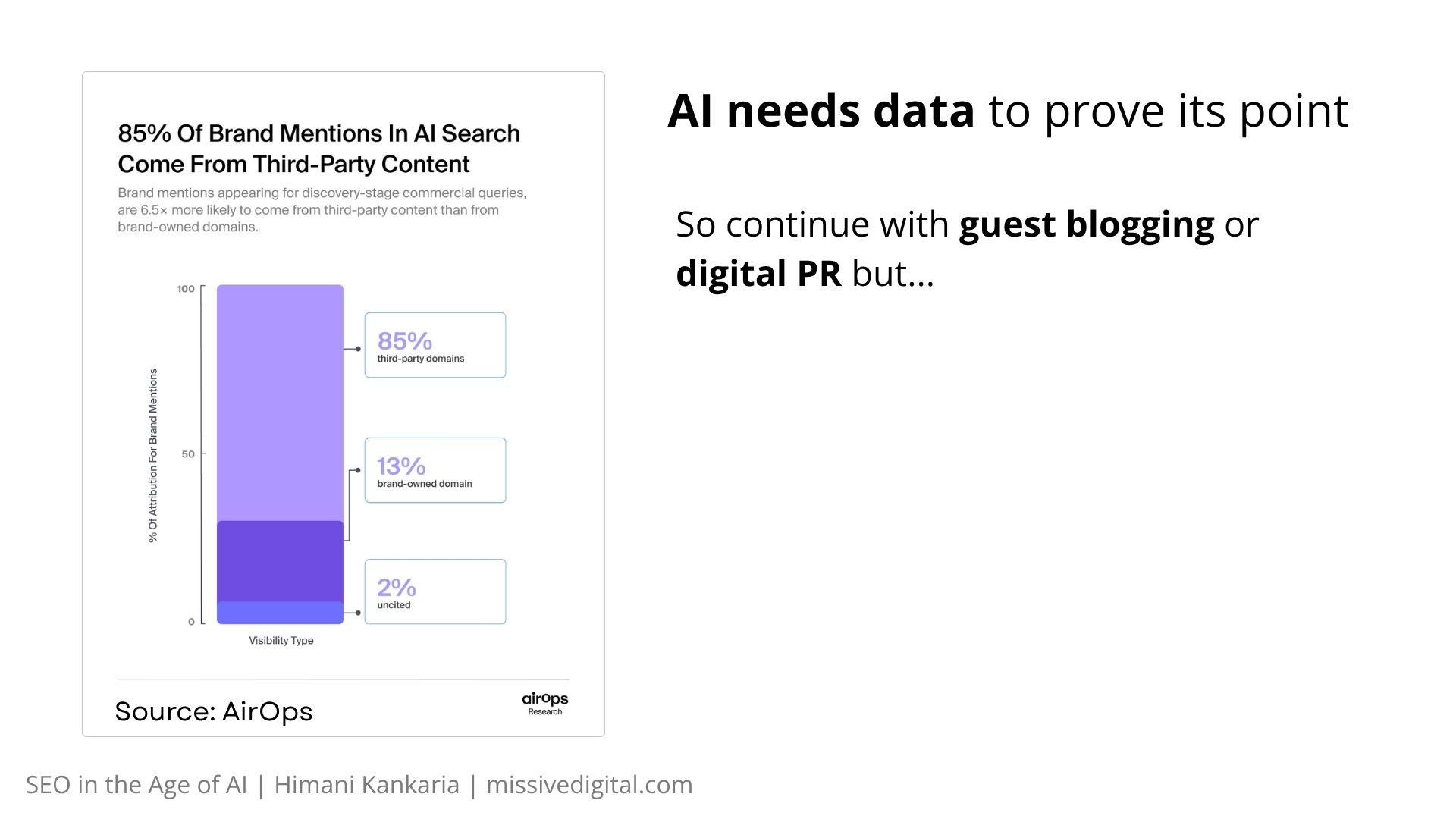
AI needs data to prove its point, and it prefers that data from someone other than you. AirOps found that 85% of brand mentions in AI search come from third-party content, and only 13% from the brand’s own domain.
Ahrefs studied 75,000 brands and found the same thing from another angle. Brand web mentions had the strongest correlation with visibility in AI Overviews, at 0.664. Backlinks were far behind at 0.218.
And the websites don’t need to be famous. When I checked the sources an AI tool cited for a programmatic SEO question, they had domain ratings of 46, 47, and 65. They were relevant to the topic, and that was enough.
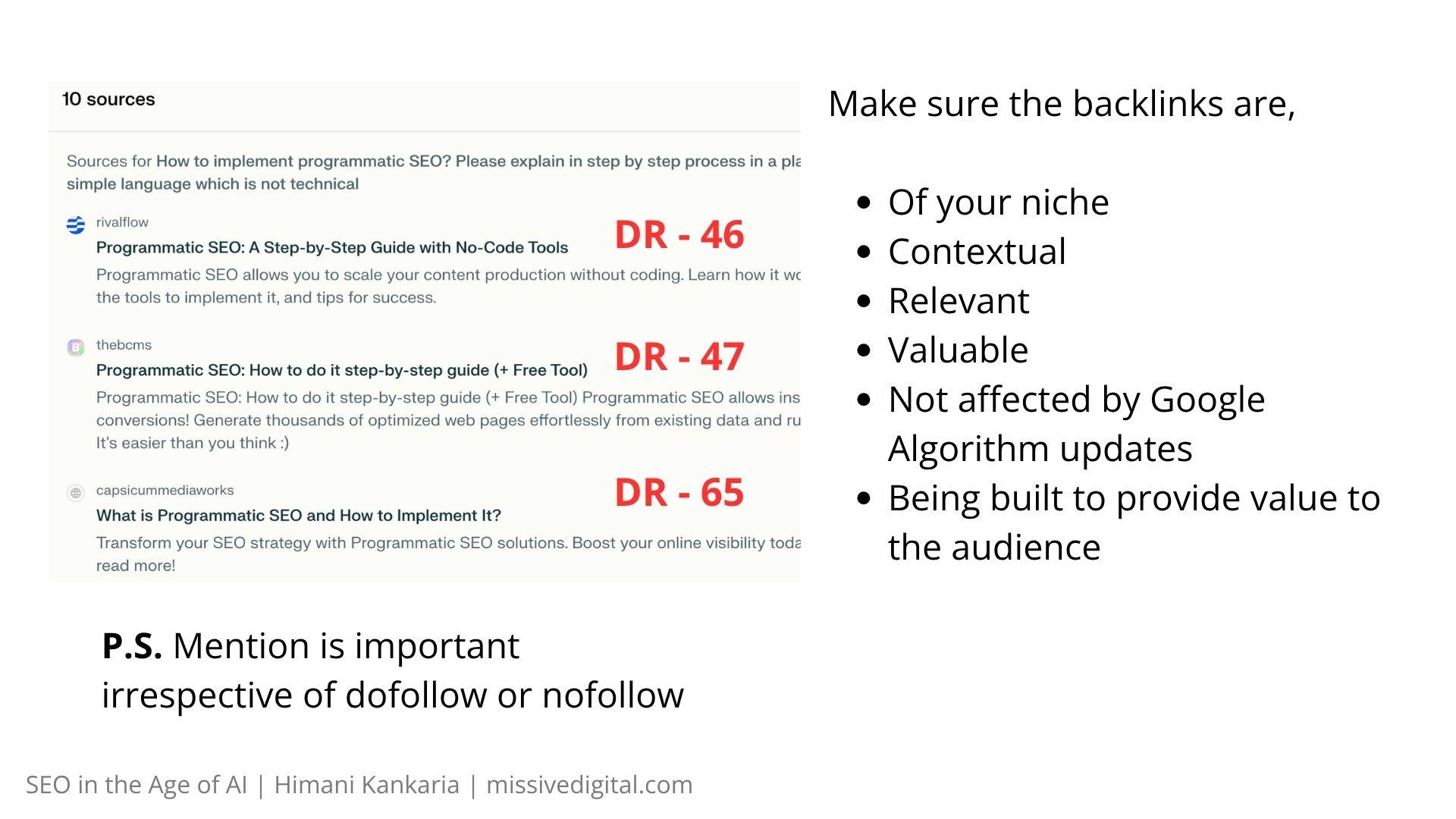
How to act on it: continue guest blogging and digital PR, but make sure every mention is:
- From your niche, and contextual to the topic
- Relevant and valuable to that website’s audience
- On a website not hit by Google’s algorithm updates
And remember, the mention matters whether the link is dofollow or nofollow. Yet in Andy Crestodina’s October 2026 survey of 1,000 marketers, only 26% said they are working on third-party mentions.
4. A Clear Entity: What You Are and Who You're For
An entity, in simple words, is how clearly an AI tool can say what your brand is, what it does, and for whom.
Look at how ChatGPT described Gumloop in our test. For the first task: AI-powered web scraping for extracting emails and URLs. For the second: AI-generated custom outreach and follow-ups. One clean line each, with no confusion about what the tool does.
That clarity is not an accident. If your homepage says one thing, your LinkedIn page says another, and review sites say a third, the model has nothing consistent to repeat. In our Citation Architecture Framework, we call this the Entity layer: AI may know you exist, but not what you own.
How to act on it:
- Write one sentence that says who you are, what you do, and for whom
- Use it consistently on your website, social profiles, directories, and author bios
- Connect your brand to the specific topics you want to own, on every relevant page
5. Presence in the Places LLMs Retrieve From
LLMs can only recommend what they can find. That means your pages, videos, profiles, and listings need to be crawlable and present in the sources these tools search.
Does this mean Google rankings no longer matter? No. But they are no longer the only door.
| Study | What it found |
|---|---|
| Ahrefs, July 2025 and its March 2026 update | The share of AI Overview citations coming from Google's top 10 fell from 76% to 38% in eight months |
| Rankability, June 2026 | About a third of AI citations go to pages that don't rank in Google at all. Among pages that do rank, a higher position still means more citations |
So ranking still helps, and the fundamentals of SEO haven’t changed. But a page can now be cited without ranking for the head keyword, which is exactly what we saw with Gumloop.
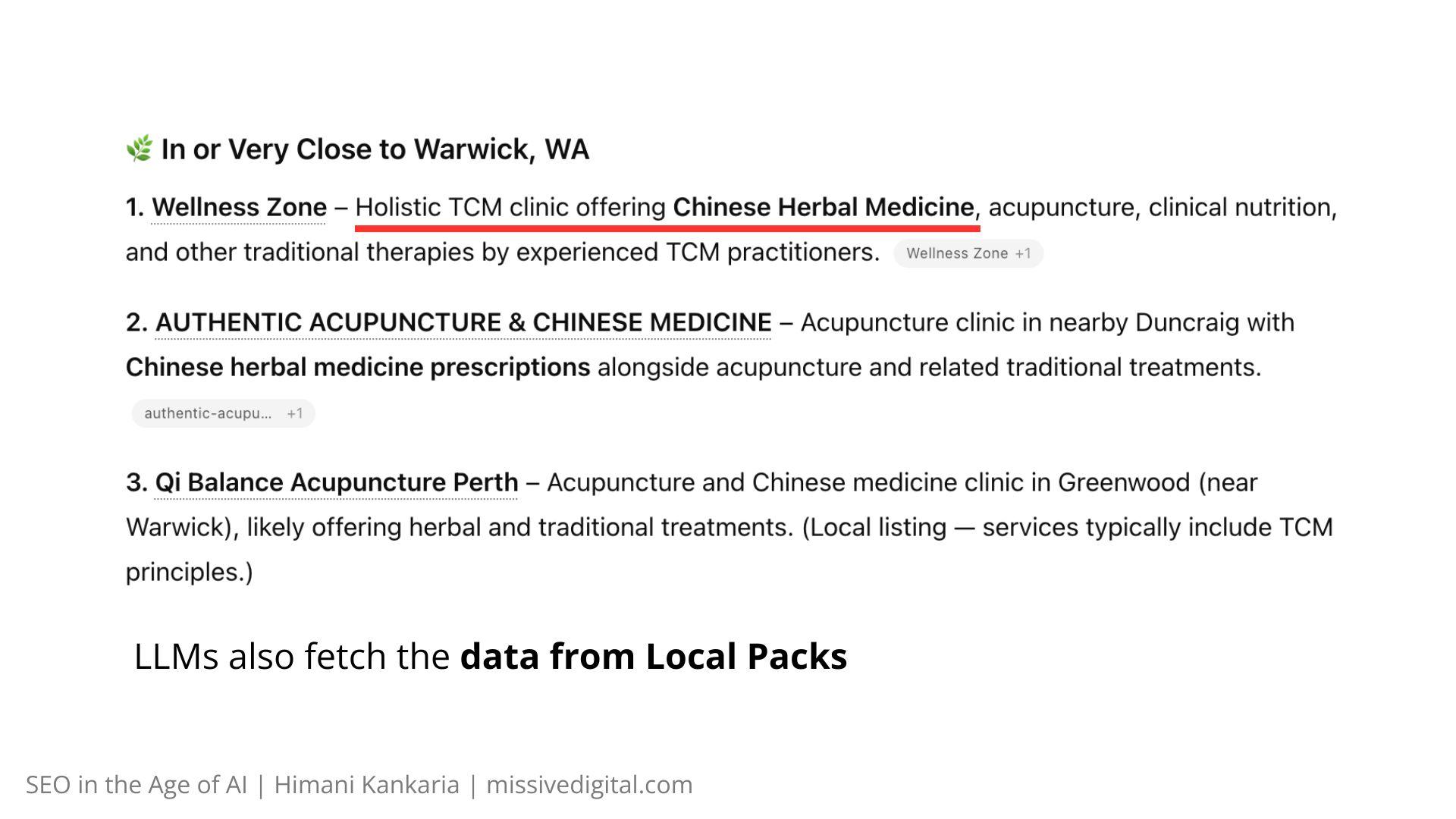
We saw the same thing in local search. For a wellness clinic in Perth, a Google Business Profile post about Chinese herbal medicine was enough for Google to match the clinic to that search, even without a dedicated page. And when we asked ChatGPT for Chinese herbal medicine near Warwick, the clinic came first.
How to act on it:
- Keep crawlability, indexability, structured data, and site speed in order. These are non-negotiable
- Treat Google Business Profile as a content channel, and post about each service
- Be present on the platforms your audience uses: YouTube, LinkedIn, Reddit, and review sites
As John Mueller of Google puts it, good SEO is good GEO.
How to Run the Gumloop Test for Your Own Brand
You can repeat our research for your own category in five steps, with ChatGPT, Google, and one spreadsheet.
Step 1: Write Five Prompts Your Customers Would Ask
Pick five tasks your product or service solves, and write each as a prompt in your customer’s words. Use tasks, not category keywords. “Tools to scrape link building contacts” will teach you more than “best link building tools.”
Step 2: Run Each Prompt on ChatGPT, Perplexity, and Google's AI Mode
Note which brands are recommended, and in what words they’re described.
Run each prompt three to five times. SparkToro and Gumshoe’s January 2026 research found that the same prompt returns the same list of brands less than 1 time in 100. What stays consistent is which brands keep appearing. So count how often a brand shows up, not where it sits in one answer.
Step 3: Search Google for the Same Tasks
Note who ranks on page 1. Then mark the brands that the AI tools recommended but Google didn’t rank. Those are your “Gumloops,” and they have the most to teach you.
Step 4: Search Each Recommended Brand With the Use Case
Search “[brand] + [task]” on Google and YouTube. Look for the three things we found: the brand’s own use-case pages, other people’s tutorials and reviews, and mentions on third-party websites.
Step 5: List Your Gaps Against the Five Factors
Put it all in one sheet, and compare your brand with the brands that got recommended.
| Prompt | Brands recommended | On Google page 1? | What backs them | Our gap |
|---|---|---|---|---|
| Tools to scrape link building contacts | Gumloop, Hunter.io, Snov.io | Gumloop: No | Docs page, template, YouTube tutorials | [Your gap] |
| [Your prompt 2] | ||||
| [Your prompt 3] |
The “Our gap” column becomes your content and PR plan. If the recommended brands have use-case pages and you don’t, start with factor 1. If they have tutorials and mentions and you don’t, start with factors 2 and 3.
Make It Easy for LLMs to Recommend Your Brand
Gumloop didn’t get recommended by ranking for a big keyword. It got recommended because, for a specific task, it was the easiest brand for the AI to find, understand, and back up with proof.
That’s the lesson I’d like you to take from our research. LLMs don’t recommend the biggest brand. They recommend the clearest answer for the person asking.
This is the thinking behind the AEO and GEO work we do for our clients. For a VoIP client, it led to 3,600% growth in ChatGPT-driven traffic and 300% growth in sales-qualified leads.
To help you apply it, download the checklist we use to audit content for AI citations.
And if you’d like us to run this research for your brand and build the plan with you, explore our AI SEO services or book a free consultation.
Don’t just rank for keywords. Be the brand that’s easiest to recommend.
FAQs About How LLMs Recommend Brands
LLMs recommend brands they can clearly connect to the task in the prompt. They draw on their training data and on live web searches, and they favour brands with use-case content, coverage by other people, third-party mentions, and a consistent description of what they do.
Yes. In our research, ChatGPT recommended Gumloop first for two tasks where it wasn't on page 1 of Google. Rankability's June 2026 study found that about a third of AI citations go to pages that don't rank in Google at all.
Backlinks still matter, but brand mentions matter more. Ahrefs' study of 75,000 brands found that brand web mentions correlate with AI Overview visibility at 0.664, against 0.218 for backlinks.
Reddit and YouTube. Peec AI's March 2026 analysis of 30 million cited sources found they were the two most-cited domains, and the only two in the top five of every AI platform studied.
LLM answers vary by design. SparkToro and Gumshoe found the same prompt returns the same list of brands less than 1 time in 100. Track how often your brand appears across repeated prompts, not its position in one answer.