
The Short Answer
For telecom, VoIP, and UCaaS companies, there is no single best channel for telecom lead generation anymore. Search gets you discovered. AI gets you shortlisted. Partners and events build trust. LinkedIn keeps you visible. Email keeps you remembered. The strongest telecom brands don’t pick one. They stack them.
Every telecom founder I speak to asks me some version of the same question: “Which channel should we double down on?” And almost every time, they’re expecting me to say SEO. Because that’s what we’re known for.
In 15+ years of running Missive Digital, we’ve optimized 17,836+ content pieces, resolved 9,854+ technical SEO issues, and trained 21+ marketing teams across B2B and telecom brands such as Ecosmob, Convergenze Italy, HoduSoft, Tragofone, and more
It would be very convenient for me to say “do SEO.” But that’s not what our telecom marketing data says. B2B telecom lead generation is different from generic SaaS lead generation. How exactly?
Here’s what I’ve actually observed across telecom engagements. If VoIP lead generation or UCaaS marketing is your day job, this is written for you.
The Telecom Buyers Risk It All
By tech telecom, I mean UCaaS platforms, VoIP and SIP trunking providers, CPaaS companies, telecom software and billing vendors, and MSPs that resell them.
And these buyers don’t research the way a generic B2B funnel suggests. The sales cycle is longer. The risk is higher. Moreover, think about what switching can involve. Number porting. Infrastructure changes. Integrations. Customer disruption. Compliance. Internal approvals. Procurement. Training. Migration risk.
No business wants to go through so much trouble and end up looking for another option six months down the line.
First, The Shift Nobody's Pricing Into Telecom Lead Generation
No single channel or strategy is king in telecom lead generation anymore. Telecom buyers haven’t fundamentally changed how they buy. But how they search, validate, compare, and decide has.
What has changed: Gartner’s 2026 research found that 45% of surveyed B2B buyers used GenAI during a recent purchase. At the same time, 69% said they prefer to validate AI-generated insights with sales reps.
The result is a buyer journey that looks less like a funnel and more like a network. AI is one stop on the journey, not the whole journey. A buyer might search, ask AI, check LinkedIn, hear from a partner, meet you at an event, disappear for months, and come back through email.
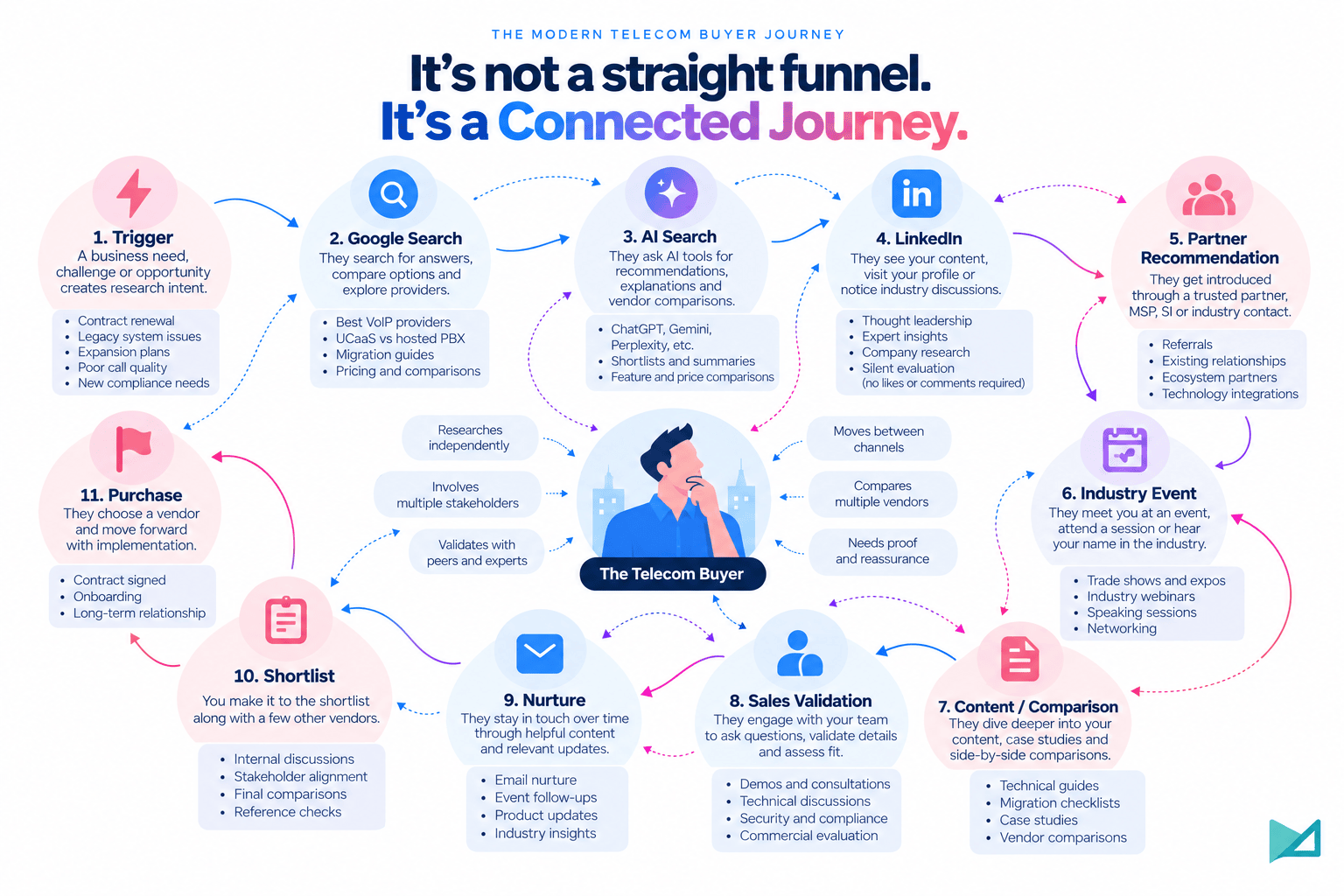
Don’t be scared by the complex situation, because every channel below is another chance to be discovered, trusted, or remembered. Let’s explore channel by channel.
1. Partnerships & Channel Demand Gen: The Most Traditional Channel, and Still The Strongest
What I’ve observed: Your next customer might already work with an MSP, an integrator, a hardware vendor, or a billing platform, and trusts that partner’s advice more than your website. It doesn’t have to mean white-label.
A partnership can be a referral arrangement, a co-delivery model, or a joint go-to-market for one region or vertical.
What the data says: This isn’t nostalgia; it’s where the market has moved. In Forrester’s 2026 partner ecosystem survey, more than half of partner-marketing leaders said 41% or more of their revenue comes through indirect routes and partners.
Why most telecom companies underperform: They treat partnerships as relationship management instead of a demand channel. No deal registration, no co-marketing calendar, no attribution.
What to Do Differently
- Map the 10 companies already sitting inside your ideal customer’s ecosystem: SIs, MSPs, hardware vendors, billing platforms.
- Target 20–30 genuinely active partners, not 100+ dormant registrations.
- Build co-branded integration landing pages (e.g., “Your CPaaS + Salesforce Integration”). These capture high-intent technical searches from buyers actively looking for ready-to-deploy stacks.
- Run co-authored benchmark reports and joint webinars. Both lists get promoted, cost is shared, and the credibility transfers.
Case Study: Partnerships work best when they create more than a referral.
X2Com, a telecom and cloud communications provider with a strong partner network, chose Tragofone when it needed a scalable, customisable softphone for its customers. The collaboration turned a technology need into a longer-term partner relationship.
2. Google & AI Search: Momentum Is Real, The Cycle Is Slower
What I’ve observed: People still research and explore providers on Google, and increasingly ask AI tools directly for recommendations. The clean search → form fill → demo path has gotten messy. So, the journey didn’t stop working; it just got longer and more fragmented.
We’ve seen this shift firsthand.
See how we helped a telecom-VoIP brand grow organic visibility and generate stronger leads through SEO & AI citation.
What the data says: Buyers now consume around 13.4 pieces of content before contacting sales, with 67% of the journey self-directed (CMI 2026). Dreamdata’s 2026 benchmark puts the typical B2B journey at 88 touchpoints across 4 channels, up from 76 across 3.7 the year before.
The real risk: Google can still put you on page one. AI can now decide whether you make the answer at all. If a buyer asks an AI assistant “who are the best telecom service providers” and your company isn’t part of that answer set, you’re invisible at a critical point in the shortlist.
What to Do Differently
- Optimize for visibility & citation, not just ranking. Structured comparisons, clear entity definitions, original data, and specific answers to specific buyer questions.
- Build for the middle of the journey. Comparisons, pricing logic, integration guides, migration paths, use cases, and implementation content are often what buyers consume before they ever talk to sales.
- Keep pages fresh and dated. A visible “last updated” line matters.
- Stop judging search on last-click conversions alone. Track assisted conversions, branded search, returning visitors, target-account engagement, and where your brand appears across AI answers.
- Make your expertise easy to verify. AI may surface the answer, but buyers still look for evidence that you know what you’re doing.
How to get your telecom brand cited by AI (ChatGPT, Perplexity, Google AI Mode)
AI doesn’t cite the highest ranker. It cites the source it can quote, verify, and trust. To get AI’s attention, publish original data, clear definitions, useful comparisons, expert commentary, technical explanations, and decision-stage content.
Build authority beyond your own website through credible third-party mentions and keep important pages fresh and easy to crawl.
Want to understand how this works in practice?
Read our telecom AI SEO guide or put your pages through our five-layered Citation Architecture Framework (CAF) test.
3. Expos: The Channel Everyone Under-Credits
What I’ve observed: This one makes most performance marketers uncomfortable. In telecom, consistent visibility builds trust, and that’s how business actually happens here. Notice the word consistent.
One booth at one event does nothing. The companies winning here show up at the same events year after year, meet the same faces, and slowly stop being “that vendor” and become “our guy for this.”
What the data says: Events and trade shows are the most expensive B2B channel by cost per lead. Roughly $874 per lead, versus $33 for SEO and $57 for email (Searchlab, 2026 B2B benchmarks).
So why do I still recommend it? Don’t measure an expo like a paid search campaign, as CPL is the wrong metric for a trust channel. A booth can produce 200 leads and zero meaningful revenue. It can also produce 20 conversations that eventually influence several large deals.
That’s why pipeline touched or pipeline influenced is a more useful measurement than booth leads.
What to Do Differently
- Pick 2–3 events and commit for 3 years. Rotating events every year destroys the only thing that makes this channel work.
- Choose events where your actual buyers and ecosystem partners gather, not simply events with impressive attendance numbers.
- Don’t measure booth leads. Measure pipeline influenced, partner conversations, account engagement, and opportunities created.
- Publish content around the event, not just at it. Pre-event POV posts, on-site takes, post-event teardowns. That’s a thousand dollar booth becomes six months of visibility.
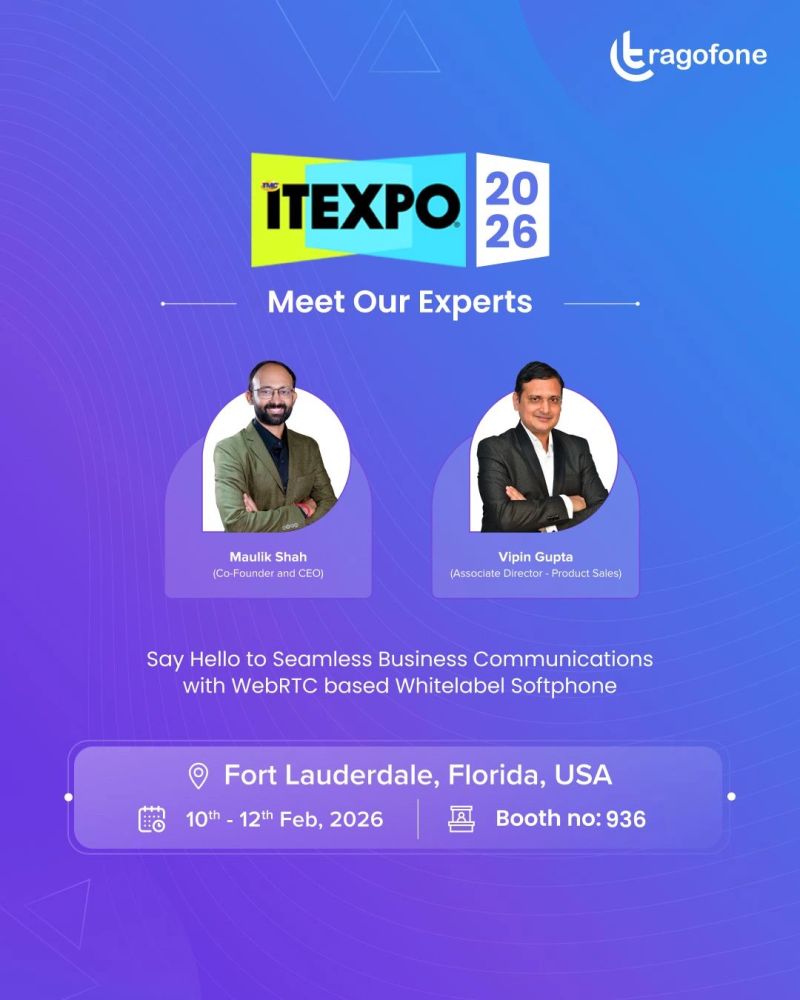
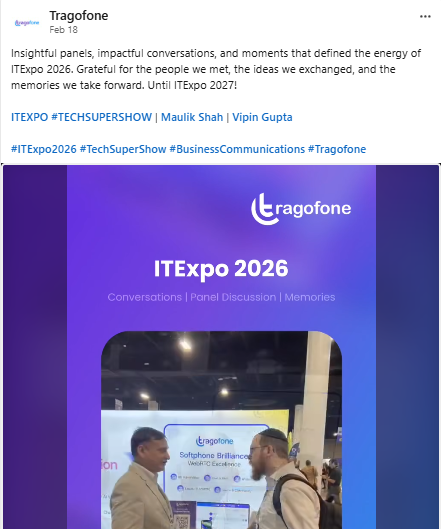
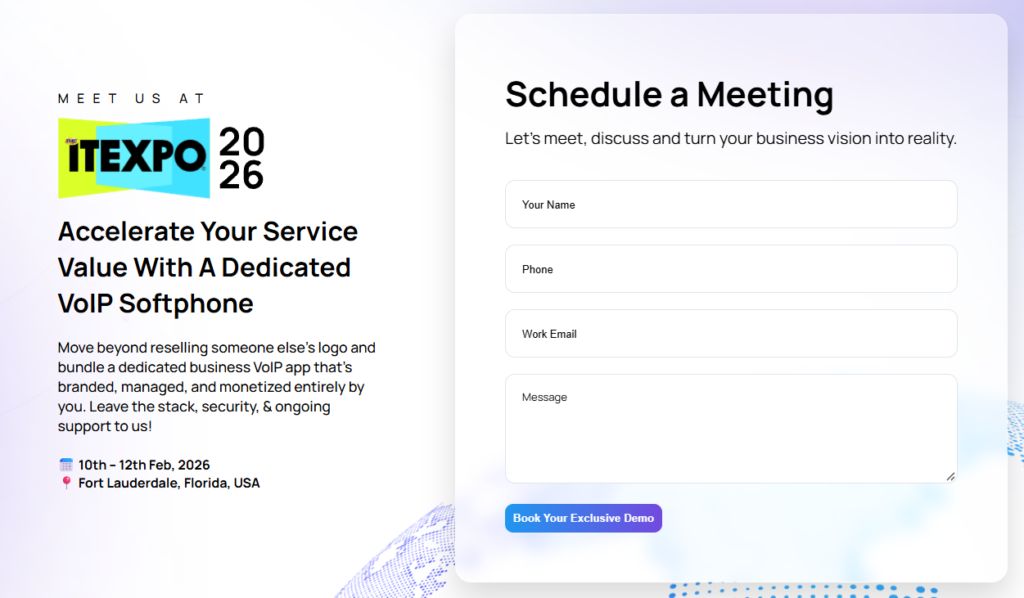
We’ve seen this play out with Tragofone at ITEXPO.
The event became more than a booth. Thanks to an event page, timely social media posts (before, during, after) real conversations, content, visibility, and continued brand presence across LinkedIn was achieved.
4. Social Selling & Dark Social: LinkedIn Presence Matters More Than LinkedIn Outreach
What I’ve observed: I would separate social presence from social outreach. LinkedIn outreach can work. But I wouldn’t build a telecom lead generation strategy around sending more connection requests and DMs.
The bigger opportunity is social selling: building enough visibility and credibility that when someone hears your company name, they can find evidence that you’re worth trusting.
The buyer checks more than your website. They might look at your LinkedIn company page, connections, founder’s profile, company mentions, and more, before going back to your website.
None of those actions may show up as a lead. But they can influence the lead. Mostly through dark social: the DMs, group chats, and forwarded links analytics can’t see.
What the data says: 61% of B2B buyers prefer to research independently before speaking to sales, and 73% actively avoid suppliers that send irrelevant outreach (Gartner). You are not fighting an algorithm. You are fighting a stated preference.
What to Do Differently
- Treat your LinkedIn presence as part of your brand infrastructure, not just a social media channel.
- Your company page and leadership profiles should make it immediately clear who you are, what you know, who you serve, and why you’re credible.
- Make your experts visible. In telecom, a founder, technical leader, or subject-matter expert will build more trust than another branded product post.
- Publish the things buyers actually want to validate: industry POVs, customer problems, technical insights, lessons from implementations, event observations, product thinking, and opinions that demonstrate expertise.
- Make sure your website, LinkedIn presence, leadership profiles, and third-party mentions tell the same story.
- Don’t judge by likes and comments alone. Look for profile visits, branded search, target-account engagement, etc.
5. Email: Stop Calling It Outreach, Start Calling It Nurture
What I’ve observed: Telecom buying cycles are rarely short. A prospect may download something today, attend an event six months later, compare vendors a year from now, and only then become sales-ready.
So email’s job isn’t an instant reply. It’s lead nurturing: staying useful until the buying window opens. Your list is full of people who raised a hand once already.
What the data says: Email costs about $53 to $58 per lead, second only to SEO (Martal, Searchlab). And Forrester found 86% of B2B purchases stall mid-process. Stalled deals don’t disappear. They go quiet and come back if someone stayed in touch.
What to Do Differently
- Give every email one job: explain a technology shift, compare options, solve a specific problem, help evaluate vendors, or help build the internal business case.
- Start each contact where they entered. An expo meeting, a webinar, a download, and an inquiry that went silent each deserve a different first email.
- Time it to the contract. If your buyers sign two or three year terms, record the renewal date and start nurturing six to nine months before it.
- Treat silence as “not yet,” not “no.” A quiet prospect is rarely a dead one.
Your list is everyone who downloaded something, attended a webinar, met you at an expo, or inquired two years ago and went silent. The goal isn’t a reply this week. It’s being the first name they think of twelve months from now.
If I Had To Prioritize
| Priority | Channel | Job it does | Realistic CPL | Time to impact |
|---|---|---|---|---|
| 1 | Partnerships | Qualified pipeline via borrowed trust | ~$89 | 3–6 months |
| 2 | Google + AI visibility | Get into the shortlist you can't see | ~$33 | 6–12 months |
| 3 | Expos | Build trust at speed | ~$874 | 2–3 event cycles |
| 4 | Email nurture | Compound everything above | ~$57 | 3–9 months |
| 5 | LinkedIn presence | Credibility during silent research | Low | Continuous |
The uncomfortable truth is that the two channels doing the heaviest lifting in telecom, partnerships, and expos are the two hardest to put in a dashboard. That’s not a reason to deprioritize them. It’s usually the reason your competitors already have.
Telecom Lead Generation is Becoming a Visibility Game
The old question was: which channel gives us the most leads?
The better question now is: how often does our brand show up while the buyer is deciding?
Your job is to make sure you’re present across enough of the journey that choosing you feels less like a risk and more like the obvious decision. Remember, the channels aren’t competing. They’re stacking.
No channel closes the deal alone. Each one removes a different piece of uncertainty.
- Partnerships → Who trusts you?
- Search → Can I find you?
- AI → Are you considered?
- Events → Can I meet you?
- LinkedIn → Do you look credible?
- Email → Will I remember you?
Hopefully now you know what modern telecom lead generation should do: not just generate leads, but build preference before the lead ever reaches sales. Of course, you also have Missive by your side. Book a free consultation to build your telecom lead generation engine.
Frequently Asked Questions About Telecom Lead Generation
Telecom lead generation is the process of attracting and qualifying buyers for telecom products such as VoIP, UCaaS, CPaaS, SIP trunking, and telecom software and billing platforms. In practice, it means getting on the buyer's shortlist, including the one AI assistants now write, and then proving your track record to a committee of several decision-makers.
There isn't one universal best strategy. For most B2B telecom companies, the strongest programs combine:
- Partner and ecosystem marketing
- SEO and AI search visibility
- Industry events
- Expert-led LinkedIn content
- Account-based marketing
- Email nurture
- Customer proof and case studies
The right mix depends on your product, sales cycle, ICP, geography, and existing market reputation. Want help? Connect with us; we’ll help you design and implement your strategy.
There isn’t one “best” channel. Telecom buyers move across multiple touchpoints, so your channels need to stack up. Spread your influence across search, AI, partnerships, events, LinkedIn, content, and nurture so you’re present wherever buyers are making decisions.
Yes, but SEO's role is expanding beyond traditional Google rankings. Telecom buyers still use search engines to research technical questions, providers, integrations, pricing, migration, and comparisons. At the same time, AI is becoming part of the research process. So, telecom SEO increasingly needs to support both search visibility and AI visibility.
GEO, or Generative Engine Optimization, is the practice of improving a company's visibility in AI-generated answers. For a telecom company, this can mean increasing the likelihood that AI systems mention or cite the brand when buyers ask questions such as: What are the best VoIP providers? GEO doesn't replace SEO; it expands the visibility surface marketers need to consider.
Very. Telecom is an ecosystem-heavy industry. Customers often already work with MSPs, SIs, cloud providers, hardware vendors, consultants, resellers, and complementary technology providers. A strong partner can transfer trust that would otherwise take months or years to establish. The opportunity is to turn those relationships into structured demand generation through referrals, joint content, webinars, integrations, events, and co-marketing.
Yes, particularly for companies selling complex or high-trust telecom technology. Their value is not measured by the number of leads collected at the booth. It’s about partner relationships, enterprise conversations, customer meetings, brand visibility, market intelligence, content creation, pipeline influence, and sales acceleration.
Yes, but its value isn't always visible through likes and comments. For telecom companies, LinkedIn can act as a credibility and awareness layer. A buyer may see your content without engaging, then later visit your website, search your company, ask an AI assistant about you, or recognize your name during an RFP. That means LinkedIn should be measured through account engagement, assisted pipeline, inbound conversations, and brand visibility, not just engagement rate.
Don't build your content calendar entirely around product features. Build around the questions and triggers that create buying intent, such as provider comparisons, migration/integrations guides, technical explainers, regulatory changes, architecture comparisons, buyer checklists, etc. The best telecom content doesn't simply explain what your product does. It helps a buyer make a decision.
Both have a role, but they are not the same thing. Lead generation captures identifiable interest. Demand generation creates interest and preference before someone becomes a lead. For telecom companies with long buying cycles, demand generation can be particularly important because buyers may spend considerable time researching, comparing and validating providers before ever contacting sales. The strongest programs connect the two.