
5 Things You'll Take Away From This Article
- AI search doesn’t reward the highest ranker. It prioritizes those who are trustworthy and easiest extract.
- The solution isn’t complicated, but it requires a strategic shift in Telecom SEO. Remember, rankings get you seen, structured authority gets you chosen.
- Telecom is more exposed to zero-click disruption because the exact queries that drove your traffic are the ones AI was built to answer.
- Citation Debt: The gap between your market position and your AI answer presence is the most underdiagnosed metric in telecom SEO right now.
- The brands winning in AI search didn’t build a new strategy. They built the old one properly: technical health, genuine depth, real expert credibility. AI just made those things matter more.
You’re still ranking #1 for SIP trunking providers. But traffic is tumbling, and leads are dwindling. Why? Readers are now getting answers without clicks from AI Overviews on Google & answer engines like ChatGPT, Perplexity, Claude, or Gemini, so your telecom page has lost its visibility.
That’s the new normal for telecom SEO in 2026. AI search doesn’t just change how your content ranks. It changes whether users ever see your brand at all. AI now intercepts millions of telecom queries every day: “best unlimited plan,” “VoIP vs landline for business,” “how to choose a mobile plan.” The user gets an answer. They don’t click. Your traffic dips. Your MQLs follow.
The Telecom AIO/GEO Conundrum
"Brands appearing inside those AI answers are getting better traffic, better leads, and stronger brand recall than they ever did from a blue link."
AI search is opening a new battleground for telecom SEO. The page needs to be cited by AI, not just ranked by SERPs.
This article is a working playbook on exactly why telecom SEO is more vulnerable to AI search disruption, how AI systems decide what to cite, and how you can earn citations in this zero-click journey.
How AI Search is Changing Telecom SEO
"AI doesn’t rank pages. It selects sources. It’s a strategic shift from ranking visibility to citation visibility."
Most industries are affected by AI search, but telecom gets hit harder. Because most telecom content, landing pages, plan listings, & technical documentation were never built for extraction.
Historically, Telecom SEO is optimized for indexing. But AI search seeks clear definitions, structured comparisons, and extractable answers.
Traffic Down, Leads Slipping, Did AI Take Your Visibility?
AI answers are replacing your pages in real time. We can help you prevent that from happening and make AI work with you.
How Search Has Shifted for Telecom Brands
"Questions are answered without visiting your page, threatening your highest-value content pages, which drove steady organic traffic for years."
| AI Surface | What It Does | Primary Telecom Impact |
|---|---|---|
| Google AI Overviews | Captures intent
Generates answers above organic results (ten-blue links), citing multiple sources | Intercepts plan comparison, switching, and "best" queries at the point of highest intent, before users ever click |
| Research Engines (Perplexity or Claud) | Shapes consideration
Synthesize multiple sources into structured answers with citations | High-intent B2B customers use this layer for vendor discovery, comparison, and due diligence |
| Answer Engines (ChatGPT, Gemini) | Influences decisions
Deliver direct, synthesized answers using web & trained knowledge | Captures decision-stage queries like “which UCaaS provider should I choose?” |
Why Telecom Is More Affected Than Most Verticals
"AI uses you, doesn’t choose you. AI can power its answers with your content and still exclude you as a credible option in the “best” category."
- Traffic earning blogs are now AI’s fodder – Your layered and technical content, like guides, how tos, & comparisons, is used by AI to answer queries. Readers get the answers, but you don’t get the clicks.
- Queries have become longer, sharper, smarter – From ‘best SIP trunking’ to ‘best SIP trunking solution for multi-location enterprise with failover’. Your content mostly gets lost in transition.
- Comparison pages are losing their power – Plan comparison pages once drove telecom SEO (high traffic, intent, and conversions). Now, AI can generate the comparison instantly, and no clicks, visits, or leads are coming your way.
Traditional Telecom SEO vs. AI Search Visibility - What's Actually Different
"SEO isn't dead or being replaced by AIO or GEO. It's just evolving as priorities are shifting."
| SEO Priority (Traditional) | AI Visibility Priority (Now) | What Changed |
|---|---|---|
| Keyword ranking | Entity authority | AI needs to know who you are before citing you |
| Click-through rate | Answer presence | Citation is not equal to click, but it compounds |
| Content volume | Content depth | One structured, cited guide outperforms twenty thin posts |
| Page-level signals | Site-level trust | AI evaluates the domain holistically, not just the URL |
| Backlink quantity | Cited source quality | One Fierce Telecom mentions is greater than 50 directories |
| Author unknown | Expert authorship | Requires credentialed sources to establish trust & brand value |
How AI Actually Selects Answers
"If your content is not structured, entity-rich, and contextually connected, it will not be cited, regardless of its ranking position."
Understanding how AI search engines select sources is the most practical thing a telecom SEO can learn right now. Because you can fix citation gaps much faster than you can fix domain authority gaps.
AI citation logic works in four layers.
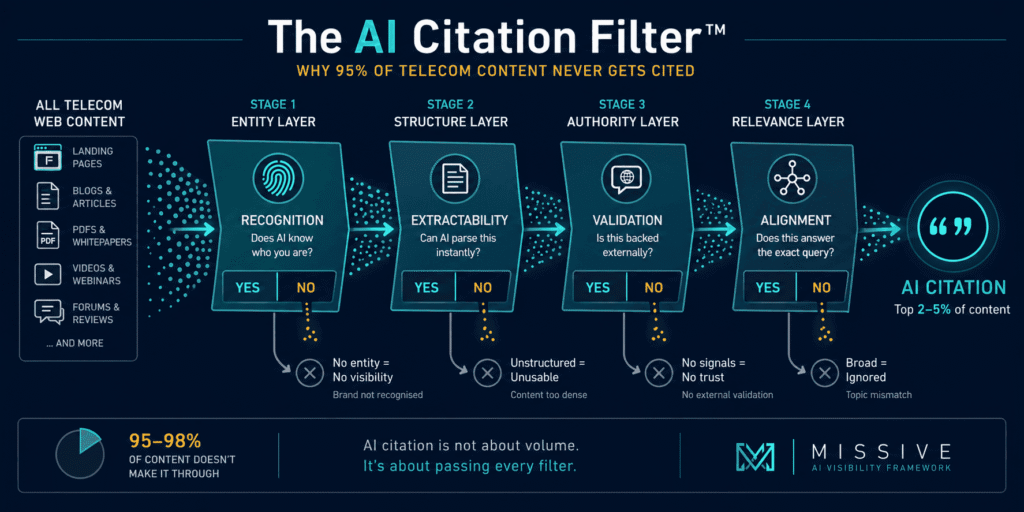
1. Entity Recognition – Does AI know & trust you?
AI systems need to recognize & trust you. It won’t cite ambiguous sources. Inconsistent schema, unverified Knowledge Panels, authorless content, and conflicting brand descriptions across the web make you ambiguous.
2. Content Extractability – Can AI extract content from your page?
If your content is too dense for AI to extract information from, it won’t cite you. Tables, definition blocks, FAQ pairs, numbered frameworks, and summary callouts are structurally easy to extract.
3. Authority Signals – What others are saying about you?
It matters more than what you say about yourself. External references, analyst reports, industry publications, brand mentions, etc., carry more AI citation weight than internal self-assertion.
4. Contextual Relevance – Do you cover the breadth of a topic?
A domain with deep, internally linked topic coverage signals to AI systems that it is a reliable, comprehensive source. A single page cannot replicate that signal.
How to Optimize for Telecom SEO in the AI Era
“Ranking on Google and being cited by AI are two different outcomes, and they need two different (but overlapping) inputs. The good news: fixing one often lifts the other.”
This five-component telecom SEO framework will help you fill the citation gap; consider it as connective tissue between ranking well on Google and getting cited in AI answers.
1. Authority Signals: Making Sure AI Knows Your Brand Exists
AI systems build knowledge graphs. If your brand isn’t mapped to a topic area with enough consistent signals, you’re invisible, regardless of where you rank.
How to Achieve Entity Recognition
A consistent voice across the web: If your website says “enterprise UCaaS provider,” LinkedIn says “business phone systems,” and G2 profile says “cloud communications,” AI gets confused and deprioritises you. Inconsistency signals weak entity recognition.
Own a specific niche, not just a category: “Business VoIP” is crowded. “VoIP for multi-site retail operations” or “hosted telephony for NHS trusts” gives AI (and consumers) a clear entity hook. Be the obvious answer to a specific question.
Build topical depth, not topical breadth: One thorough cluster on SIP trunking outperforms ten surface-level posts on “telecom tips.” AI rewards sites that demonstrate they actually understand a topic, not just mention it.
Get named in the right company: Organic PR is now an AI SEO strategy. A single mention in Fierce Network or a co-citation alongside Ofcom is worth more to your AI authority signal than fifty directory links.
The bottom line: Entity authority isn’t built overnight, but it also isn’t mysterious. Its consistency and relevance across the web, the same discipline that built brand trust before AI search, is applied to a new set of surfaces.
2. Content Structure: Formatting for Humans Who Skim and AI Systems That Extract
Here’s what most telecom content teams get wrong: they write for readers, but structure for neither readers nor AI. A wall of well-researched prose is as invisible to an AI crawler & mobile user.
Your content needs to be structurally legible: clear, hierarchical, and answer-shaped.
How to Structure Your Content for Telecom AI SEO
A consistent voice across the web: “Our VoIP Features” tells AI nothing. “What Makes Cloud VoIP Reliable for Multi-Site Businesses” is extractable, citable, and useful.
The bottom line: Structure is not a UX nicety. For telecom content in the AI era, it’s the difference between being cited and being invisible.
Real-world Example – VoIP Brand Case Study
A B2B VoIP brand we worked with had blogs that ranked well but converted poorly and were completely absent from AI answers.
After restructuring them for scannability: clear summaries, proper heading hierarchy, intent-matched keywords, and schema, ChatGPT & Perplexity-driven traffic grew more 100%, leads doubled, even as Google click-through rates fell due to AI Overviews.
The content didn’t change. The structure did.
3. Structure Data – Giving AI the Map to Your Content
Schema tells AI exactly what your content is, who wrote it, what it’s about, and how trustworthy it is. Without it, AI has to guess. It usually guesses wrong or skips you entirely.
The Telecom Schema Stack to Implement
| Schema Type | Where to Use It | What It Does for AI Citation |
|---|---|---|
| FAQ Page | Plan pages, guides, comparison pages | Most-cited schema type across all AI platforms |
| Product | Individual plan pages | Signals price, features, and availability in a structured form |
| HowTo | Switching guides, setup tutorials | AI loves procedural content, schema makes it extractable |
| Article | All blog and guide content | Credentialed authorship leads to higher citation weighting |
| Organization | Homepage / About page | Links your brand entity to Wikidata, LinkedIn, and directories |
The bottom line: Schema and technical health aren’t prerequisites to the “real” work. They are the real work. Everything else is built on top of them. Run your site through Google’s Rich Results Test and Schema Markup Validator to resolve all errors.
Real-world example – Softphone company case study
A softphone company came to us with strong traffic but a lead quality problem, junk form fills, spam, and mismatched intent. The technical layer was broken: canonical issues, unnecessary schema, redirect chains, crawl waste.
Once we rebuilt the technical foundation, schema cleaned up and correctly implemented, site architecture rebuilt, Core Web Vitals resolved, organic traffic grew 50%, SQLs doubled, and branded search climbed 30%. Structured data wasn’t the whole story, but it was a meaningful part of the trust signal rebuild.
4. Citations, Mentions & Reviews: What the Internet Says About You
Third-party signal is the trust multiplier, and in 2026, that means three distinct things: who cites you, who mentions you, and what customers are saying about you on review platforms.
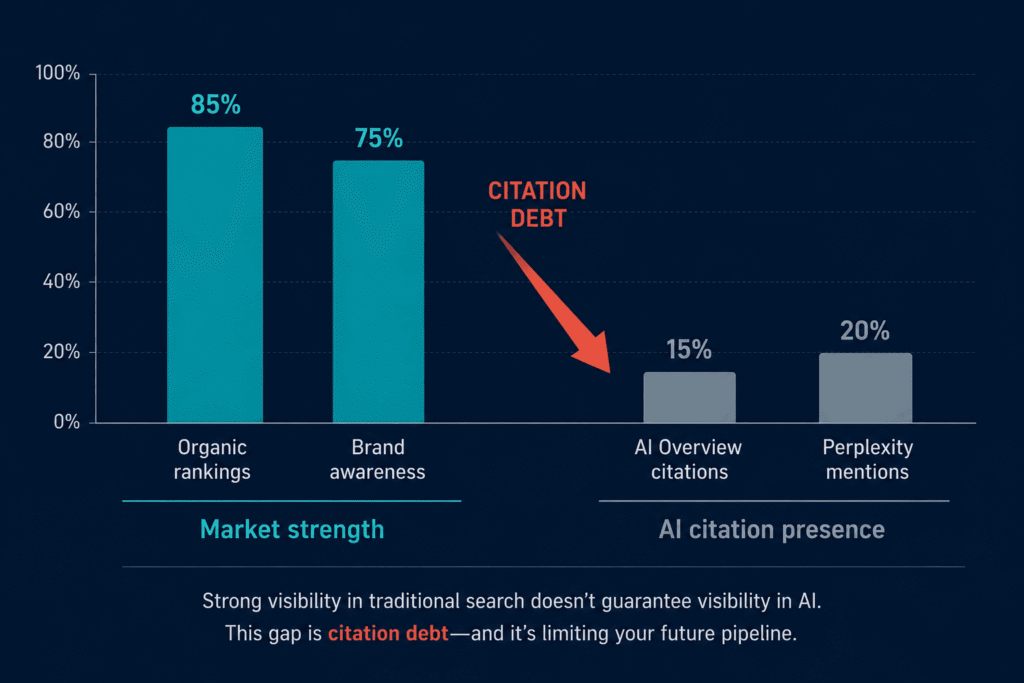
The Citation Gap
"The gap between the AI citations you're currently getting and the citations you should be getting based on your market position. "
How to Get Citations & Reviews
Earned mentions over purchased links: The VoIP brand we worked with earned international enterprise leads without a single paid link. Proving content quality that genuinely helps people is still the most reliable citation-building strategy.
The Bottom Line: In telecom SEO, a single Fierce Telecom mention in the right context outweighs fifty directory links for AI citation purposes. Quality of co-citation is the new link equity.
5. E.E.A.T – The Trust Layer AI Won’t Skip
Experience. Expertise. Authoritativeness. Trustworthiness. In telecom, this isn’t an audit checklist item; it’s the gate.
A customer evaluating a business broadband switch or a UCaaS migration is deciding with real operational consequences. AI engines treat telecom content with corresponding scrutiny.
How to enhance your E.E.A.T
Named authors with real telecom credentials: “The Missive Team” means nothing to an AI system. “Written by [Name], former network engineer at [Carrier], now specializing in UCaaS migration strategy” means a great deal. Real experience, specifically named.
The Bottom line: E-E-A-T isn’t a box to tick, it’s the question AI systems are implicitly asking every time they decide whether to cite you. Anonymous content from an unverifiable team, with undated pricing and no external recognition, answers that question the wrong way.
Not sure where to start? Try Missive’s
Telecom SEO Roadmap & Framework
These five levers don’t work in isolation. Get all five pointing in the same direction, and AI doesn’t just find you, it cites you consistently. But how?
We’ve packaged the T-GEO model into two free resources; try them out.
What AI Loves the Most
| Content Type | Citation Potential | Production Difficulty | Why it Works |
|---|---|---|---|
| Content Formats | |||
| FAQs (with schema) Direct answer format | Very High | Low |
Easiest content for AI to extract and cite verbatim. Schema markup tells the engine exactly where the answer lives. |
| Original data & primary research Proprietary statistics, surveys, benchmarks | Very High | High |
Unique data cannot be replicated; AI must cite the source. No other content type earns a mandatory citation. |
| Structured comparison tables Static HTML only, not JavaScript-rendered | High | Medium |
Comparison clarity in tabular form is immediately parseable. AI extracts structured rows without needing to interpret prose. |
| Expert-authored how-to guides Named, credentialed author required | High | Mid-high |
E-E-A-T credibility signals, especially for telecom's financially consequential queries. Anonymous guides score significantly lower. |
| Named frameworks & definitions Coined concepts, models, terminology | High | Low (layer as you write) |
Easy extraction, AI loves a clean, self-contained definition. Own the concept name, and you own the AI answer for any query that asks about it. |
| General blog content Unstructured, no schema, no clear authorship | Low | Low |
No clear extraction point for AI. Restructure existing pieces before producing more. |
| Structural Elements | |||
| Bullet points & structured lists Scannable, parallel-structure items | Mid-high | Low |
Structured output, AI reads lists as enumerable facts and can lift them directly. Unordered prose covering the same ground is harder to extract cleanly. |
| Entity mentions Brand names, product names, proper nouns in context | Medium | Low | Context building, AI uses entity co-occurrence to map your brand to relevant topics. |
| Internal linking (semantic) Topically-connected anchor text across the site | Medium | Low |
A well-linked topical cluster presents AI with a knowledge graph, not isolated pages. Tells the engine your authority extends across the full subject area. |
| Consistent terminology Same terms used across all pages and assets | Medium | Low |
Reduces ambiguity, AI entity graphs strengthen when a brand uses the same terms to describe itself consistently. Synonyms and renamed products fragment your entity signal. |
Lessons We’ve Learned Are Now Yours
"The goal isn’t to publish more telecom content. It’s to make your content impossible for AI to ignore."
Citation is the new ranking. The measure isn’t where you appear in a list of ten blue links. It’s whether AI systems consider you trustworthy enough to reference when your customers are asking.
After working, struggling, failing, surviving, and succeeding with telecom brands for the past 2 years, we’ve realized that when it comes to AI citations or Telecom AIO/GEO:
- Authority makes you eligible
- Structure makes you usable
- Schema makes you understandable
- Citations make you credible
- E-E-A-T makes you selectable
The good news is that you already have most of what you need: the content, the credibility, and the product. What’s missing is some tweaks, a structure, and insights.
Is Your Telecom Brand Invisible in AI Search?
The million-dollar question, when AI answers your category’s biggest queries, is your brand even in the room? Most telecom teams don’t have a ranking problem; they have a citation gap they haven’t measured yet.
Well, Missive Digital can help you get the answer (without that million-dollar check). Set up a free consultation call now.
FAQs
AI search visibility refers to how frequently and accurately a telecom brand appears as a cited source within AI-generated answers on platforms like Google AI Overviews, Perplexity, Gemini, Claude, and ChatGPT.
Unlike traditional rankings, AI visibility is earned through entity recognition, structural content legibility, and source trust, not keyword density or backlink counts alone.
Google AI Overviews intercept high-volume telecom queries, plan comparisons, switching guides, "best provider" searches, and answer them directly within the results page. This compresses click-through rates for traditional organic listings. However, brands cited within AI Overviews gain significant brand visibility and referral traffic, even without a first-position ranking.
Generative Engine Optimisation (GEO) is the practice of structuring content and authority signals to earn citations from AI-powered answer engines.
For telecom, it involves formatting content for AI extraction (FAQ schema, structured comparison tables, expert authorship), building entity recognition signals across the web, and earning co-citations from sources AI systems already trust.
Telecom content, such as plan comparisons, feature explainers, and "how to choose" guides, maps almost match the query types AI systems are designed to answer. Combined with telecom's E.E.A.T classification (stricter source weighting) and typically slow content production cycles, telecom brands are more structurally exposed to zero-click disruption than most verticals.
Yes, and this should be the goal. The framework discussed in the article is built on the principle that good SEO and good GEO share the same foundation: technical health, content depth, structured architecture, and genuine authority.
Optimising for one strengthens the other. AI search doesn't replace traditional SEO; it rewards the same disciplined approach more explicitly and penalises shortcuts more visibly.
Ranking is about a page meeting Google's relevance and authority criteria for a given query. Being cited in AI Overviews is about a source being structurally legible, entity-recognised, and trustworthy enough for AI to synthesise and reference in a generated answer.