
Quick Fixes for Jewelry SEO
- Optimize category pages around search intent.
- Write human, buyer-focused, conversational content.
- Add product schema; enable Merchant Center.
- Optimize your jewelry store’s GBP thoroughly.
- Benchmark competitors and design for AI.
If you’re running a jewelry business and have invested in SEO, chances are you’ve asked this at some point:
“Why isn’t it working?”
The traffic & sales aren’t growing. The blogs are published, but nothing seems to be moving.
We have spent the last few years working with a diverse range of clients, from D2C brands and eCommerce-first jewellers to legacy businesses. We’ve audited websites, analyzed content, reviewed hundreds of SKUs, and spoken directly with decision-makers.
Here’s what we found:
- It’s rarely about SEO “not working.”
- It’s usually about a few critical gaps in strategy, execution, or expectations. The ones that keep showing up across the industry.
This guide breaks down those gaps.
If you’ve been wondering why your organic growth is stuck or never really picked up, what you’re about to read will likely sound familiar.
Let’s get into it.
10 reasons why jewelry SEO does not work and what Missive recommends you to do
1. No category-level SEO strategy
This is one of the most consistent issues we come across.
Jewelry brands often launch their digital storefront with a homepage and a few top-level categories, such as “Rings” or “Necklaces”, expecting to rank for competitive, high-intent terms.
Also, even if category pages are created, the major optimization and focus goes to product pages, considering they should be visible first, and then those can get sold.
However, we often overlook the fact that products can go out of stock, and if this information isn’t managed properly, your user experience is impacted.
But that’s not how search engines work, especially not in a niche like jewelry, where search terms are extremely specific.
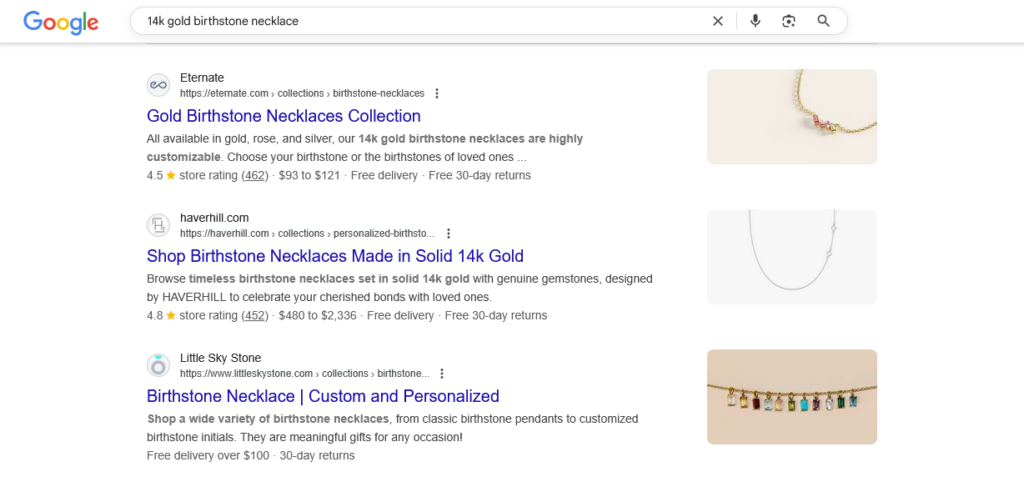
For example, people don’t just search for “necklaces”. They might search for:
- “14k gold birthstone necklace”
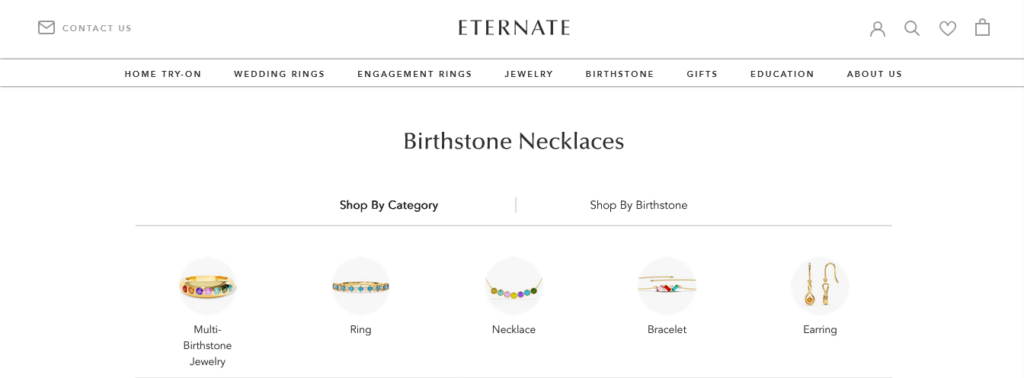
- “Diamond engagement ring under $5,000”
- “Vintage sapphire engagement ring”
- “Minimalist gold hoop earrings”
- “Rose gold bridal set”
If your website doesn’t have dedicated, optimized category pages targeting these variations and sufficient SKUs to support them, you simply won’t show up.
Many brands try to rank without having enough depth in categories or a structured internal linking system. What’s missing isn’t keywords. It is the site structure and inventory depth.
This is where SEO starts. Without this, no content or technical fix will move the needle.
2. Content strategy based on what the brand owner says and not what the customer searches
We’ve seen beautifully drafted blog layouts filled with content that no one is searching for.
Topics like:
- “Our founder’s journey”
- “Why we believe in timeless beauty”
- “Crafting heritage with heart”
Lovely stories. Great for a brochure. Not so great for organic search.
SEO content is about how you draft the actual craft with the intent to reach the right set of audience looking for it. It’s about answering what your customers are already searching for. Think:
- “How to choose between lab-grown vs. natural diamonds”
- “Trending gold chain styles 2025”
- “Are sapphire engagement rings durable for daily wear?”
When content is shaped around brand voice instead of search intent, it becomes invisible, no matter how well it is written.
3. Content that feels like a robot wrote it, and not a human
This one’s easy to spot.
Short paragraphs. Overused phrases. Usage of words like elevate, enhance, elegant, etc.
Your audience knows instantly when something is written just to “check the box.”
We get your idea, it’s quick, easy, and “better than nothing.”
But in reality, it doesn’t work.
Jewelry is personal, visual, and emotional. Shoppers aren’t looking for generic product descriptions or vague lists. They want real insights, such as styling tips, buying guides, care instructions, occasion-based recommendations, and humanized content that builds your brand.
Here is what we recommend while you draft your content,
- Decide on the core message you want to convey
- Build a clear content outline
- Write H2s that read like complete thoughts, not just keywords
- Add research, opinions, and personal expertise
- Draft your introduction and conclusion yourself so it carries your brand’s voice
If your content lacks voice, trust, or value, it’s not going to rank and definitely won’t convert.

Struggling to reach your jewelry buyers?
Boost your sales with fresh ideas to connect with your shoppers.
4. Publishing content with SEO vendor/team approval
Here’s a situation we’ve come across too often:
The SEO team reviews a blog draft and flags major issues, such as weak structure, missing metadata, irrelevant topics, or keyword stuffing.
Just because the content team or founder says, “It’s fine. Let’s publish it anyway,” it goes live.
But remember, there are higher chances that it underperforms, and the same question comes back, “Why didn’t this work?”
SEO isn’t just about writing blogs. It’s about planning content with a blog structure, user intent, and search visibility in mind. If pieces are going live without aligning with your SEO strategy, you’re wasting time building a library of content that does nothing.
For the blog post titled “15 Diamond Gift Ideas to Steal a Woman’s Heart”, we structured the content around the various roles a woman plays in someone’s life, guiding readers on how to choose the perfect diamond gift.
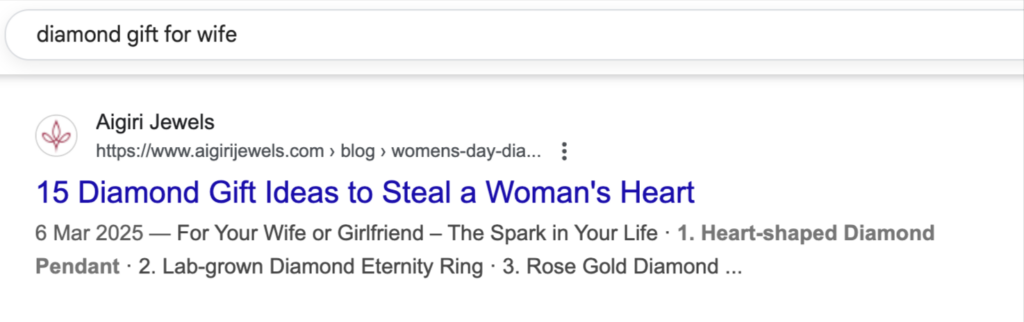
For example, the blog structure included:
- For Your Wife or Girlfriend – The Spark in Your Life
- For Your Mother – The Eternal Guide
- For Your Sister – Your Forever Friend
- For Your Daughter – The Promise of Tomorrow
- For Your Female Best Friend – The Unsung Ally
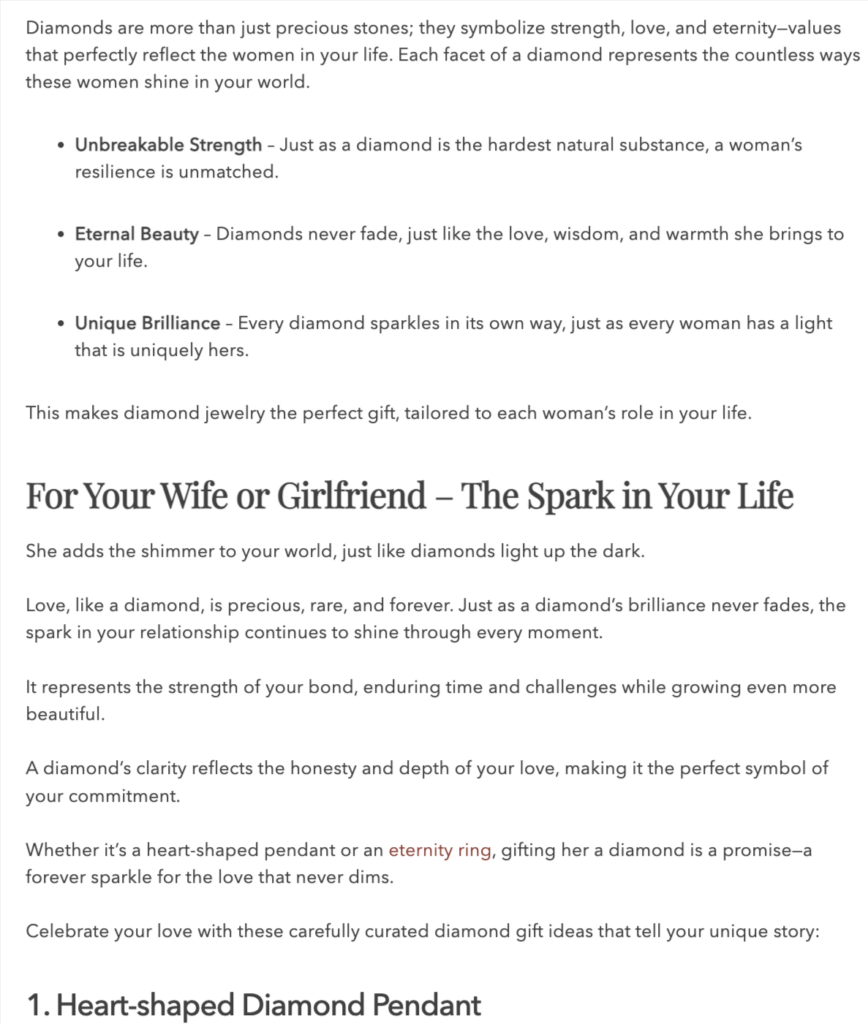
Alignment between content & SEO is not
just ‘nice to have’. It’s a baseline for the content that ranks and converts.
5. No structured data leads to ignorance of your products in rich results
Ever noticed how some jewelry products show up in a clean grid with price, rating, discounts, delivery timelines, and stock right when you search for any jewelry pieces on a search engine?
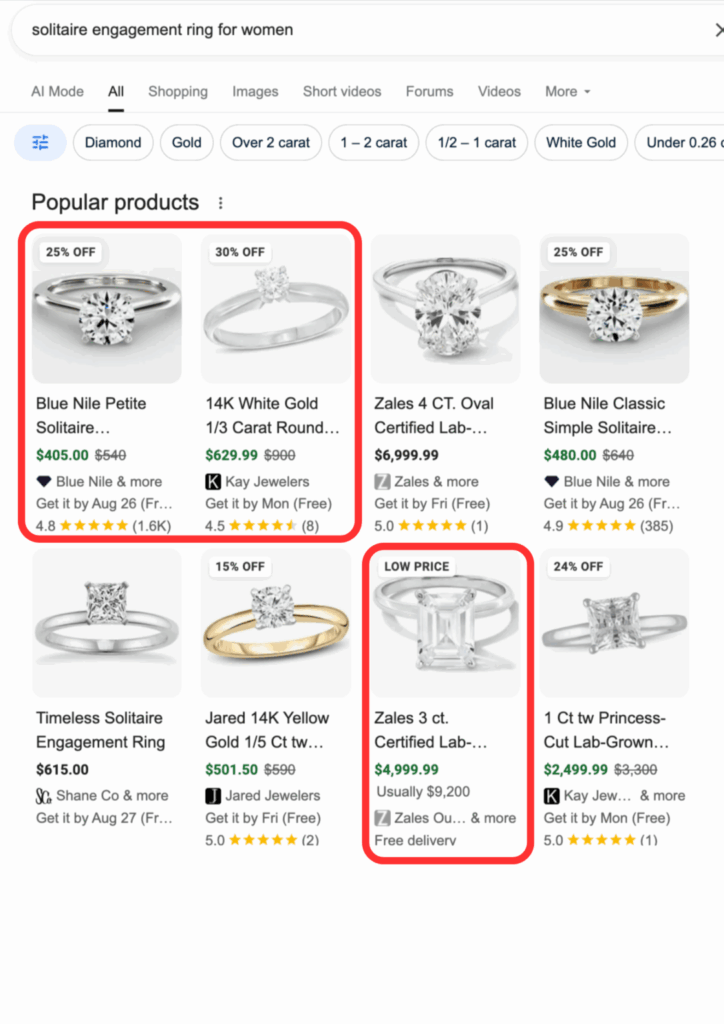
That’s not luck. That’s structured data at work.
Most jewelry websites we have worked on forget to add detailed product schema. Which means:
- No presence in Google’s product grids
- No star ratings or price previews in search
- No visual product data that helps buyers in decision-making
Even if your categories are relevant and have products in high demand, they’re invisible in the formats that drive clicks. It’s a simple fix, but a powerful one.
6. Your Google Business Profile exists, but doesn’t create impact
If you have physical stores or offer local delivery, your Google Business Profile (GBP) is more than just a listing. It can be your most powerful local SEO engine.
Take a look at what customers see when they search for “engagement rings in Barcelona”
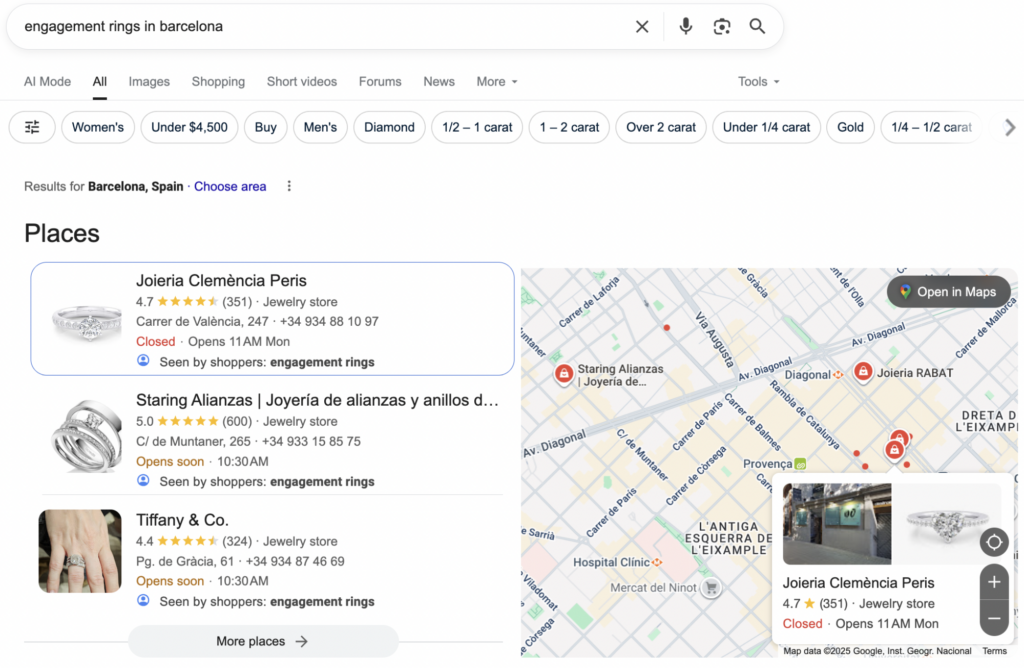
And yet, we’ve seen countless GBPs that are:
- Incomplete
- Outdated
- Missing product uploads
- Lacking customer reviews
- Not linking to key landing pages
Local discovery plays a huge role in the jewelry industry, especially around engagement season, holidays, or special occasions. If your GBP isn’t active and optimized, you’re missing out on ready-to-buy customers who are searching for things like “jewelry store near me” or “engagement rings in [city]”.
7. Not using Google Merchant Center means missing out on free shopping listings
This one hurts because it’s such an easy win.
Many jewelry brands assume Google Merchant Center (GMC) is only for ads. It’s not.
GMC powers organic product listings in Google Shopping, particularly for image-driven results that appear at the top of commercial searches for jewelry products.
When your jewelry is listed in GMC, you’re placing it where millions of potential shoppers are already browsing and comparing. It’s not just about online sales; GMC can also highlight your in-store availability for people searching locally.
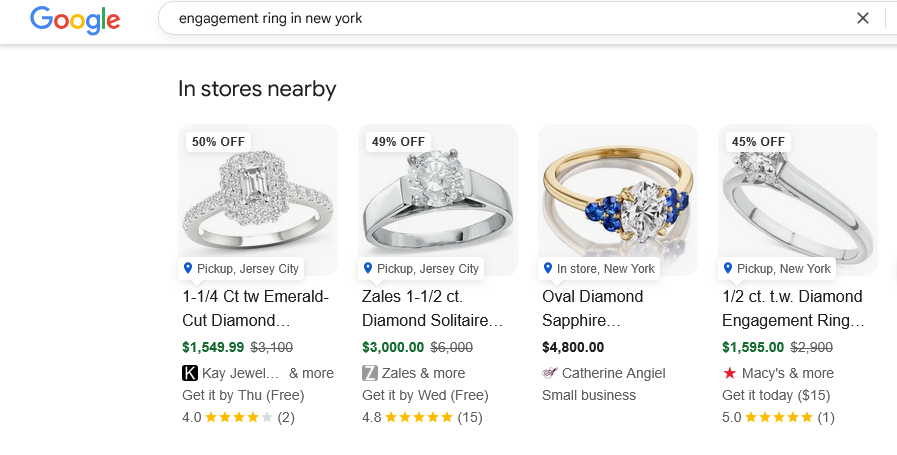
GMC will help you in:
- Learning about your top-selling products on Google
- Make it easier for nearby potential customers to visit your store
- Increase visibility in organic shopping results, without ads
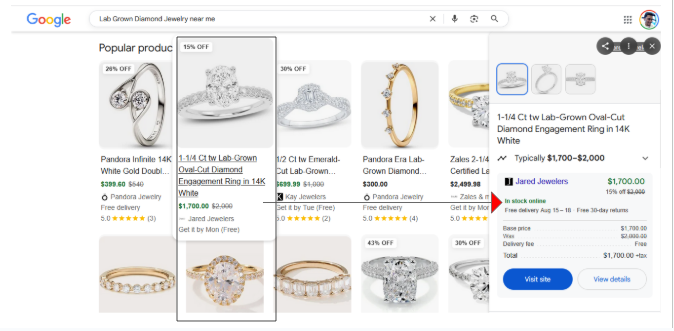
If your products are not optimized on GMC, you miss out on showing up in various Google search results, such as Google Shopping, Google Product Grids, and YouTube Shopping.
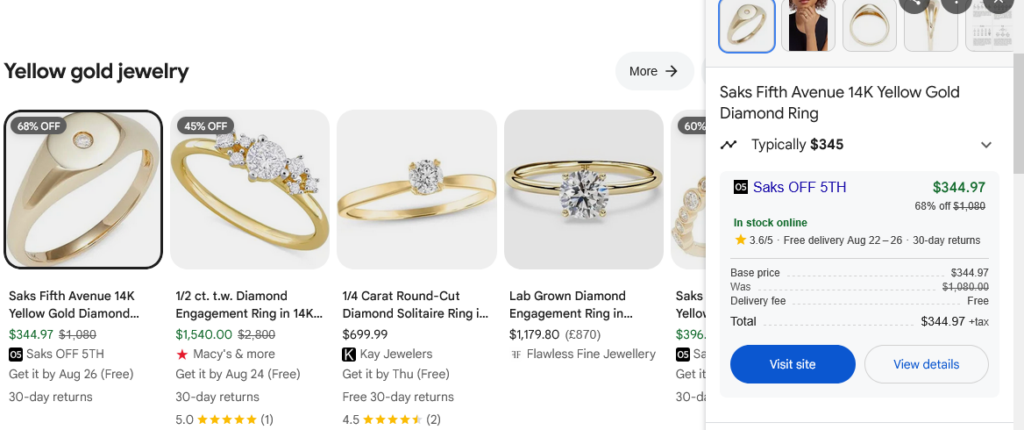
Aye, it’s free.
8. No competitive benchmarking
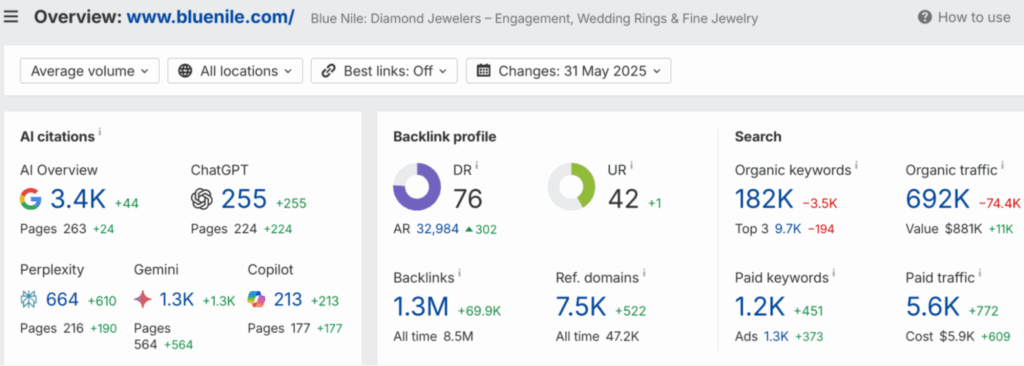
A few jewelry businesses we speak to aren’t aware of what sets their competitors apart from them, and competitors are easily visible on intent-driven search queries.
They often treat a brand next door as their competitor, but forget to benchmark what brands like
- Blue Nile
Just look at the growth of organic traffic, AI citations, and paid traffic that Blue Nile has:
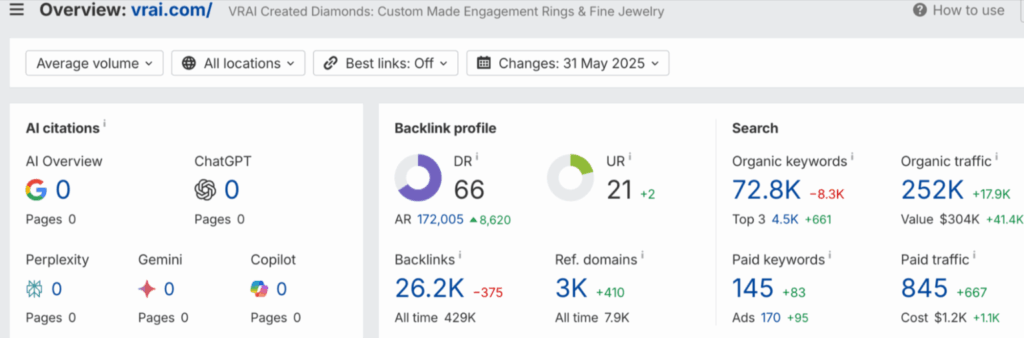
- VRAI
Though AI citations are still not visible on Ahrefs for VRAI, see the growth ratio of organic traffic and referral domains:
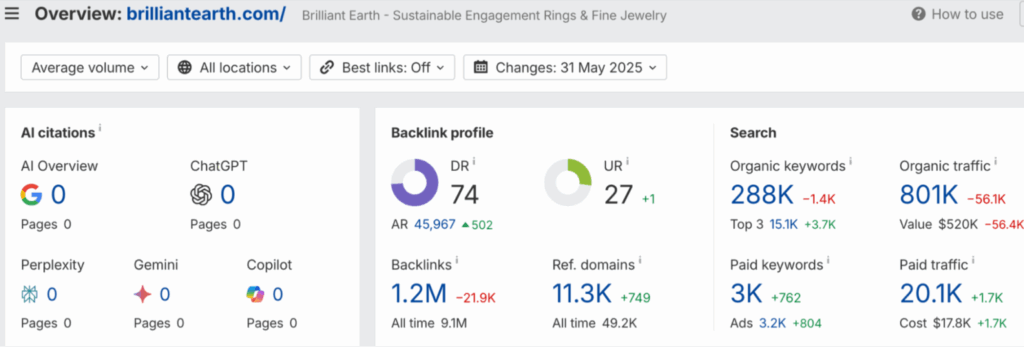
- Brilliant Earth
Compared to Blue Nile and VRAI, the organic traffic is declining for Brilliant Earth:
You need to know what’s happening with your competitors to plan your strategy better.
And they’re not alone. This is just a fraction of jewelry brands dominating the SERPs.
If you’re not actively reviewing how they structure product pages, what keywords they rank for, how their category pages are built, or what content helps them scale, you’re building in a vacuum and guessing.
9. Your website does not build a trust factor to convert organic traffic
If you ask us, it is the most important one to consider for jewelry SEO.
You can rank on Google. You can even get traffic. But if your site doesn’t feel credible within seconds, people leave.
That’s what we see on jewelry sites with:
- No reviews
- No returns policy
- No trust badges
- No size guide
- No visible store address or helpline
- No GIA or AGS certification
- No secure payment icons like Visa, Mastercard, etc.
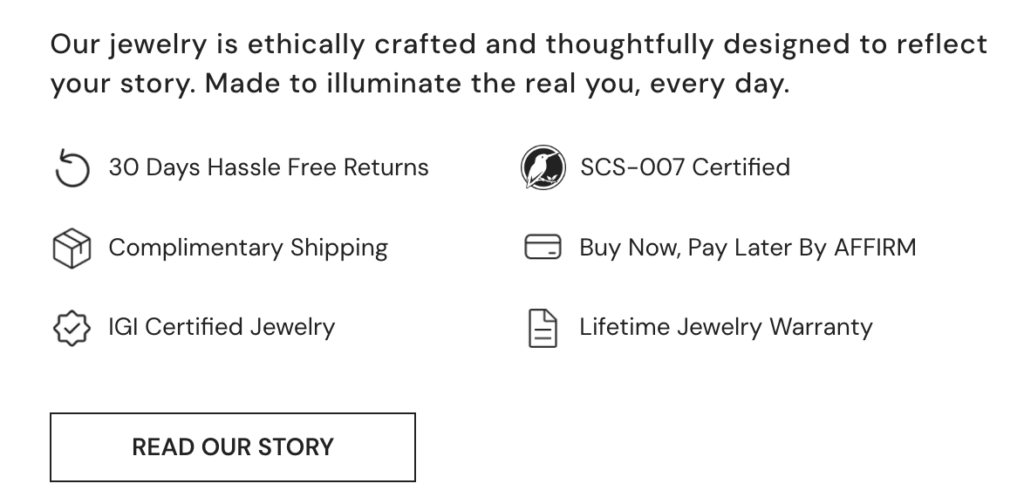
If your site feels risky, no one buys, especially when your target audience is there to purchase jewelry.
SEO brings the visitor. But trust converts them.
10. When your SEO strategy is not built for scale, like AI
Most jewelry brands still build SEO strategies like it’s 2015—optimize a few hero products, write some blogs, and wait. That approach might move the needle a little, but it doesn’t match how search itself has evolved.
Shoppers no longer type just “diamond ring.” They ask AI-powered systems questions like:
- “Find me a diamond engagement ring under $5,000 with a GIA certificate.”
- “I’m looking to buy a diamond engagement ring from Austin under USD 2000, do you have any options available? I need the ring within 2 working days..”

The AI tool then shares that they have found some options, local jewelry stores in Austin, recommendations, and all.
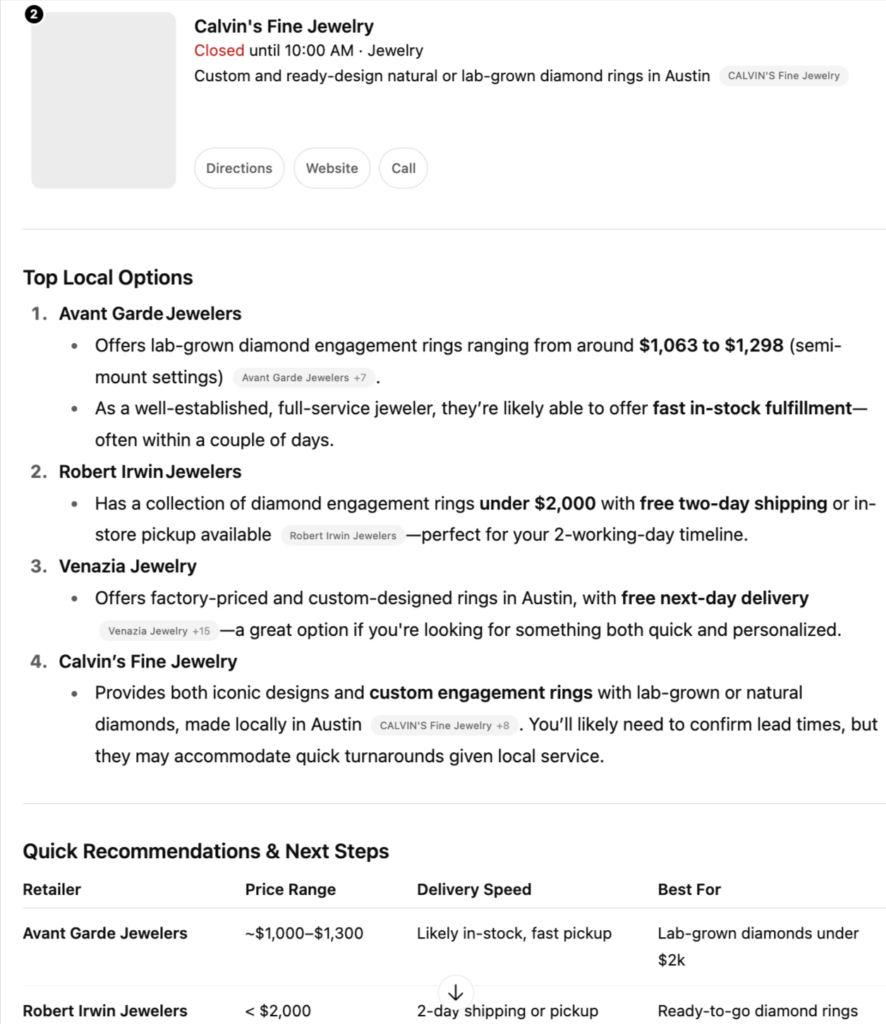
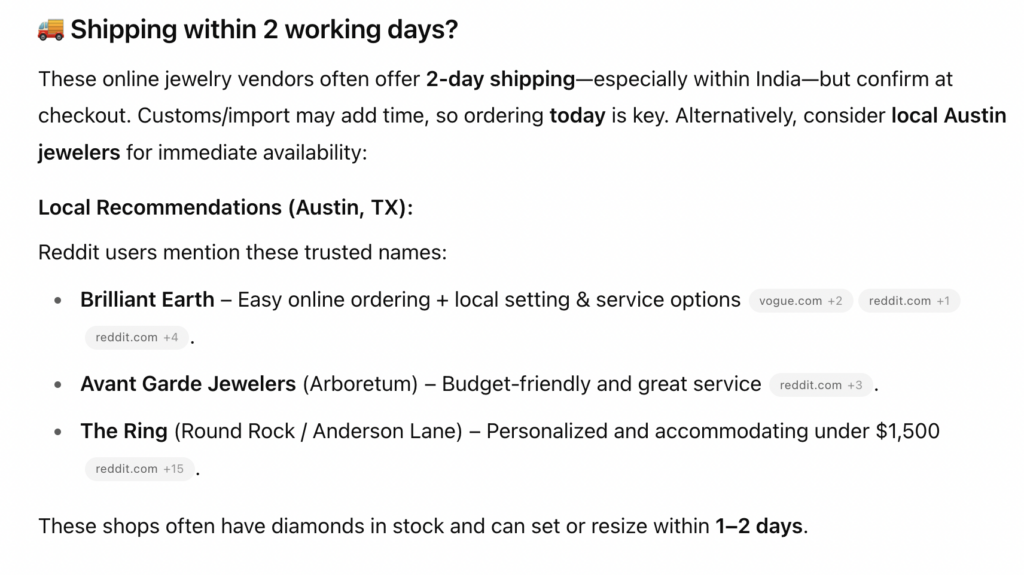
AI doesn’t wait for your buyer to scroll through 10 links. It curates, answers, and recommends. If your SEO isn’t designed to scale into this AI-driven discovery ecosystem, you’ll remain invisible.
What “not built for scale” looks like:
- Optimizing a few product pages while ignoring 80% of your SKUs.
- Publishing blogs without connecting them to ecosystems of guides, FAQs, and product links.
- No schema or structured data to help AI understand your catalog.
- Treating SEO as a one-time checklist, not an evolving system.
What “built for scale” (and AI) looks like for Jewelry SEO:
AI-friendly content : Writing the way buyers search—natural, conversational, and emotional. (Not “18k rose gold ring” but “Celebrate your next chapter with a heart-shaped 18k rose gold ring.”)
Structured depth : Using schema like Product, Offer, Review, and FAQ so AI can confidently pull your details into overviews and shopping results.
Content freshness : Regularly updating guides, FAQs, and seasonal categories so AI recognizes your brand as current, not outdated.
Multi-modal readiness : Rich visuals—optimized images, 360° videos, styling clips—because AI search increasingly blends text + images + video discovery.
Scalable technical setup : Templates and automation that ensure every new product page is SEO- and AI-ready from day one.
AI scales instantly. Your SEO must, too.
If your strategy can’t expand with your catalog, your content, and your buyers’ evolving search habits, you’re not just falling behind competitors—you’re invisible in the very places where your customers now shop.
Struggling to reach your jewelry buyers?
Boost your sales with fresh ideas to connect with your shoppers.
So, when does the jewelry SEO work?
When it’s treated like a strategy, and not just another marketing activity.
After working with jewelry businesses, we’ve seen this repeatedly:
“If you’re not seeing results, it’s rarely because SEO doesn’t work. It’s because something (or several things) is off behind the scenes.”
- Maybe the content isn’t relevant.
- Maybe the category pages weren’t built with search intent in mind.
- Perhaps your products aren’t appearing where your customers are searching.
And that’s not unusual.
This guide isn’t just a checklist; it’s a mirror.
If even a few of these points sound familiar, you’ve likely found the reason your organic growth has stalled.
The good news?
Every one of these issues is fixable.
With the proper SEO foundation, the right structure, and the right team, jewelry brands do grow organically. We’ve experienced it happen, again and again.
At Missive, we work as organic growth partners for jewelry businesses, helping them build search-ready pages with content that aligns with real demand and stay visible where it matters.
If that sounds like what you’re aiming for, let’s talk.
And if not, we hope this helped you get a clearer picture of what’s holding your organic growth back.
Either way, we’re glad you’re here.