
After consulting multiple SEO and content teams (mid-to-large-scale) over the past 15 years, I’ve realized that both want the same thing: results that last. Yet, they often move at different speeds and speak different creative languages.
SEO professionals think in terms of structure, precision, and timing. Content teams believe in emotion, narrative, and flow. When these worlds come together, the outcome is magic. When they don’t, even strong strategies lose their edge.
What I’ve learned is that most challenges aren’t about skill or intent. They stem from alignment gaps that can easily be fixed with awareness and communication.
Here are a few complaints I’ve consistently heard from the SEO teams (clients’ in-house, partner agencies, and my in-house) that, once addressed, can help SEO and content teams perform in sync and produce work that truly compounds results.
Note before you read:
This blog is written with the assumption that the writers and content professionals involved are already experienced in their craft. It doesn’t cover basic writing hygiene like grammar checks, plagiarism, or AI detection tools. The focus here is on collaboration challenges and process maturity between seasoned SEO and content teams; the kind of issues that arise only when you’re already past the fundamentals.
1. Content teams don’t do enough competitor analysis
This is one of the most common complaints I’ve heard from SEO teams.
Writers often start creating content as soon as they have the keyword, without studying what’s already ranking. They miss how competitors structure their articles, use visuals, or answer intent more effectively. This is particularly important when developing an SEO content strategy for telecom companies, where search competition is often driven by highly detailed and technically accurate content.
The result is well-written content that lacks positioning.
It might sound great, but it doesn’t explain why a reader should choose it over the ten similar results already on page one.
The blog topics, like “Top CRM Tools,” read smoothly, but they miss comparison tables, feature matrices, and brand context that competing pages include.
The SEO team then ends up rewriting sections to match what the search landscape already rewards.
The fix is simple. Before starting a draft, spend a few minutes reviewing the top three ranking pages for that keyword. Observe how they organize information, the depth of examples they use, and what questions they answer best. Then, write something that fills the gaps rather than imitates them.
When content teams start treating competitor research as the foundation of creativity, SEO teams stop “fixing” and start amplifying. That’s when collaboration truly begins to compound.
2. They don’t bring enough uniqueness to the table
Another recurring concern from SEO teams is that the content often sounds too similar to what already exists online.
Writers do their research well, but instead of identifying what the top results have missed, they end up repeating the same ideas in slightly different words.
The problem is not the effort; it is the approach.
Most content begins with the question “What’s ranking?” rather than “What’s missing?”
That small shift defines whether the piece stands out or disappears in the crowd.
We have seen it so many times that unique presentation formats like tables, frameworks, or visual comparisons often make it to featured snippets and, now, even appear prominently in AI Overviews.

For example, for each of the pointers explaining “SaaS development cost,” we recommended the Bacancy writers that they should add tables so that they become easily scannable for the audience.
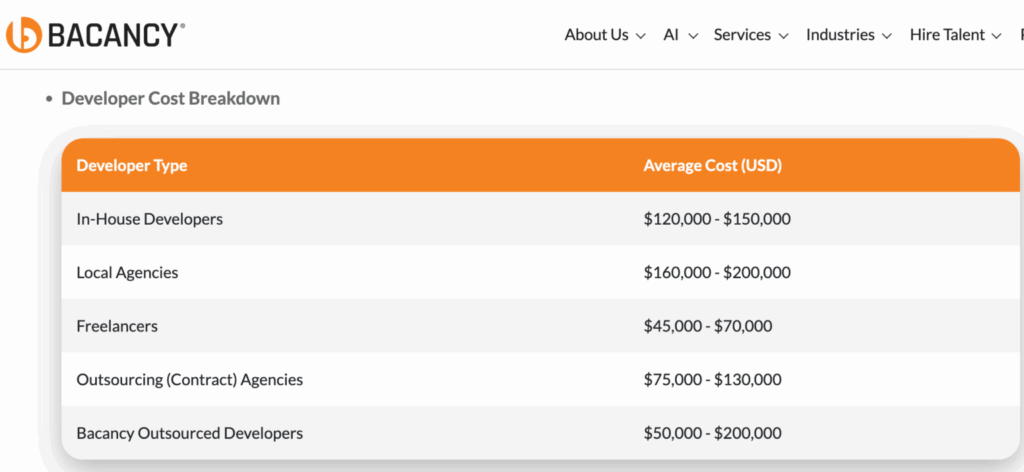
They also drive higher engagement when you check heatmap recordings, as users naturally pause longer to consume and interact with such content.
For instance, when every article on “AI Tools for Marketing” lists the same ten tools, creating another list does not help the reader or the brand. A better approach would be to bring a new lens, such as categorizing tools by marketing goals, budgets, or actual use cases.
The fix is simple. Before writing, define the unique value of the piece. Ask what this content will add to the conversation that others have not. It could be a data-backed opinion, an original example, or a first-hand insight from your brand’s experience.
When content teams focus on contribution instead of repetition, SEO teams spend less time pushing rankings and more time scaling performance.
3. They don’t fully get the search intent
This is one of the most common complaints SEO teams have.
Writers understand the keyword but often miss what the user actually wants to do with it. The intent behind a query determines everything — the depth of explanation, the structure of information, and the type of CTA.
When that intent is unclear, the content may look complete, but it won’t perform.
I’ve seen this confusion play out in many niches repeatedly.
For example, the keyword “best VoIP softphone in South Africa” clearly has commercial intent, but most listicles still start with a section like “What is a softphone?” simply because competitors added it.
When we wrote a blog on this, we recommended our writers to make sure it directly starts with the listicle and no basic information:
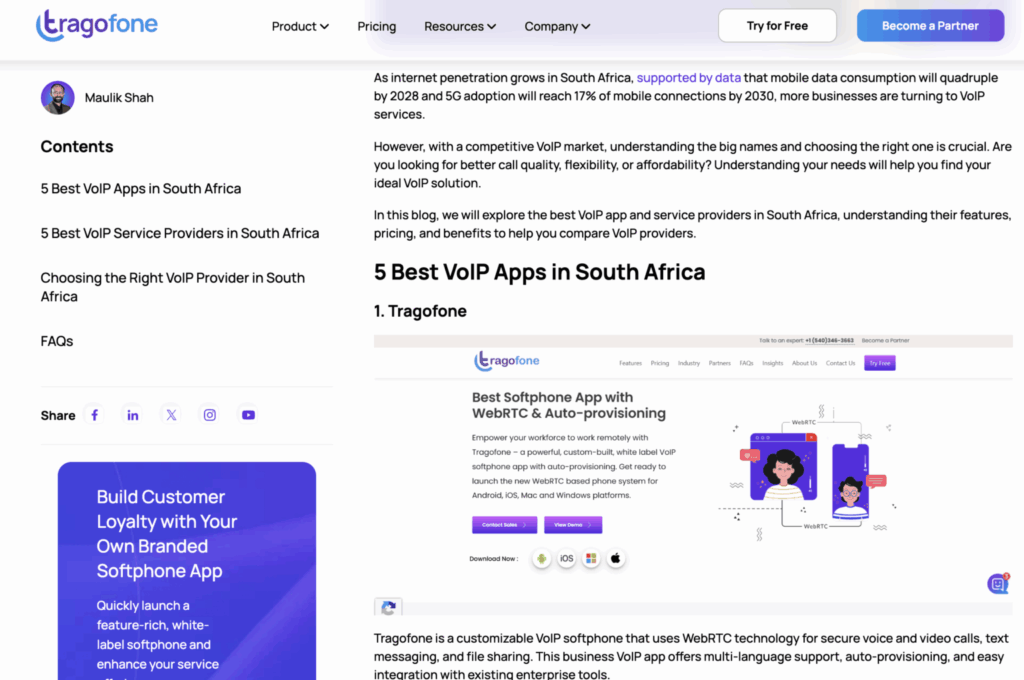
The audience searching for that term already knows what a softphone is; they are evaluating options, pricing, or integration features. By adding unnecessary explanations, we dilute the relevance and lose engagement.
On the other hand, if your audience includes beginners, evergreen topics such as “What is options trading” or “How VoIP works” make complete sense.
The key is to match the search maturity of your audience with the purpose of the keyword.
When content is written without understanding this distinction, tone and structure drift; a comparison post reads like a beginner’s guide, or a high-intent keyword ends up buried under basic explanations.
The fix is simple. Make intent mapping a standard part of every brief. Label each keyword as informational, comparative, or transactional, and align it with your target reader’s awareness level.
Once writers build this habit, the balance between depth and direction becomes clear, and SEO performance improves naturally.
4. We’re looped in too late.
This is one of the most frequent complaints from SEO teams, especially in setups where the content process runs independently or involves multiple layers of contributors.
It happens most in smaller marketing teams where everyone wears many hats, or when content creation is outsourced to freelancers who receive topics but not the full SEO roadmap. By the time the SEO team reviews the draft, the piece is written, edited, and waiting for approval. At that stage, optimization becomes a correction exercise instead of a collaboration.
The result is predictable. Keywords don’t flow naturally, internal links are missed, and subheadings don’t support the right search intent.
Writers feel frustrated when asked to rework their content, and SEO teams feel like they are always fixing things that could have been right from the start.
For example, I’ve seen detailed blogs on “Regulatory Compliance in FinTech” written beautifully from a storytelling angle but missing essential phrases like “FinTech compliance software” or “KYC verification tools.” When SEO gets involved only after publishing, rewriting those sections becomes unavoidable.
The solution is simple. Involve SEO early, ideally during the briefing stage. A short sync between the SEO strategist and writer before drafting can clarify keyword priorities, user intent, and internal linking opportunities. This early alignment prevents rework and ensures both creativity and optimization flow together from the first draft.
When SEO is part of the process from the beginning, the collaboration feels like co-creation, not correction.
5. Keyword use feels off.
This is one of those quiet complaints that often comes back to us as SEO leaders.
The content sounds robotic, repetitive, or over-optimized, even though every keyword from the brief has been used. The irony is that this usually happens because of the same keyword SOPs we built years ago.
Writers are often told to use a keyword a specific number of times — two in the introduction, three in the body, one in the conclusion.
They follow the checklist perfectly, but when you read the draft, it feels heavy and unnatural.

That isn’t a content problem; it’s a process problem.
Search engines and AI engines no longer rely on repetition to understand what a page is about. They process meaning, context, and relationships between entities to determine intent. Which means our keyword strategy has to evolve, too.
Take an example from the Odoo ERP content. When blogs on “Odoo ERP Implementation” and “Odoo ERP Customization” both repeat the same phrase unnecessarily, the issue isn’t cannibalization; it’s clarity.
The algorithm understands both are relevant, but it becomes unclear which page should satisfy which search query. The result is inconsistent visibility across both.
This is where SEO teams need to lead the correction. We have to define intent clarity, not keyword counts.
Each keyword cluster should come with a context note that says what kind of user is searching this and what action they’re likely to take. Writers then have the freedom to express it naturally while staying aligned with the purpose.
When SEO teams upgrade their frameworks and content teams write with context, optimization becomes invisible, and that’s when content starts performing without sounding like it’s trying to.
6. Briefs are often half-followed.
This is a common complaint from SEO teams, but in most cases, it tells only half the story.
Writers are often expected to understand who will read the content and what its purpose is.
And they should, since it’s part of their craft.
But since the topics usually originate from the SEO side, the responsibility to define who the content is for and why it is being written must start there.But since the topics usually originate from the SEO side, the responsibility to define who the content is for and why it is being written must start there.
The real issue lies in how most briefs are built. They include keywords, titles, search volume, and difficulty, but they rarely mention audience type, intent, or the searcher’s stage in their journey.
Writers are told what to rank for, but not who they are helping or why the search happens. Without that clarity, even strong writers can take the content in a slightly different direction.
A topic like “Best Fitness Apps in Australia” can be written very differently depending on whether the audience is everyday gym enthusiasts, professional trainers, or wellness startup founders researching market gaps. Without defining that in the brief, the tone, examples, and structure easily drift away from what the audience actually needs.
The fix begins with how briefs are structured. SEO teams can go beyond keyword data by including audience insights, purpose, and the expected action from the reader.
Here is a sample content calendar by Missive Digital that includes everything that a writer would need to know before writing:
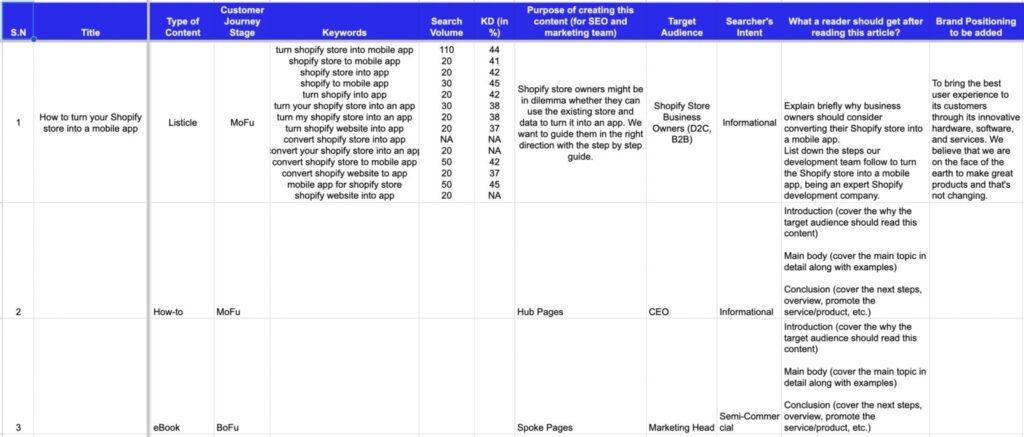
Writers, on the other hand, should review the brief with that context in mind and confirm their understanding before they begin.
When both sides share the responsibility
- SEO teams can provide direction
- Writers can validate intent
Here, the communication gaps close, expectations align, and the final content performs exactly as planned.
7. No writer tracks performance after publishing.
This is a complaint that surfaces frequently, especially in small to medium SEO teams that work with one to four writers.
The content gets written, reviewed, and published, and once it goes live, it disappears from the writer’s view. Writers can usually check whether their article ranks on page one, but that’s where their visibility ends. They rarely know what happens after the click:
- How long users stay
- Which section do they engage with
- Or whether the content drives any conversions
See what we mean by tracking those metrics to understand how the content performs:
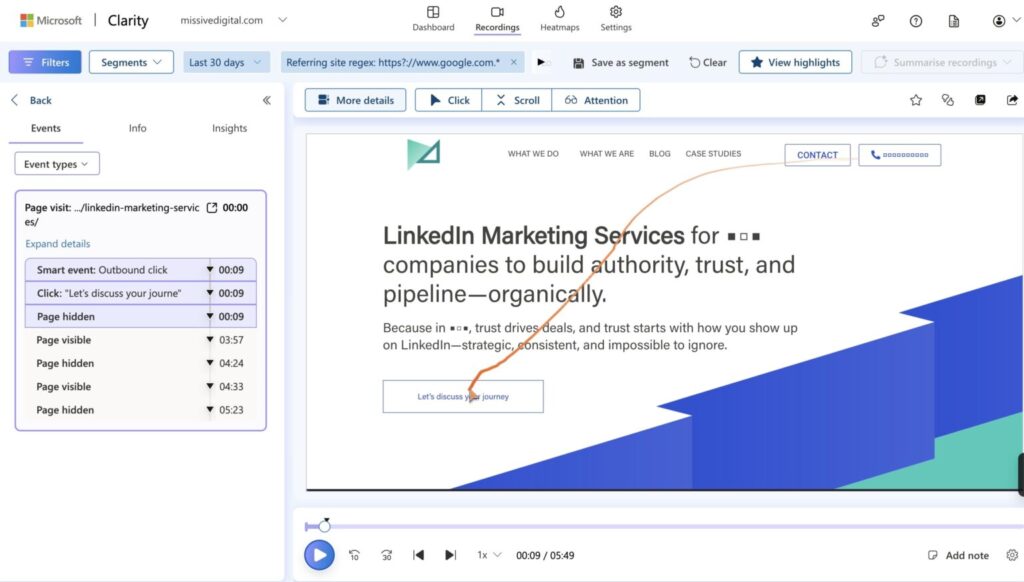
Source: Missive Digital’s LinkedIn Branding Services’ Page Performance on MS Clarity
The issue is not a lack of curiosity; it’s the absence of a system that allows consistent visibility.
Writers don’t have access to analytics dashboards, and most SEO teams don’t schedule regular performance reviews.
It’s not part of their weekly or bi-weekly task list to check how their content performed. Without that rhythm built into the workflow, learning never compounds.
Writers keep producing new content without ever seeing what structure, keyword usage, or tone worked well in previous pieces.
A blog on “Managing Diabetes Naturally” ranks well and even drives consultations, but the writer never learns that users spent the most time reading the FAQ section or that the CTA placement boosted conversions. That feedback stays buried in analytics reports that writers rarely see.
The fix is simple. Build a performance review into the system.
Add a recurring two-week task for writers to check their published pieces and review engagement data shared by SEO. A short summary of what worked and what didn’t helps every writer get better with each post.
When writers regularly track outcomes, they stop writing just for delivery. They start writing for results, and that shift changes how both SEO and content teams grow together.
8. Timelines keep slipping, even with AI
This is one of the most common complaints from SEO teams today.
Even with AI tools to speed up drafts, timelines for content delivery continue to stretch. The assumption was that AI would make writing faster, but in reality, it has only shifted where the time is spent.
Writers now spend less time drafting and more time researching, editing, and refining tone. In industries like Salesforce, where the content demands deep product understanding and constant platform awareness, AI can help structure ideas but cannot replace subject expertise.
A blog on “Top Salesforce Integration Challenges” may take longer because the writer needs to validate each example or update screenshots from the latest release. The draft that AI produces is just the starting point, not the final product.
Timelines also slip when the content approval chain is long or unclear. In smaller teams, writers juggle multiple deliverables. In larger teams, drafts move through several layers of edits, feedback loops, and client reviews before publishing.
AI cannot solve that; process can.
The fix is to redefine how timelines are planned. Instead of assuming AI will cut the writing time in half, plan timelines that include research, fact-checking, and quality review. For technically complex industries like Salesforce, it helps to create a modular workflow: ideation, outline approval, draft, and optimization. Each stage gets its own realistic timeline.
When timelines are set around effort, not assumptions, both teams start trusting the process again.
AI becomes a tool for acceleration, not an excuse for overcommitment.
9. They hardly ask questions (no brainstorming)
This is another recurring complaint across SEO teams, especially in technically complex industries.
Writers receive a brief, start drafting, and submit the content without asking a single question. It feels efficient, but it often means the content misses critical depth that comes only from discussion.
In industries like oil and chemical manufacturing, where accuracy and context are everything, silence in the early stage is a red flag. A topic like “Optimizing Chemical Plant Efficiency through Predictive Maintenance” sounds straightforward, but the SEO team might have specific expectations around search intent, safety compliance terms, or industrial examples that need validation.
When writers don’t ask, those details never make it to the draft.
This usually happens because of assumptions on both sides.
Writers think the brief already covers what’s needed. SEO teams assume writers will clarify if they’re unsure. The result is a well-written piece that technically fits the brief but doesn’t hit the strategic goal.
The fix is simple but cultural. Make curiosity a part of the process.
Encourage writers to ask at least three questions before they begin, such as about the target audience, content angle, or the end goal of the page. On the SEO side, create space for these questions through quick alignment calls or brainstorming sessions before writing starts.
When both sides start the process with curiosity, the final content carries the depth and relevance that search engines value and audiences trust. Asking early saves rewriting later, and that’s a lesson every high-performing SEO team eventually learns.
10. They don’t QA themselves before the content reaches us
This complaint comes up in almost every SEO-to-content feedback loop.
By the time the content reaches the SEO team, it has been run through tools for grammar, plagiarism, and now even AI detection. But that isn’t real quality assurance. Those checks fix form, not purpose.
True QA is about intent, clarity, and structure.
It means asking whether the content actually addresses the search intent, whether the examples align with the audience, and whether the flow supports easy scanning and comprehension. Most of these checks don’t happen because the process stops at surface-level editing.
I’ve seen this repeatedly in both agency and in-house setups. A writer finishes the piece, runs the standard checks, and sends it ahead confidently. But the SEO review finds missing internal links, unoptimized subheadings, or factual gaps that could have been caught with a quick self-review.
The issue isn’t capability; it’s that the definition of “done” is incomplete.
The fix is to create a clear pre-submission checklist that goes beyond technical hygiene. Writers should verify on-page alignment, meta title logic, internal link placement, and factual consistency before sharing their draft.
A 10-minute self-QA saves hours of feedback cycles later.
Here’s a simple one SEO leads can implement right away and give it to their content writers:
Missive Digital’s Content Self-QA Checklist for Writers
When writers follow this checklist before submission, SEO reviews become faster, revisions are reduced dramatically, and both teams start trusting each other’s quality process.
11. They don’t adapt fast to the changing trends like AI
This is a new-age complaint, but a valid one.
When AI tools started becoming part of the content workflow, the expectation was that they would help teams research faster, understand audience questions better, and refine tone and structure. Instead, many writers began using them primarily to generate complete drafts.
The problem is not with AI. It is with how it is being used.
Writers who rely on AI for entire drafts often miss the depth, empathy, and context that real subject knowledge brings. The result is content that reads clean but lacks insight — the kind of content that blends into everything else on the internet.
I have seen this across multiple industries where writers depend on AI to fill word count goals or write listicles in minutes. It saves time in the short term, but it creates long-term inefficiency because SEO teams then spend more time editing, fact-checking, and restructuring than they would have spent reviewing a thoughtfully written piece.
Adapting to AI means understanding its role, not outsourcing responsibility to it. The writers who use AI effectively treat it as a partner for idea expansion, research support, and data summarization; not as a substitute for thinking.
The fix lies in clarity and training. SEO teams and content leads should define exactly where AI fits in the workflow:
- For research
- For outlines
- For tone checks
- Or for summarization.
At the same time, writers need to pair AI efficiency with human insight by adding examples, analogies, and data that reflect brand depth.
AI is a powerful tool, but it cannot replace observation, curiosity, or strategy. When writers adapt with that mindset, AI becomes an accelerator of quality, not just speed.
Conclusion: Turning Complaints into a Collaboration System
Across all these complaints, one thing is clear: the problem isn’t people, it’s process.
Both teams are capable and committed, but the system they work within is often reactive instead of proactive.
If the goal is to stop repeating the same conversations every quarter, both SEO and content teams need a shared rhythm — one that defines clarity, accountability, and continuity.
Here’s a simple structure both teams can implement immediately, without waiting for leadership intervention or new tools.
1. Weekly Alignment (30 minutes)
Every week, have one joint SEO–content sync where only two things are discussed:
- What’s being planned (next 2 weeks)
- What performed (last 2 weeks)
No long presentations, no spreadsheets. Just insights, decisions, and next actions.
2. Intent-First Briefs
Before any content is written, the SEO team should share who the piece is for, why the audience is searching for it, and what they should take away from it.
Every brief must include:
- Target audience and stage of awareness
- Search intent (informational, comparative, or transactional)
- Primary and secondary topics (not just keywords)
- Purpose of the piece (educate, compare, convert)
When writers know the intent, the SEO team never has to “fix” content later.
3. Pre-Submission QA
Writers should own the first layer of quality.
Use the Self-QA Checklist (intent check, readability, internal links, meta, accuracy, CTA, formatting).
This keeps SEO teams focused on optimization, not clean-up.
4. Bi-Weekly Performance Review
Set a recurring two-week task for writers and SEOs to check how published content performed.
Track: engagement rate, scroll depth, bounce rate, ranking, and conversions.
Each writer should document one insight, such as what worked, what didn’t, and why.
This turns every piece into a learning opportunity instead of a finished file.
5. Quarterly Process Refinement
Once every quarter, review the workflow itself.
Which steps slowed down? Which ones added real value?
This isn’t about people; it’s about improving the system continuously.
The outcome:
- No dependency on one team to lead.
- No confusion about ownership.
- No friction between creativity and optimization.
When both teams follow the same rhythm: brief, create, QA, measure, refine.
They stop working in sequence and start operating in sync.
That’s when SEO drives visibility, content drives depth, and together they drive growth that sustains.