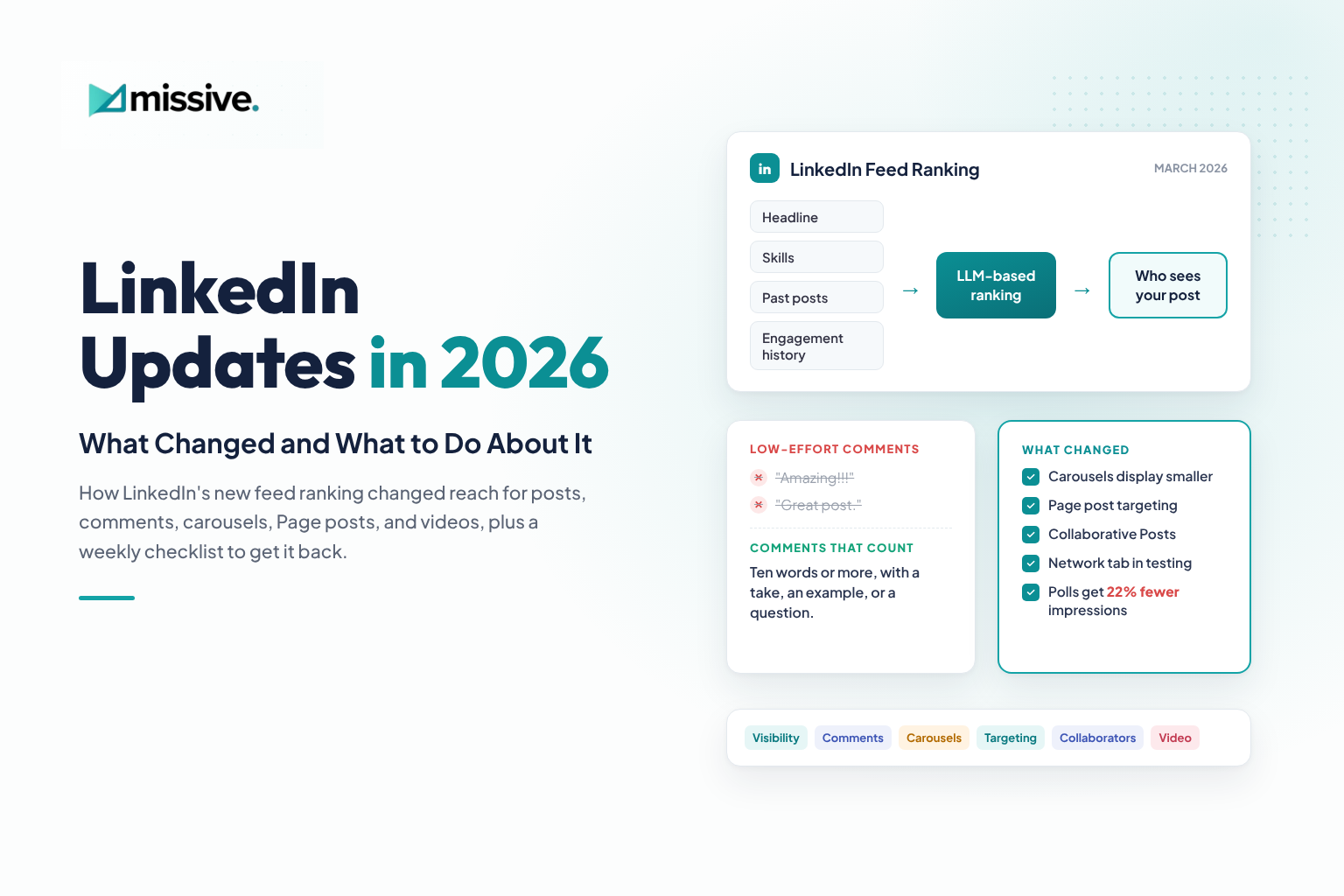

LinkedIn Growth for Doctors
- Why: LinkedIn is where patients, media, referrals, and healthcare decision-makers verify doctors today.
- Problem: Doctors use LinkedIn without a strategy, structure, or measurable results.
- Solution: A done-right LinkedIn system that builds authority, trust, and inbound opportunities.
Today, patients research doctors online. Healthcare professionals vet peers digitally. Corporations, hospitals, and even the media look for credible experts before reaching out. Increasingly, that research happens on LinkedIn.
If you’re not working the platform in your favor, LinkedIn becomes a wasted opportunity; But if used right, it becomes a growth engine. Built on proven strategies we’ve implemented for doctors across specialties, this guide distills exactly what has worked into a clear, step-by-step playbook to help doctors build authority, trust, and sustainable growth on LinkedIn.
Step 1. Optimize Your LinkedIn Profile
Profile Optimization - At a Glance
- Treat your profile like a digital first impression, not a resume.
- Remove stock photos, selfies, and blanks. Use real, professional visuals.
- Optimize your headline with specialty + value + location + experience.
- Write an About section that shows expertise & empathy, not just degrees.
- Use numbers, skills, and recommendations to prove credibility.
Whether someone finds you through Google, LinkedIn search, a post you shared, or a mutual connection, your profile acts as your first digital impression.
An unoptimized profile quietly kills opportunities. Optimizing your LinkedIn profile helps you show up in the right searches, establish instant credibility, and turn profile views into connections, conversations, and referrals.
So, let’s make sure you/ your profile makes a memorable impression.
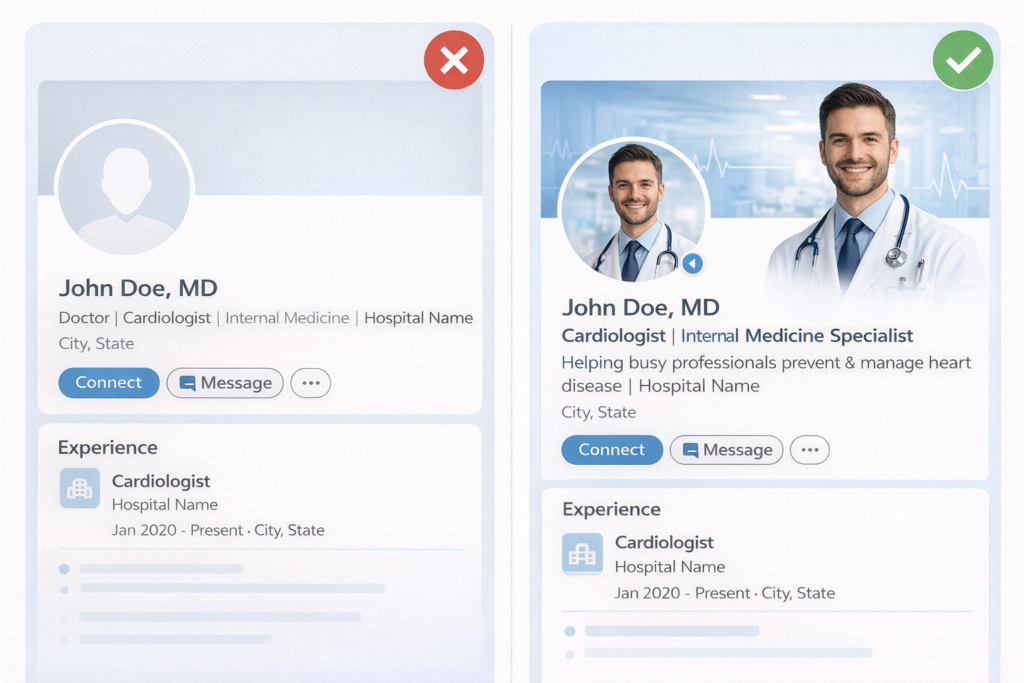
1. Profile Photo & Banner – Say No To Stock Images
Stock photos, AI-generated, casual, cropped, or blank visuals give an impression that you don’t care. Selfies or OOTD belong on Instagram, X, etc.; LinkedIn is a professional platform. You won’t go to a major interview wearing informals, right?
Use real photos for profile picture, preferably with direct eye contact and natural expression to build confidence, authenticity, and instant professional trust.
Banner is where you can take a little liberty and show off your personality. Add your clinic logo, a tagline like “Transforming Cardiac Care, One Patient at a Time,” or even specialty visuals (cardiologists often use heart imagery, orthos use spines, etc.).
2. Headline Optimization – An SEO Gold Mine
Your LinkedIn headline is the most searchable, most valuable real estate on your profile. It’s what LinkedIn’s algorithm reads first and what people scan in under three seconds.
When optimized correctly, your headline works like SEO. It should be a blend of,
- Specialty + Value + Location + Credibility/Exerience or
- Specialty + Who you help + Unique value/Credibility
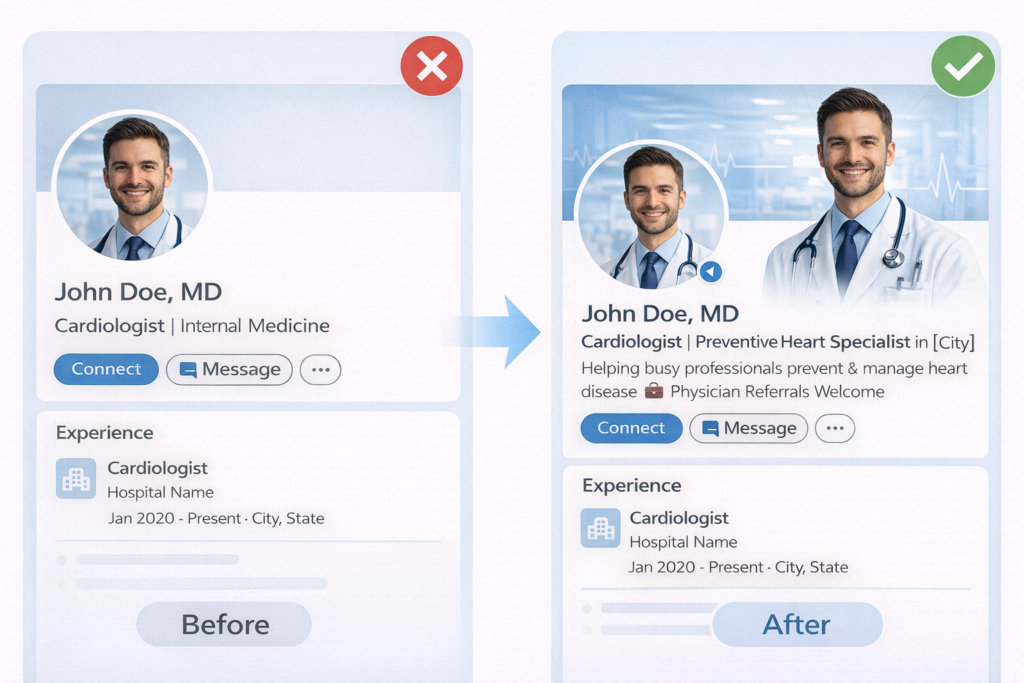
When someone searches “cardiologist New York” or “interventional cardiology specialist USA,” LinkedIn surfaces profiles with these exact keywords.
Tip: Naturally incorporate keywords like “heart failure specialist” or “minimally invasive surgery” to be found in searches.
3. About Section – Mix Authority and Empathy
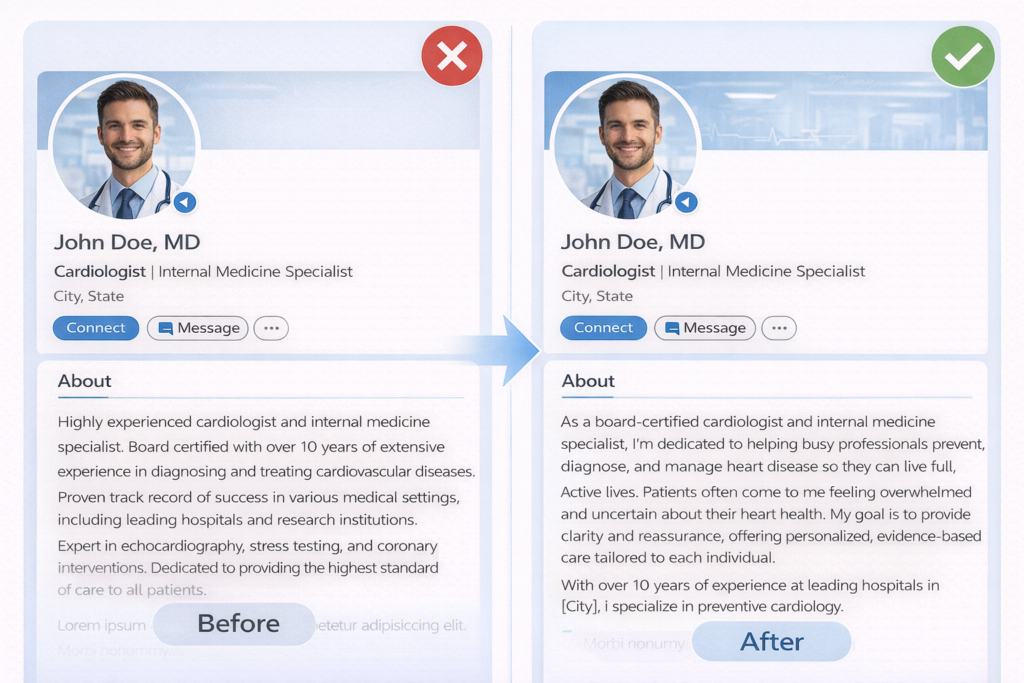
Your About section should do two things:
- Establish expertise – your qualifications show credibility
- Build trust – empathy helps people feel confident reaching out, whether they’re patients, peers, or referral partners.
The best About sections sound professional but human. They explain who you help, how you approach care, and what matters to you without overpromising or sounding clinical. When done right, this section makes your profile feel reliable, approachable, and worth engaging with.
As per our experience, the ideal way is to use a 5-paragraph structure:
- The hook: Who you are, who you help, and how
- Credibility: Certifications, experience, and achievements
- Medical philosophy: Why you do what you do
- What you offer: Services and specialties (how people can work with you)
- Soft CTA: “DM to collaborate” / “Let’s connect”
Tips:
- Be direct, LinkedIn’s algorithm, like Google’s, rewards content that immediately signals what you’re about.
- Be honest, never promise outcomes. Focus on process and expertise, not results.
4. Skills & Endorsements – Show your Feathers
Your skills section tells LinkedIn and profile visitors what you’re known for. When optimized, it boosts search visibility and reinforces your expertise.
Endorsements add quiet social proof, showing that others recognize and validate your skills. Moreover, as endorsed profiles rank higher internally on LinkedIn.
Which Skills Doctors Should List on LinkedIn (By Specialty)
| Specialty | Core Skills to Add |
|---|---|
| Cardiology | Preventive Cardiology, Cardiac Diagnostics, Interventional Cardiology, Patient Education, Risk Factor Management |
| Oncology | Cancer Treatment Planning, Chemotherapy Management, Clinical Research, Patient Counseling, Multidisciplinary Care |
| Orthopedics | Sports Injury Management, Joint Replacement, Rehabilitation Planning, Musculoskeletal Diagnosis, Post-Op Care |
| Gynecology | Women’s Preventive Health, Hormonal Health, Fertility Counseling, Pregnancy Care, Patient Education |
| General Practice | Preventive Care, Chronic Disease Management, Patient Communication, Diagnostic Evaluation, Care Coordination |
Tips:
- Limit to 10–15 highly relevant skills. More ≠ better.
- Get the skills endorsed by your peers.
5. Experience & Featured Content – Not a Resume, It’s a Proof
Here’s how LinkedIn, peers, and patients interpret this section
- Titles explain your role.
- Numbers explain your credibility.
- Featured content proves it.
So, don’t just add experiences plainly. Quantify achievements, such as the number of patients treated, research publications, talks, and leadership roles. Say “Performed 600+ surgeries”, “Trained a team of 15 healthcare professionals.
Use featured content to pair measurable experience with visible work, like –
- Articles
- Talks
- Case insights
- Media features
- Educational posts
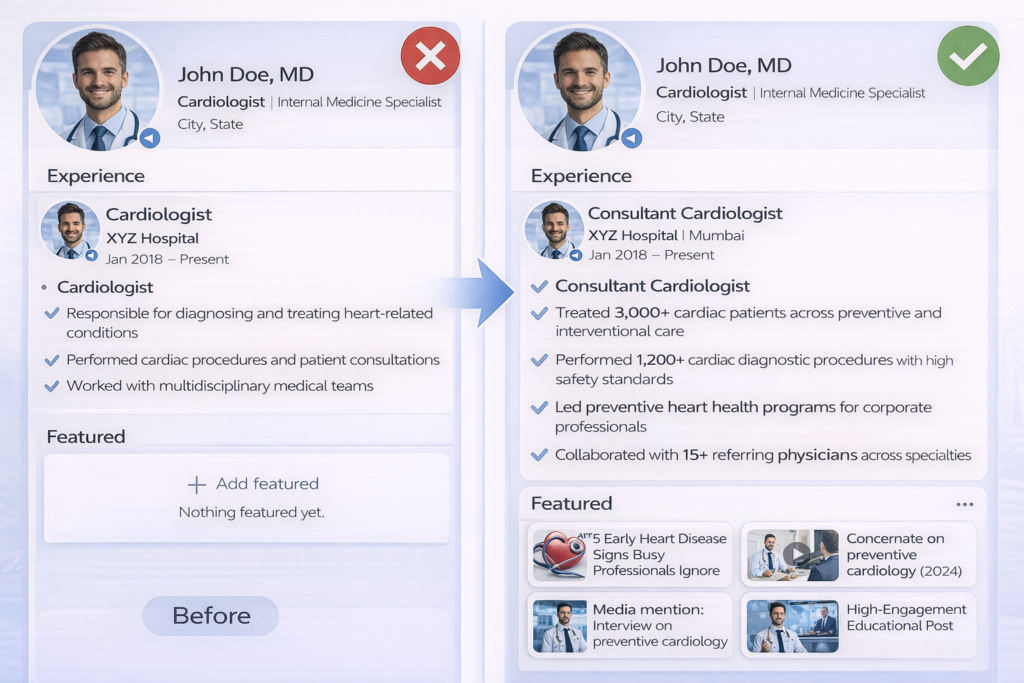
This turns your profile from descriptive to convincing. In LinkedIn marketing, clarity prevails, and numbers bolster your credibility.
6. Recommendations – Build Credibility
Recommendations show that others trust your work, ethics, and expertise. For doctors and healthcare professionals on LinkedIn, this credibility carries far more weight than self-written claims.
Ain for a few well-written recommendations from colleagues, referral partners, senior peers, or patients (non-clinical, experience-based). They reassure profile visitors that your expertise isn’t just stated, it’s validated by real professionals.
Tip: Set your LinkedIn URL to something clean: linkedin.com/in/yourname or linkedin.com/in/dryourname. It’s a small touch that signals professionalism.
Step 2. Build a Credibility-First LinkedIn Content Strategy
Content Strategy - At a Glance
- Don’t post randomly. Have a clear purpose for every post.
- The goal isn’t virality. The goal is usefulness and trust.
- Rotate between education, insights, and engagement to stay relevant.
- Always know what to post and what to avoid to stay compliant.
- Consistency (1–2 posts/week) beats daily posting and burnout.
Posting randomly on LinkedIn doesn’t work, especially in healthcare. Remember, the goal isn’t to go viral, it’s to be useful. Your posts should educate, build trust, and attract the right attention from patients, peers, and referral partners.
A strong content strategy helps you stay visible, credible, and consistent without crossing ethical or compliance lines. So your content works quietly in the background, strengthening authority, starting conversations, and supporting long-term growth.
1. What Can You Post About – LinkedIn’s Content Pillars for Doctors
In this section, we’ll break down exactly what to post, what to avoid, and how to stay consistent without burnout.
| Content Pillar | What to Post (Do) | What NOT to Post (Don’t) |
|---|---|---|
| Educational Content |
|
|
| Myth-Busting |
|
|
| Case Study |
|
|
| Professional Insights |
|
|
| Thought Leadership |
|
|
| Engagement Content |
|
|
| Video Content |
|
|
Tips:
- LinkedIn rewards consistent, original, experience-driven content, not generic health tips.
- Focus on showcasing expertise and professionalism, not chasing virality or quick leads.
- Don’t repurpose WebMD or syndicated health content. Your audience, i,e, busy doctors, potential referral partners, and informed patients, want your perspective, experience, and insights.
2. Use LinkedIn to Become a Trusted Voice in Healthcare
LinkedIn marketing for doctors isn’t about self-promotion or going viral. But if you have experience, insight, and perspective, why not become an influencer, a thought leader?
On LinkedIn, thought leadership builds long-term authority. It positions you as someone whom peers respect, patients trust, and decision-makers remember. Over time, this may lead to referrals, collaborations, speaking opportunities, and inbound conversations.
Thought leadership is about consistently sharing informed perspectives that help others think better about a topic. For doctors, this means,
- Sharing opinions backed by experience and evidence, not generic advice
- Commenting on industry trends, policy shifts, or common misconceptions
- Explaining the why behind medical decisions, not just the what
- Writing posts that educate peers, not just patients
Tips:
- Be consistent in your point of view, as authority comes from repetition.
- Don’t post to impress. Post to inform and guide.
- You can work with content teams to convert your expertise and experience into structured, universally understandable, and legally acceptable content.
3. Formats You Can Use For LinkedIn Posts
LinkedIn rewards clarity, not complexity. Different formats help you explain ideas better, keep attention, and stay consistent without repeating yourself. You can choose between,
- Text post
- Carousel posts
- Multimedia – Images and short videos
- LinkedIn articles (for deep dives)
- Polls
4. How Often Should You Post?
Consistency matters more than volume. You don’t need to post every day to stay visible. What matters is showing up regularly with content that adds value.
A realistic posting rhythm, say (1-2 posts per week), helps you stay active, build recall, and avoid burnout.
5. Compliance, Ethics & Medical Advertising Considerations
Visibility should never come at the cost of ethics. Moreover, medical marketing requires responsibility. A compliant LinkedIn strategy focuses on awareness, education, and professional visibility, not aggressive selling.
Healthcare Professionals must always:
- Respect patient confidentiality
- Avoid misleading claims
- Follow the local medical council advertising rules
- Prioritize education over promotion
Step 3. Engage, Network, and Grow on LinkedIn
Posting is half the battle. The other half is building genuine relationships that convert into referrals, collaborations, and opportunities.
However, effective LinkedIn networking isn’t about volume. It’s about connecting with the right people, in the right roles, for the right reasons. So, you’ll need this strategy.
The 3-Tier Connection Strategy
Tier 1 – Warm Connections: Existing patients, colleagues, alumni, and referral partners you already work with.
Tier 2 – Strategic Connections: Hospital admins, insurers, pharmacy reps, lab networks, corporate health leaders. Use LinkedIn’s filters to find the right connection in your field.
Tier 3 – Community: Peer groups and specialty communities, like the doctors’ network. LinkedIn physician leaders and your specialty-specific groups.
Don’t sell here, just engage. Comment thoughtfully on 5-10 posts per week. Share insights. Build relationships.
Tips:
- Prioritize decision-makers and referral influencers, not just peers
- Send personalized connection requests, never generic templates
- Aim for quality conversations, not connection counts
DIY vs Agency-Managed LinkedIn for Doctors
So, when should healthcare professionals connect with a LinkedIn marketing agency?
You can absolutely manage LinkedIn on your own, at least at the start.
However, managing a profile effectively takes time, consistency, and strategic clarity, all of which are in short supply for busy healthcare professionals. Plus, as your goals grow, so does the complexity, so
DIY works when: You have time (5-7 hours/week), enjoy writing and content creation, growth speed isn’t urgent, are ready to learn LinkedIn analytics and experiment.
Agency is needed when: Time is limited, consistency is difficult, positioning needs clarity, and compliance is giving you a headache.
How a LinkedIn Marketing Agency Can Support Without Taking Control
A LinkedIn strategy without consistent content is like a world-class surgical suite with the lights off. The expertise is there, but no one knows you’re open.
That’s where a LinkedIn Marketing agency steps in. It doesn’t replace your voice. It keeps the lights on, the direction clear, and your expertise visible, week after week.
The agency will act as both a guide and an assistant. You’ll keep control of your expertise and voice; the agency handles structure, clarity, consistency, and scale. Moreover, you save 30–50 hours/month without compromising credibility.
| Task | Solo (DIY) Time | Time With Agency |
|---|---|---|
| Profile optimization | 5–8 hours | 2 hours (audit, guidance, implementation support) |
| Content strategy & planning | 6–8 hours | 2–2.5 hours (strategy framework + calendar) |
| Content writing for 30 posts | 20–30 hours | 4 hours (ghostwriting from your inputs & reviews) |
| Visual content for 5 posts | 10–15 hours | 1.5–2 hours (your inputs & reviews) |
| SEO optimization | 0.5–1 hour/post | Entirely managed by the agency |
| Posting & scheduling | 2–3 hours/month | Entirely managed by the agency |
| Engagement | 5–7 hours/week | 1–2 hours/week (guided or assisted) |
| Analytics interpretation | 2–3 hours/week | Reports & insights provided by the agency |
| Time spent on LinkedIn marketing per month | 40–60 hours | 8–10 hours |
Ready to Do LinkedIn the Right Way?
LinkedIn only works when strategy, consistency, and compliance are aligned. Missive helps doctors maintain that balance, so their expertise shows through, week after week.
Final Thoughts - Build a Credible LinkedIn Presence
LinkedIn is not about selling healthcare services. It’s about building professional gravity, being visible where trust is formed.
Whether you manage it yourself or with support, consistency and clarity matter more than volume. Either way, showing up thoughtfully is already a competitive advantage.
If you want structured guidance, you can explore our LinkedIn marketing for doctors services or connect with us for a free consultation.
LinkedIn Strategy FAQs for Healthcare Professionals
Doctors should write LinkedIn headlines using keywords that patients and professionals actually search for, such as specialty, condition focus, or location.
A strong structure is: [Specialty] | [Who You Help or Unique Focus] | [Location or Experience]
This helps LinkedIn surface your profile in relevant searches.
Here are some effective LinkedIn headline examples for healthcare professionals:
- Interventional Cardiologist | Heart Disease Prevention | New York | 20+ Years Experience
- Orthopedic Surgeon | Sports Injury & Joint Replacement Specialist
- Gynecologist | Women’s Preventive Health & Fertility Care
These headlines explain expertise clearly and avoid vague job titles.
Yes. A LinkedIn cover photo for doctors plays a major role in first impressions and credibility.
A well-designed cover photo can include your clinic name, specialty, city, or a simple professional tagline, helping visitors instantly understand who you are and what you do.
Yes. Using keywords in a LinkedIn headline is essential for doctors. LinkedIn works like a search engine; profiles with relevant keywords (specialty, condition focus, location) are more likely to appear in searches by hospital administrators, peers, and patients.
Many doctors also overlook profile optimization and fail to use LinkedIn strategically for visibility, referrals, and professional networking.
- Treating LinkedIn like Facebook or Instagram
- Writing profiles like CVs instead of trust-building narratives
- Posting inconsistently or without a clear strategy
- Sharing generic health tips instead of real-world experience
- Avoiding LinkedIn altogether due to compliance fears
Yes, if used correctly. They work best for brand authority, professional visibility, events, webinars, and partnerships, not aggressive patient acquisition. Poorly targeted or non-compliant ads often waste budget, which is why many doctors use expert support for campaign setup and optimization.
Yes. LinkedIn matters for doctors now more than ever because it’s where hospital administrators, fellow doctors, referral partners, insurers, and informed patients research professional credibility.
A strong LinkedIn presence helps doctors build authority, expand referral networks, and stay visible beyond their clinic or hospital.
Compliance is critical. Doctors must always:
- Protect patient confidentiality
- Avoid misleading or absolute claims
- Follow the local medical council advertising rules
- Prioritize education over promotion
A compliant LinkedIn strategy focuses on awareness, insight, and professional credibility, not selling medical services.